Kathmandu
Sunday, July 5, 2026





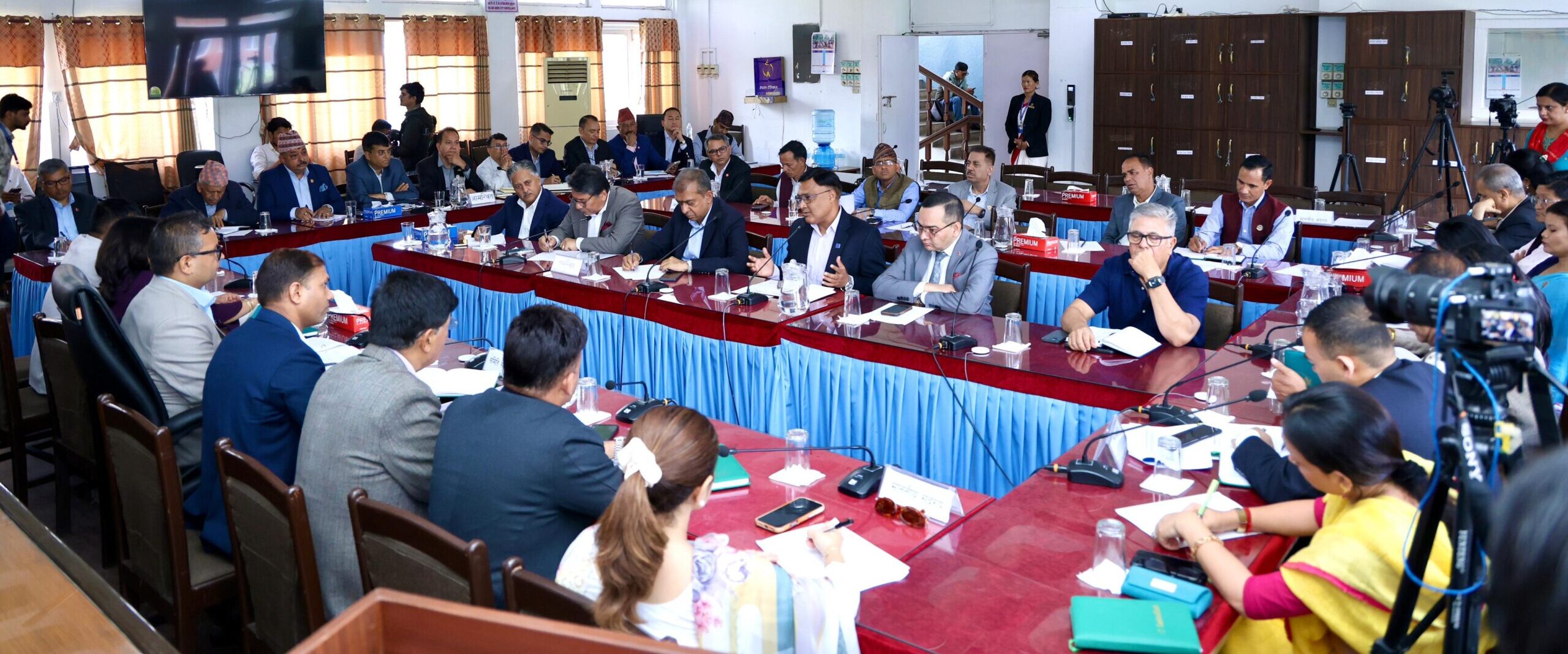
KATHMANDU: During a meeting of the Finance Committee of the House of Representatives, various stakeholders suggested that the upcoming fiscal year’s monetary policy must be timely and address critical gaps left unaddressed by the federal budget.
Former central bank governors, commercial bank executives, and leaders of private-sector umbrella organizations all emphasized that the policy’s primary focus must be economic recovery.
Former Governor Dipendra Bahadur Kshetri expressed that the monetary policy should be formulated to stabilize the country’s declining economy.
Highlighting the need for harmony between fiscal and monetary policies, he stressed that the central bank’s autonomy must be fiercely maintained.
Former Governor Maha Prasad Adhikari noted that because monetary policy is highly technical and largely predictable, its direction is naturally dictated by the domestic economic climate and external sector conditions.
Considering current indicators, he stated there is no justification for the central bank to tighten the bank rate, policy rate, or interest rate corridor.
Since price stability and external sector conditions remain satisfactory, he argued against making interest rates or other monetary instruments more restrictive. However, he cautioned that past policies aimed at boosting domestic production and economic recovery should not be scrapped simply for the sake of easing regulations.
Former Governor Chiranjibi Nepal reiterated that central bank autonomy and international best practices must be respected. Because the core objectives of monetary policy are to curb inflation and support the government’s economic growth targets, he stated the bank must align its responsibilities accordingly.
To manage the banking sector’s rising non-performing loans, he recommended establishing a dedicated Asset Management Company.
Anjan Shrestha, President of the Federation of Nepalese Chambers of Commerce and Industry, pointed out that while the national budget addressed a few concerns, the remaining demands of the private sector must be resolved through monetary adjustments.
He added that introducing policy reforms through the upcoming monetary framework would be highly beneficial for reviving the national economy.
Manoj Gyawali, CEO of Nabil Bank, stated that the monetary policy must be drafted with the understanding that when banking and financial institutions face distress, the entire country suffers.
He emphasized the need for a clear distinction between borrowers who genuinely cannot service their principal and interest due to adverse economic circumstances and those who are willfully defaulting.
Furthermore, he noted that legal reforms are essential to simplify overall banking processes.
Santosh Koirala, President of the Nepal Bankers’ Association, urged policymakers to account for the economic slowdown observed in recent days.
Specifically, he noted that modifications are necessary regarding current loan loss provisioning requirements.
Prachanda Man Shrestha, President of the Bank and Financial Institutions Association of Nepal, argued that since the banking sector is enduring significant hardships, the central bank needs to step up and play a more supportive, guardian-like role.
He stated that even minor flexibility in watch-list criteria and the classification of non-performing loans would send a highly positive signal to the market.
Additionally, Bhim Prasad Ghimire, Vice President of the Confederation of Nepalese Industries, and economic expert Nara Bahadur Thapa, among other attendees, reiterated the urgent need for a timely, contextual monetary policy.