Kathmandu
Saturday, July 4, 2026





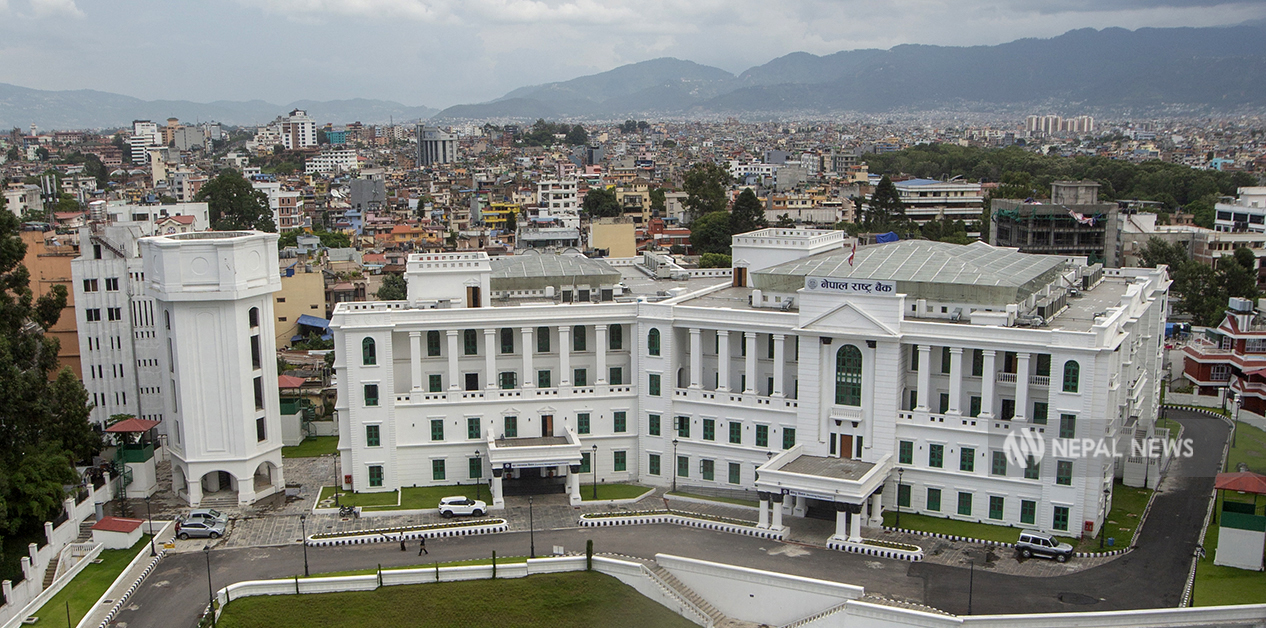
KATHMANDU: On April 2, 2026, Nepal Rastra Bank (NRB) released its “Current Macroeconomic and Financial Situation of Nepal” based on eight months’ data (mid-July 2025 to mid-March 2026) of FY 2025/26.
The report highlights sustained economic stability with y-o-y CPI inflation at 3.62 percent, gross foreign exchange reserves reaching Rs 3,413.77 billion (USD 23.08 billion) — enough for 18.5 months of imports — and a healthy current account surplus of Rs 552.85 billion.
Remittances grew strongly while credit expansion remained cautious, reflecting resilient external balances despite subdued domestic lending.
What does the NRB’s eight-month report primarily reveal about Nepal’s overall macroeconomic health?
The NRB’s April 2, 2026 report paints a picture of macroeconomic resilience driven by strong external sector performance.
Consumer price inflation moderated to 3.62 percent year-on-year in mid-March 2026 (from 3.75 percent a year earlier), with the eight-month average at just 2.13 percent versus 4.72 percent previously.
Gross foreign exchange reserves expanded 27.5 percent to Rs 3,413.77 billion (USD 23.08 billion), sufficient to cover 18.5 months of prospective merchandise and services imports.
The current account recorded a surplus of Rs 552.85 billion and the balance of payments a surplus of Rs 658.35 billion. Remittances rose sharply by 37.7 percent in Nepali rupees (31 percent in USD) to Rs 1,449.65 billion.
However, private sector credit grew modestly by 4.4 percent during the period (6.7 percent year-on-year), while broad money (M2) expanded 6.7 percent.
Government expenditure reached Rs 926.59 billion against revenue of Rs 747.28 billion.
Overall, the indicators underscore external strength and price stability, though domestic credit pickup remains a watchpoint for sustained growth. These trends suggest Nepal’s economy is weathering global headwinds well, with buffers to support future policy easing if needed.
How has consumer price inflation performed in the first eight months of FY 2025/26?
Year-on-year CPI inflation stood at 3.62 percent in mid-March 2026, marginally lower than 3.75 percent a year earlier, while the average inflation for the review period eased significantly to 2.13 percent from 4.72 percent previously.
Food and beverage inflation was 3.60 percent (versus 3.34 percent last year) and non-food and services inflation 3.63 percent (versus 3.97 percent).
Key drivers included sharp rises in vegetables (11.49 percent), ghee & oil (9.86 percent), and fruit (9.63 percent), offset by declines in pulses & legumes (-3.66 percent), cereals (-2.18 percent), and spices (-2.03 percent).
In non-food categories, miscellaneous goods & services surged 22.81 percent while insurance & financial services dipped slightly.
Rural inflation was 3.06 percent and urban 3.82 percent. Provincially, Madhesh saw the highest at 4.95 percent and Karnali the lowest at 2.21 percent.
Compared with India’s February inflation of 3.21 percent, Nepal’s remains comfortably within NRB’s target range.
The report attributes moderation to stable global commodity prices, improved domestic supply, and prudent monetary policy, bolstering purchasing power and reducing pressure on households.
This controlled inflation environment provides room for NRB to maintain accommodative stances if credit demand picks up.
What are the latest figures on Nepal’s foreign exchange reserves and their adequacy?
Gross foreign exchange reserves stood at Rs 3,413.77 billion (USD 23.08 billion) in mid-March 2026, marking a 27.5 percent increase from Rs 2,677.68 billion in mid-July 2025 (18.3 percent rise in USD terms).
Reserves held by NRB rose 25.7 percent to Rs 3,035.11 billion, while those with banks and financial institutions grew 44 percent to Rs 378.66 billion.
The Indian currency share was 21 percent. These reserves are sufficient to cover prospective merchandise and services imports for 18.5 months — well above the international benchmark of three months — indicating strong external liquidity.
The surge stems from robust remittance inflows, current account surplus, and moderate import growth.
This buffer shields Nepal against external shocks, supports currency stability under the peg with the Indian rupee, and allows the central bank flexibility in managing liquidity.
The report underscores that such healthy reserves enhance investor confidence and provide a solid foundation for potential monetary easing or infrastructure financing without immediate balance-of-payments concerns.
What is the status of Nepal’s current account and balance of payments?
The current account posted a surplus of Rs 552.85 billion (USD 3.88 billion) in the first eight months, more than doubling from Rs 197.03 billion a year earlier.
The balance of payments recorded an even larger surplus of Rs 658.35 billion (USD 4.61 billion) versus Rs 310.37 billion previously.
Net secondary income (largely remittances) reached Rs 1,591.66 billion. Net capital transfer was Rs 12.59 billion, and FDI (equity only) rose 27.9 percent to Rs 10.84 billion.
These surpluses reflect strong remittance-driven inflows outpacing the trade deficit. The healthy BOP position has enabled reserve accumulation and reduced external debt pressures.
Analysts view this as evidence of structural improvement in external accounts, giving NRB scope to focus on domestic growth stimulation.
The report notes that continued surpluses will support exchange-rate stability and bolster Nepal’s international creditworthiness.
How have remittance inflows trended and what is their impact?
Remittance inflows increased 37.7 percent in Nepali rupees and 31 percent in USD terms to Rs 1,449.65 billion (USD 10.15 billion) during the eight months.
In the single month from mid-February to mid-March alone, inflows reached Rs 188.64 billion. This sharp rise — compared to just 9.5 percent growth last year — is attributed to higher numbers of renewed labor permits (251,985 versus 217,403) and stable global labor markets.
Net transfer income surged accordingly. Remittances remain the backbone of Nepal’s external account, funding consumption, reducing poverty, and building reserves.
The report highlights their role in narrowing the current account deficit and supporting household incomes amid moderate domestic credit growth.
Sustained high inflows also ease pressure on the rupee and provide a cushion against tourism or export volatility.
NRB expects this trend to continue, aiding overall economic stability.
What are the key developments in Nepal’s merchandise trade?
Exports grew 20.8 percent to Rs 191.11 billion, while imports rose 12.5 percent to Rs 1,289.25 billion, resulting in a trade deficit of Rs 1,098.14 billion (up 11.2 percent).
The export-to-import ratio improved slightly to 14.8 percent. Exports to India increased 25.3 percent, though those to China fell 53.7 percent.
Major export gainers included soyabean oil, cardamom, and palm oil. Imports saw rises in crude soyabean oil, chemical fertilizer, silver, and vehicles.
The terms of trade improved marginally by 0.5 percent. Despite the widening deficit in absolute terms, the slower import growth relative to exports signals some import substitution and export diversification.
The report notes that higher export prices and volumes contributed positively, though the deficit remains a structural challenge.
Overall, the external trade position is manageable given remittance offsets and reserve strength.
How has the government’s fiscal position evolved in the first eight months?
Government expenditure totaled Rs 926.59 billion while revenue mobilization stood at Rs 747.28 billion, leaving a fiscal gap being financed through internal and external sources.
The report does not detail exact deficit figures but indicates steady revenue collection amid controlled spending.
Combined with external surpluses, this has not strained liquidity significantly. Fiscal operations remain supportive of growth without excessive borrowing pressure on the banking system.
The data reflect improved tax administration and expenditure discipline, aligning with broader macroeconomic stability.
This fiscal prudence complements monetary policy and helps maintain low interest rates.
What are the trends in broad money supply and banking system deposits?
Broad money (M2) expanded by 6.7 percent during the review period, with year-on-year growth at 14.5 percent.
Deposits at banks and financial institutions (BFIs) grew 6.6 percent (15.1 percent y-o-y). These figures indicate adequate liquidity in the system despite moderate credit off-take.
The growth in deposits reflects continued public confidence in the formal banking sector and high remittance inflows.
NRB’s liquidity management tools have kept inter-bank rates stable. Healthy deposit growth provides headroom for future lending expansion once private investment demand revives.
The report positions this as a positive sign of financial deepening.
How has private sector credit performed and why is it significant?
Private sector credit increased by 4.4 percent during the eight months (6.7 percent year-on-year).
While positive, the pace remains subdued compared to deposit growth, pointing to cautious lending by BFIs amid high liquidity and selective demand.
The report notes this modest expansion amid strong external balances, suggesting banks are prioritizing asset quality over aggressive lending.
This trend supports financial stability but highlights the need for policy measures to boost productive credit to agriculture, industry, and SMEs.
Lower lending rates (6.9 percent weighted average) are expected to encourage borrowing going forward.
What are the prevailing interest rates in Nepal’s banking system?
The weighted average deposit rate of commercial banks stood at 3.45 percent and the lending rate at 6.9 percent.
The inter-bank rate was 2.68 percent and the 91-day Treasury bill rate 2.47 percent. These historically low rates reflect abundant liquidity and NRB’s accommodative policy stance.
The narrow spread indicates efficient transmission of monetary policy.
Low borrowing costs are expected to stimulate investment once economic confidence improves fully.
The report underscores that stable and declining rates support growth without fueling inflation.
How does the eight-month performance compare with the same period last year?
Inflation is lower (3.62 percent vs 3.75 percent y-o-y; average 2.13 percent vs 4.72 percent).
Reserves grew faster, remittances accelerated dramatically (37.7 percent vs 9.5 percent), and current account surplus more than doubled.
Export growth slowed from 57.2 percent but remained robust at 20.8 percent, while import growth was similar.
Credit expansion was modest but M2 growth solid.
Overall, external indicators strengthened markedly while domestic credit remained cautious, indicating improved resilience.
What are the implications of the report for Nepal’s economic stability and policy outlook?
The strong external buffers, low inflation, and surplus positions enhance macroeconomic stability and provide policy space for NRB and the government.
Authorities can focus on reviving credit growth and private investment without immediate external risks.
The report suggests continued monitoring of liquidity and NPLs, with potential for further monetary easing if needed. It reinforces Nepal’s ability to withstand global uncertainties and supports a positive growth trajectory.
Are there notable provincial or regional differences in inflation?
Yes — Madhesh Province recorded the highest y-o-y inflation at 4.95 percent, followed by Lumbini (4.21 percent) and Koshi (3.96 percent). Karnali (2.21 percent) and Sudurpashchim (2.25 percent) had the lowest.
Regionally, Terai saw 4.11 percent, Kathmandu Valley 3.64 percent, Hill 3.11 percent, and Mountain 2.83 percent.
These variations reflect differences in food supply chains, urbanization, and local economic activity. The report highlights the need for region-specific interventions to ensure balanced price stability nationwide.
What does the report say about wholesale price inflation and other supporting indicators?
Wholesale price inflation (WPI) eased to 3.64 percent y-o-y from 4.43 percent. Consumption goods prices fell 4.44 percent while intermediate goods rose 8.54 percent.
Services trade deficit narrowed. Foreign employment approvals and tourism-related data (travel income) also showed resilience.
These complementary indicators reinforce the narrative of contained inflationary pressures and improving external balances.
How might the NRB use this report to shape future monetary and financial policies?
The data provide NRB with evidence to maintain or further ease policy rates, relax select credit guidelines, or introduce targeted incentives for productive sectors.
With ample liquidity and low inflation, the central bank can prioritize credit growth to agriculture, hydropower, and SMEs without risking price stability.
The report also signals scope for liquidity absorption tools if surpluses persist.
Overall, it supports a growth-oriented policy stance while safeguarding external and financial stability.