Kathmandu
Saturday, July 25, 2026





Qualified since 2015, the country has now pushed its exit from Least Developed Country status to 2029. A necessary breather for economic resilience or a symptom of deeper structural failure?

KATHMANDU: Nepal has been on the United Nations’ list of Least Developed Countries since 1971 — the very year the category was born. More than five decades later, the country still cannot leave.
Having first qualified for graduation in 2015, Nepal has repeatedly asked for more time — after the earthquake, after COVID, and now again, citing sluggish growth, geopolitical turbulence, and the fear of losing trade privileges it has not yet learned to live without.

The latest deferral request, filed with the UN on May 13, 2026, pushes the graduation date to November 2029, buying three more years of a status that was always meant to be temporary.
What does it actually mean to be on the UN’s LDC list, and why does it matter so much?
The Least Developed Country category is a formal classification maintained by the United Nations for countries that are simultaneously poor in income, weak in human development, and highly vulnerable to economic and environmental shocks.
It is not a label of shame so much as a passport to a set of very tangible benefits: duty-free and quota-free access to markets in Europe, China, Japan, and elsewhere; preferential treatment under the WTO’s trade rules; concessional financing at low interest rates; technical assistance; and negotiating flexibility within multilateral forums.
For Nepal, these privileges have for decades helped its exporters — garment makers, carpet weavers, pashmina traders — sell their goods competitively abroad despite the country’s landlocked geography, weak infrastructure, and thin industrial base.
The moment Nepal exits the LDC club, those advantages begin to erode, and the country must compete on the same terms as far stronger economies.
What are the actual criteria that the UN uses to determine whether a country has graduated?
The United Nations Committee for Development Policy evaluates all LDCs every three years against three distinct benchmarks.
The first is Gross National Income per capita, which must reach at least USD 1,306 per person.
The second is the Human Assets Index, which aggregates education and health outcomes — including school enrollment, adult literacy, under-five mortality, and maternal health — and requires a minimum score of 66.
The third is the Economic and Environmental Vulnerability Index, which measures how exposed a country is to external shocks such as commodity price swings, natural disasters, and climate events; a score below 32 is needed to pass this test.
A country qualifies for graduation when it meets at least two of these three criteria in two back-to-back triennial reviews. Alternatively, if a country’s GNI per capita crosses three times the standard graduation threshold, it can graduate on income alone, but no LDC has managed that feat.
When did Nepal first meet the graduation criteria and how many times has it delayed?
Nepal’s development indicators quietly crossed the graduation thresholds as far back as 2015, a year most Nepalis remember not for economic progress but for the catastrophic earthquake that killed nearly nine thousand people and destroyed billions of dollars in infrastructure. Because of the disaster, the UN granted a deferral without hesitation.
In the 2018 triennial review, Nepal again met the criteria — this time with reconstruction underway but GNI still well below the threshold — and again sought more time. In 2021, Nepal met all three benchmarks simultaneously, even as the COVID-19 pandemic was battering the economy.
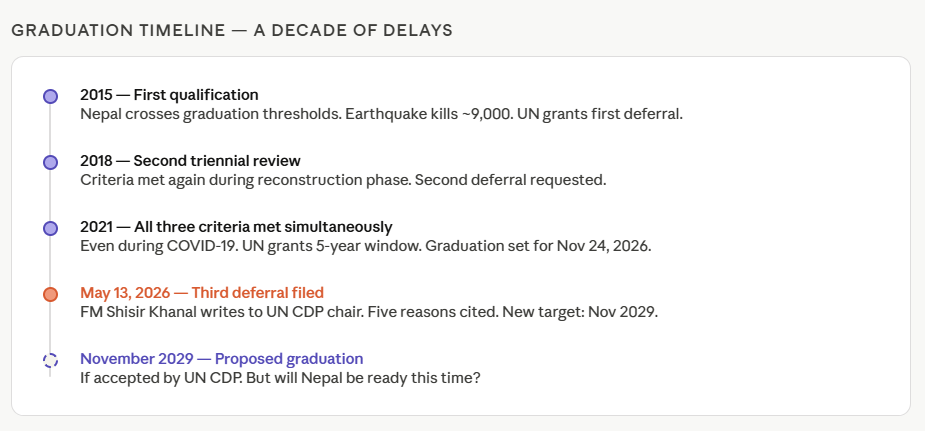
The UN agreed to a five-year preparatory window, setting the graduation date for November 24, 2026. Now that date too has been abandoned.
The formal request filed in May 2026 pushes graduation to November 2029, making this Nepal’s third consecutive delay and raising uncomfortable questions about whether the country will keep finding reasons to postpone indefinitely.
Why has Nepal asked for another deferral this time? What are the five reasons the government cited?
Nepal’s Foreign Minister Shisir Khanal, in his letter to the UN Committee for Development Policy chair, offered five distinct justifications for the requested delay.
First, geopolitical tensions — particularly conflict in the West Asia — have disrupted remittance flows, which are a lifeline for Nepal’s economy and account for a substantial share of household income.
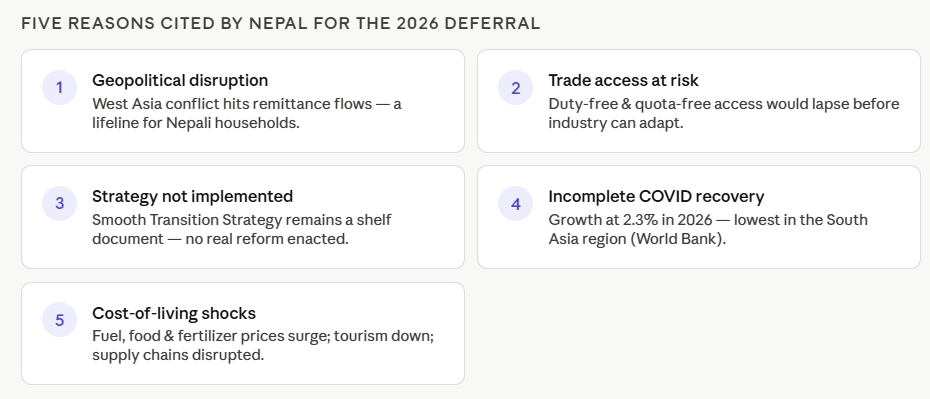
Second, graduation threatens Nepal’s duty-free and quota-free market access, which export-dependent manufacturing sectors cannot afford to lose without immediate alternatives in place.
Third, implementation of Nepal’s own Smooth Transition Strategy — a roadmap prepared specifically to make graduation manageable — has proceeded far slower than planned, largely remaining a policy document rather than a lived economic reform.
Fourth, Nepal’s recovery from COVID-19 has been incomplete, with growth projected at only 2.3 percent in 2026, a figure the World Bank considers the lowest in the region.
Fifth, rising fuel, food, and fertilizer prices, combined with reduced tourism and supply chain disruptions, have compounded vulnerability precisely when the country should have been building resilience.
What would Nepal actually need to do to make graduation sustainable and credible?
Genuinely graduating — not just statistically crossing a threshold but being economically ready to survive without LDC privileges — would require Nepal to tackle several structural gaps simultaneously.
It would need to diversify its exports well beyond garments, carpets, and pashmina into higher-value goods and services, particularly in information technology, tourism, and hydropower.
It would need to modernize its trade infrastructure, reduce the cost of doing business, upgrade its customs and port-of-entry systems, and negotiate bilateral trade agreements to replicate some of the market access it currently enjoys through LDC preferences.
The country would need to invest heavily in workforce skills, so that its people can compete in a post-preference environment where compliance, quality standards, and labor rights matter as much as price.
It would also need to build a domestic manufacturing ecosystem, since relying on remittances and importing most goods is not a development strategy — it is a holding pattern. Above all, Nepal would need to translate its many policy documents into functional programs that the private sector can actually use.
The ILO warned of 132,000 job losses. How serious is that threat and who bears the greatest burden?
The International Labour Organization’s employment impact assessment, released in March 2026, paints a sobering picture of what LDC exit could mean for Nepal’s workers in the near term.
The report projects that without adequate policy mitigation, Nepal could lose between 2.5 and 4.3 percent of its total export earnings following graduation, translating to a loss of as many as 132,000 jobs by 2030.
The sectors most exposed are apparel, textiles, and hand-knotted carpets — industries that depend heavily on duty-free access to European and Chinese markets.
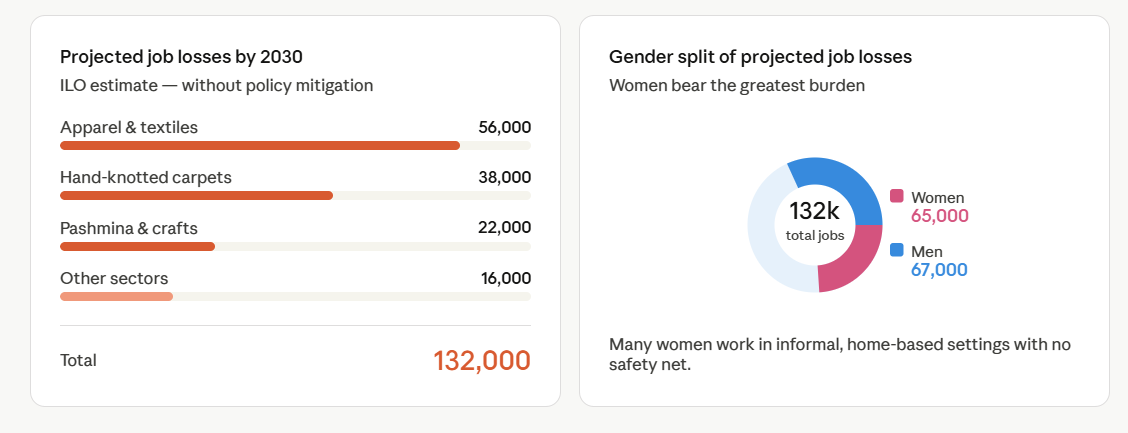
What makes this particularly troubling from a social equity standpoint is the gender dimension: roughly 65,000 of the projected job losses would fall on women, many of whom are already working in informal, home-based settings with no safety net. These are workers who have already absorbed decades of economic instability; graduation, without preparation, risks pushing them further into precarity.
The ILO did note that targeted investments in trade facilitation, tourism, and the technology sector could offset some of these losses, but it stressed that policy action must begin early and be coordinated across government agencies and industries.
What is positive about delaying graduation? Is there any genuine upside?
There are legitimate arguments in favor of the delay, and they deserve honest consideration rather than reflexive dismissal. Three additional years of duty-free and quota-free market access gives Nepal’s garment and carpet exporters a longer runway to invest in competitiveness, quality upgrades, and market diversification before facing full international tariffs.
It gives policymakers a chance to negotiate transition arrangements with trading partners — GSP+ status with the EU, bilateral deals with China and India, and WTO waivers — that could soften the eventual loss of LDC preferences.
The delay also provides time to finally implement the Smooth Transition Strategy in a way that goes beyond paper, potentially supporting small manufacturers with credit, training, and market intelligence.
Additionally, a deferral protects short-term employment stability in a country that has just endured political upheaval, the Gen Z protests in September 2025, and economic losses estimated at around 1.3 percent of GDP from that unrest alone. Rushing graduation in such turbulent conditions would have been economically reckless.
What is genuinely negative about the delay? What does it cost Nepal?
The costs of another postponement are real and should not be minimized by the comfort of short-term relief. Every deferral reinforces the signal — to investors, to trading partners, and to Nepal’s own private sector — that the country lacks the political will to implement reform. The pattern is now unmistakable: Nepal meets the criteria, asks for more time, does not meaningfully use that time, and then asks again.
This cycle erodes credibility and discourages the foreign direct investment that Nepal desperately needs to build an industrial base. There is also an opportunity cost: remaining on the LDC list keeps Nepal associated with a category of fragile, low-income countries, which can subtly dampen investor confidence and limit the kind of partnerships available to more ambitious developing nations.
Furthermore, concessional aid flows and development assistance are already shifting away from Nepal as donors perceive it as having made sufficient progress. The delay does not bring those resources back. And perhaps most importantly, it defers the political discipline that graduation would have imposed — the necessity of making hard decisions about tax reform, industrial policy, and trade agreements.
Does Nepal actually meet the graduation criteria right now? Is it technically ready even if not economically prepared?
Yes, Nepal currently meets all three UN graduation criteria, which makes this situation unusual. Nepal’s GNI per capita for fiscal year 2025-26 is projected at USD 1,535, comfortably above the required USD 1,306 threshold.
Its Human Assets Index score has long exceeded the required 66 — the 2021 review recorded it at 75, reflecting genuine improvements in health and education over the past two decades. And its Economic and Environmental Vulnerability Index score of 24.7 in 2021 was well below the required ceiling of 32.
This means Nepal is not delaying because it has failed the tests — it is delaying despite passing them. It is technically eligible to graduate. The argument for delay is not about statistical readiness but about economic resilience: whether the institutional infrastructure, the private sector capacity, and the policy environment are strong enough to absorb the shock of losing preferential treatment. That is a legitimate concern, but it is distinct from the question of whether Nepal qualifies.
How does Nepal compare with other LDC graduates, particularly Bhutan and Bangladesh?
The comparison is instructive and occasionally uncomfortable. Bhutan graduated from LDC status in December 2023 — a smooth and credible exit built on a deliberate economic strategy, a focused tourism industry, and hydropower exports that generate real foreign exchange.
Bhutan went in with a plan and executed it. Bangladesh, also scheduled to graduate in November 2026, has also now sought a deferral, citing the disruption of its ready-made garment sector. But Bangladesh’s situation is structurally different: it has a far larger and more diversified industrial base, a GNI per capita that has more than doubled Nepal’s in recent years, and a proven track record of export growth.
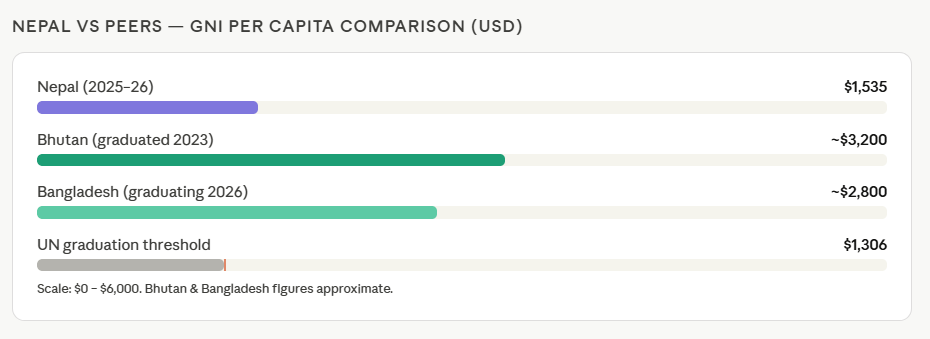
Nepal’s case sits uncomfortably between these two — more developed in human indicators than its income might suggest, but lacking the export muscle and institutional depth that would make graduation genuinely painless.
The fact that Nepal has qualified since 2015 but still does not feel ready in 2026 suggests the problem is less about criteria and more about the structural transformation that was never fully pursued during the extended preparatory period.
Why has Nepal’s Smooth Transition Strategy failed to deliver? Who is responsible?
Nepal prepared a formal Smooth Transition Strategy precisely because the UN requires countries earmarked for graduation to have a roadmap for managing the shift. The strategy identified sectors at risk, mapped required policy reforms, and outlined actions needed to build economic resilience before LDC privileges expired.
The problem, as trade experts have pointed out publicly, is that the strategy remained almost entirely within government files. The state did not use the time to build private sector capacity, increase productivity in export industries, or negotiate successor trade arrangements.
Structural factors made this harder: Nepal has cycled through numerous governments in the period since graduation was recommended in 2021, political attention has been consumed by coalition arithmetic and electoral calculations, and institutional follow-through on economic planning has consistently been weak.
The private sector also bears some responsibility for not pushing hard enough, early enough, for the specific reforms — credit access, infrastructure investment, skills training — that would have made its exporters more competitive. The result is that Nepal arrives at the 2026 deadline in much the same structural position as it occupied in 2021.
Should Nepal rethink how it even measures development? Is GDP the right yardstick?
This is perhaps the most philosophically important question the graduation debate forces into the open. Nepal’s economic progress — such as it is — has in large part been invisible to standard GDP accounting. Remittances, which at times account for more than a quarter of GDP, flow primarily into household consumption, education, and housing: they sustain livelihoods but do not always show up as productive investment.
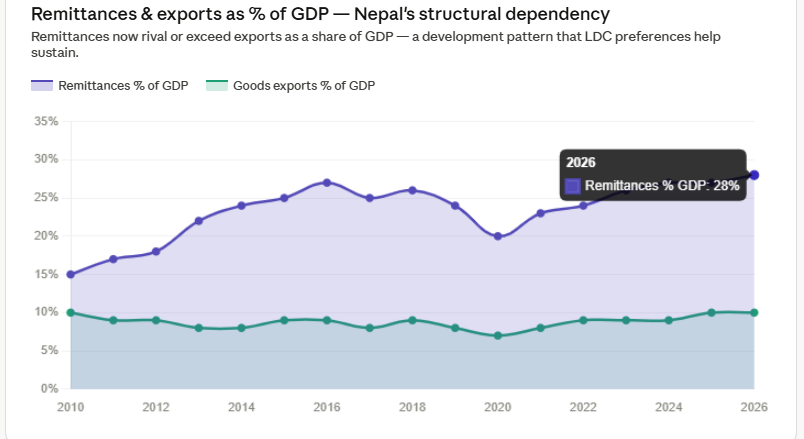
The informal economy, estimated by researchers at between 31 and 39 percent of GDP, goes largely unrecorded. Subsistence farming, care work performed predominantly by women, community-based mutual aid during earthquakes and blockades and pandemics — none of these appear in national accounts.
Feminist economists and development researchers have argued that if own-account production and unpaid care services were formally recognized and valued in Nepal’s national accounts, GDP could appear significantly higher and the economic contribution of women would be far more accurately represented.
Nepal’s actual human development progress — in child mortality, literacy, maternal health — has outpaced its income figures for decades. This suggests that GNI per capita, as a single gateway indicator, captures only a partial and somewhat distorted picture of whether a country is genuinely developing.
The LDC graduation system itself may need revision to incorporate wellbeing, ecological sustainability, and economic resilience more holistically.
What happens to Nepal’s access to concessional loans and aid after graduation?
Graduation from LDC status triggers a gradual withdrawal of several layers of concessional support. Access to specialized international financing mechanisms — including the LDC Fund for climate adaptation — becomes restricted or unavailable.
Many bilateral donors operate tiered aid allocation systems that deprioritize countries that have formally graduated, meaning development assistance flows tend to decline. The terms of external borrowing shift: Nepal would gradually lose eligibility for the most concessional lending windows of multilateral institutions and would need to borrow at higher interest rates on international markets.
This matters enormously for a country with a large infrastructure deficit and a need for significant investment in hydropower, roads, and digital connectivity. The deferral buys time, but it does not solve this underlying problem — Nepal must use the years between now and 2029 to develop alternative financing strategies, including improving domestic revenue mobilization, attracting foreign direct investment, and pursuing public-private partnerships that do not depend on subsidized international credit.
Is there a danger that Nepal becomes permanently trapped in the LDC category? Could 2029 become 2032?
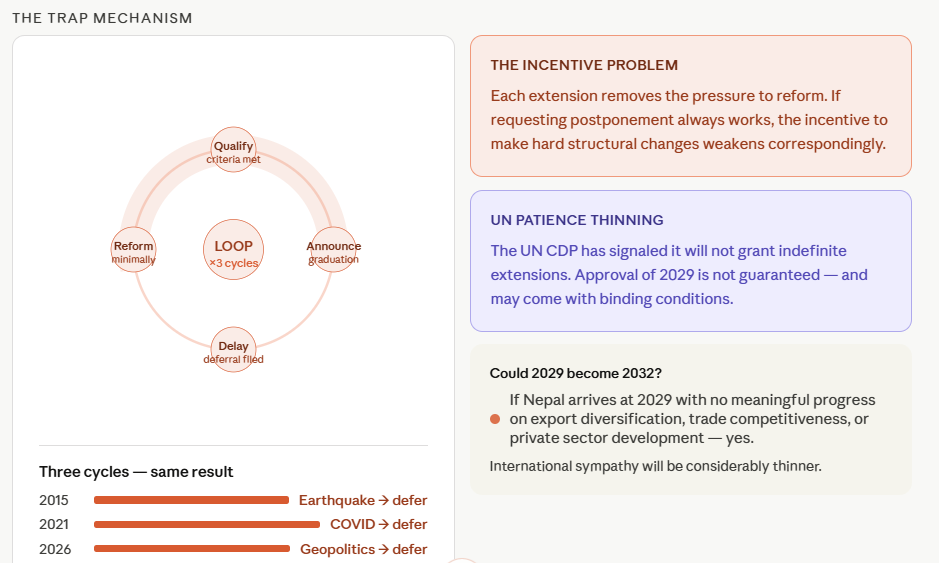
The risk of graduation turning into a perpetual deferral is real and several economists have named it directly. The pattern — qualify, delay, reform minimally, qualify again, delay again — has now repeated across three review cycles.
Each extension reduces the urgency of reform because the immediate pressure of losing privileges is removed. Political systems respond to incentives, and if requesting another postponement always works, the incentive to undertake genuinely difficult structural change is correspondingly weakened.
The UN Committee for Development Policy has previously signaled that it was not inclined to grant indefinite extensions, and it is not certain that the 2029 request will be accepted without conditions.
If Nepal arrives at 2029 without having made meaningful progress in export diversification, trade competitiveness, and private sector development, the international community’s patience — and its sympathy — may be considerably thinner than it is today. The 2026 delay should be treated not as another breathing space but as the final one.
What should Nepal concretely do in the next three years to make 2029 a real and irreversible graduation?
Three years is sufficient time to make decisive progress if political will is matched with administrative follow-through.
Nepal should immediately operationalize its Smooth Transition Strategy, treating it as a binding implementation plan rather than a shelf document — with quarterly reviews, budgetary allocations, and ministerial accountability.
It should negotiate a GSP+ arrangement with the European Union before LDC preferences lapse, which would preserve much of its preferential market access in its most important export destination. It should invest urgently in the garment, carpet, and pashmina sectors — not to subsidize inefficiency but to upgrade quality, meet compliance standards, and open new markets beyond traditional buyers.
It should pursue bilateral investment treaties and trade agreements with India, China, and Gulf nations that reflect its post-LDC reality. It should reform its tax system to widen the domestic revenue base, reducing dependence on external concessional financing.
And it should finally acknowledge and account for the immense economic contribution of its informal sector and its women workers — not just as a statistical exercise, but as the foundation of a development model that values what Nepal’s people have always actually been doing to hold the economy together.