Kathmandu
Sunday, June 21, 2026





Only 8 million cubic feet of sal is produced each year, just 16 percent of capacity, leaving 84 percent or Rs 20.16 billion worth unused due to restrictive policies and procedural hurdle
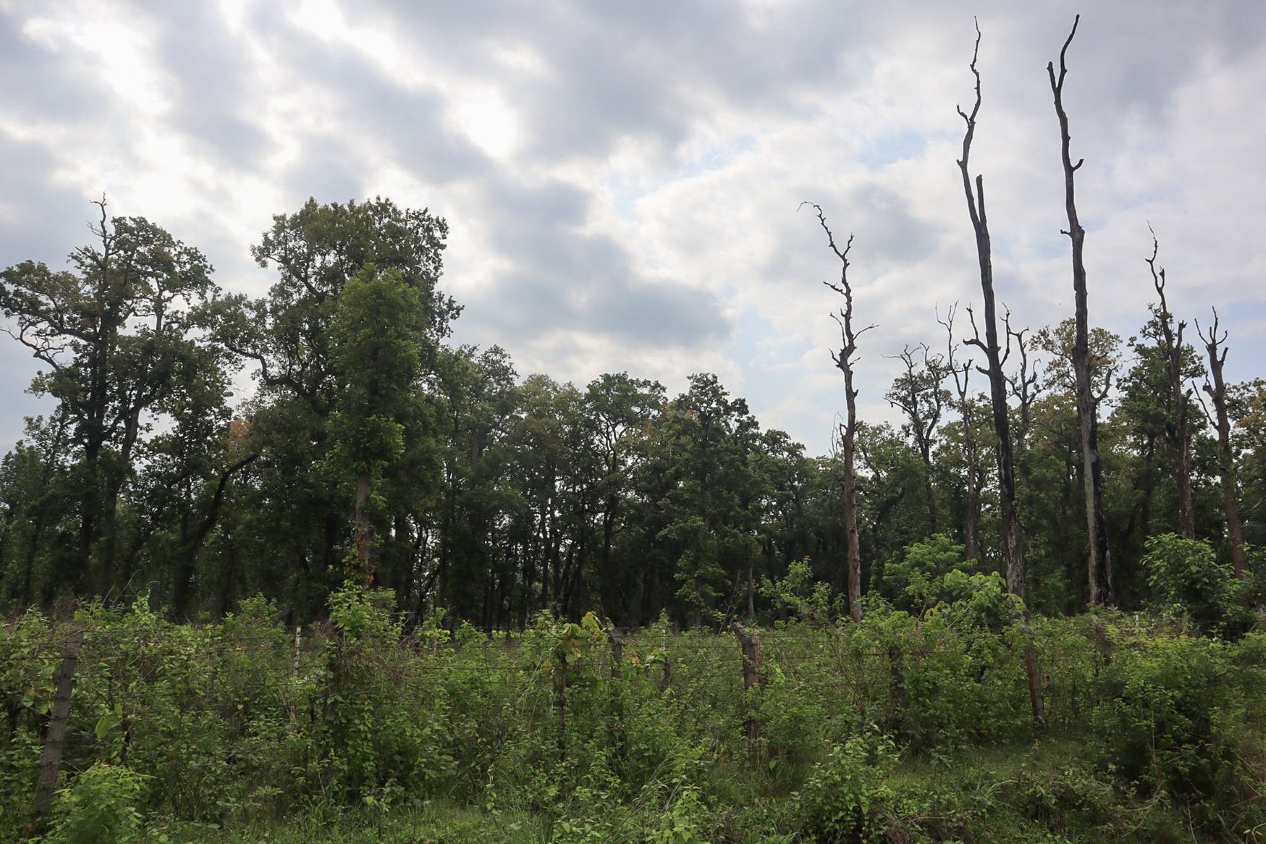
KATHMANDU: The Jalakanya Community Forest User Group in Ward-1 of Barahakshetra Municipality, Sunsari, is permitted to extract 1,200 cubic feet of timber annually. Spanning 196.85 hectares in the Chure region, a fragile east-to-west Himalayan foothill range extending roughly 800 km across Nepal, the forest is dominated by sal trees (Shorea robusta). However, regulations allow timber collection only after a tree has naturally dried and fallen.
Lok Bahadur Dahal, chairperson of the user group, says the rule severely limits benefits. “Green sal trees cannot be felled. Even dried trees cannot be removed until they fall on their own,” he says, adding that timber often rots before use. “From decayed trees, not even 50 percent of usable wood is recovered.” Registered on December 24, 2002, the group includes 109 households from Bagdalbari, Phulbari, Archale, Chawacha, and Jugpakhri. Annual income, after transport costs, stands at just Rs 150,000 to Rs 200,000.
Dahal also points to logistical constraints. The Division Forest Office in Sunsari requires timber and firewood to be extracted within 15 days, a deadline he says is unrealistic given the forest’s steep terrain and difficult access.
The Community Forest Timber and Firewood Collection and Distribution Guideline, 2015, mandates that only fallen, dried, dying, diseased, crooked, or overmature trees be selected for harvesting. It also requires cutting activities to be completed between mid-October and late May of the upcoming year, with all timber collected at depots within a 15-day window from late May to mid-June.
Ramala Bhandari, information officer at the Forest Products Development Board under the Ministry of Forests and Environment, says such “impractical” provisions have discouraged sal timber production nationwide. According to her, complex procedures for felling, transport, and sale have limited utilization despite strong production potential.
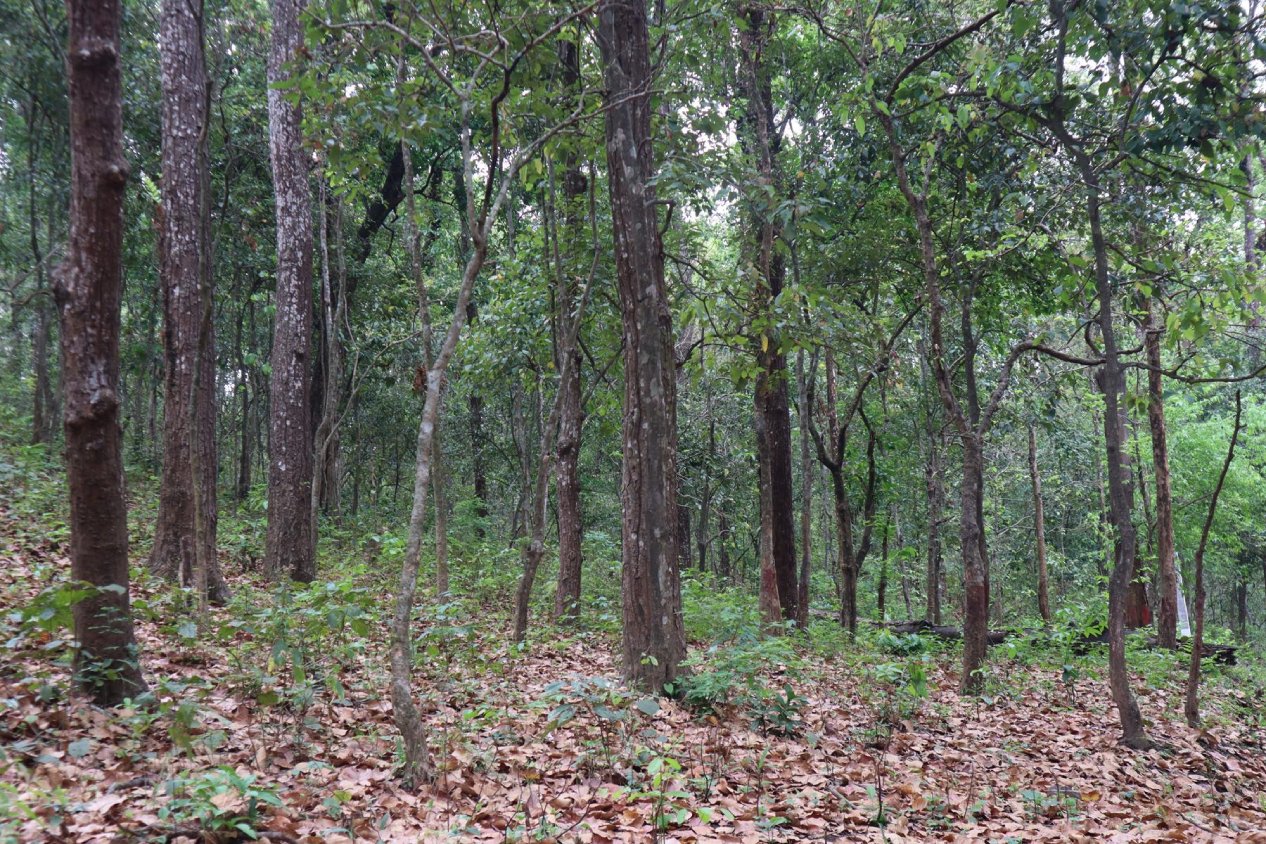
A view of the forest on the way to Devghat from Aptari, Chitwan District. Photo: Sabita Shrestha
As a result, consumers struggle to access quality timber, and income opportunities remain underrealized. This gap has pushed the country toward increased reliance on imported wood and alternatives such as iron, aluminum, and uPVC for construction and furniture.
According to Professor Rajesh Rai of the Institute of Forestry, Tribhuvan University, 50 million cubic feet of Sal timber worth Rs 24 billion can be produced annually nationwide. This represents the production capacity of 700,000 hectares of Sal tree forest area outside protected regions. According to the Annual Report 2023/24, released by the Department of National Parks and Wildlife Conservation, protected areas cover 23.39 percent of Nepal’s total land area, or 3,450,399 hectares. This is even more than Nepal’s agricultural land. Agricultural land covers 22.59 percent or 3,332,570 hectares.
Within the protected areas, there are 33 protected sites, including 12 national parks, one wildlife reserve, one hunting reserve, six conservation areas, and 13 buffer zones. According to the study titled ‘State of Nepal’s Forests’ published by the Forest Research and Training Center in December 2015, more than 1 million hectares of the total forest area fall within protected regions.
Although there is no exact data, Professor Rai estimates that currently only about 20 percent of the timber produced annually in Nepal is Sal. Of the 39,985,000 cubic feet produced in the fiscal year 2024/25, only 8 million cubic feet were Sal timber. The largest portion of that comes from Lumbini Province. Navaraj Pudasaini, joint secretary and head of the REDD Implementation Centre under the Ministry of Forests and Environment, states that 2.5 million cubic feet of Sal timber was produced there.
Deepak Gyawali, Joint Secretary at the Environment and Biodiversity Division under the Forest Ministry, acknowledges that a significant share of sal timber is going unused in forests. He notes that the current annual production of 8 million cubic feet represents only about 16 percent of the country’s estimated capacity.
The remaining 84 percent, valued at approximately Rs 20.16 billion, is not harvested or utilized due to regulatory and procedural constraints. As a result, much of this timber remains uncollected in forest areas, limiting its economic value and reducing potential returns for both the state and local communities.
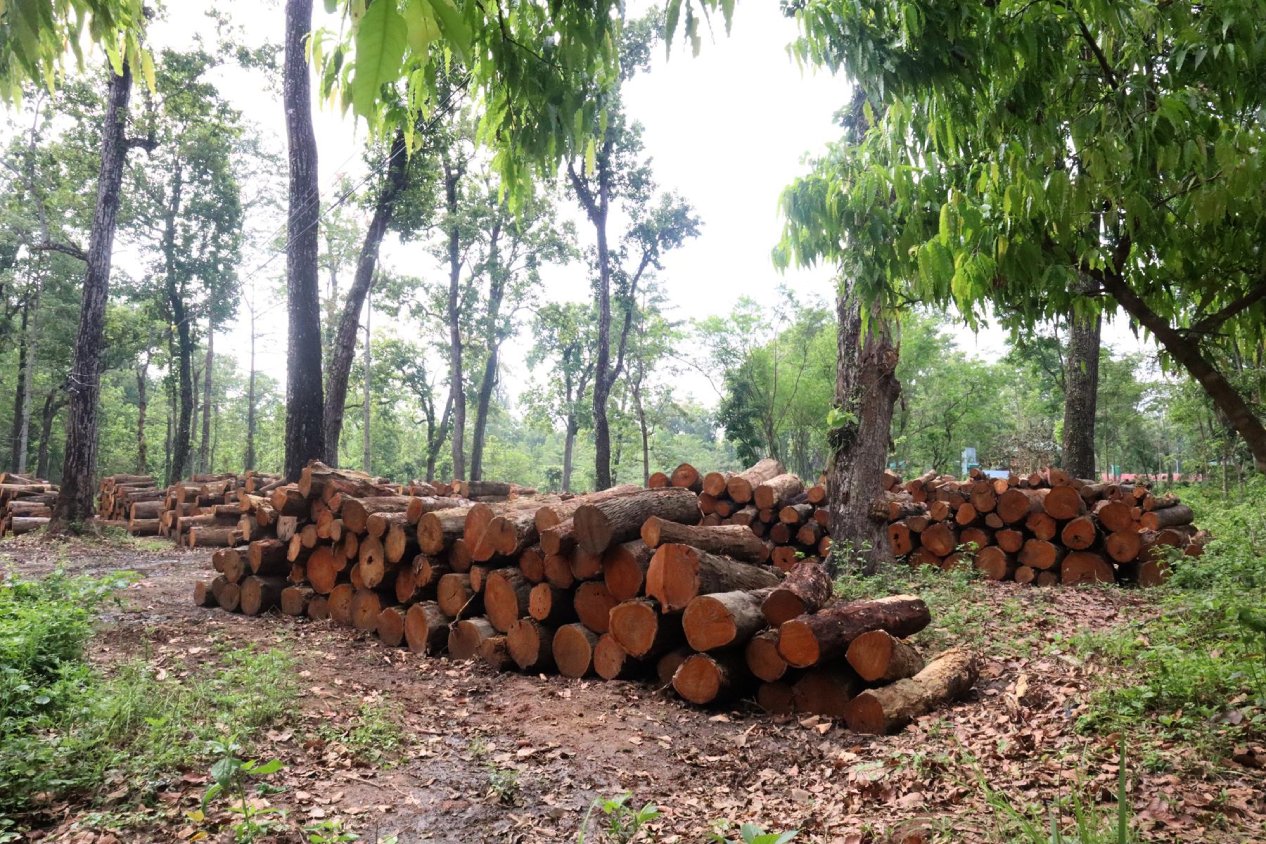
Log of timber in the Bhojad Forest area within Bharatpur Municipality. Photo: Sabita Shrestha
Apart from Sal timber production, employment worth Rs 6 billion can be created annually for marking and felling trees. When both incomes are combined, the total exceeds the annual budget of the Ministry of Forests and Environment. The government has allocated Rs 18.61 billion for the Ministry of Forests and Environment for the current fiscal year 2025/26. On this basis, the income from Sal timber alone would be 1.5 times higher than the ministry’s budget.
“The production of Sal timber alone can significantly help keep the country’s economy dynamic,” says Professor Rai. “But a mindset-based policy that says Sal trees must never be cut or touched, even if they waste away and rot in the forest, is creating problems.”
Forest coverage and Sal distribution
According to the fiscal year 2024/25 report released by the Forest Research and Training Center of the Forest Ministry based on the National Land Monitoring System, forest area covered 46.08 percent of the country’s total land (about 6.8 million hectares) in 2022. This includes 43.38 percent forest area (6,399,244 hectares) and 2.70 percent (398,293 hectares) of shrubland. Rabindra Maharjan, Director General of the Forest Research Center, explains that this count includes forests on private land and protected areas.
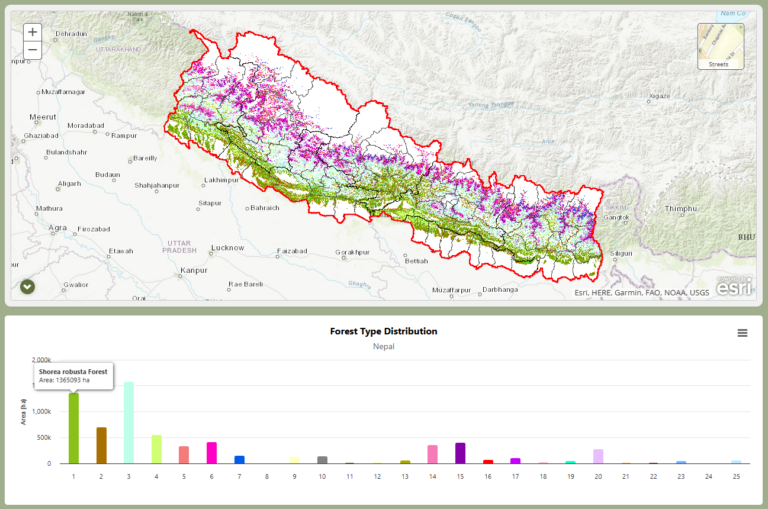
Out of the total forest area, pure Sal forests cover 1,365,093 hectares. This also includes Sal forests within protected areas. Looking by province, the area with pure Sal forests is highest in Lumbini, where there is a Sal tree forest area of over 324,417 hectares. Similarly, there is a Sal tree forest area of over 250,973 hectares in Bagmati, 209,709 hectares in Koshi, 188,026 hectares in Gandaki, 169,427 hectares in Sudurpashchim, 138,210 hectares in Madhesh, and 84,331 hectares in Karnali.
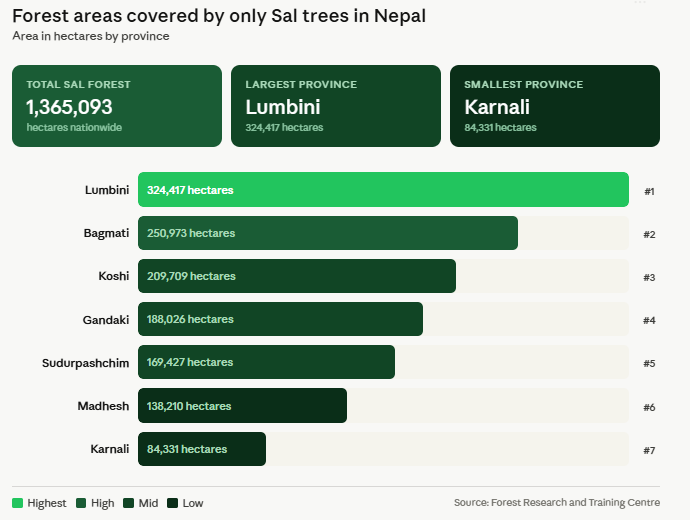
Additionally, there is mixed forest with Sal dominance over another 545,387 hectares. This includes other species like khayer (Senegalia catechu, previously known as Acacia catechu) and simal (Bombax ceiba) along with Sal trees.
It is not just Sal; timber from all species in Nepali forests is not being produced according to capacity. A study titled ‘Economic Potential of the Nepali Forest Sector’ conducted by Professor Rai and his team showed that timber can be produced at a rate of 129 million cubic feet annually nationwide. However, timber is not being produced to capacity in forests outside protected areas. According to the records of the Ministry of Forests and Environment, at least 39.9 million cubic feet were produced in the fiscal year 2024/25, some 30 million in the fiscal year 2023/24, some 31.8 million in the fiscal year 2022/23, at least 21.7 million in the fiscal year 2021/22, and 19.4 million in the fiscal year 2020/21. Although statistics show that timber production in forests has been increasing annually over the last five years, it is not sufficient.
As a result, there is a compulsion to import wood from 34 countries, including neighbors India, Vietnam, and Malaysia, to meet the annual demand for constructing houses and buildings and preparing windows, doors, and furniture.
According to Kishore Bartaula, Director of the Department of Customs, foreign timber; iron; aluminum; and plastic (uPVC) windows and doors worth Rs 55.308 billion have been imported in the last 8.5 years alone.
Lost opportunity
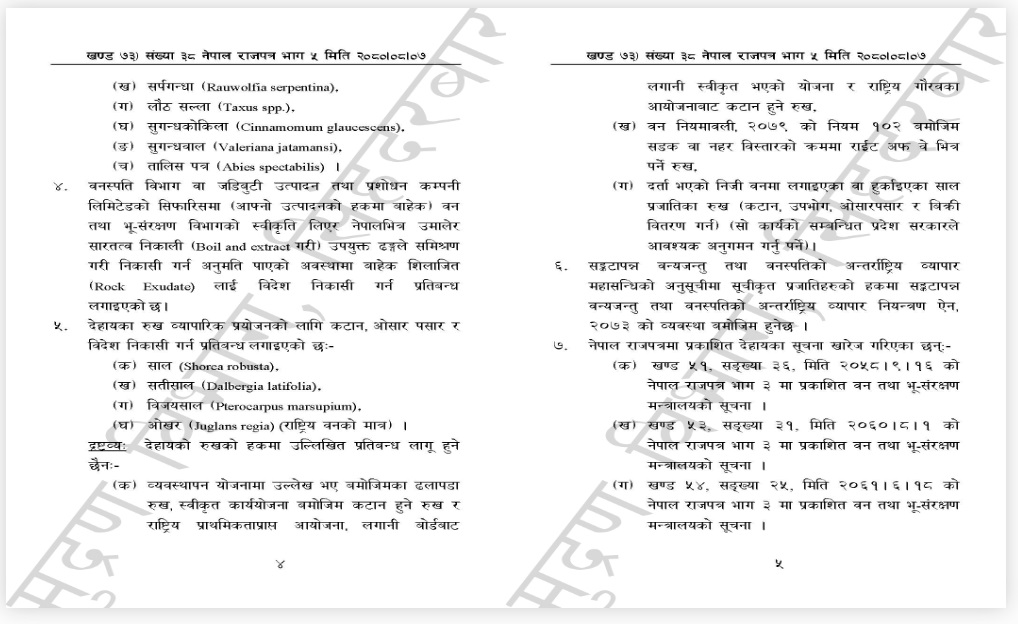
If the utility of Sal timber can be increased, there is an opportunity to replace the import of foreign wood, iron, aluminum, and plastic (uPVC) windows, doors, and furniture. Income generation and employment can be increased. However, unstable timber policies and expensive price rates have affected timber production and utility in Nepal. Since 1999, bans on timber production and distribution have been imposed five times, primarily prohibiting the felling, transportation, and export of high-value wood like Sal, Satisal (Dalbergia latifolia), and Bijayasal (Pterocarpus marsupium Roxb.) for commercial purposes. In the Nepal Gazette published on November 23, 2023, the felling, transportation, and export of trees, including Sal, for commercial purposes was prohibited.
Furthermore, Professor Rai states that Siltimber cannot compete in the market due to expensive royalties. The Forest (Second Amendment) Regulation, 2024, fixed the price of A-grade Sal timber at Rs 1,250, B-grade at Rs 900, C-grade at Rs 600, and D-grade at Rs 300. Timber businessmen and employees of the Ministry of Forests and Environment say this rate varies by province and local units.
Dinesh Raj Regmi, president of the Federation of Forest Based Industry and Trade, Nepal, says that when buying A-grade Sal tree timber, the price per cubic foot comes to Rs 1,500 to Rs 1,800. When that wood is brought to Kathmandu, sawn, and sold, the price per cubic foot comes to at least Rs 4,500 according to current market rates. He explains that this includes revenue, transportation, sawing costs, and the expenses paid to middlemen in the name of various checks on the way to Kathmandu after picking up sal tree logs from the depot.
“About Rs 1,500 has to be paid to middlemen stationed at check posts,” Dinesh Raj Regmi says. “Because the government has made rules and laws that discourage wood cutting, those who pick it up from the depot and bring it also face obstacles at every post. The burden of all these costs falls on the consumer, and Sal tree timber becomes expensive. Therefore, consumers choose aluminum and uPVC, which are available cheaply.”
Devesh Mani Tripathi, former Director General of the Department of Forests and Soil Conservation, says that there has been no positive publicity regarding the use of Sal timber. “In our country, the idea is that trees should not be cut; Forest Ministry employees brief the forest minister that Sal will not grow back once cut, and the forest minister does not have the time to study the potential of Sal,” he says.
If trees are left as they are, they become old, their quality deteriorates further, and they end up destroyed. Tripathi states that by doing so, the opportunity to earn foreign currency through exports is being lost. He says, “When the Finnish government was running a forest management project in Nepal, they even said, ‘Nepal’s Sal timber is very strong, we will take it to build ships.'” In the 1990s, a program was run with the support of the Finnish government to increase production by managing Sal forests.
Professor Rai, however, expresses doubt about being able to sell Sal timber abroad. “In other countries, there is a trend of using modern technology to make soft wood strong; they prefer light wood,” he says. “Even though Sal timber is durable, it is heavy and expensive; for this reason, I am not very optimistic about being able to sell it abroad.” He believes high benefits should be obtained by increasing its internal consumption.
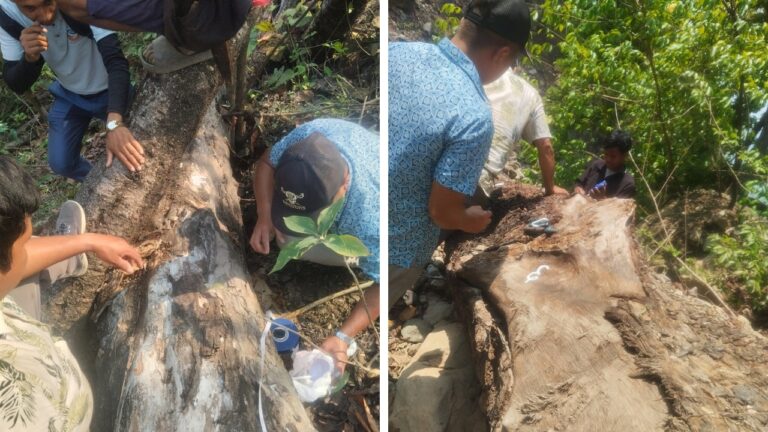
Marking a fallen Sal tree in the Jalkanya Community Forest. Photo credit: Lok Bahadur Dahal
His understanding is that the government is limited to the royalty of Sal and has failed to recover its full value. “The secretaries of the Forest Ministry do not have the time to look into this. They are busy figuring out how to arrange opportunities to travel abroad and receive allowances, while most of the time of other ministry employees is spent moving files around,” he complains.
Professor Rai states that tightening the production of Sal timber has also encouraged smuggling. “When it is not easily available in the market, smuggling is bound to happen. This applies to Sal timber as well,” he says. On March 10 this year, police recovered ‘illegal’ Sal timber from Sadakghat in Belauri Municipality-10, Kanchanpur. Based on confidential information that a local, Dipendra Chaudhary, had hidden illegal wood inside a room in his own house, a police team deployed from the Area Police Office, Beldandi, Kanchanpur, found 64 cubic feet of Sal timber during a search. The estimated market value of the recovered wood is Rs 80,837.
Joint Secretary Gyawali of the Environment and Biodiversity Division says that perception is the main problem in Sal timber production. “As soon as a tree is cut, there is harassment saying there was collusion with employees; a tendency to not want to be involved in tree cutting tasks at all is starting to dominate among employees rather than going around giving explanations in 10 places,” he says. Because of this, files keep moving around to complete the process for timber production.
Indra Prasad Sapkota, secretary of the Ministry of Forests, Environment and Soil Conservation, Koshi Province, however, claims that the utility of Sal has not been ignored. “Sal is mentioned in most forest policies,” he says. “Legal hurdles in timber production are a half-truth because smuggling is high; policy processes must be completed to regulate it.”
Sal’s economic prospects
Forest experts and stakeholders say that the market price of Sal tree timber and materials made from it should be affordable for consumers. Professor Rai has three suggestions for this. First, royalties should be reduced; second, the timber production process should be made easier; and third, the auction sale process should be made for a five- or 10-year period. “Because of expensive royalties, competition in the timber market is not easy, so royalties should be reduced,” he says. “The tradition of annual auctions makes the availability of raw timber uncertain. Therefore, it is difficult for timber businessmen to make business plans.” He argues that an environment should be created where Sal timber is easily available in the market to discourage smuggling.
Information Officer Bhandari of the Forest Products Development Board also suggests making production easier by reducing royalties and legal hurdles. Joint Secretary Gyawali of the Environment and Biodiversity Division agrees with this. He says that sal tree timber should be produced using modern tree cutting and sawing technology without affecting nature. “When it comes to extracting wood, there is a trend of destroying the forest using dozers; this should not happen,” he says.
In the Forest Rules, 2022, there was a provision that Sal tree timber, among wood and firewood at depots, could not be sold for seven years.
Joint Secretary Rajendra KC of the Planning, Monitoring and Coordination Division of the Forest Ministry emphasizes that there should be a guarantee that consumers get Sal timber at a cheaper price corresponding to the reduction in royalty rates. “There are often complaints regarding royalties, in which there are various interest groups,” he says. “Reducing revenue makes sense only if consumers get it cheaper; if the price of wood for consumers does not decrease, there is no utility in reducing royalty fees.” He stated that the ministry is reviewing because improvements in policy, behavior, and thinking are necessary to increase Sal timber production and utility.
Lately, the government has become flexible in policy arrangements to facilitate the sale and distribution of Sal timber and firewood. The Forest (Third Amendment) Regulation, 2026, implemented by publication in the Gazette on January 22 this year, has opened the sale and distribution of five-year-old Sal timber kept at depots after re-measurement and grading. In the Forest Rules, 2022, there was a provision that Sal tree timber, among wood and firewood at depots, could not be sold for seven years.
Diverse uses of Sal
As mentioned in the Forest Manual of Afforestation in Nepal prepared by the Forest Research and Survey Center in July 1994, Sal is also known locally as Sakhuwa and Agrakh (the heartwood of the Sal tree). The Sal tree is large. The leaves are smooth, oval-oblong. The flower is yellow and fragrant.
Journal of Plant Resources published by the Department of Plant Resources in 2025 mentions that bark juice is used to treat diarrhea, cough, rheumatism (joint pain), bone fractures, piles, cancer, kidney stones, and skin diseases (such as herpes zoster).
Studies have shown that all parts of the sal tree can be used, from its leaves, bark, and slime flux to its wood. A study titled ‘Sal Tree Economy,’ published in BioNature on October 21, 2025, mentions that Sal holds ecological, environmental, economic, social, cultural, and medicinal importance.
Sal forest areas are major habitats for large animals like tigers, rhinos, and elephants. Indra Prasad Sapkota, who completed a PhD thesis in 2009 titled ‘Species diversity, regeneration, and early growth of Sal trees within the forests of Nepal: response to natural forest disturbances,’ says that Sal trees have a higher carbon sequestration capacity.
Because Sal wood is hard, strong, and durable, it is preferred for house and building construction. Sal tree timber is used in the furniture business to make windows, doors, and handicraft items. In rural areas, it is used for firewood and fodder along with timber. Dried leaves can be used as litter to make compost manure. In cultural activities like festivals and feasts, ‘Duna’ and ‘Tapari’ traditional, biodegradable bowl-shaped containers made by stitching Sal tree leaves together with small bamboo sticks, are used. Through the business of producing Duna, Tapari, and plates as well, the income of women and marginalized people in rural areas can be increased.
Fragrant items like incense sticks can be made from Sal flowers and seeds. Similarly, the Journal of Plant Resources published by the Department of Plant Resources in 2025 mentions that bark juice is used to treat diarrhea, cough, rheumatism (joint pain), bone fractures, piles, cancer, kidney stones, and skin diseases (such as herpes zoster).
Even decayed, rotten, and low-quality Sal timber and firewood are used for burning. Briquettes can be made from dried Sal leaves and small branches to be used as fuel. Such versatile Sal forests are in a state like ‘wasting wealth,’ as mentioned in the Forest Manual of Afforestation in Nepal.
Due to the government’s inability to focus on the sustainable use of the Sal tree, which provides significant contributions to nature and human life, uncontrolled exploitation, deforestation, and climate change have put its sustainability at risk.
After a widespread problem of leaf shedding was seen in Sal species in community forests of Dailekh District, the Forest Research and Training Center conducted a study. The leaf shedding problem was seen in nearby community forests, including Kimugaun, Chupra, Kotila, Shristhan, Belpata, Sadu Chhahare Jamune, and Torya. Among these, field observations were made in two community forests in the Kimugaun and Chupra areas. Damage was caused by leaf-eating insects in the hairy larva stage in those forest areas. According to locals, the insects seen since the last month of the last fiscal year 2024/25, had gradually started eating Sal leaves.
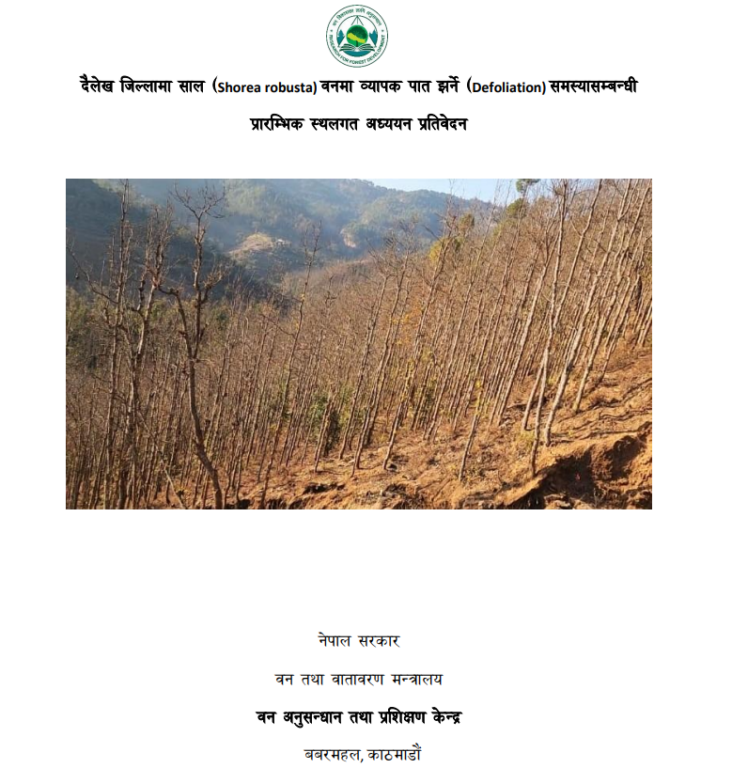
A couple of months ago, around in January/February this year, the Forest Research and Training Center made a preliminary analysis from the study that the outbreak of leaf-eating insects in the Sal forest might have been created by factors like prolonged drought, lack of winter rain, and seasonal instability. “Although there is not enough scientific evidence available to conclude that the currently seen leaf-eating insect outbreak is directly due to climate change, a preliminary analysis has been made that climate change may have subsidiarily promoted such an outbreak,” the study says.
Properties of Sal timber
Sal is the most sought-after timber for windows, doors, and beams in house construction across Nepal, primarily due to its strength and durability compared to imported wood and other local species. Indra Prasad Sapkota, secretary at the Ministry of Tourism, Forests, and Environment in Koshi Province, notes that sal timber used in temples has lasted up to 300 years and has even been reused. “Aluminum and uPVC last about 40 years, and iron corrodes over time. Compared to these, sal timber is exceptionally sturdy,” he says.
Professor Rajesh Rai adds that durability also depends on proper use and treatment. According to him, wood that undergoes seasoning, a scientific process of removing internal moisture, tends to last significantly longer. Without this process, wood may crack, warp, shrink, or deteriorate due to insects and fungi as moisture expands in winter and contracts in summer. Experts say seasoning can be done through sun drying or kiln drying, improving both strength and longevity.
Source: Forest Research and Training Centre
Former Director General Devesh Mani Tripathi describes sal timber as a natural substitute for iron, with potential applications in bridges and multi-story structures. However, he points out that its use in Nepal remains largely limited to doors and windows.
Sal forests are distributed across Nepal from east to west, spanning the Terai, Madhesh, and Chure and extending into the mid-hills up to 2,000 meters in elevation. According to Indra Prasad Sapkota’s doctoral research, these forests are broadly classified into two types: lower tropical or mixed broad-leaf sal forests and hill sal forests. In tropical regions, sal trees can grow up to 40 meters tall, while those in hill regions are comparatively smaller.
As outlined in the Forest Management Standard 2022 Based on the Lumbini Silvicultural System, the rotation cycle for Terai sal forests ranges from 80 to 100 years, while hill sal forests require 100 to 120 years before they are ready for harvesting.
A study published in BioNature shows that sal forests extend across South Asia, including Nepal, India, Bhutan, Bangladesh, Myanmar, and Thailand. These forests are commonly found in lowland areas, riverbanks, and valleys. According to Sapkota’s research, sal forests cover approximately 10,570,000 hectares in India and 120,000 hectares in Bangladesh.