Kathmandu
Wednesday, June 17, 2026





Nepal has the potential to produce around 150 million cubic feet of timber annually, yet the country produces only about 30 million cubic feet. As a result, Nepal continues to import large quantities of timber and timber-based products
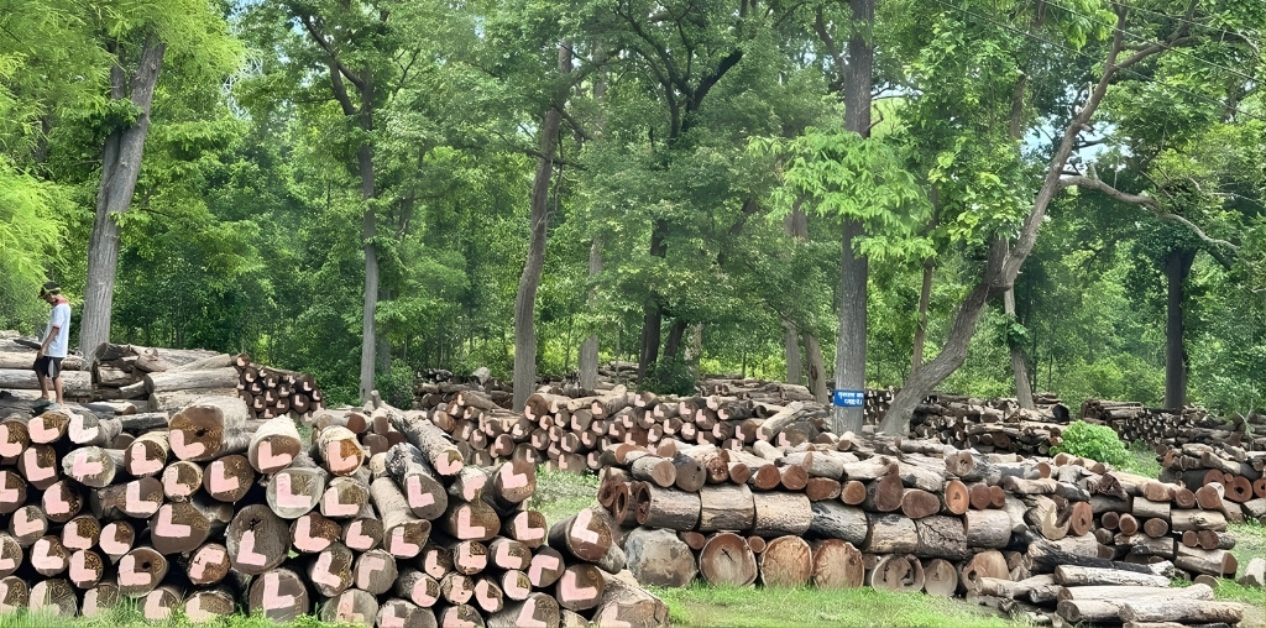
KATHMANDU: Since the Panchayat era, a popular saying related to forests has circulated widely in Nepali society: “Green forests are Nepal’s wealth.” The phrase emerged from the understanding that forest products such as timber, firewood, and medicinal herbs generate income for the state, making forests an important national asset. Over time, as forest conservation awareness campaigns expanded, the phrase was widely used in school textbooks, government programs, and public campaigns, eventually becoming almost like a national slogan.
However, because this national wealth has not been managed and utilized properly, Nepali timber is not only going to waste but the country is also forced to import timber products worth billions of rupees every year to meet domestic demand. The government has often been accused of allowing domestic timber to rot in forests while purchasing foreign timber for internal consumption. In reality, the absence of practical policies for forest management and utilization has led to situations where decades-old trees decay in forest areas, while timber stored at ghatgaddi (timber collection depots) also deteriorates due to exposure to sun and rain, eventually rotting and becoming unusable.
According to the Forest Regulation, 2022, timber and firewood stored in depots could not be sold or distributed for long periods: sal timber for up to seven years, asna, sisau, and teak for up to five years, other timber species for three years, and firewood for four years. However, the Forest (Third Amendment) Regulation, 2026, published in the Nepal Gazette on 22 January 2026, introduced a more flexible policy regarding depot timber management. Under the revised provision, sal timber stored for five years, asna, sisau, and teak stored for two years, and other timber species and firewood stored for one year can now be re-measured, graded, and sold.
Minister for Forests and Environment Madhav Prasad Chaulagain says the new provision will bring relief to the domestic timber market. According to him, “Timber kept in depots for long periods deteriorates due to sun and rain, and complaints had begun to arise that such timber had to be sold at a loss and buyers were reluctant to purchase it. Therefore, the government decided to reduce the storage period for depot timber.”
Similarly, on 2 February 2026, the Ministry of Forests and Environment published a 34-point list of immediate reform activities. The first item on the list states that the use of domestic timber will be made mandatory in the construction of government buildings at the federal, provincial, and local levels. This move may help the government counter accusations that it allows domestic timber to rot while importing foreign timber. However, because of the complicated procedures involved in producing domestic timber, it may still be difficult to implement the policy effectively. Consequently, timber required annually for houses, buildings, doors, windows, and furniture continues to be imported from 34 countries, including India, Vietnam, and Malaysia. According to the Department of Customs, Nepal imported timber as well as iron, aluminum, and plastic (uPVC) doors and windows worth Rs 55.30 billion in the past eight and a half years alone.
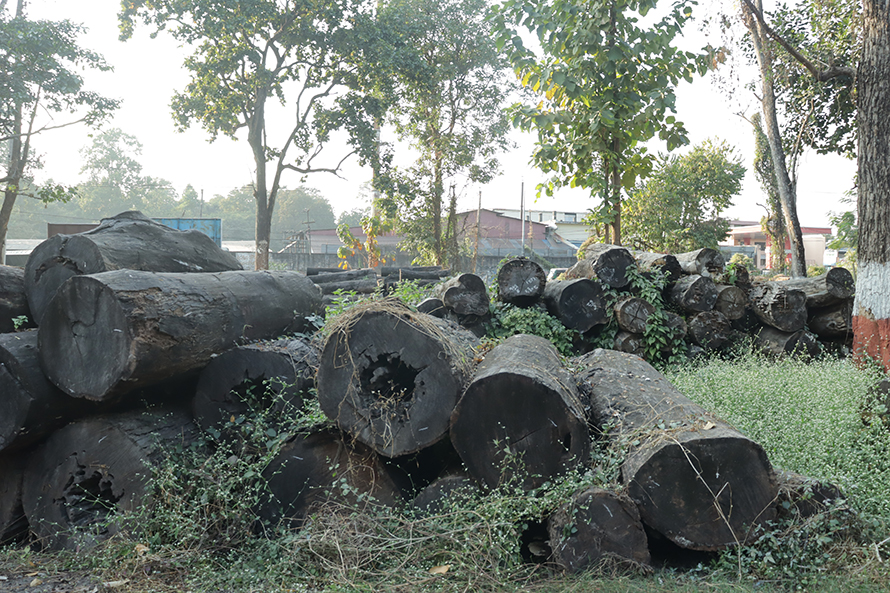
Decaying timber at the Panchakanya and Bishnupaduka forest sub-divisions in Sunsari district. Photo courtesy: RSS
High production and market potential, but complicated procedures
In 1994, forests covered 29 percent of Nepal’s total land area. By 2022, forests and shrublands together covered 46.07 percent of the country’s land area, according to a World Bank report published on 12 November 2025. Of this, 41.69 percent consists of forest area while 4.38 percent is shrubland.
A recent study conducted by a team led by Professor Rajesh Rai from the Institute of Forestry at Tribhuvan University shows that Nepal could produce 129 million cubic feet of timber annually. However, the country currently produces only about 30 million cubic feet each year. Because 97.9 million cubic feet of timber remains unproduced annually, the government loses approximately Rs. 61.47 billion in potential revenue every year, according to the study. Professor Rai observes, “This amount is more than three times the annual budget of the Ministry of Forests and Environment.” For the fiscal year 2025/26, the government allocated Rs 18.61 billion to the ministry.
The study also indicates that the failure to produce 97.9 million cubic feet of timber leads to the loss of employment opportunities worth Rs 14.12 billion annually, which could otherwise provide jobs for about 60,200 people. Despite the significant potential of the timber market, Rai argues that the government has not focused sufficiently on scientific and sustainable forest management, timber harvesting, and utilization. “Policies have mainly emphasized protecting trees and expanding forest areas, allowing trees to remain standing until they become over-mature,” he says.
According to Nabaraj Pudasaini, chief of the REDD Implementation Center under the Ministry of Forests and Environment, Nepal’s forests have the capacity to produce 150 million cubic feet of timber annually. However, by 12 February 2026 in the current fiscal year 2025/26, the country had produced only 34.2 million cubic feet of timber. In 2018, Nepal produced only 18 million cubic feet, and timber production has been gradually improving in recent years.
Currently, Lumbini Province produces the highest amount of sal timber, about 2.5 million cubic feet annually, while Koshi Province produces about 20 million cubic feet of softwood each year. “Timber production has not yet begun in Sudurpashchim, Bagmati, and Madhesh provinces because provincial-level guidelines for sustainable forest management have not yet been formulated,” explains Pudasaini.
Although Nepal’s forests offer enormous potential for timber production and markets, unclear and complicated procedures remain a major barrier.
The Forest Regulation, 2022 sets the price of sisau timber per cubic foot as follows: Grade A at Rs 1,000, Grade B at Rs 800, Grade C at Rs 500, and Grade D at Rs 300. Similarly, the price of sal timber is fixed at Rs 1,000 for Grade A, Rs 700 for Grade B, Rs 500 for Grade C, and Rs 250 for Grade D. For pine timber, the price is set at Rs 350 for Grade A and Rs 250 for Grade B.
The government sells round timber stored in depots through competitive tender bidding. According to Dinesh Raj Regmi, president of the Federation of Forest-based Industry and Trade Nepal (FenFIT Nepal), contractors typically pay between Rs 1,500 and Rs 1,800 per cubic foot for Grade A sal timber. After transporting the timber to Kathmandu, sawing it, and selling it in the market, the price reaches at least Rs 4,500 per cubic foot. Regmi explains, “The tender price along with taxes paid to three levels of government reaches around Rs 2,000 per cubic foot, while transportation, loading and unloading, and sawing cost about Rs 1,000. The remaining Rs 1,500 is often spent on intermediaries at various checkpoints and inspections while transporting timber to Kathmandu.”
Because timber becomes expensive through this process, consumers tend to choose cheaper uPVC alternatives, according to environmental lawyer Dil Raj Khanal. He argues, “If timber costing Rs 4,500 per cubic feet can be replaced by uPVC costing around Rs 400, why consumers would buy timber which is expensive.”
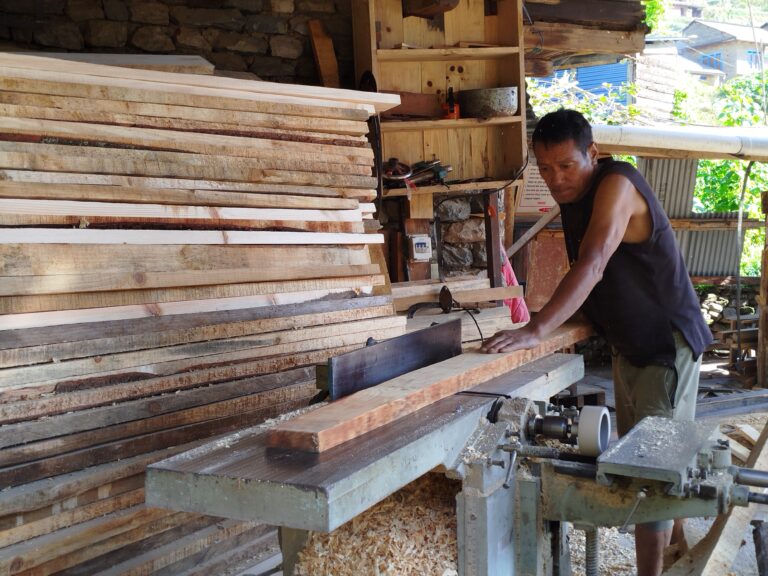
A man working at a furniture factory located in Tarakhola Rural Municipality, Baglung. Photo: Bidhya Rai
Timber entrepreneur Bal Krishna Shiwakoti also believes that Nepal has failed to make proper use of its forest resources because of numerous obstacles involved in producing timber and delivering it to consumers. “Policies related to timber production place burdens on both businesses and consumers. Instead of buying expensive domestic timber produced through complicated procedures, purchasing foreign timber has become easier and cheaper,” he says.
The complications within the forest itself remain unchanged. For instance, to produce timber from a community forest, the user committee must prepare a forest management plan every decade, which costs between Rs 100,000 and Rs 500,000. After the community decides to harvest timber, forest officials must be called to mark the trees that are to be cut. Regmi, president of the Fen FIT Nepal, says, “This process is extremely cumbersome. Officials do not do it easily; we have to visit them at least 15 times. It is very troublesome.” When officials come to mark the trees, the community must arrange their food and accommodation. After the trees are marked, labor costs must be paid to fell them. Transporting the timber from the forest to the depot requires additional expenses for loading, unloading, and transportation. “Because of these complicated procedures, timber is often left to fall, rot, and decay in the forest itself rather than being harvested and used. The processes of transporting and selling timber have been made extremely complex,” observes Regmi.
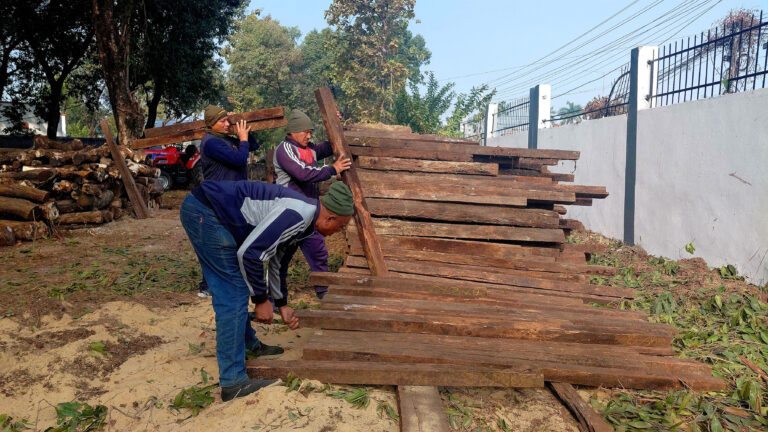
Armed forest guards working to organize and manage old timber stocks in Banke on January 10. Photo courtesy: Rupani GM/RSS
The National Forest Policy, 2018 aims to export timber with value addition after meeting domestic consumption. However, unclear legal provisions, complicated procedures, an unmotivated timber market, and the lack of appropriate skills and technology have created obstacles even for producing timber for domestic use.
Studies have also shown that domestic timber is not being utilized effectively. A study titled “Pathways to Forest Wealth in Nepal,” published in the journal Australian Forestry (Volume 82, 2019) by the British publisher Taylor & Francis for Forestry Australia, points out that although Nepal has enormous potential in timber-based forest products, this potential has not been properly utilized.
Similarly, the 61st Annual Report of the Auditor General, 2024 states that the country is losing revenue due to the underutilization of timber while importing timber-based materials worth billions of rupees. The report notes that the number of fallen trees, dry standing trees, degraded trees, and over-mature trees in forests is increasing. It recommends that such trees should be managed properly and used to contribute to the national economy through timber and other forest products. Although the Auditor General has recommended better utilization of timber-based forest products, complicated government policies, regulations, and administrative procedures continue to obstruct the process of extracting, transporting, and using timber from forests. There is no precise data on how much timber has been destroyed or wasted. However, Regmi claims that an estimated 30 billion cubic feet of timber has rotted in forests over the past five years.
Regulatory amendments are not sufficient
According to Thakur Bhandari, president of the Federation of Community Forest Users Nepal, reducing the storage time in timber depots through the amended forest regulations alone will not solve the problem of domestic timber production. He says, “Timber traders must still pay money at various points while transporting timber from depots to markets. Unless the government ends this practice, timber trade will not become easier and consumers will not get timber at affordable prices.” After timber is collected from depots, traders must pay fees to five to seven layers of intermediaries along the way, which significantly increases the price. This situation has not only discouraged timber entrepreneurs but has also burdened consumers because of rising prices of timber products. “This is unfair both to consumers and to forests, as well as to those engaged in the timber business,” argues Bhandari.
According to Navaraj Subedi, owner of Tarakhola Furniture Industry in Tarakhola Rural Municipality–5 of Baglung, even timber extracted from nearby forests becomes expensive because of the heavy tax burden. Timber extracted from private forests must pay 13 percent revenue, and after furniture is produced another 13 percent VAT must be paid to the government. Furniture manufacturers add this VAT amount to the price of products sold to consumers. “This increases the price of furniture, causing customers to shift toward alternatives such as aluminum and uPVC products. When customers say the price is too high and choose aluminum or uPVC products instead, it becomes difficult for us to survive in business,” he says.
He also points out that sending finished furniture products to markets in rural municipalities or districts requires numerous documents and administrative procedures. “We have to go to the district Division Forest Office to prepare documents, obtain stamps, and complete various formalities,” he says, “The government should make rules and laws simpler and more transparent.”
High import of timber and timber products
According to the Department of Customs, from the fiscal year 2017/18 to mid-March in the current fiscal year 2025/26, Nepal imported timber-based products worth Rs 5 billion over the past eight and a half years. Between fiscal year 2019/20 and mid-March 2026, Nepal imported timber worth over Rs 2.70 billion and timber products worth Rs 46.25 billion, mainly from India, the largest source. During the period from fiscal year to mid-March 2026, Nepal exported timber products worth Rs 28.61 billion. However, timber exports from Nepal appear to have started only from fiscal year 2024/25. Since then, timber worth only Rs 15 million has been exported.
Because domestic timber production is neither easy nor affordable, Nepal has not only imported timber and timber products but also ready-made materials for doors and windows made of iron, aluminum, and plastic. From fiscal year 2017/18 to mid-March 2026, Nepal imported such materials worth Rs 4.05 billion. This includes iron doors and windows worth Rs 1.96 billion, aluminum doors and windows worth Rs 1.33 billion and plastic doors and windows worth over Rs 760 million.
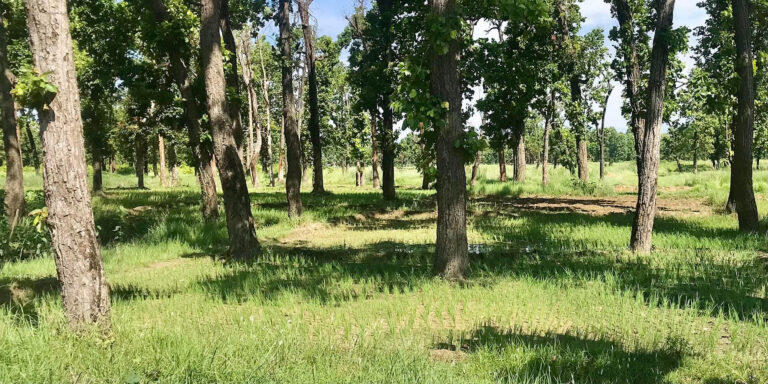
Community forest in Rupandehi. Photo credit: Basant Giri
Over the past eight years, the import of iron, aluminum, and plastic doors and windows, along with their frames and fittings, has increased by more than three times. In fiscal year 2017/18, imports of these materials were worth Rs 184.9 million. By fiscal year 2024/25, imports had risen to Rs 574.94 million. The highest import occurred in 2019/20, when iron and aluminum doors, windows, and frames worth Rs 746.33 million entered Nepal.
Unstable timber policy
Legal and administrative complications related to forests have discouraged timber production. Devesh Mani Tripathi, former Director General of the Department of Forests and Soil Conservation, says that sudden legal and administrative decisions made in the name of regulating timber production affect both government employees and businesspeople. According to him, employees often hesitate to make decisions because they fear facing disciplinary action. “This has created obstacles in domestic timber production and trade,” he says. Tripathi also explains that repeated bans imposed by the government in the name of preventing illegal logging and protecting forests have hindered domestic timber production.
A policy paper titled “Potential and Challenges of the Timber Business,” published by Forest Action Nepal in 2024, states that five separate bans have been imposed on timber production and distribution in Nepal since 1999.
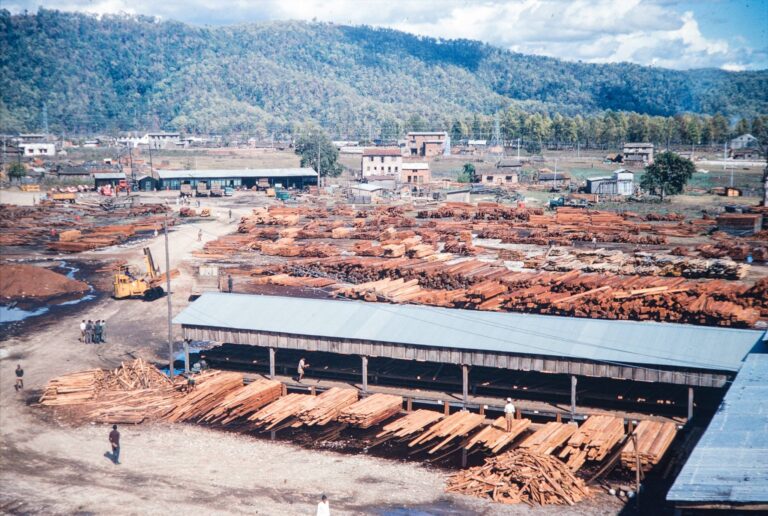
Nepal Forest Corporation Limited, Hetauda. Photo courtesy: Forest Corporation/Facebook
In 1999, when the government agency responsible for selling timber – The Timber Corporation of Nepal (now Nepal Forest Corporation) – was unable to sell accumulated timber, large quantities of timber piled up in forests. As a result, the government imposed a ban on cutting new trees until the existing stock was sold. Following instructions from then Prime Minister Krishna Prasad Bhattarai, the Secretary of the Ministry of Forests and Soil Conservation imposed a nationwide ban on tree felling on 1 November 1999. After protests from civil society and stakeholders, the ban was lifted partially by assigning forest management responsibilities to community forest user groups.
On 31 December 2001, the government again banned the cutting, transportation, and sale of timber from species such as chanp, khayar, sal, simal, satisal, vijay sal, and walnut for commercial purposes. On 5 November 2007, the ban was partially lifted to allow the cutting of chanp, khayar, and simal trees.
Later, after illegal smuggling of timber increased in Panchthar and Sarlahi, the then Forest Minister Dipak Bohara again imposed a ban on 26 May 2010, prohibiting the cutting, sale, distribution, and export of timber from all types of forests for commercial purposes.