Kathmandu
Wednesday, June 17, 2026





Experts criticize the Nepal Pragya-Pratishthan for a directionless dictionary project spanning 40 years, stating the new 'Pragya Nepali Brihat Sabdakosh' merely compiles raw regional dialects and neighbor-language loanwords without fixing deep-rooted lexicographic flaws
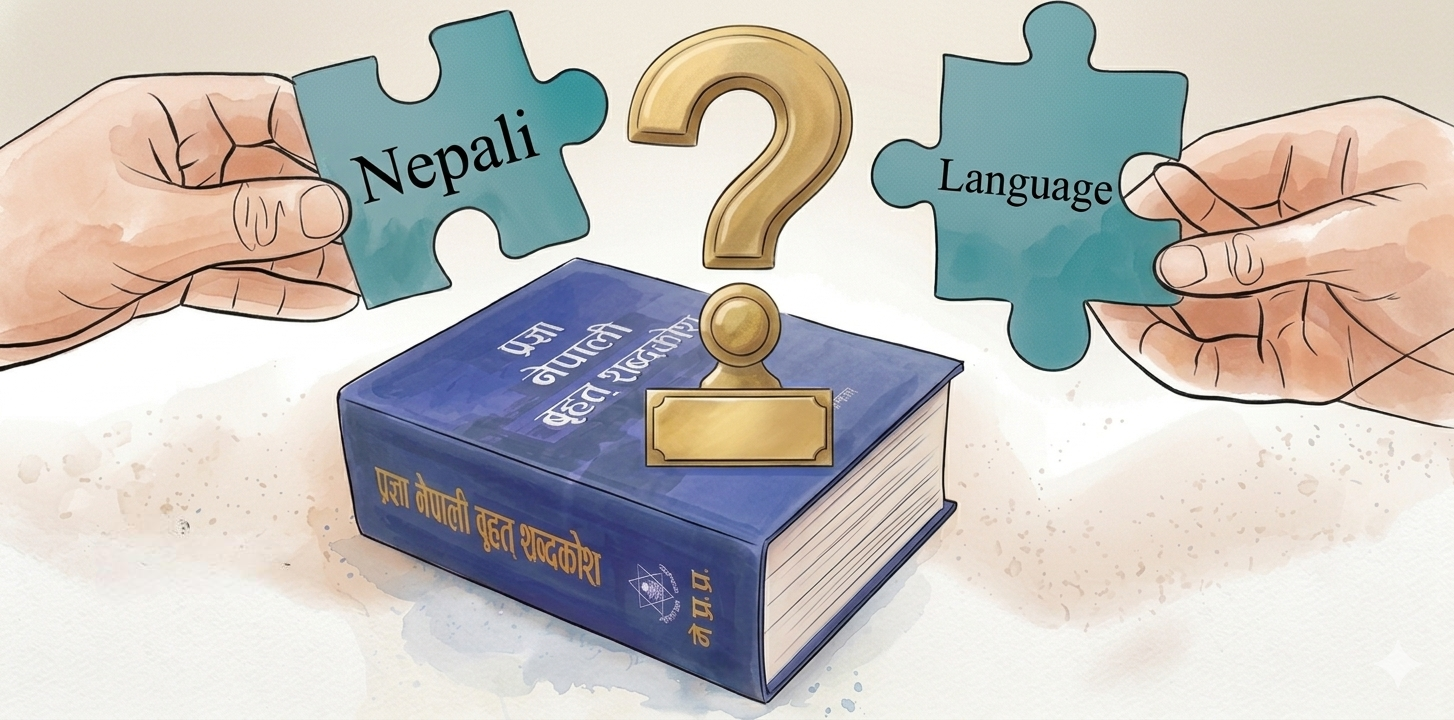
KATHMANDU: The release of the Pragya Nepali Brihat Shabdakosh (Nepali dictionary), currently the thickest dictionary available in the Nepali language, has sparked significant scrutiny regarding the long-term planning of state publishing institutions. Industry experts argue that evaluating this latest volume requires a critical comparison with three other Nepali dictionaries previously published by the exact same state entity. The recurring publication of multiple, overlapping dictionaries for a single language by a single official state institution has raised pressing questions about systemic planning, institutional justification, and the duplication of public resources.
This institution brought out Nepali Shabdakosh (edited by Bal Chandra Sharma, colloquially known as ‘Bal Chandra’s Sabdakosh’) in around 1962. Since that dictionary had been unavailable for a long time, it brought out a medium-sized dictionary named Nepali Sankshipta Shabdakosh under the chief editorship of Surya Bikram Gyawali, meant for students and ordinary readers of literature. The use of the fifth nasal character (panchamwarna) was not seen in its title (though the fifth nasal character is used in the entries inside), and the ‘Preface’ states that it was brought out according to the decision of the Nepal Pragya-Pratishthan. Stating that it “also includes Sanskrit words used in the Nepali language,” Sanskrit words like “Sthanu – Adj. Immovable, firm, stable. (Na.) Pillar. A tree without branches and twigs; a stump,” and “Shimshapa – (Na.) Sisau tree” are also entered.
In the exact same year, Nepali Brihat Shabdakosh emerged from the very same institution. This specific dictionary remained in widespread publicity and use as the dictionary of the Nepal Pragya-Pratishthan. Many users accepted it as the official standard dictionary of Nepali.
By the year 2019, its tenth edition is found to have been published, along with numerous reprints of every edition. In this manner, it became the dictionary with the highest number of copies published in the Nepali language. This dictionary has acknowledged the contribution of Bal Chandra’s Shabdakosh. The Pragya-Pratishthan stated that since new words come into high frequency within an interval of five to ten years, the dictionary Brihat Nepali Shabdakosh was prepared to capture those words and to create a standard dictionary with the participation of many scholars as expected.
It did not include obsolete, highly regional, and highly colloquial words, adopting a policy to take words from regional dialects only when an emotion could not be expressed in a single word in Nepali. It removed words present in the predecessor dictionary such as ‘Adchan‘, ‘Ehsas‘, ‘Dikkat‘, ‘Padosi‘, and ‘Pareshan‘. It included English words that had already been digested by the Nepali tongue. In the context of orthography, it “accepted the recognized forms of the polite tradition and alternately used things of new consensus that appeared recently in one or two matters.”
From the editorial statements of the two dictionaries published by the Pragya-Pratishthan in around 1983, Nepali Sabdakosh is understood not as an institutional dictionary of the Pragya-Pratishthan but rather like a private dictionary edited by Balchandra. This is also confirmed by the fact that after the Pragya-Pratishthan stopped its publication, it began to be published by other private publishing houses. Both dictionaries of around the year 1983 have entered the words ‘School‘ and ‘Shaheed‘, and ‘Skul‘ and ‘Sahid‘ are absent in both.
Nepali Sankshipta Shabdakosh was never published again. By the time the tenth edition of Nepali Brihat Shabdakosh arrived in 2018, ‘Skul‘ and ‘Sahid‘ are found entered, and ‘Shaheed‘ is also entered with a cross-reference directing to see ‘Sahid‘, but ‘School‘ is not there. Although the first edition wrote the ‘Koo‘ of ‘School‘ with a long vowel, it made the ‘Ku‘ of English words like scooter and stool short. Although it is not clear why among English spellings like school, scooter, and stool, some were made short ‘Ku‘ and some long ‘Koo‘, according to the editorial details, two types of Nepali spellings seem to have formed based on what is polite or traditionally practiced and what has come into new usage, and gradually the Pragya-Pratishthan appears inclined toward the use of short vowels and the dental ‘Sa‘, which is also reflected by the short vowel entries of words like jaagir and juloos.
Even though this was the case regarding orthography, it appears to have emphasized the standardization or normalization of the Nepali language by adopting a policy to halt the unnecessary use or influence of words from neighboring languages and to embrace words from Nepali dialects only if they have come into standard use in Nepali. It explicitly prohibited words like ‘Padosi‘ and ‘Pareshan‘. In this way, it seems to have taken the goal of protecting the identity of the Nepali language.
Against this backdrop, the discussion about Pragya Nepali Brihat Shabdakosh can begin. The question arises: what was the reason for a single institution to bring out dictionaries under four completely different names for the same language? Could it not have kept releasing editions while upgrading the single dictionary? Well, out of the four, one is a private editing, another is a student edition, but Nepali Brihat Shabdakosh is a highly popular dictionary that has already seen numerous reprints along with its tenth edition. If a dictionary of a different nature in terms of subject matter or tendency was not to be brought out, what would have been lost if they had kept releasing new editions while making improvements to this very one?
The point of my statement is that Pragya Nepali Brihat Kosh is not of a different nature than Nepali Brihat Shabdakosh from a lexicographic perspective. When searching for answers to the above questions, this dictionary gives a glimpse into the mentality of the Academic Council of the Nepal Pragya-Pratishthan over the last 40 years. Like the country, this institution also became devoid of long-term policies and plans. Just as the country’s five-year plans kept failing, its dictionary project became directionless.
Every four or five years, completely new faces appeared in the academic council, but the Nepal Pragya-Pratishthan lacked a goal regarding what kind of dictionary should be made. Therefore, when there was a shortage of dictionaries in the market, new editions or reprints came out, but arbitrary modifications of their own style were made by each council in a planless manner regarding how the dictionary should be upgraded.
Instead of a single editorial group continuing the work of revision for the upgrade of the dictionary (adding new ones through death and necessity), it is found that a different editorial board made revisions every single time. Because of this, continuity of knowledge regarding what was done previously, what the reason or objective for doing so was, what weakness occurred at that time, and what goal the dictionary was trying to achieve was reduced, and no special attention seems to have reached the aspects that needed to be improved. This being the case, in the name of modification, attention seems to have been paid only to adding words and making some changes to spellings. Doing only that much is not modification. Rectifying the shortcomings in word entries, updating the clarity and depth in meaning writing, and further exploring the historicity of word etymology are hardly found to have occurred in the new editions.
In the “Statement of the Revision Committee” of the tenth edition, it is written with great importance that “the compound character formed by the combination of ‘Ka‘ and ‘Ta‘ has been given entry alternatively (Shakti, Shak-ti)”, while in ‘In the Context of the Tenth Edition Reprint,” it is proudly presented that the reprinted copy has also been placed in an app, saying, “As the tenth edition has already addressed some grievances that came up regarding Nepali orthography, maintaining the same recognition, errors pointed out by expert users have also been addressed in this reprint.” Since the name of Ganga Prasad Upreti is marked in the “Statement of the Revision Committee” in the capacity of Coordinator and in ‘In the Context of the Tenth Edition Reprint’ in the capacity of Chancellor, the responsibility for that piece of writing belongs to him. If ‘errors have also been addressed in this reprint,’ how does it remain a reprint? And is ‘Kta / Ak-ta‘ a change that came in orthography? The weight of intellect of those who register their names as lexicographers is sufficiently measured by this.
In the revised tenth edition said to be reprinted in the year 2020, the word ‘Turkistan‘ is seen, and the meaning given in the entry of that word is “– n. A place to pass water, a place to urinate, a restroom.” The meaning ‘the country of Turks’ is not indicated there. But immediately after, in the word ‘Turki‘, the meaning is written as “– adj. (Tu. Turk+ee) 1. Relating to Turkistan, living in the country of Turks. N. 2. Turkish language. 3. The country of the Turks.” And under the word ‘Turkel‘, it is written “– n. (Turk+el) The race of Turkistan.” Is Turkistan a word of such a level that its meaning should be written as ‘a place to pass water, a place to urinate’ in a dictionary? Does it mean it is fine now if we write Turkistan instead of a toilet?
If this meaning of Turkistan finds a place in the dictionary, then it must also be indicated as slang (informal, prevalent in a specific group); such a indication is nowhere present in this dictionary for words of this level (such as Chwank). And failing to indicate ‘the country of Turks’ in the meaning of Turkistan, while providing ‘Turkistan‘ inside the definitions of Turki and Turkeli, is a serious error from a lexicographic perspective; from this, it is understood that Turkel means the race of a place to pass water, a place to urinate. After failing to pay any attention to such minute things, the Pragya Nepali Brihat Shabdakosh came out two years later in 2022 under the chief editorship of the very same Ganga Prasad Upreti.
There have been lexicographic errors right from the 1983 edition of Nepali Brihat Shabdakosh. Instead of those being corrected in each edition, that could not happen. Repeating those errors as they were, the fatty Pragya Nepali Brihat Shabdakosh emerged. Although this one removed the word ‘Turkistan‘ containing the absurd meaning like ‘a place to pass water’ with a sort of sluggish cleverness, it could not cast its sight on the lexicographic errors that had sat unmoved from the beginning in Nepali Brihat Shabdakosh, and in the meaning of the word ‘Turki‘, the meanings ‘Turkistan‘ and ‘Turkeli‘ are indicated, whereas the word Turkistan indicated in both of those meanings is not in the main entries of the dictionary. Such errors are countless throughout the dictionary.
This dictionary has not been able to present any substantial lexicographic distinction different from Nepali Brihat Shabdakosh. On the contrary, under the temptation of increasing the number of words in the name of word collection and establishing a record by bringing out a fatty, heavy dictionary, it completely abandoned the path of making the Nepali language standard and compact (as mentioned in the preface of Brihat Nepali Shabdakosh: “1. In the presented dictionary, an effort has been made to provide Nepali words that have come into currency in various fields of linguistic behavior and literature. Highly obsolete, highly regional, and highly colloquial words have not been included in the dictionary. 2. Incoming words that are influenced by Hindi-Urdu etc. and considered corrupted when used where Nepali words themselves carry sufficient meaning have also not been merged into it. In this way, numerous words included in the predecessor dictionary such as adchan, ehsan, dikkat, padosi, and pareshan have been removed.”) and brought in Arabic-Persian words like dikkat, padosi, and pareshan, and additionally, words like khidki, muchh, rakhail, rasoiya, rasoi, rasoikhana, and bakhubi [Ar., meaning – specific] were also added. From Darjeeling, words like badak (duck), from Assamese elapecha (ordinary, simple), elehuwa (lazy), phesa (owl), dantal (right, possession), from Limbu pheandak (cradle, cot), from Gangai khideki (window), from Rajbanshi bhagini (nephew), and from Newar bhaju (gentleman, sir, male) were added. Are these words that had to be borrowed from neighbors due to a scarcity in Nepali, or are they words that had to be accepted because they came into widespread currency in Nepali due to the neighbors’ influence?
It has also brought in quite a few words from the dialects of Nepali; for example, words like manth, balk, tamro (yours), and tamkhai (with you) have received entries. It is good for dialect words to gain entry, but my contention is that it must be known which dialect they belong to, from which it is understood that this is a dialect and its meaning can be understood when needed.
To use it standardly and formally, a user exercises self-discretion looking at the place and situation. However, when giving entry into the category of standard Nepali without indicating anything, is it fine now if we write ‘balk‘ in all places where balak, ketaketi, and balbalika are written? Or should we start writing manth instead of manchhe, manis, and manav? Similarly, the meaning of the word ‘dud‘ is given as “(San. Dugdha) n. 1. A woman’s breast. 2. Milk.”, it is not indicated as colloquial, and compound words containing dud are given in a row. Dud is not given in the meaning of the entry for the word ‘dudh‘. Is it fine now if a student writes dud instead of dudh? In this way, it has failed to separate the colloquial and written distinctions.
In the ‘Editorial’, it is written: “…Since many examples are found where most words used in one dialect are also used in another dialect, and since Eastern Nepali itself is also not standard Nepali, the dialect region has not been separated in this dictionary with the objective that all dialects should receive equal opportunity in written form. Since Nepali spoken in Assam uses words from the local language there, the source is mentioned as As. when opening the source for such words.” This piece of writing now tells us to write khidki, rasoi, muchh, manth, dud, and balk among others in standard Nepali.
Regarding the extraction of words from dialects, the dictionary’s statement says, “…In the backdrop, this Pragya Nepali Brihat Shabdakosh was constructed under the active participation of the Language (Nepali Language, Dictionary and Grammar) Department, in accordance with the decision of the Academic Council of the Nepal Pragya-Pratishthan to prepare a new dictionary along with editing them by collecting words under the main entries and sub-entries within Nepali Brihat Shabdakosh, as well as new words that came with the development of science and technology, words from Nepali dialects spoken within the country and abroad, and words coming from various mother tongues that are currently in use.” Even though the matter looks quite attractive, it does not mean that words which have come into widespread use in the Nepali dialect of a certain region must be used in an equally acceptable form in the standard Nepali language. The manner in which entries were given to such words here also establishes the confirmation that those words are now permitted to be used without hindrance in the Nepali language. My intention is that the dialect must be mentioned to save oneself from that, if this is not to deviate from a standard dictionary.
Let us cast a glance once at the title and preface of this dictionary. I am not satisfied with the name of this dictionary. While having another publication of its own under the name Nepali Brihat Shabdakosh, why did it keep the same name by adding the word ‘Pragya’? This has created confusion among people when buying and using the dictionary. If this had been called simply Pragya Nepali Shabdakosh, a clear difference would have been seen in the names of the two dictionaries. But when saying this, a stubborn intellect must have climbed into the editorial board or the Academic Council regarding how not to call the larger heavy one ‘Brihat’; if that was the case, if the name ‘Pragya Nepali Brihattar Shabdakosh’ had been kept, at the very least people would not be confused.
Leaving aside the naming ceremony, let’s talk about the preface, that is, the ‘Editorial’. About half of the editorial feels like reading a grammar book of some class of the lower-secondary or secondary level, such as— “Whichever language a language receives words from, that is called a linguistic source. The source for receiving words in a language can be a language itself and can also be others. In the Nepali language, basically two types of words are prevalent, from its own source and from other linguistic sources. They are: (1) Native and (2) Incoming…”.
The editorial board introduced its own linguistic ignorance by calling the language of the Newar race ‘Nepal Bhasa’ on the first page of the ‘Editorial’ and immediately calling that same language ‘Newari language’ on the second page. Just because there is a provision in grammar to make words by adding suffixes, a word is not made by adding whatever suffix one pleases wherever one likes. For example, the word ‘daan‘ can be made into daanavatta, daani, daansheel, and daanvaan, but it cannot be made into daanalu by applying the suffix ‘alu‘. Similarly, the word ‘Newari’ is not made by applying the suffix ‘ee‘ to the word Newar.
A word is not made on a grammatical basis alone; a word is also made from the acceptance of the polite traditional use of society and culture. The reality is that a race-based word is itself both a noun and an adjective. Why is it that in the same line where the criticized editorial board said ‘Newari’, they do not say ‘Magari‘, ‘Gurungi‘, and ‘Tamangi‘? Because such a word is not formed; the words Jhangadi and Santhali are also not formed. The thing to remember is that in relation to language, regional languages like Awadh, Bajhang, Mithila, Nepal, and Hind are called Awadhi, Bajhangi, Maithili, Nepali, and Hindi languages, but it is not permissible to say so for a race-based language.
It must be said Gurung language, Jhangad language etc., and just like Magar culture, Magar food, Magar attire etc., it must be said Newar food, Newar culture, Newar custom etc. Just because the mismatched currency of the word ‘Newari’ formed by adding the suffix ‘ee‘ to ‘Newar’, distinct from other race-based words, is rising out of imitation for some reason (concerning which there is also opposition from the Newar community), the dictionary is not permitted to embrace it.
What is memorable is that Nepali Brihat Shabdakosh has not given the word ‘Newari’ in the main entries as an adjective form of Newar in the 1983 edition, but it has also not left out indicating it as ‘Newari’ in the definition writing of the word ‘Neware‘. The word ‘Neware‘ as an adjective of Newar should not exist at all (the word Neware indicating a separate specific weed is different). But by the time it arrived at its tenth edition, the word Newari is found to have entered by giving the meaning “1. adj. Relating to Newar, of Newar 2. The language of the Newar race”, and the exact same mistake has been copied textually by Pragya Nepali Brihat Shabdakosh.
The mistakes of Nepali Brihat Shabdakosh are hardly found corrected by Pragya Nepali Brihat Shabdakosh, but it is clear from its editorial that this dictionary is a dictionary made gigantic by sweeping up sufficient words from numerous dialects of Nepali and from Nepali-speaking regions of Nepal and India on the main foundation of Nepali Brihat Shabdakosh. If this is a separate dictionary, it would not have been necessary to repeatedly state in the preface that where this was done in Nepali Brihat Shabdakosh, this is done here.
If this dictionary had added so many words by collecting plenty of words from books and magazines associated with the fields of humanities, commerce, science, law etc. used in the standard Nepali language, its utility and authority would have been quite high. However, it has specifically done the work of gathering and adding words from dictionaries of numerous languages printed in Nepal, which is clear from the list of dictionaries given as ‘Some dictionaries whose help was taken during word collection’.
As this dictionary is not of a different nature than Nepali Brihat Shabdakosh, it has not been able to help much in the resolution of whatever the dispute or whatever the confusion is in the orthography of Nepali words. For example, right from Nepali Brihat Shabdakosh, the word ‘Yauta‘ has not been cross-referenced with ‘see Euta‘. The meaning of ‘Yauta‘ is given as “having the number one only; one piece; Euta” and in ‘Euta‘ it says “adj. Understanding one number of any object or matter; one piece; one only; Yauta“.
Similarly, both ‘Aaphai‘ and ‘Aaphai‘ with a nasal sign are given entries at an equal level, and similarly for ‘Ota‘ and ‘Wata‘. I am a non-supporter of statements like Tatsama and Tadbhava in words like dasau, dasai, and barshau. Barsha, bars, barkha—which one to consider the root? Barkha says “1 year; age. 2 Barsha” (it does not say bars). Bars says “Barkha, Barsha“. In Barsha, there is a long six-fold meaning. From this, it appears to have considered Barsha itself as the root, and then by applying the suffix ‘e‘ to barsha, barshe is also found made, and barse and barkhe are also found. And there are numerous other words connected with it, like barkhesaag etc. In brief, difficulty has befallen the establishment of a standard for such words through Tatsama and Tadbhava as well as colloquial and written forms. The status of the same type of word structure is not present everywhere in such words, and a messiness is found in orthography in writing practice. The serious attention of the dictionary has not been able to reach this direction.
There are many even more minute things. To say it in brief, there is no situation where this dictionary can be more standard for the Nepali language than Nepali Brihat Shabdakosh. To tell the truth, if a standard dictionary is to be constructed in the Nepali language, a detailed study of the errors seen in the meaning writing of dictionaries up to the present is necessary, and for this, the state must make a massive investment. For word collection too, documents must be gathered seriously from diverse subject areas. The meaning emerging from the complexity of the use of words must be shown through sentence usage and citations. However, just like the state’s investment made in constructing useless view towers on top of hills everywhere, I feel that Pragya Brihat Nepali Shabdakosh is also a whimsical specimen.
(A summarized form of the topic initiation paper presented by Pradhan for discussion in the seminar titled ‘Why and What Kind of Standard Nepali Dictionary?’ organized by the Himal Association on June 6, 2026.)