Kathmandu
Monday, June 15, 2026





KATHMANDU: As a landlocked country, Nepal depends heavily on India’s ports, transit corridors, and transport infrastructure to access global markets. Over the decades, the two countries have established a comprehensive transit framework through bilateral treaties, customs cooperation mechanisms, and regional trade facilitation commitments aimed at ensuring Nepal’s uninterrupted access to third-country trade. While these arrangements have significantly improved Nepal’s formal market access, practical challenges persist. Nepalese exports continue to encounter a range of non-tariff barriers in the form of regulatory procedures, documentation requirements, compliance mechanisms, financial guarantees, and transshipment processes. These barriers rarely restrict access outright but often generate delays, increase logistics costs, and create uncertainty in trade operations. Consequently, the gap between transit facilitation in principle and transit efficiency in practice remains a critical concern. This paper examines the nature, sources, and implications of these procedural frictions within the India–Nepal transit system and their impact on Nepal’s trade competitiveness.
Transit Architecture Between India and Nepal
So, as we have understood which are the pillars of this paper now we will look at Nepal-India transit structures because these structures shape transit practices and outcomes. The legal foundation of Nepal’s access to Indian territory for trade is the “Treaty of Trade and Transit” between the Government of India and Government of Nepal, signed on 11th, September 1960 to facilitate cross border flow and exempted traffic in transit from customs and transit duties except some reasonable charges for transportation and replaced the “Treaty of Trade and Commerce” signed on 31st July, 1950.
Historically, Nepal’s trade transit relationship with India is embedded within broader bilateral ties that are a result of “Indo-Nepal Treaty of Peace and Friendship of 1950”, which institutionalized residence and movement of goods and people between the two nations and this treaty later on provided a backdrop for the evolution of trade and transit agreements between India and Nepal in the upcoming years.
The “Transit Treaty” between India and Nepal has been renewed periodically and the most recent update and renewal was on 13th November, 2025 through a letter of exchange between the Minister of Commerce and Industry of India and the Minister of Industry, Commerce and Supplies of Nepal in New Delhi. After discussions both nations agreed various points such as movement of rail-based freight between Jogbani (India) and Biratnagar (Nepal) and extension of Kolkata-Jogbani, Kolkata-Nautanwa and Visakhapatnam-Nautanwa transit corridors to strengthen trade connectivity between the two nations.
Apart from legal structure, operational infrastructure also plays a crucial role in this architecture. For example, “The Integrated Check Post at Raxaul” on the Indo-Nepal border in Bihar whose foundation was laid in 2010 at a project cost of Rs. 120 crores and with a purpose to streamline the procedural chain by co-locating agencies, reducing duplicate documentation checks at border and mechanising inspections. This Raxaul ICP which spread over 100 bighas of Indian land and 116 bighas of Nepalese land begins its operation in 2018 and marked a coordinated start of operations in Raxaul of India and Birgunj of Nepal by facilitating transport of 85 petroleum tankers and 3 truckloads of shoes and doormats on the very first day.
Another important component of Nepal-India transit architecture is “Inland clearance depot” that links India’s seaports with Nepal’s overland routes and the most significant node for Nepal is “Sirsiya Dry Port” also Known as “Birgunj Inland Depot” which serves as the inland terminal for containers and break-bulk cargo moving between Indian ports and Nepal. The “Birgunj ICD” was functional from 2004 and located in the Parsa district of Nepal which connects Nepal to Indian seaports in Kolkata and Vishakhapatanam by railways via Raxaul, India. This Sirsiya Dry Port has been Nepal’s largest ICD for many years, handling a significant share of the country’s imported cargo and generating substantial customs revenue through handling of containers and goods. Apart from the functional importance this dry port also has some constraints and to overcome those constraints and procedural delays caused by congestion, the Government of Nepal in collaboration with World Bank initiated an expansion project of 396.9 million in June, 2025. The expansion project included upgradation of warehouse, parking areas, weighbridges and other infrastructure to improve the accommodation capacity of 1,586 containers.
Despite institutional engagement and tangible improvements in transit infrastructure these nodes continue to face handling capacity bottlenecks, procedural variability and documentation complexity during transition between customs jurisdictions.
Where the Friction Occur
After mapping the legal and institutional transit structure between India and Nepal we now move to where the real challenges and constraints occur.
The first of these is the system of Indian seaports, which are critical entry points for Nepal’s third country trade and which also faces a major set of procedural challenges. Seaports like Kolkata, Haldia and Vishakhapatanam are critical and important for Nepal as more than 98 percent of Nepal’s trade to third world countries depends almost entirely on these 3 seaports. This dependence means that any inefficiency at these seaports becomes an immediate cost and time burden for Nepalese Traders. One such inefficiency is port handling charges at Kolkata and Haldia for Nepal’s exports in form of handling and documentation charges which for example ranges form USD 150 to USD 250 for a standard 20 foot container and this increases Nepal’s logistics cost base. Because of these logistics and handling costs Nepal’s logistics cost is 20-30 percent higher than other landlocked comparators in the region which in a way reduces Nepal’s competitiveness in the market. Another inefficiency is delays arising from congestion which have direct financial impacts on Nepal’s trade and this can be seen from the fact that in 2023-2024 containers bound for Nepal incurred demurrage charges of USD 300 TO USD 400 due to congestion related holdovers of 7 to 15 days at Kolkata and Haldia terminals. These port delays also have downstream effects on working capital because cargo delays at ports due to congestion increases costs which creates additional liabilities for small and medium enterprises of Nepal.
Once Nepal bound cargo is evacuated from Indian seaports, it enters the second critical node of the transit chain which is Inland transport and transhipment across Indian territory, where containers move by rail or road towards border points such as Raxaul, Nautanwa and Jogbani.
As a stated fact, Rail transport is considered the most cost effective and secure mode for long distance inland movement but still the movement of Nepal’s cargo via Indian territory is done by road as Nepal cargo faces limited access to dedicated rail service and less availability of container racks due to India’s preference to domestic freights and passenger traffic. Because of less availability of rail transport Nepalese traders have to opt for the road based movement which exposes them to multiple procedural checks and vehicle inspections which increases transit time and scope for delay. Empirical assessments indicate that procedural delays during inland road transit can add upto 3 to 7 days to transit time between Indian Seaports and Nepal’s border. In addition to procedural checks and inspections, bank guarantee and insurance requirements imposed to safeguard transit cargo also adds a financial burden for Nepalese trade during inland road movement. The poor quality of roads in some sections of Bihar also adds up to 1-2 days to transit time and increases the time from Kolkata/Haldia to Birgunj to 4 days which can be covered in 2 days in normal conditions. These Inland delays have measurable cost implications which raises the effective price of Nepal’s exports and imports before they reach customs clearance points.
After inland movement across Indian territory, Nepal bound cargo reaches the Raxaul-Birgunj border, which is the most important transit crossing point between India and Nepal as it handles around 70 percent of Nepal’s third country trade. Given this large concentration of trade Nepal’s third country trade volume, even a minor delay at Raxual-Birgunj affects Nepal largely. Despite the infrastructure upgrade at the Integrated Check post at Raxual-Birgunj border, duplicate inspections rather than joint processing remains a common and undermining issue. Trucks and containers frequently undergo separate verification of seals, cargo condition and documents adding up to 6 to 24 hours to border clearance. Some surveys also indicate that due to duplication of checks and verification, average cargo clearance time at Raxual-Birgunj border ranges from 1.5 to 3 days against the target of same day clearance. Another challenge at Raxual-Birgunj ICP is congestion and taking together all these delays accounts to direct economic costs and adds up to USD 100 to USD 150 per truck during peak congestion and delay periods.
After crossing the Raxaul-Birgunj border, Nepal bound cargo reaches the final node which is Inland clearance at the Sirsiya Inland Container Depot, which serves at Nepal’s primary dry port for third country trade. The Sirsiya ICD handles the largest share of Nepal’s containerised imports and exports and also accounts for a majority of customs revenue collected at land ports and serves as the main clearance point for goods arriving from Kolkata, Haldia and Vishakhapatanam. Despite its centrality, capacity constraints have been a persistent challenge at Sirsiya because it was originally designed to handle around 400 to 500 containers per day, while actual inflows during peak periods exceed 800 containers daily, placing a sustained pressure on handling and clearance systems. Another challenge which is faced by Nepalese containers at Sirsiya is administrative delays as the ICD and the Birgunj border are handled by separate offices which creates duplication of checks and verification procedures. As a result of these delays and congestion the average cargo clearance time period at Sirsiya is 3 to 7 days, delaying final release of goods into Nepal’s domestic market despite crossing the border. To address this, the Government of Nepal announced a merger of Sirsiya ICD and Birgunj customs office in July 2025. Nepal received a Rs 820 million investment from the World Bank and a Rs 200 million investment for a rail link from Raxual by India for this expansion project. While these reforms signal progress, field assessments suggest that infrastructure upgradation alone is not sufficient without deeper harmonisation.
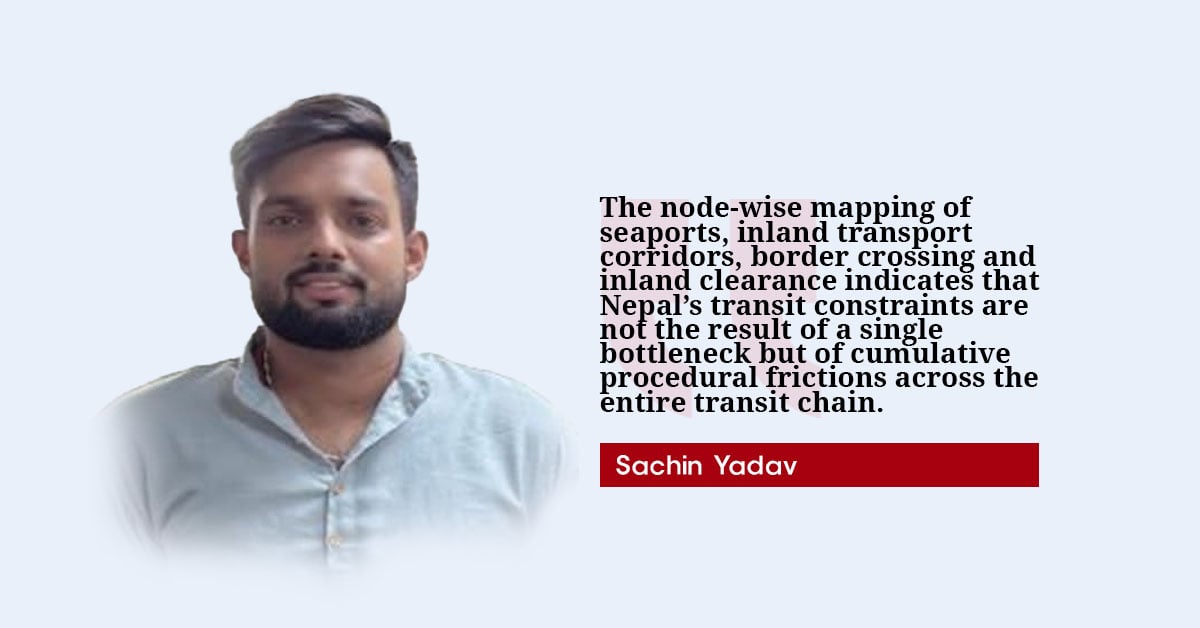
Taken together, the node-wise mapping of seaports, inland transport corridors, border crossing and inland clearance indicates that Nepal’s transit constraints are not the result of a single bottleneck but of cumulative procedural frictions across the entire transit chain.
Policy Pathways
The above node wise analysis shows that both India and Nepal are making constant efforts to advance trade transit structure and Infrastructure but still Nepal faces high trade transit costs. Nepal’s transit costs do not arise from denial of access rather it arise from cumulative procedural delays, which means that even some minor changes to gain more at each node can generate large aggregate benefits.
One of such changes is introducing dwell-time benchmarks and priority evacuation lanes for Nepal bound containers which could reduce average port delays. These priority evacuation lanes for Nepal bounded cargo would not only reduce the delay period but also can save demurrage and detention cost per container.
Another important reform could be shifting a larger share of Nepal bound cargo from road to rail which would yield even larger gains as South Asia is a region where freight costs are lower than the road transport for an equivalent distance.
Some reports also indicate that Inland transit time of landlocked countries like Nepal could be decreased by increasing rail usage for transit cargo, which would reduce the overall logistics cost.
Similarly, further expanding capacity and streamlining procedures at the Sirsiya ICD could also improve the inventory turnover and freeing working capitals for Nepalese firms by reducing the cargo dwell time. This reduction in inland clearance time can also increase the productivity of Nepalese firms as according to an international agency every one day reduction in inland clearance time increases firm level productivity.
Taken together, all these reforms and changes across Indian ports, inland corridors, ICDs and borders could increase Nepal’s export competitiveness and lower Nepal’s overall logistics cost alongside strengthening Nepal’s integration into regional value chains.
Conclusion
While Nepal has maintained a legal transit structure with India through a series of treaties, protocols and infrastructure initiatives, the analysis demonstrates that formal access has not translated into operational and practical efficiency. Instead Nepal’s trade performance and competitiveness continue to be shaped by non tariffs barriers embedded in the everyday operations. The node wise assessment reveals that procedural delays at Indian Seaports, inefficiencies in inland transport corridors, duplication of procedures at border crossings and coordination challenges at clearance depots collectively become a reason to increase trade costs for Nepal. The study also indicates that infrastructure development and legal frameworks alone are insufficient to overcome the trade constraints but merging them with incremental and implementation focused reforms can lower Nepal’s logistics costs and improve trade predictability.
(Sachin Yadav is a Ph.D. scholar in International Studies at Jamia Hamdard, New Delhi With a background in economics and education, his work bridges political economy and geopolitics. His research focuses on India’s strategic partnerships, South Asia, India’s Neighbourhood and Geoeconomics.)