Kathmandu
Wednesday, June 17, 2026





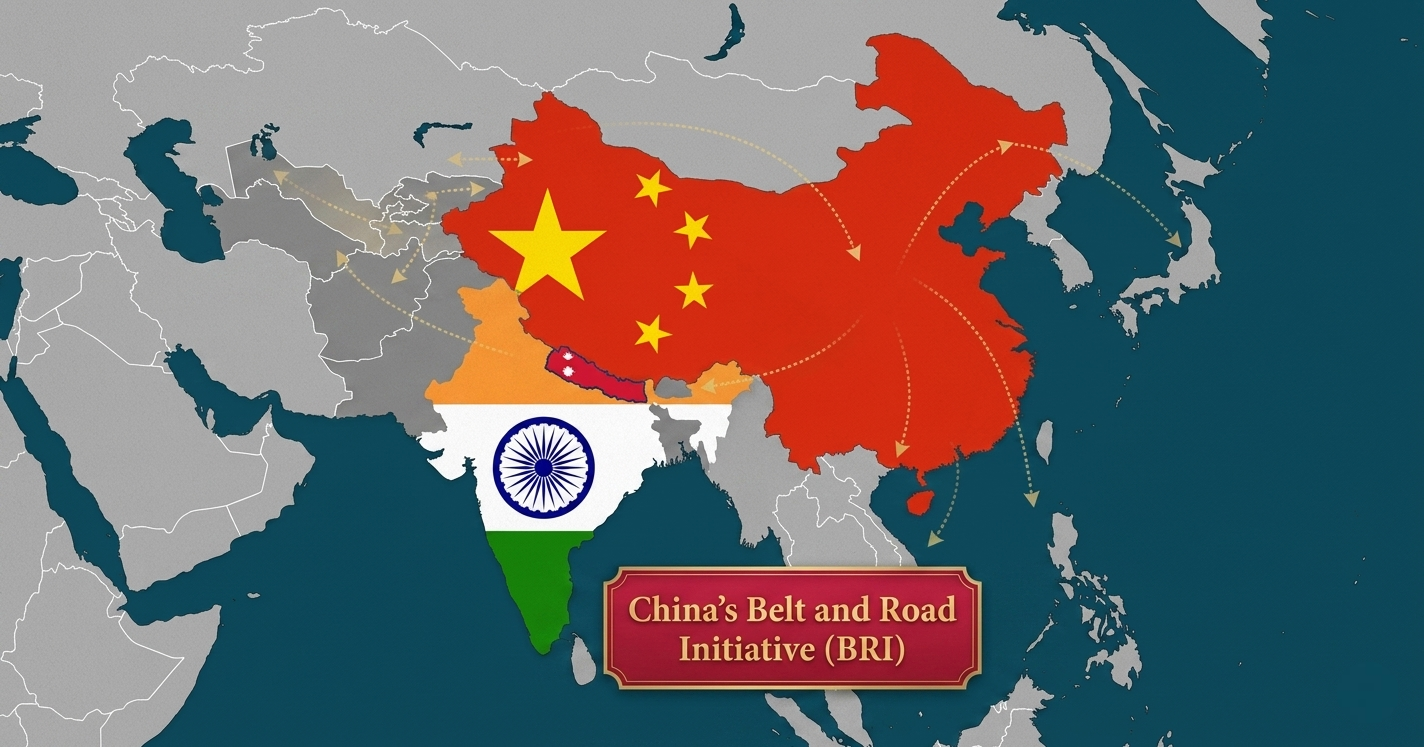
KATHMANDU: Nepal’s new government has fallen conspicuously silent on China’s Belt and Road Initiative (BRI). Despite the strong mandate of the Rastriya Swatantra Party (RSP), Foreign Minister Shisir Khanal’s visit to Beijing signaled continuity rather than change in Kathmandu’s foreign policy. Yet in the official readout after the trip, one word was missing: BRI.
The omission was striking. While Kathmandu emphasized the implementation of previously agreed projects and programs, it avoided any reference to China’s BRI Initiative-the framework under which most major Sino-Nepal infrastructure cooperation has been discussed since the decade.
Beijing, however, left no room for ambiguity. Following talks with minister Khanal, Chinese Foreign Minister Wang Yi stated that China was prepared to work with Nepal to advance a “high-quality Belt and Road Initiative”. Chinese statements framed bilateral cooperation squarely within the BRI framework. Nepal’s did not.
Such diplomatic asymmetry rarely occurs by accident. Kathmandu’s silence reflects the new political realities that have emerged since the upheavals of September 2025 Gen Z protests. Nepal’s foreign policy establishment now operates in a far more sensitive geopolitical environment, where every reference to the BRI is scrutinized not only in Beijing, but also in New Delhi, Washington and increasingly at home.
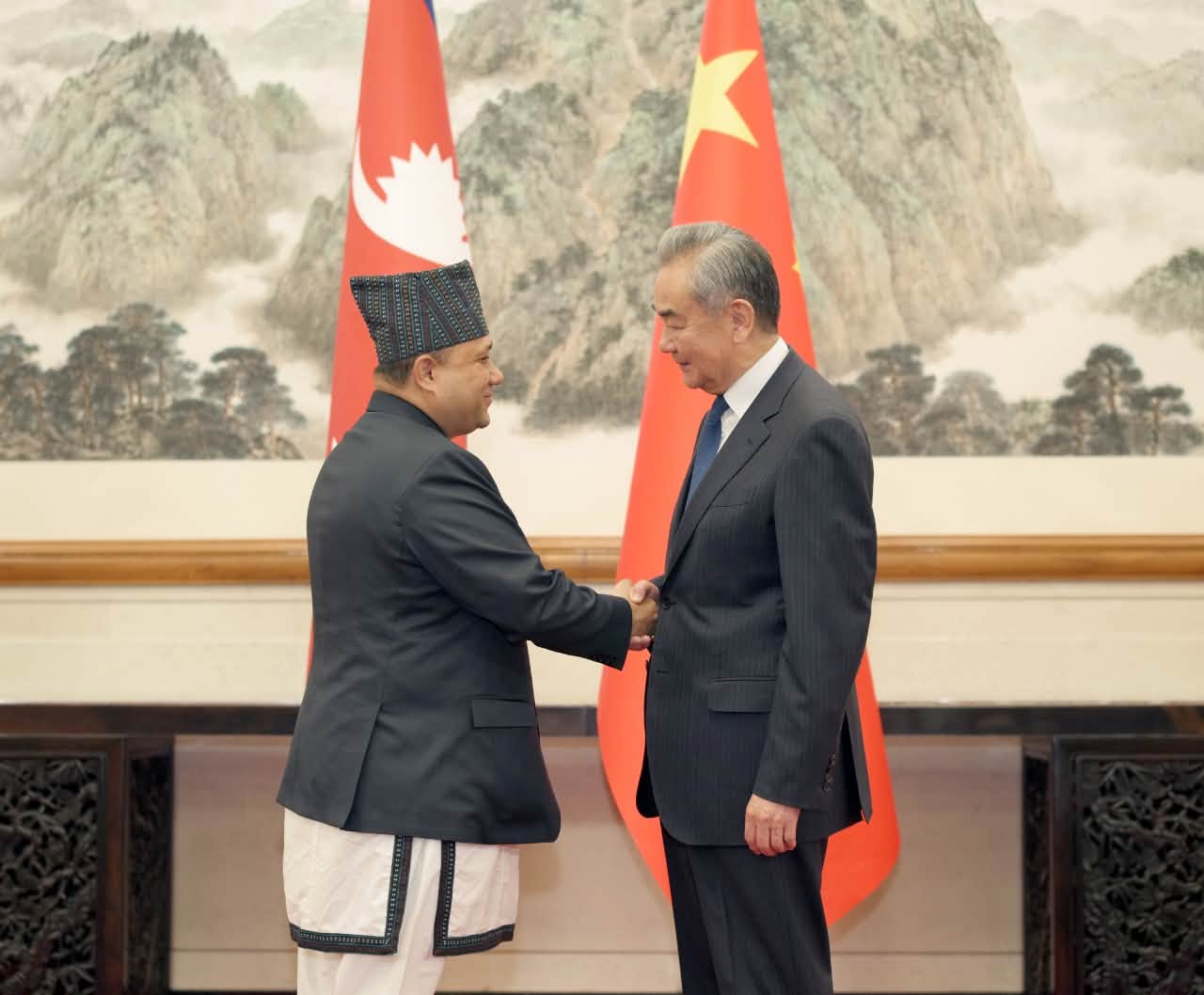
Foreign Minister Shisir Khanal (left) with his Chinese counterpart Wang Yi in Beijing (right). Photo courtesy: Minister Khanal’s social media
The omission appears less a rejection of China than an exercise in strategic ambiguity. Nepal wants to preserve economic cooperation with Beijing while avoiding the political baggage that now accompanies the BRI label. In effect, Kathmandu is seeking Chinese investment without publicly embracing China’s flagship geopolitical brand.
China, for its part, appears willing to tolerate the ambiguity-for now. Beijing continues to view Nepal through a BRI lens and remains committed to projects agreed under that framework. From the Chinese perspective, implementation matters more than terminology. If projects move forward, the absence of three letters in a joint communiqué is unlikely to be decisive.
Yet symbolism matters in diplomacy. Nearly a decade after Nepal joined the BRI, its flagship projects remain largely on paper. Financing mechanisms remain unresolved. Political consensus remains elusive. And despite repeated high-level visits, there was no visible conversation during foreign minister Khanal’s trip on the central question: who pays, and on what terms?
That leaves both sides in a familiar position. China continues to keep the door open. Nepal continues to hesitate at the threshold. For Beijing, the language about implementing existing agreements offers a sliver of optimism. For Kathmandu, avoiding explicit mention of the BRI creates room to maneuver in an increasingly contested geopolitical landscape.
The real test, however, lies beyond diplomatic phrasing. China has shown consistency in its willingness to move projects forward. The unresolved question is whether Nepal’s new political leadership possesses the strategic clarity-and political confidence-to do the same. For now, the relationship is defined by an awkward reality: China still speaks the language of the BRI, while Nepal increasingly prefers not to say the words aloud.
BRI in Nepal: Plenty of agreements, little concrete
China’s Belt and Road Initiative (BRI) in Nepal remains a study in geopolitical ambition colliding with political uncertainty and bureaucratic inertia. Nine years after joining China’s Belt and Road Initiative, Nepal has little to show beyond agreements, studies and diplomatic rhetoric. Successive governments negotiated financing models, debated projects and signed new frameworks, yet implementation barely moved.
Nepal formally joined China’s Belt and Road Initiative (BRI) on May 12th 2017, signing a memorandum of understanding nearly four years after Beijing unveiled the strategy. Kathmandu’s engagement with China’s flagship connectivity project, however, had begun much earlier. The initiative itself evolved from the “Silk Road Economic Belt” to “One Belt, One Road” before being rebranded as the Belt and Road Initiative.
For years, progress remained slow. Political divisions, concerns over debt sustainability and uncertainty over financing modalities prevented the two sides from translating broad commitments into concrete projects.
Screenshot of the official portal of China’s ‘Belt and Road Portal’
Chinese development assistance to Nepal has slowed markedly since 2013, leaving more than Rs 100 billion in pledged aid undisbursed, including Rs 56 billion announced during Xi Jinping’s 2019 visit and Rs 15 billion promised during the Chinese Foreign Minister’s 2022 trip.
The BRI regained momentum during then Prime Minister K.P. Sharma Oli’s visit to China from December 02- 05, 2024. The two countries signed nine memorandums of understanding and, more importantly, the “Framework for Belt and Road Cooperation”, a revised BRI agreement signed on December 3rd, 2024. Unlike the original arrangement, the new framework reflected several of Nepal’s priorities in economic development cooperation.
The agreement identified ten potential projects for future negotiation and established cooperation across five sectors: economic cooperation; financial-sector cooperation; transport, connectivity and logistics; trade, industrial capacity and investment; and customs cooperation. Yet the most contentious issue remained unresolved-how these projects would be financed.
At that time ruling coalition’s two largest parties held conflicting positions. The CPN (UML) favored greater flexibility over financing, while the Nepali Congress insisted that Nepal should not take commercial loans under the BRI. During negotiations, China reportedly proposed several funding options, including blended financing and commercial lending. In the end, neither side secured a complete victory. The final text adopted the broader phrase “aid financing modalities” instead of the “grant financing modalities” demanded by the Nepali Congress, leaving room for differing interpretations after final approval by then Nepali Congress president Sher Bahadur Deuba.
The legally binding framework entered into force for three years, with an automatic extension mechanism. However, it does not specify financing arrangements for individual projects, ensuring that the debate over loans, grants and debt exposure will continue.
From Kathmandu’s perspective, the negotiations secured a temporary compromise that protected immediate political interests. From Beijing’s perspective, the agreement represents another step in a longer strategic process. China typically approaches such frameworks as evolving arrangements rather than final settlements, leaving scope for future negotiations as circumstances change.The BRI has become less an infrastructure programs than a geopolitical balancing act. Beijing sees Nepal as a key link in its Himalayan connectivity ambitions; India views the initiative with suspicion, while Washington remains wary of China’s expanding influence.
Despite renewed commitments under the December 2024 BRI framework agreement, most projects remain trapped in feasibility studies and bureaucratic limbo. Even Chinese diplomats more focused on Tibet, Starlink and American influence than on advancing BRI projects themselves.
The result is a striking gap between ambition and execution. Nearly a decade on, Nepal’s BRI remains what it has long been: a promise repeatedly renewed, but rarely delivered.
Seven years and seven months after Nepal signed the Belt and Road Initiative Memorandum of Understanding in 2017, then Prime Minister K.P. Sharma Oli travelled to Beijing in December 2024 and signed the “Framework for Belt and Road Cooperation”, a move widely portrayed as the long-awaited operationalization of Nepal’s participation in China’s flagship infrastructure program.
Nepal and China also identified 10 priority projects, including strategic roads and tunnels, a cross-border railway, a transmission line, a university, an industrial park, a scientific center, a city hall and sports infrastructure. Yet more than a year later, tangible progress remains elusive.
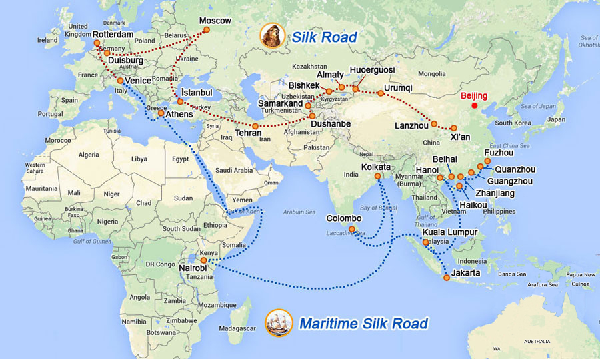
Chronology of China’s Belt and Road Initiative. Photo courtesy: Belt and Road Portal of China
The delay is not merely technical. Geopolitics is deeply intertwined with the fate of Nepal’s BRI projects. New Delhi remains wary of China’s expanding footprint in Nepal and views several BRI-linked projects, particularly cross-border connectivity schemes, with suspicion. For Beijing, meanwhile, Nepal occupies an important position in its broader Himalayan strategy.
Remarkably, even the Nepali Congress, which had long opposed Chinese loans and insisted that BRI projects should be grant-funded, eventually endorsed the framework agreement. The compromise effectively recognized both loans and grants as eligible financing mechanisms under the BRI umbrella in the name of AID, removing one of the biggest political obstacles to the deal in Nepal.
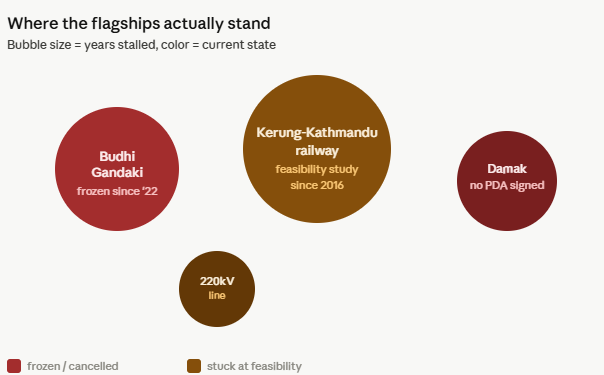
However, the framework has so far delivered more symbolism than infrastructure. Among the flagship projects, the Tokha-Chhahare Tunnel-considered a strategic gateway linking Kathmandu with Kerung in Tibet-remains stuck at the preliminary stage. Nepal insists on completing a feasibility study before conducting an environmental assessment, while China prefers the reverse sequence.
The 95-kilometre Hilsa-Simikot Road, a crucial section of the Karnali Economic Corridor connecting China to Nepalgunj and ultimately the Indian border, has progressed little beyond feasibility discussions. Nepal is still awaiting China’s response regarding motorable bridge construction.
The Kimathanka-Khandbari Road and Bridge project, another strategically important corridor connecting eastern Nepal with Tibet, remains largely conceptual. Although the Nepali Army has opened sections of the track, vehicular connectivity remains absent.
The much-publicised China-Nepal Cross-Border Railway, often described as the crown jewel of Nepal’s BRI ambitions, has also advanced slowly. Pre-feasibility studies have been completed, and a Chinese-funded detailed study is underway. Aerial surveys have been conducted, while drilling and soil testing are expected to continue through 2026.
Similarly, the proposed Kerung-Rasuwagadhi-Chilime 220-kV transmission line, which could eventually facilitate electricity trade between Nepal and China, remains under discussion without a formal implementation agreement.
Even softer infrastructure projects have struggled. The proposed Madan Bhandari University, first discussed during former President Bidya Devi Bhandari’s visit to China, has yet to move beyond debates over its location, shifting from Makawanpur to Kavre without a site inspection.
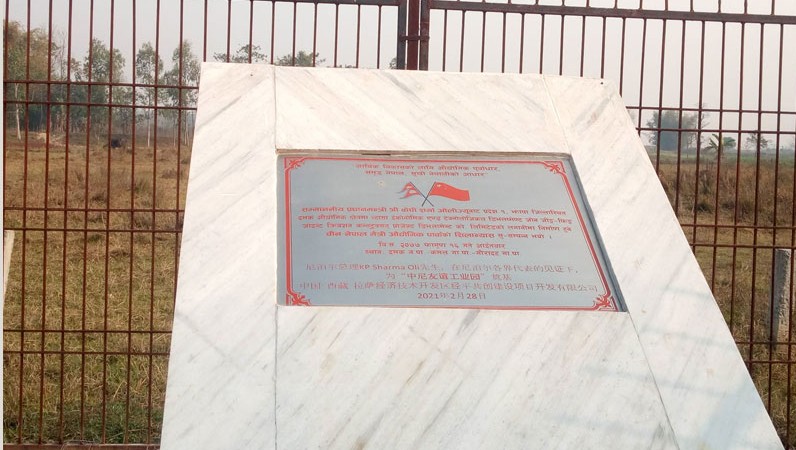
Foundation stone of ‘China-Nepal Friendship Industrial Park in Jhapa.’ File photo
Several projects appear effectively frozen. The China-Nepal Friendship Industrial Park in Jhapa has not progressed despite a foundation stone being laid by then Prime Minister Oli. No Project Development Agreement has been signed. Likewise, the Amaragadhi City Hall, Kathmandu Scientific Centre and Jhapa Sports Complex have seen little more than paperwork, with studies and formal communications yet to begin.
The broader question is whether Nepal’s BRI portfolio is suffering from administrative delays or political uncertainty.
Beijing has traditionally viewed Nepal’s communist forces as more receptive to deeper engagement under the BRI. Chinese policymakers had hoped Nepal’s fragmented communist parties would reunite and return to power, creating stronger political momentum for large-scale infrastructure cooperation. However, successive electoral setbacks and the fragmentation of Nepal’s left bloc have complicated that calculation.
Alongside economic engagement, Beijing has deepened ties with Nepal’s political establishment through party-to-party exchanges, leadership visits and training programs. These efforts are designed to shape policy dialogue, strengthen political networks and advance Chinese interests. Beijing has long viewed Nepal’s leftist parties as particularly receptive partners in pursuing those goals.
Nearly a decade after Nepal joined the BRI, the initiative remains defined less by completed projects than by feasibility studies, negotiations and unrealized expectations. The gap between diplomatic announcements and physical infrastructure continues to be strikingly wide.
Why China’s BRI has stalled in Nepal?
For nearly a decade, Nepal was supposed to be one of the Belt and Road Initiative’s showcase projects in South Asia. Instead, it has become a case study in how grand geopolitical ambitions can collide with domestic politics, institutional weakness and shifting regional realities.
When Nepal signed up to China’s Belt and Road Initiative (BRI) in 2017, expectations were high. Beijing envisioned the Himalayan nation as a strategic bridge between China and South Asia. Nepali leaders imagined railways crossing the Himalayas, modern highways, industrial zones and a transformation of the country’s chronic infrastructure deficit.
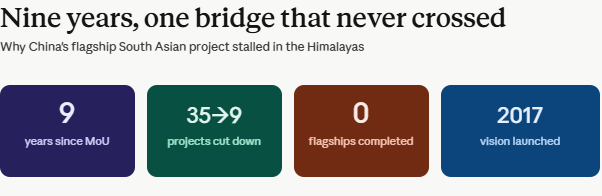
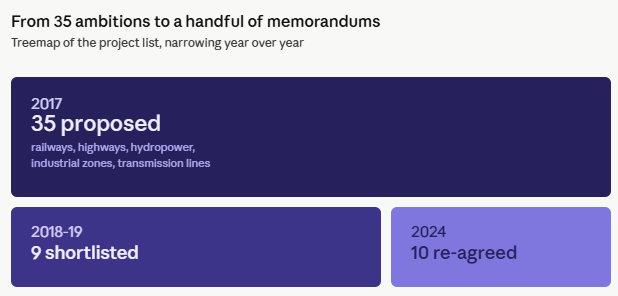
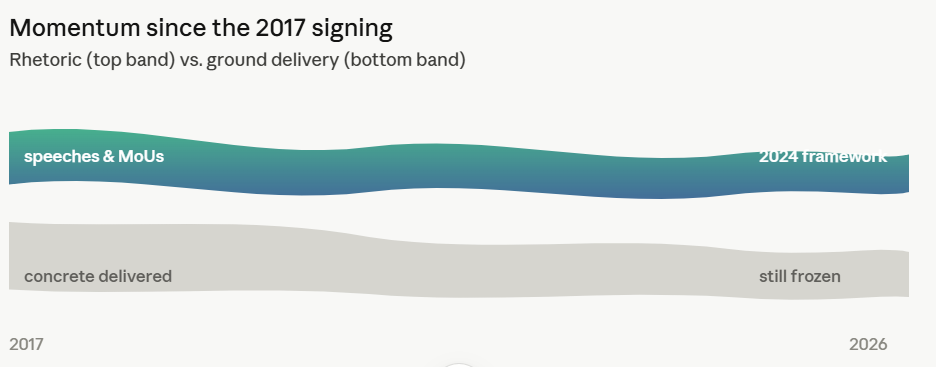
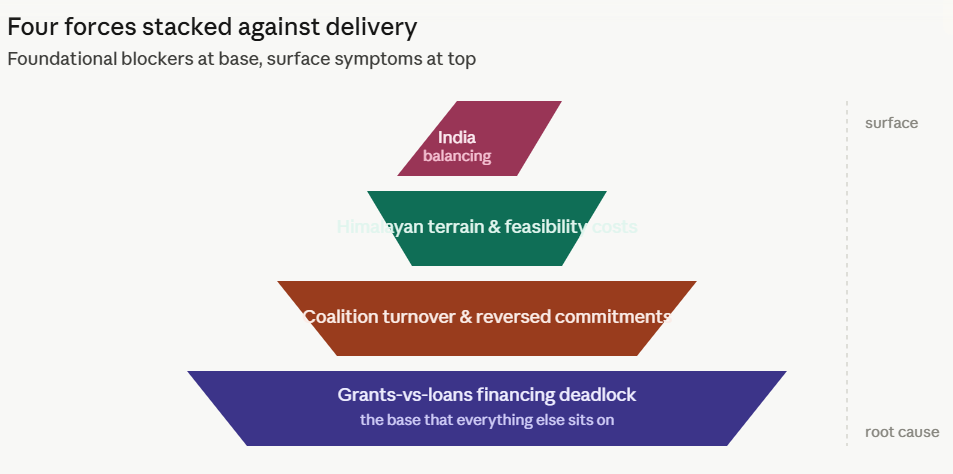
Nearly nine years later, little of that vision has materialized and now heading into more confusing direction.
The BRI remains more visible in speeches, memorandums and diplomatic communiqués than in concrete and steel. Despite repeated visits by senior leaders, numerous agreements and ambitious announcements, Nepal has yet to see a major flagship BRI project move substantially beyond the planning stage. The question is no longer why Nepal joined the BRI. It is why the initiative has struggled so profoundly to advance.
The answer lies in a combination of strategic miscalculations, domestic political fragmentation, geopolitical competition and growing public skepticism.
A strategic vision without strategic clarity
China’s interest in Nepal has never been merely economic. Under the BRI framework, Nepal occupies a unique geographical position. Beijing views the country as an important component of its broader effort to improve connectivity across Asia and potentially gain greater access to South Asian markets. Projects such as the proposed Trans-Himalayan Multi-Dimensional Connectivity Network, including the much-discussed Kathmandu-Kerung railway, fit neatly into this strategic vision.
For China, Nepal offers both economic and geopolitical value. It can serve as a transit corridor, strengthen Beijing’s influence in South Asia and reduce Kathmandu’s traditional dependence on India.
Yet while China’s objectives have generally remained consistent, Nepal’s own goals have often appeared unclear.
Successive governments embraced the BRI rhetorically but failed to undertake the technical, financial and legal groundwork necessary to implement major projects. Policymakers frequently treated the BRI as a source of unlimited infrastructure financing rather than as a complex strategic framework requiring careful negotiation and planning. The result was predictable. Expectations soared while implementation lagged.
Nepal never developed a coherent BRI strategy
One of the most significant obstacles has been Nepal’s inability to formulate a comprehensive national strategy regarding China. There remains limited understanding among policymakers, political parties and even most of the bureaucracy or security establishment about what the BRI actually represents. Originally promoted as a connectivity initiative, the BRI has evolved into one of China’s most important foreign-policy instruments, carrying economic, strategic and geopolitical implications far beyond infrastructure development.
Nepal entered the framework without fully assessing these implications. Questions regarding financing models, debt sustainability, procurement procedures, strategic consequences and implementation mechanisms were often left unanswered. Negotiations repeatedly stalled because Kathmandu itself lacked consensus about what it wanted from the initiative.
Rather than defining national priorities first and seeking Chinese support for them, Nepal frequently allowed discussions to revolve around Chinese proposals. This imbalance weakened Nepal’s negotiating position and contributed to years of uncertainty.
Political parties cannot agree
If China expected ideological affinity with Nepal’s communist parties to accelerate BRI implementation, it misread the country’s politics. The BRI has become one of Nepal’s most divisive foreign-policy issues.
With traditional parties losing ground, Nepal’s new political forces-led by the Rastriya Swatantra Party (RSP)-have taken a more cautious line on the BRI, demanding transparency, financial accountability and clear project terms.

The Nepali Congress, the second largest party in Nepal has traditionally expressed reservations about Chinese loans and debt-financed infrastructure. Communist parties, particularly the CPN (UML) and Maoist factions, generally displayed greater enthusiasm. Other parties have introduced additional skepticism regarding governance, transparency and debt risks.
Even within individual parties, positions have frequently shifted depending on whether leaders were in government or opposition.
As a result, every change of government has brought new uncertainty over China’s BRI in Nepal. Few major infrastructure projects can advance when political consensus evaporates every few months. Investors become cautious. Bureaucrats become reluctant. Negotiations slow. The BRI increasingly became a political symbol rather than a development program.
The shadow of debt
No issue has generated more public concern than financing. The experience of countries such as Sri Lanka has profoundly shaped Nepal’s debate over the BRI. Critics frequently point to the Hambantota Port episode as a warning about excessive borrowing and strategic vulnerability.
Whether such comparisons are entirely accurate is almost beside the point. Public perceptions matter. Large-scale infrastructure projects involving billions of dollars naturally raise concerns in a country with limited fiscal capacity. Questions about commercial loans, interest rates, repayment schedules and long-term economic viability remain politically sensitive.
Successive governments struggled to explain how expensive projects-particularly the proposed trans-Himalayan railway-could generate sufficient economic returns. Without convincing answers, caution increasingly replaced enthusiasm.
Geopolitics complicates everything
Nepal’s location between two Asian giants has always shaped its foreign policy. The rise of China has complicated this balancing act. India views Nepal as part of its traditional sphere of influence. The United States increasingly sees the region through the lens of strategic competition with China. Beijing, meanwhile, seeks deeper engagement with Kathmandu.
The result is that almost every major Chinese project acquires geopolitical significance. Infrastructure proposals that might otherwise be evaluated on economic grounds become entangled in broader strategic calculations. The Kathmandu-Kerung railway, for example, is viewed by many not merely as a transport project but as part of China’s larger regional ambitions.
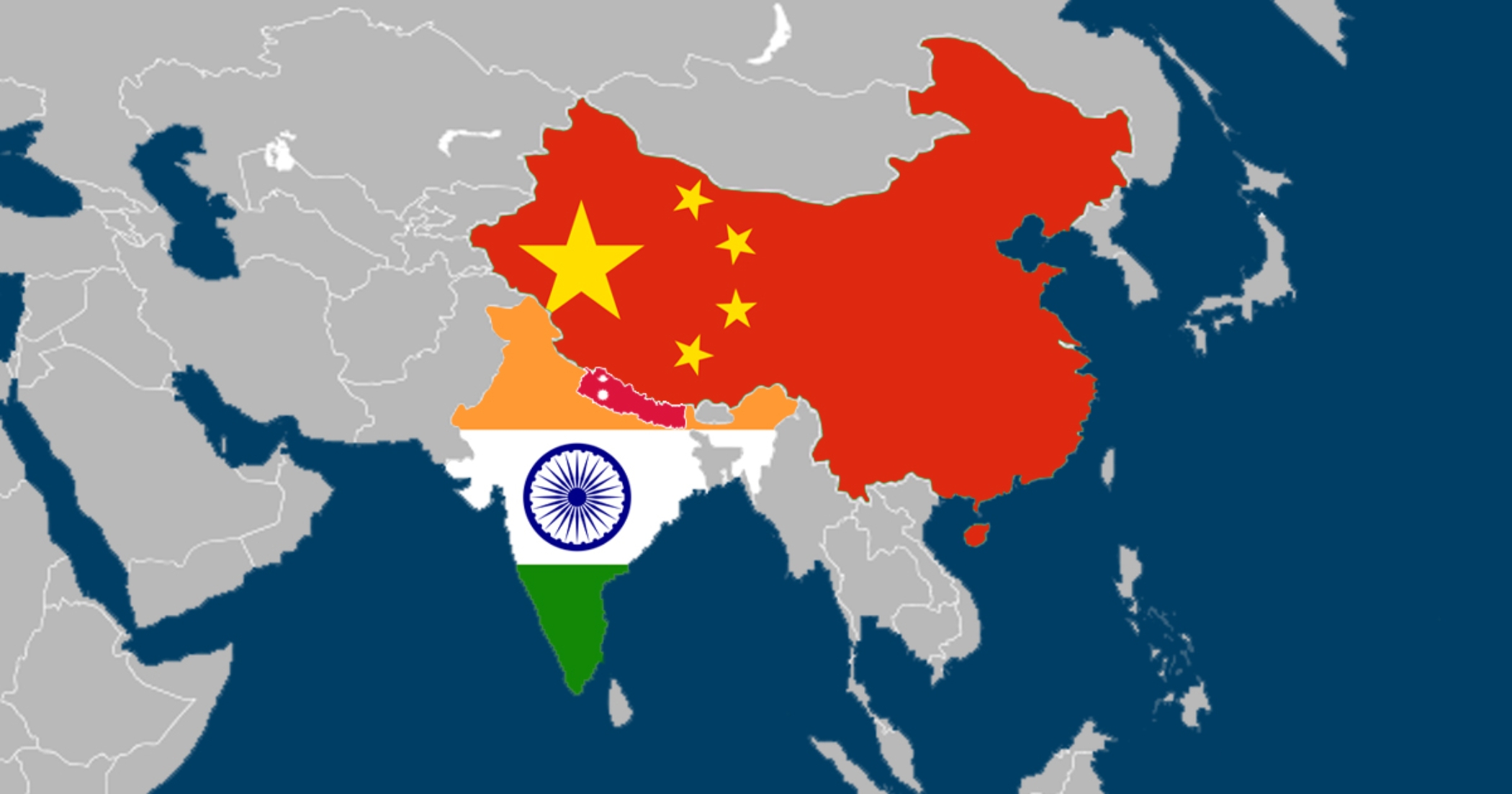
Photo courtesy: Khabarhub.com
Nepal consequently finds itself under pressure from multiple directions. Rather than focusing solely on development needs, policymakers must constantly weigh the geopolitical implications of major decisions. This dynamic has repeatedly slowed BRI implementation.
China’s own contradictions
Ironically, some obstacles have emerged from Beijing itself. China promotes regional connectivity and economic integration. Yet its unilateral border closures and restrictive border-management decisions have occasionally generated frustration in Nepal.
For a landlocked country dependent on cross-border trade, predictability matters. When borders can be closed with little consultation, questions naturally arise about the reliability of future connectivity projects. Such episodes have reinforced arguments that Nepal should pursue greater transparency and reciprocity in its relationship with China rather than relying on assumptions of strategic partnership.
Institutional weakness in Kathmandu
The BRI’s slow progress also reflects a deeper problem: Nepal’s weak state capacity. No dedicated institution has existed to coordinate BRI-related negotiations, evaluate projects and oversee implementation. Responsibilities are dispersed across ministries and agencies, creating confusion and bureaucratic delays. Decision-making often depends more on political personalities than on institutional processes.
This fragmentation has made it difficult to maintain continuity. Chinese officials frequently complain about slow procedures. Nepali officials complain about changing proposals and unclear financing arrangements. Both criticisms contain elements of truth. The consequence has been paralysis.
Transparency deficit
Another major weakness has been the lack of public debate. Many BRI-related discussions have occurred behind closed doors. Project details, financing arrangements and implementation plans have often remained opaque. This secrecy has fueled suspicion.
Critics argue that agreements affecting future generations should be subjected to parliamentary scrutiny and public consultation. Supporters counter that excessive politicisation delays development.
Yet transparency is not an obstacle to successful projects; it is often a prerequisite. The absence of open discussion has undermined public trust and strengthened opposition narratives.
The shock of political upheaval
The youth-led anti-corruption movement that erupted in September, 2025 has created additional uncertainty for BRI projects implementation. It represented a profound challenge to Nepal’s established political order. Unlike previous movements organized around political parties or ideological agendas, the protests emerged from digitally connected networks of young citizens frustrated by corruption, patronage and elite impunity.
The unrest fundamentally altered Nepal’s political landscape as well engagement with China. Many established political actors found themselves discredited. Traditional party structures appeared vulnerable. Foreign powers accustomed to working through familiar political networks suddenly faced a much less predictable environment.
For Beijing, this created particular difficulties. China has historically invested heavily in relationships with political parties, government institutions and established elites. Rapid political upheaval disrupted many of those channels simultaneously. The result was not necessarily anti-China sentiment. Rather, it was growing uncertainty about who would shape Nepal’s future political direction.
Pokhara International Airport and the corruption cloud
Nothing has damaged the image of Chinese-funded infrastructure in Nepal more than controversies surrounding Pokhara International Airport. Originally promoted as a symbol of Nepal-China cooperation, the airport has increasingly become associated with allegations of financial irregularities and cost inflation. China has been claimed it is part of BRI project.

Pokhara International Airport. File photo
Investigations by anti-corruption authorities and parliamentary committee have generated intense scrutiny of the project. Allegations involving procurement practices, consultancy expenses and inflated construction costs have received widespread attention.
The legal process remains ongoing, and courts-not commentators-will determine culpability. Nevertheless, the political damage is already substantial. For many Nepalis, the controversy reinforces concerns about transparency, accountability and governance in large foreign-funded projects. For Beijing, it represents an unwelcome challenge to the narrative that BRI infrastructure automatically delivers developmental benefits.
Beijing’s diminishing leverage
China’s frustration increasingly reflects a broader reality. Over the past decade, Beijing has sought greater influence in Nepal across politics, economics, diplomacy and security cooperation. Progress has been limited now. Even in past China failed to prevent the ratification of the American Millennium Challenge Corporation compact. India has still retained significant influence within Nepal’s political and security establishments. Major BRI projects remain stalled.
Meanwhile, Nepal’s political environment has become increasingly unpredictable for China. The assumption that closer diplomatic relations would automatically translate into strategic alignment has proven incorrect. Nepal continues to pursue its traditional strategy of balancing external powers rather than choosing sides.
The future of the BRI in Nepal
The BRI is unlikely to disappear from Nepal’s foreign-policy agenda. Beijing continues to express support for cooperation. Infrastructure needs remain immense. Economic connectivity with China retains long-term appeal. Yet the era of China grand expectations in Nepal appears over.
Future progress will depend less on diplomatic symbolism and more on practical realities: transparent financing, economically viable projects, stronger institutions and broader political consensus. Nepal’s challenge is to engage China without compromising autonomy, accumulating unsustainable debt or becoming trapped in geopolitical rivalries.
China’s challenge is equally significant. Beijing must recognize that influence cannot be built solely through infrastructure promises, elite relationships or political lobbying. Sustainable partnerships require transparency, trust and responsiveness to local concerns.
For now, the Belt and Road Initiative in Nepal remains suspended between ambition and reality-a reminder that geography may be permanent, but geopolitical influence is never guaranteed.