Kathmandu
Tuesday, June 16, 2026





Despite allocating nearly Rs 65 billion to defense, Nepal still relies on costly helicopter rescues for women facing childbirth complications in underserved regions.
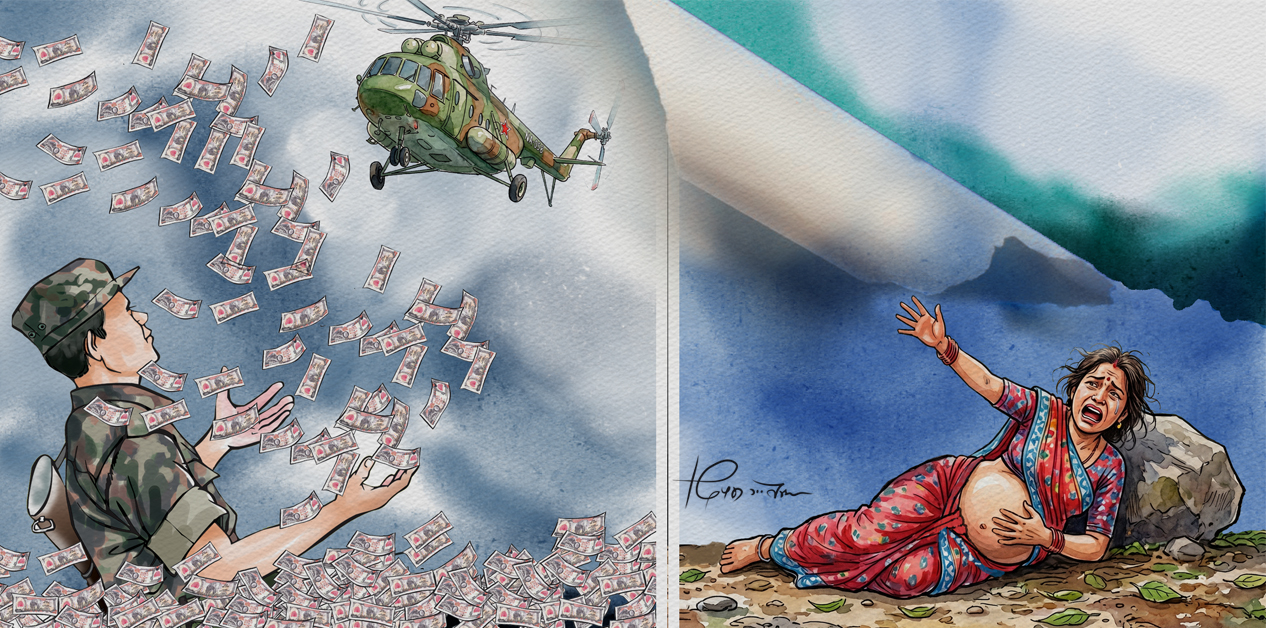
On May 24, 2026, maternal life became a struggle between life and death for 30-year-old Sabita Magar of Khandbari Municipality-7, Sankhuwasabha. After going into labor, she was admitted to the District Hospital. Following a cesarean delivery the next morning, she began bleeding profusely. Her condition became critical.
Since further treatment was not possible at the District Hospital, a free aerial rescue was arranged under the President’s Women Advancement Program. A Nepal Army helicopter immediately transported her to the Paropakar Maternity and Women’s Hospital in Thapathali, Kathmandu. Thanks to the timely air rescue and treatment at a well-equipped hospital, Magar’s life was saved.
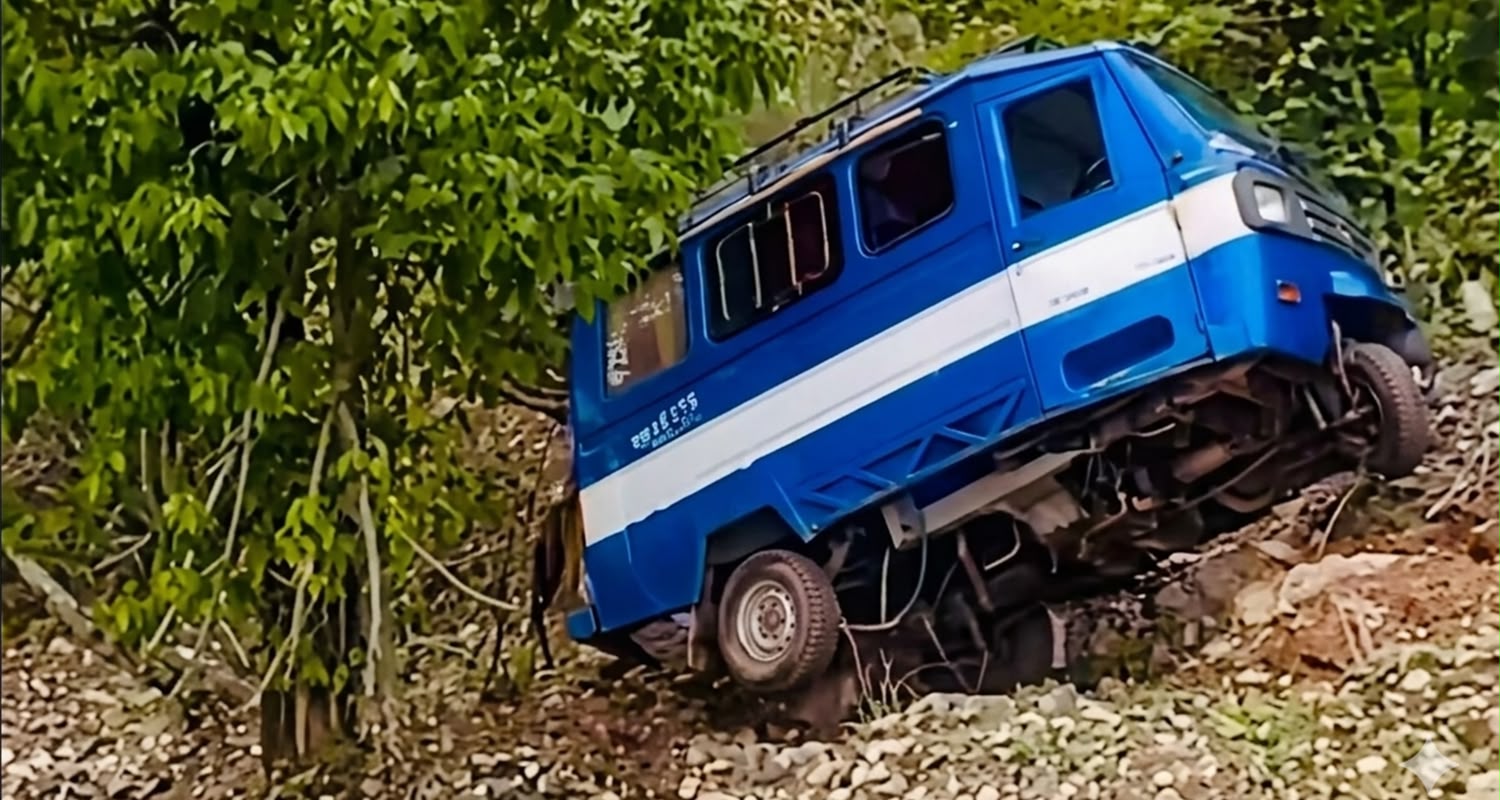
However, not everyone in labor is fortunate enough to receive the facilities Sabita did. Numerous women in western Nepal have lost their lives due to a lack of timely treatment and access to air rescue. On January 6, 2025, 31-year-old Khina Bohara of Dudil, Kedarasyu Rural Municipality-1, Bajhang, died when she failed to receive timely medical care. After going into labor at 3 AM, she gave birth on the way while being rushed toward the Deura Primary Health Center. By the time an ambulance equipped with medical supplies arrived from the health center, the condition of both mother and infant had already become critical. Both passed away before reaching the hospital.
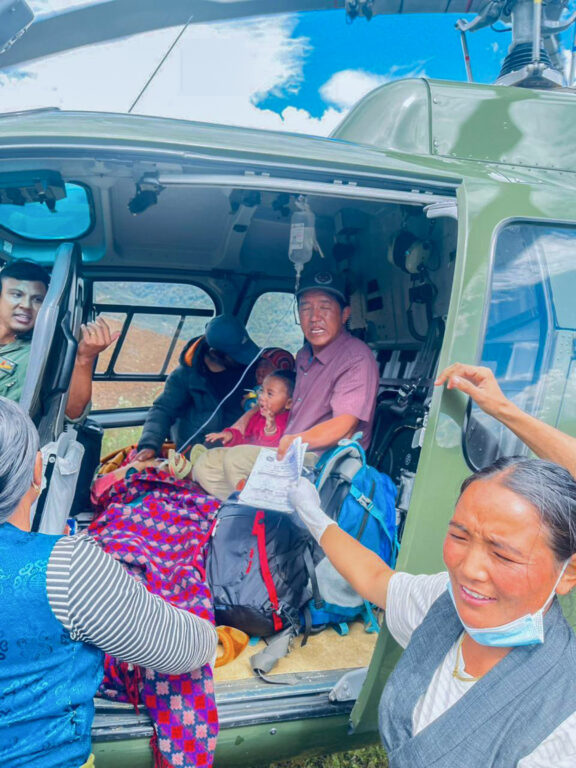
Caption: A Nepal Army helicopter rescuing a pregnant woman from Hunghung, Bhotkhola Rural Municipality-3, Sankhuwasabha. Photo: Bhabin Karki/RSS
On October 2, 2024, 29-year-old Saritadevi Jaisi of Dhakari Rural Municipality-6, Achham, died due to excessive bleeding. After going into labor at midnight, she gave birth on the way while being taken to the Dhungachalna Health Center. Following delivery, she began hemorrhaging. When she was finally brought to the health center, it lacked the necessary equipment and skilled manpower. By the time she was transported to the District Hospital in the district headquarters of Mangalsen, she had already passed away.
These maternal deaths are not exceptions; giving birth remains a perilous process in Nepal’s remote rural areas. Even basic maternity services have failed to reach the villages. Out of 77 districts, more than half do not have reliable hospitals capable of providing maternity care in their rural sectors. To rescue pregnant women and new mothers whose lives are endangered due to a lack of treatment in remote areas, the government has been operating a free air rescue service through the “President’s Women Advancement Program” since 2018.
Under this program, women who might otherwise lose their lives due to untreated labor complications are rescued by Nepal Army helicopters and flown to well-equipped hospitals.
In Nepal, there are 18 districts where the free air rescue program for pregnant women and new mothers is fully implemented, and 29 districts where it is partially implemented. Even districts considered relatively accessible, such as Ilam, Udayapur, and Dhankuta, fall under the partially implemented list. From provincial governments to the federal government, the focus is not on constructing high-quality hospitals for safe childbirth across all regions or making existing hospitals reliable, but rather on promoting air rescue schemes.
According to the Nepal Army, 136 mothers were rescued from 23 districts in the fiscal year 2024/25. In the fiscal year 2025/26, up until June 2, 2026, 86 mothers in labor have been airlifted from 23 districts.
Obstetrician and Gynecologist Dr. Jageshwor Gautam states that while the helicopter rescue program for pregnant women and new mothers is humane and effective, it should not be considered a sustainable solution. “The state ought to build hospitals capable of delivering babies in every locality, but it has paid no attention to this,” says Dr. Gautam, who retired from the Ministry of Health in 2022.
Even the government led by Balendra Shah, formed after the Gen Z protest, has not prioritized structural improvements in maternal and neonatal health services in remote areas. Instead of expanding hospitals, specialist personnel, and necessary equipment capable of providing safe local or district-level treatment for obstetric complications, the government’s emphasis appears heavily weighted toward air rescues. While presenting the budget for the upcoming fiscal year 2026/27 on May 29, 2026, Finance Minister Swarnim Wagle announced the operation of air ambulance services in the districts of Karnali. A special budget has been allocated for the aerial rescue of pregnant women, new mothers, and newborns. This shows that the government remains focused on short-term fixes rather than long-term measures to elevate Karnali’s health status.
Dr. Gautam notes that the air rescue service is merely an alternative, not a long-term solution to the problem, and it will not always work. “It is impossible to rescue every mother facing health complications via helicopter. Weather conditions, geographical difficulties, flight availability, and administrative procedures can cause delays in rescue operations,” he says.
Indeed, making air rescue the primary strategy without ensuring safe delivery services, blood transfusions, surgical facilities, and the availability of specialist health workers in remote regions looks like a policy centered purely on immediate crisis management. Safe childbirth cannot be guaranteed without working on long-term healthcare reforms. For instance, Magar was saved by a helicopter rescue in Sankhuwasabha, but that same facility could not reach Bohara in Bajhang.
These two incidents demonstrate that Nepal’s maternal health system is still grappling with stark inequalities in access, infrastructure, and geography.
Official government statistics themselves reveal that the state does not prioritize healthcare as needed. According to Bhakta Bahadur KC, Information Officer at the Ministry of Health and Food Hygiene, the sanctioned posts for physicians in hospitals nationwide stood at 1,212 in 1991. In 35 years, the number of physician posts has not been increased. Recently, the government added 977 posts for doctors and nurses to work within the federation and its subordinate agencies. According to him, a total of 2,315 physician positions are required under the Ministry of Health.
There are 7,889 government hospitals across the country. Since 1991, 30 governments have come and gone in the country. Yet, increasing the number of doctors to provide citizens with smooth health services has never become a government priority. Dr. Gautam says, “The Health Ministry has approved Organization and Management (O&M) surveys ten times stating the required positions and sent them to the Ministry of Finance. Finance routinely blocks them, claiming there is no budget. If just 10% of the total health budget were allocated properly, positions and hospital facilities could be upgraded. The budget provided nowadays is simply not enough.”
Since 1991, civil service positions have increased by 33,378. The size of the Nepal Army has doubled. The military has taken a massive leap not only in terms of numbers but also in terms of budget. Even the government of the Rastriya Swatantra Party (RSP)—which came to power with a mandate of nearly a two-thirds majority following the Gen Z protest—could not break the traditional pattern of defense spending. Questions are frequently raised about the tendency to pour budgets into defense matters without justification, rather than investing in health infrastructure and manpower in a country where citizens must wait for helicopter rescues when complications arise during childbirth.
In the budget for the fiscal year 2026/27, the government has allocated Rs 64.96 billion to the Ministry of Defense. The lion’s share of the defense budget is spent on the Nepal Army. Similarly, the Ministry of Home Affairs has a budget of Rs 107.95 billion. This budget is distributed within the Home Ministry among the home administration, Nepal Police, Armed Police Force, border security, and the Department of Immigration. Within the Home Ministry’s budget, the Nepal Police receives Rs 65.00 billion. This amount, falling to the Nepal Police who are deployed 24 hours a day across 77 districts, is NPR 5 billion more than the army’s budget. During the Gen Z protest, 459 police offices were partially or completely arsoned and vandalized. The police budget was increased because most of these office buildings became unfit for long-term occupation.
The police almost always complain about budget shortages. Stating that fuel expenses are insufficient for 24-hour duties, they frequently appeal to local levels and donors for help.
In the budget formulation process, resource allocation appears to be driven by the balance of power rather than policy debates. Statistics show that the budget for the army, which largely remains in the barracks, increases year after year. In the current fiscal year, the defense budget rose by nearly Rs 3 billion. In the previous fiscal year 2025/26, the defense budget was Rs 62.01 billion.
Budget trends and historical military spending
In 1983, the government’s defense budget was Rs 392.39 million. During the Panchayat era, when open political activities were prohibited, the army was the government’s top priority. Four years later, in 1987, the government increased the defense budget by 74.4% to reach Rs 684.4 million. The military budget growth did not stop during the Panchayat. In 1988, it increased by 15.7% to hit Rs 791.46 million. By 1989, during the first People’s Movement, the defense budget reached Rs 905.7 million.
After the collapse of the Panchayat regime and the onset of the multi-party system, the Maoist armed conflict began in 1996. The defense budget spiked by 171.7% compared to the Panchayat-era budget, reaching Rs 2.15 billion. As the Maoist insurgency intensified, the army was deployed to neutralize it. In 2001, the defense budget doubled to reach Rs 4.52 billion.
By 2002, the defense budget increased by 91.7% to stand at Rs 7.28 billion, at a time when the country’s total national budget was around Rs 96 billion. Within three years, by 2005/06, the defense budget crossed Rs 10 billion, with an average growth rate hovering around 15–18%.
By 2026, the army’s budget has increased nearly ninefold compared to the conflict period. This year, 99% of the budget allocated for defense will be spent on the army itself. Comparing the last eight years, 99% of the Ministry of Defense’s budget remains concentrated on the Nepal Army. Kedar Bhakta Mathema, former Vice-Chancellor of Tribhuvan University, remarks, “I don’t know much about the army, but in a country with a socialism-oriented constitution, it is a matter of shame that we must wait for air rescues for a basic treatment like childbirth.”
According to him, a socialist country’s priority should be basic needs like education and healthcare. “Private sector intervention is growing in these areas, and wide inequalities exist; shouldn’t the state think about this? Today, 30% of children attend private schools, while public schools are shrinking. Is this a socialist policy?” he questions.
Security expert Shobhakar Budhathoki points out that although questions are repeatedly raised regarding the justification for increasing military expenditure in a peaceful country like Nepal, state organs remain intimidated by the army. He notes that since the peace agreement, there has been a complete lack of discussion and debate on why the military budget continues to grow. “At a time when the state’s regular expenditure is rising, the justification for the expenses of security organs confined to barracks must be clarified. In Nepal, individuals in power do not have the courage to review the army’s benefits and facilities.
The Defense Minister does not even possess the stature to call the Army Chief for an explanation,” he says. “After the peace agreement, issues regarding the restructuring of the army were raised, but they faded away. The army continues to operate in the same manner as it did when ruled by the King during the Panchayat.”
Another security expert, Deepak Prakash Bhatta, notes that the Ministry of Defense has become nothing more than an agency that manages the army’s budget. He sees a pressing need for the restructuring of the Ministry of Defense itself. “Rather than simply stating that the army took this much or that much budget, the restructuring of its parent institution, the Ministry of Defense, seems necessary,” he states. “Whoever has gone into the Ministry of Defense as minister has merely been utilized for the financial management of the army; no effort on their part is visible regarding the modernization of the military.”
Rising expenditures in a conflict-free country
When the Maoist war was at its peak, the government increased the military budget annually under the guise of strengthening the army. Following the Comprehensive Peace Accord, a transitional period began. It was expected that some balance would return to the army’s budget. However, that did not happen. Instead, from 2009/10 onward, the defense budget began to rise rapidly. In 2011/12, the army’s budget crossed Rs 21 billion. With the practice of federalism, state structures were reorganized, but the army’s budget was not restructured accordingly. Instead, from the second Constituent Assembly in 2013/14 to the promulgation of the new constitution through 2017/18, the army’s budget expanded from Rs 26 billion to Rs 43 billion. Since the fiscal year 2018/19, it has become explicitly clear that the budget earmarked under the Ministry of Defense is entirely allocated for the Nepal Army alone.
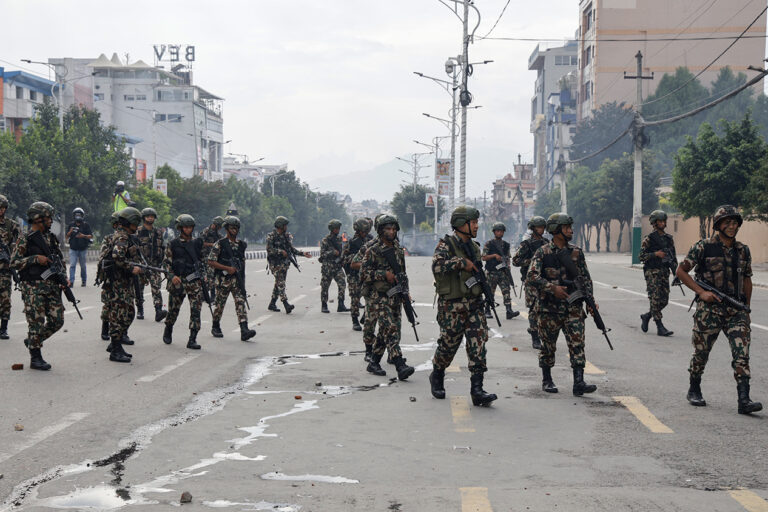
The army deploying to the streets on September 8, the first day of the Gen Z protest. Photo: Bikram Rai
Democracy arrived in Nepal after 2006, and the Royal Nepalese Army was transformed into the Nepal Army. When the warring Maoists joined the peace talks, their military cadres were integrated, increasing the army’s manpower. Before the Maoist war began, the army had a force of 45,000. During the conflict, this was increased to 93,000. When the country transitioned to a federal structure and reorganized across all seven provinces, the army’s size grew by another 3,000. Currently, the Nepal Army has 96,000 sanctioned positions.
During the Gen Z protest, the Nepal Army did not have to step out of its barracks except for two days to bring the country’s situation under control. Yet, the army did not emerge untarnished regarding its role during the Gen Z protest. Budhathoki states that while national property was being torched and destroyed, the army failed to exercise even minimum discretion to protect it. He adds, “By citing a lack of jurisdiction and orders, the army was found failing to fulfill its responsibility; it showed no basic institutional prudence.”
No attention to defense systems
The defense budget rises annually, but the question of how much this growth has modernized the Nepal Army remains unanswered. Globally, military strength is no longer measured solely by troop numbers or conventional weaponry. Drones, Artificial Intelligence, cybersecurity, satellite surveillance, and missile defense systems have become the new benchmarks of a modern military. Looking at Nepal’s defense budget, the army’s priority remains fixed on buildings, barracks, and physical structures.
Even without a war to fight, the Nepal Army’s defense mechanism is not technology-driven. The budget includes provisions to run new research and development programs to increase technological self-reliance. However, investment in research and technological development appears negligible. In the current year’s budget, the army’s research and development expenditure is a mere Rs 4 million. Meanwhile, Rs 1.24 billion is allocated for information systems and equipment procurement.
Nepal’s neighboring nations, India and Pakistan, are in a continuous race regarding military strength and technology. Both nations are increasing investments in cutting-edge tech to meet modern-day challenges. Similarly, the recent warfare involving the US-Israel and Iran highlighted the significant use of modern tech like drones and missile systems.
Nepal’s security challenge is not a conventional war like that of India or Pakistan, nor is there a risk of missile attacks like those facing Israel or Iran.
Experts point out that Nepal’s major security challenges include border security, cybercrime, critical infrastructure protection, airspace surveillance, natural disasters, and strategic information management. To counter such challenges, investments in drone surveillance, cyber defense centers, AI-based security analytics, border surveillance systems, satellite data utilization, and disaster response technology would be far more effective. The technologies the Nepal Army claims to have developed include Real-Time Patrol Monitoring Systems, spy cameras, CCTV, Smart Eye, and drones, which only serve basic surveillance roles. Telemedicine and thermal detectors were put to use for health screening services only after the COVID-19 pandemic.
The technology the army is currently working on includes a Vehicle Tracking System for ‘location tracking’. Similarly, the army utilizes disaster response gear during calamities like floods, landslides, and earthquakes, alongside technologies like mobile hospitals. According to Budhathoki, Nepal does not need to become an aggressive military power like India, China, Israel, or Pakistan. Instead, it needs to qualitatively strengthen its limited manpower and resources using technology based on the concept of ‘smart defense’. Research, cybersecurity, drones, surveillance systems, border monitoring tech, disaster response tools, and AI-driven security analysis would assist in military modernization.
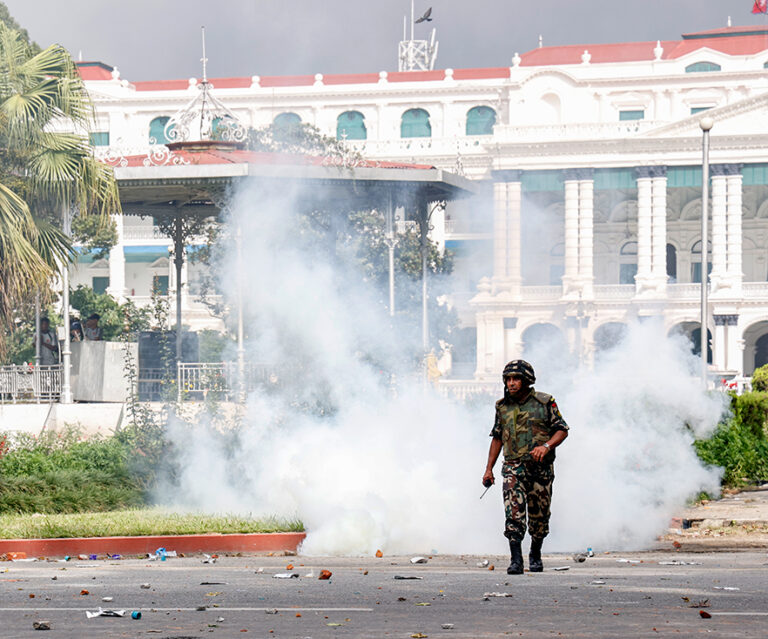
The Nepal Army in front of Singha Durbar on the second day of the Gen Z protest. Photo: Bikram Rai
Military Spokesperson Brigadier General Rajaram Basnet argues that the army is gradually being made tech-friendly. He states, “To modernize the army in keeping with the times, it is being made more tech-friendly; weapon procurement has not been a priority in recent times.” Basnet contends that the army utilizes adequate new technology to work across 12 national parks and two wildlife reserves for nature conservation.
Nepal is one of the world’s leading contributors of troops to United Nations peacekeeping missions. The army maintains that it requires a budget for training, equipment, and preparation in accordance with international standards before deployment to peace missions.
However, the army does not appear to prioritize its own modernization. This time, the army has allocated only Rs 5.66 billion for development-oriented capital expenditure. The army has focused more on programs like “Bunker to Barracks” to convert temporary bunkers and structures into managed barracks. Yet, these actions are structural maintenance rather than integral components of modernization. Budhathoki remarks, “In this era, securing society and the country is impossible through full physical patrolling by sheer numbers alone; every security organ must make its manpower tech-friendly.”
In the budget for the upcoming fiscal year, Rs 2.11 billion is allocated for the construction of the army’s non-residential buildings, and Rs 1.24 billion for security systems and equipment procurement. Brigadier General Basnet states that building construction has been prioritized to enrich the army’s housing facilities.
Why is military spending escalating?
A negligible portion of the budget allocated to defense goes toward the administrative operations of the Ministry of Defense. All the rest is spent on the Nepal Army. Apart from the Army Headquarters (Jangi Adda), the defense budget goes to the Directorate General of Army Aviation, Birendra Hospital, the Army Command and Staff College, the National Cadet Corps, and VIP security.
According to Army Headquarters, a major portion of the budget is consumed by current expenditures. In the current budget, the largest chunk of the army’s recurrent expenditure goes toward salaries. Apart from this, significant expenses are recorded under food, uniforms, dearness allowances, pensions, and gratuity funds. In the upcoming budget for the fiscal year 2026/27, the government has allocated Rs 5.66 billion toward the army’s development budget. Within this, Rs 2.11 billion is set aside for non-residential building construction, and Rs 1.24 billion is allocated for security systems and equipment procurement. The “Bunker to Barracks” initiative falls under non-residential buildings. The army has been spending heavily on “Bunker to Barracks” since 2009.
According to Army Headquarters, capital expenditures are being directed toward upgrading training center infrastructure and managing accommodations, operating under guidelines related to the army’s physical infrastructure construction process. A total of 5,850 structures are scheduled for construction under the “Bunker to Barracks” program. By 2023, 3,782 structures had already been completed. In 2024, 73 approved structures were built. The army stated that details regarding building constructions approved in 2025 will be made public at the end of July.
The Directorate General of Army Aviation under the Nepal Army has been allocated Rs 1.09 billion, while Rs 2.35 billion has been set aside for the military hospital.
Training and exercises have also been prioritized in the budget to enhance the army’s professional capacity. Although separate funds are said to be allocated for regular training across various units and levels, joint exercises, and international training, the details remain ambiguous.
Administrative cost constitutes another part of the defense budget. This expenditure is incurred to manage personnel, materials, and services required to operate the ministry, Army Headquarters, and subordinate bodies. However, when the army is deployed for rescue and relief during natural disasters, calamities, pandemics, or crises, the government covers the budget through emergency funding.
The Ministry of Defense’s budget has increasingly become an area shielded from criticism. It undergoes little debate in parliament, nor is there any public review regarding its utility. In democratic practices, the military is an institutional structure that remains subordinate to the executive. In Nepal, the Ministry of Defense itself appears to function merely as a manager of military salaries, allowances, procurements, and projects, rather than as a policymaking body. Military Spokesperson Brigadier General Basnet states that a process exists for phased discussions with stakeholder agencies regarding the annual budget, and allocations are made accordingly. He says, “The budget appears to have been allocated with a focus on enhancing the army’s capacity according to the changing environment. The army has utilized the budget provided by the government to foster multi-dimensional thinking and capability building.”
According to former Finance Secretary Krishna Hari Baskota, policymakers fear geopolitical pressure. Nepal is situated between two large and militarily powerful neighbors, India and China. This geopolitical reality exerts pressure on Nepal to keep its army constantly prepared to maintain its national security and sovereignty.
“Since the country lies between two large neighbors, the state has invested in the Nepal Army to protect sovereignty and national unity; a minimum standard of expenditure is required to operate the military,” Baskota says.
The army’s analysis indicates that although the Maoist conflict has ended, internal security challenges in Nepal have not completely vanished. Army Headquarters evaluates that the government is making the army’s role vital in controlling occasional group clashes, criminal activities, and periodic political instability. However, Budhathoki states that the nature of Nepal’s current security threats remains unclear and shrouded in secrecy. He notes that countries like the US and the UK make their national security policies public. “Operational modalities and tools are not made public, but what the state’s national security strategy is must be disclosed,” he asserts.
Budhathoki mentions that a national security strategy was drafted a decade ago. “I was also present during the discussions, but upon leaving the meeting, we were told to tear up the notes we had taken in our diaries,” he says. “The army always keeps such matters secret. No one is permitted to question the transparency of what the security budget is being spent on.”
Silence over military personnel numbers
On June 20, 2023, a proposal to downsize the Nepal Army was raised in the House of Representatives. At that time, Swarnim Wagle, an MP from the opposition Rastriya Swatantra Party (RSP), suggested that the military size could be reduced. He stated in parliament that he had met and spoken with the then Chief of Army Staff, Prabhuram Sharma, the day before his speech. He brought up the issue of army size in the context of measures to reduce the country’s burgeoning recurrent expenditure.
Wagle had stated that steps should be taken by reaching a political consensus regarding the size of the civil service and the military. With the country’s economy heading south, he cited the example of Sri Lanka, which slashed its military size by one-third because it could no longer sustain the costs.
His statement had little impact on the civil administration, but it created unease within the army. Wagle’s proposal created ripples not just in parliament, but within ruling circles and military cohorts. Instead of generating an open debate on the issue, he found himself surrounded by direct and indirect pressure.
Wagle’s remarks irritated Army Headquarters. Although the military leadership did not speak out immediately, it eventually broke its silence months later. Nine months later, during a military event in Pokhara, the then Army Chief Sharma vented his anger from a public stage: “Determining the size of the army is the job of the Government of Nepal. It is not something to be done by self-proclaimed academics, self-proclaimed experts, and security experts sitting in some INGO or NGO.”
Wagle is currently the Finance Minister of a government that enjoys nearly a two-thirds majority. Now that he holds the keys to the country’s economy, he has not been heard speaking about the size of the army anywhere. The voice he raised while in opposition as a formula to save recurrent expenditures has vanished since he entered power. “Parties that raise loud voices while in opposition tend to forget their promises and agendas when they reach power. Wagle appears to be a continuation of that trend,” says security expert Shobhakar Budhathoki.
Before the Maoist war, the Nepal Army had 45,000 personnel. According to Army Headquarters, the number was expanded to 93,000 after the conflict began. When the nation transitioned to a federal structure and restructured across all seven provinces, the army’s size grew by another 3,000. Currently, the Nepal Army has 96,000 sanctioned posts.
According to Military Spokesperson Brigadier General Rajaram Basnet, the process of posts falling vacant and new recruitments being made is continuous. He states that the strength of the Nepal Army has fluctuated since its inception, and the annual numbers of vacancies and enrollments vary. “On an annual basis, an average of about 7,000 posts fall vacant due to retirements, gratuity, and tenures,” he says.
The size and structure of an army are not unchangeable matters; balance must be struck according to circumstances. It was natural for numbers to rise during the conflict when fighting insurgents. However, no review has been conducted since peace was established, even though continuous pressure is being exerted on a budget managed with great difficulty from internal and external sources.
Since the establishment of peace, the Armed Police Force and the Nepal Police have been sharing security challenges. According to former military officials, a public debate should take place regarding the size of the army. They argue that elected representatives should not be barred from raising issues in the House of Representatives, but those debates must be based on facts and studies.
Former Major General Ananta Karki states that a debate on reducing numbers by making the army high-quality and tech-friendly remains valid. “The army must be made high-quality and tech-friendly; technology can reduce manpower,” he says. “Numbers and technology are complementary to each other.”
The Nepal Army is an institution built for security, yet today it has been made active in roles far beyond security. The army has been given a free hand in development construction, trade and business, contracting, and running everything from hotels to hospitals. Looking at this multi-dimensional presence, the army appears not merely as an arm of the state, but as a supplier of cheap labor, a semi-contractor, and a commercial business entity.
For the past few decades, the government has been handing over non-security tasks to the army. The contract for the Kathmandu-Terai Fast Track project has been taken up by the army. The army is specifically utilized in remote roads requiring blasting, tunnel projects, hydropower plants, national park protection, and disaster management.
On the pretext that the army’s role in these tasks has often been supportive and effective, debates over military downsizing have been sidelined. Security expert Budhathoki says, “The size of the Nepal Army does not have to remain static and unalterable in a peaceful country. It is a matter that increases or decreases based on time, circumstances, and strategic requirements.”
According to Budhathoki, the army is not a structure built for development work. He notes that there are historical examples where democracy was endangered in countries where the military was deployed in contract work. He states that democracy was eroded in Pakistan and Burma when the military was assigned to development tasks. He adds, “If commercial ambitions grow within the army and go unchecked, the military ends up taking control of the state apparatus.”
He maintains that restructuring the army is also necessary to reduce the country’s recurrent expenditure. “The army’s size, jurisdiction, and numbers must be distinct; the restructuring of the military deployed in defense must be carried out at policy and operational levels,” he says. “Whenever such discussions and debates arise, the army merely perceives it as an attempt to reduce its numbers; the criteria for troop size must be amended.”
Former Major General Binoj Basnyat agrees that debates on the size of the army are permissible. However, he argues that debates conducted by the political class should not be for personal interest or gain. He points out that even 20 years after the arrival of democracy in Nepal, the nation has not gained momentum, and a vision regarding what kind of army to build has eluded the political leadership to this day. “In politics, the only thought is how to come to power and how to keep institutions under one’s influence; there is no real reflection on what kind of army should be built,” he says.