Kathmandu
Sunday, July 26, 2026






KATHMANDU: Nepal News presents today’s snapshot of Nepal’s economic activities. Get quick updates on major market movements, policy shifts, and financial developments shaping the economy of Nepal. Here are the key economic highlights for today:
NRB Begins Quarterly Publication of Real Estate Market Trends
The Nepal Rastra Bank (NRB) has initiated the publication of comprehensive quarterly statistics on real estate trends, using the fiscal year 2022/23 as the base year. The data, collected from the Department of Land Management and Archive and the Inland Revenue Department, tracks transaction volumes, prices, and bank credit. Analysis shows that Madhesh Province leads in transaction numbers and area, while Bagmati Province remains highest in declared value. Between the fiscal year 2020/21 and the fiscal year 2024/25, real estate loans grew by 72.41 percent. Government revenue from the sector, which dipped to Rs 8.2 billion in the fiscal year 2022/23, improved to Rs 15 billion by the fiscal year 2024/25.
NEPSE Slips Marginally as Turnover Reaches Rs 8.665 Billion
The Nepal Stock Exchange (NEPSE) declined by 4.18 points or 0.14 percent on Monday to close at 2,833.60. The sensitive index fell 0.31 percent to 476.65, while float and sensitive float indices also dropped. A total of 20.16 million shares of 342 companies were traded through 101,180 transactions, generating a turnover of Rs 8.665 billion. Six of 13 sector indices advanced, led by hotels and tourism and hydropower, while banking and finance groups declined. Four companies hit the positive circuit breaker during the session.
Commercial Banks Lower Interest Rates
Commercial banks in Nepal have reduced interest rates for the month of Baishakh (April 14 to May 14). According to published data, the average interest rate for individual fixed deposits will be 4.41 percent, down from 4.49 percent in the month of Chaitra (March 15 to April 13). Institutional fixed deposits will offer an average of 3.23 percent. While seven banks lowered their rates and 12 kept them stable, Agriculture Development Bank increased its individual rate to 4.15 percent. Everest Bank and Kumari Bank set their individual rates at 4.05 percent, while NMB Bank and Rastriya Banijya Bank are offering the highest individual rate at 5 percent. Other banks like Global IME and Nabil Bank have maintained rates around 4.5 percent.
Koshi Province Starts Returning Funds to Cooperative Fraud Victims
The Koshi Province government has formally begun returning savings to victims of troubled cooperatives. In the first phase, 287 depositors of the Ambe-Koshi Saving and Credit Co-operative in Itahari will receive their funds. The Troubled Cooperative Management Committee is prioritizing those with savings under Rs 20,000. The cooperative has a total liability of Rs 426 million to its members. Investigations revealed that the former chairman misappropriated Rs 200 million for personal use. To recover funds, the committee has frozen 42 land plots and is preparing to auction properties of major debtors. Rs 2.8 million will be distributed in this initial payout.
Karnali Province Spends Only 12.97% of Capital Budget
Karnali Province has demonstrated weak fiscal performance, spending only 19.64 percent of its total budget in the first eight months of the fiscal year 2025/26. Out of the Rs 19.982 billion annual capital budget, only Rs 2.591 million, or 12.97 percent, has been utilized. The Ministry of Physical Infrastructure has spent only 15 percent of its Rs 11.12 billion allocation. Other departments, including Social Development and Industry, Tourism, Forest, and Environment, report capital expenditures as low as 11 percent and 3 percent, respectively. This performance is lower than the 22 percent expenditure recorded during the same period last year.
Birgunj Metropolitan City Accused of Collecting Illegal Highway Taxes
Birgunj Metropolitan City is reportedly collecting illegal vehicle management and scrap taxes from cargo vehicles on national highways, defying federal directives. Although the Ministry of Home Affairs instructed all 77 districts on October 28, 2024, to stop local tax collection on highways, contractors in Birgunj continue to charge fees. The metropolis signed a Rs 76.1 million contract for vehicle management and a Rs 48.8 million contract for scrap tax collection. While local authorities claim these are necessary for internal revenue, transport entrepreneurs and federal lawmakers have called for immediate intervention. Parsa administration officials stated they are monitoring the situation to remove illegal “barriers” that reappear during night hours.
Gaur Customs Office Surpasses Revenue Targets for FY 2025/26
The Gaur Customs Office, Rautahat, has achieved significant progress in revenue collection for the current fiscal year 2025/26. Office Chief Bikash Kumar Rajak reported that by April 11, the office collected Rs 301.8 million, reaching 90.63 percent of its annual target of Rs 332.9 million. Monthly collections consistently exceeded targets, with the month (November 17, 2025, to December 15, 2025) reaching 170.17 percent and the month (December 16, 2025, to January 14, 2026) hitting 213.05 percent. The surge is attributed to increased imports of coal, jaggery, and tiles, along with the timely auction of seized goods and vehicles. Revenue from auctions alone contributed Rs 4.2 million. However, the office still lacks plant quarantine facilities, forcing reliance on other customs points for food imports.
NEA Resumes Collection of Dedicated and Trunk Line Arrears
The Nepal Electricity Authority (NEA) has reactivated its campaign to collect outstanding dues for dedicated and trunk line services. Following a March 15 ruling by the Electricity Regulatory Commission against Panchakanya Steels and Panchakanya Plastic Industries, the NEA has a strengthened legal basis to demand payment. Executive Director Hitendra Dev Shakya stated that regional offices have been instructed to correspond with industrial customers regarding their arrears. While 22 industries previously agreed to a 28-installment plan, most have stopped payments since November. The NEA is currently seeking legal counsel on further steps, though no immediate power disconnections have been ordered.
Home Minister Sudhan Gurung Reveals Rs 27 Million Share Portfolio
Home Minister Sudhan Gurung disclosed his property details on Sunday, revealing significant investments in land and securities. His assets include 11.24 hectares of ancestral land and 89 tolas of gold. His financial holdings include Rs 5.6 million in Nabil Bank and shares in the secondary market valued at Rs 27.4 million. Minister Gurung also owns 30,000 shares in Hope Holdings and an MG S5 car purchased for Rs 4.7 million. Following public criticism of his “poverty” comments on social media, Gen Z activist Rakshya Bam challenged his remarks, stating that economic status should not define a citizen’s worth.
Minister Gita Chaudhary Publicizes Personal Property Details
Gita Chaudhary, the minister for Agriculture and Livestock Development and Forests and Environment, has disclosed her property details, revealing assets including electronics, jewelry, and livestock. According to the report, she owns a watch valued at Rs 50,000, a mobile phone worth Rs 90,000, and a laptop valued at Rs 75,000. Her jewelry assets include 58.319 grams of gold and 1,166.38 grams of silver. Financial records show a total bank balance of Rs 126,000 across five banks. Additionally, she owns two scooters, one valued at Rs 330,000 and another purchased on credit. Her other assets include two goats and 10 chickens received from her parental home.
Minister Gauri Kumari Yadav Discloses Multi-Million-Rupee Assets
The Office of the Prime Minister and Council of Ministers has publicized the property details of Minister for Industry, Commerce, and Supplies, Gauri Kumari Yadav, on Monday. Her assets include a three-story house and 794.90 square meters of land in Kathmandu, along with 9820.23 square meters in Mahottari. She possesses 180 tolas of gold and two kilograms of silver. Her financial portfolio features Rs 1 million in bank deposits and company shares valued at Rs 33.8 million. Minister Yadav attributed her wealth to business earnings in Russia and currently receives Rs 90,000 in monthly rent from Big Mart.
Govt. Assures Sufficient Chemical Fertilizer Stocks Until July
The Ministry of Agriculture and Livestock Development has confirmed that current fertilizer stocks are sufficient to meet demand until mid-July. There are approximately 170,000 tons of fertilizer available in warehouses or in transit. Despite supply chain disruptions caused by Middle East conflicts, which delayed 140,000 tons of contracted supply, the government is pursuing alternative plans. This includes requesting 150,000 tons from India via a G2G (Government-to-Government) agreement. For the next fiscal year, Rs 20 billion has already been secured to import 300,000 tons of fertilizer to prevent potential shortages during the peak monsoon season.
Agriculture Development Office Distributes Rs 447 Million in Grants
The Agriculture Development Office has distributed Rs 447.1 million in grants to 915 farmers over the last five years. Information Officer Biswas Kafle stated that individual grants ranged from Rs 870 to Rs 55 million. The Jugepani Tamang Tol Farmers’ Group received the highest amount for crop insurance. The grants covered various categories including commercial vegetable farming, fruit orchard management, small-scale farm expansion, and agricultural machinery purchases. For the current fiscal year, the office has allocated Rs 51.7 million for various agricultural promotion programs, including crop-specific training and laboratory services, to enhance self-sufficiency in seed production and food crops.
Labor Leaders Demand Equal Pay and Safety for Informal Workers
Labor advocates in Nepal are calling for an end to wage discrimination and the implementation of robust social security for workers in the informal sector. During a recent assembly, leaders from the National Freed Haliya Society Federation of Nepal emphasized that social prejudices often result in women receiving lower wages than men for the same work. They urged for an “equal work, equal pay” policy and highlighted that poverty, illiteracy, and landlessness force many into exploitative labor. Advocates for Freed Kamaiyas (bonded laborers) stressed that the state must introduce effective protection policies and ensure workers are provided with insurance and safety equipment for hazardous jobs. They also noted that weak government policy implementation remains a primary cause of forced labor.
Nepal Imports Rs 62.9 Million Worth of Dried Vegetables in 8 Months
Despite Nepal’s potential for local production, the country remains heavily dependent on imports for dried vegetables. Data from the Department of Customs reveals that in the last eight months, Nepal exported only Rs 707,000 worth of dried vegetables while importing Rs 62.9 million worth. The USA was the largest export destination, accounting for Rs 305,000. Meanwhile, imports totaling 229,544 kg arrived from India, China, and the USA. While regions like Manang, Mustang, and Karnali produce traditional dried apples and vegetables, the industry lacks commercial scale. Health experts emphasize that promoting chemical-free dried vegetables could improve food security and provide significant economic benefits through organized exports.
Irrigation Shortage Leads to Decline in Spring paddy Cultivation
The number of farmers cultivating early spring paddy (Chaite Dhan) in the Kanchanpur district has significantly decreased due to inadequate irrigation facilities. Data from the Prime Minister Agriculture Modernization Project shows that cultivation area has shrunk from 400 hectares to just 150 hectares. Despite government subsidies on seeds, fertilizers, and boring equipment, the lack of regular water flow in the Mahakali Irrigation Canal makes cultivation difficult. Although early spring paddy offers higher yields than regular varieties, boring water is insufficient for the crop’s high demand. Kanchanpur has 161,741 hectares of arable land, but only 29 percent has irrigation access. Currently, the first and second phases of the Mahakali project cover only 11,600 hectares.
Rising Fuel and Raw Material Costs Paralyze Construction Sector
The surge in global fuel prices, fueled by the US-Israel-Iran conflict, has severely impacted Nepal’s construction industry. According to the Federation of Contractors’ Associations of Nepal, cement prices have spiked by Rs 150 per bag, while iron bars have increased by Rs 20 per kilogram. Currently, OPC cement is trading at Rs 830 per bag and PPC cement at Rs 760. Iron bars have risen from Rs 85 to Rs 105 per kilogram. Industry leaders report that construction activity has plummeted to only 15 to 20 percent of its usual capacity during this peak season due to high costs and labor shortages.
Kaligandaki Reservoir Project Capacity Set at 640 MW
The Kaligandaki Reservoir Hydroelectric Project will be constructed with a capacity of 640 megawatts (MW). Although initially planned for 844 megawatts, recent studies determined 640 megawatts as the optimal capacity. The project will feature a 244-meter-high dam located 10 kilometers above the confluence of the Seti and Kaligandaki rivers, spanning Gulmi and Parbat districts. The reservoir will create a 29-kilometer-long lake reaching Khaniyaghat. The project, being studied by the Department of Electricity Development, is expected to generate 1,645.65 gigawatt hours of annual energy. It will impact various wards across Parbat, Baglung, Gulmi, and Syangja districts.
Talchowk-Begnas Road Construction Reaches 72 Percent Physical Progress
The expansion of the 3.28-kilometer road connecting Talchowk to Begnas in Pokhara has reached 72 percent physical progress and 65 percent financial progress. Construction of the four-lane road, funded by the World Bank, began in 2023 and is targeted for completion by mid-July 2026. The project, managed by ‘Swachhanda-Sapana-Worldwide JV’, faced initial delays due to land disputes and contractor sluggishness. The Rs 75.8 million project will include foot tracks, cycle lanes, and three bridges. This model road is expected to boost tourism and economic activity in the Lekhnath region, connecting Prithvi Highway to Lamjung.
Madi River Arc Design Bridge in Tanahun Nears Completion
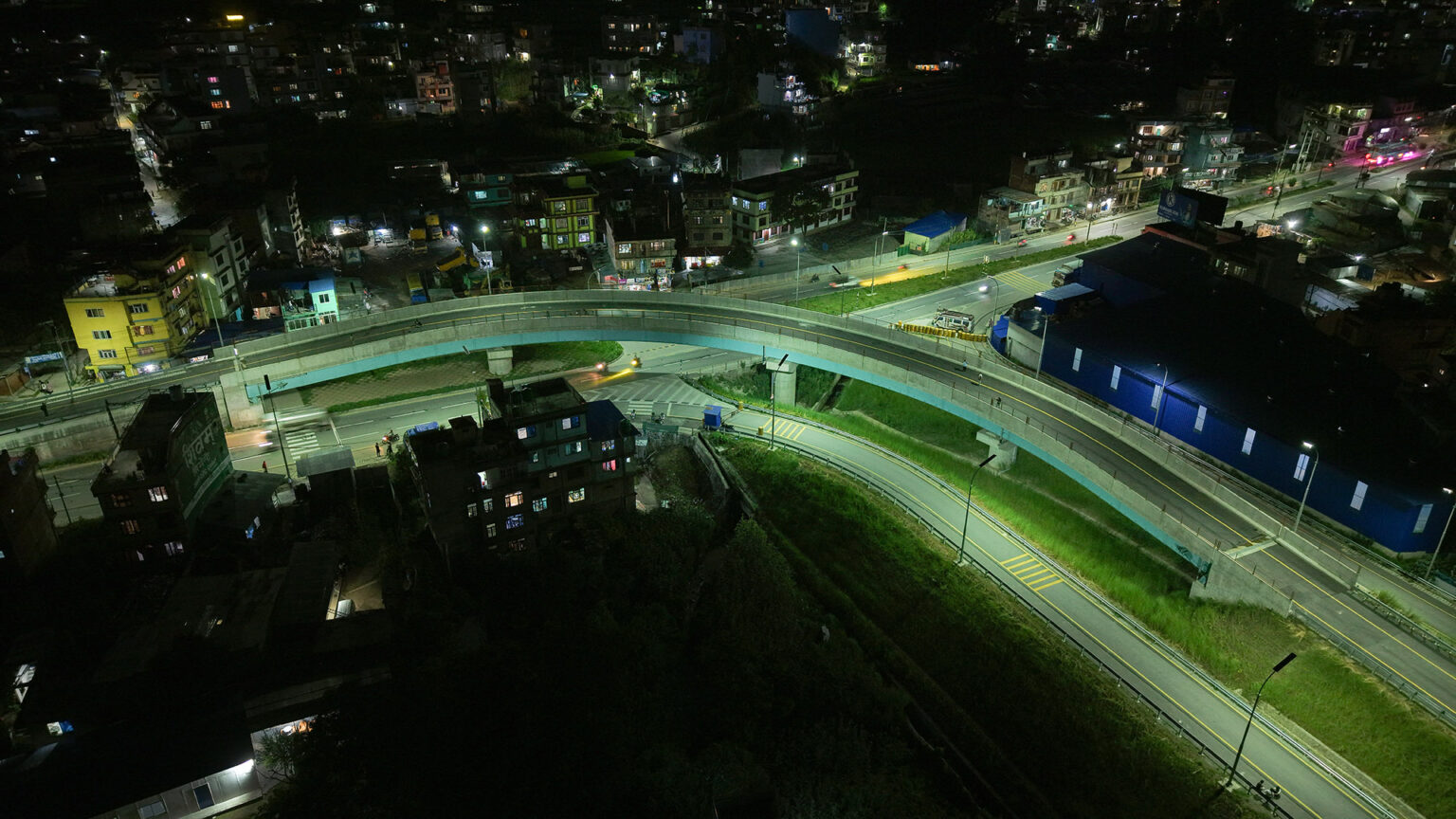
Construction of the four-lane ‘Arc Design’ bridge over the Madi River, connecting wards 4 and 5 of Vyas Municipality, Tanahun, has reached 80 percent physical completion. The bridge is part of the Prithvi Highway expansion project and was contracted to ZIST-Annak JV for Rs 1.21 billion in mid-July 2022. Engineer Bishnu Prasad Pandey confirmed that complex foundation and pillar works are finished, with finishing touches now underway. The 370-meter bridge, funded by the Asian Development Bank, is designed to be a major tourist attraction due to its modern aesthetic. Once operational in the coming months, it is expected to significantly ease traffic congestion in the Damauli market area.
Local Unit Conducts Awareness Training for Footpath Traders
Triyuga Municipality, Udayapur, has urged local entrepreneurs to stop operating businesses on the main sidewalks of the Gaighat market. The municipality organized awareness training for 225 footpath traders and businessmen to address the issue. Long-term encroachment on sidewalks has severely obstructed pedestrian movement. To avoid immediate force, the training was held to explain the necessity of clear walkways. The municipality is identifying alternative roadside lands to relocate these traders. Currently, sidewalks are occupied by vendors selling clothes, fish, fruits, shoes, and roasted corn, causing significant hardship for pedestrians.
BP Koirala Memorial Cancer Hospital Faces Financial Crisis
BP Koirala Memorial Cancer Hospital is struggling with a severe financial crunch, affecting its ability to pay gratuities to retired employees. Executive Director Dr. Shivaji Paudel stated that government agencies owe the hospital Rs 416.7 million. The Health Insurance Board alone owes Rs 258.8 million. Consequently, the hospital has outstanding liabilities of Rs 191.7 million for salaries and maintenance, plus Rs 97.7 million for medicines. Despite the crisis, the hospital saw a record 209,594 patients last year. The absence of a board chairman since April 1 has further complicated financial transactions and administrative functions.
SWC to Seal 20 Organizations Over Rs 77.9 Million Rent Arrears
The Social Welfare Council (SWC) is preparing to seal the offices of 20 organizations and businesses operating within Bhrikutimandap for failing to pay long-standing rent. Total outstanding arrears have reached Rs 77.9 million. Among the defaulters is ANNISU, a student wing affiliated with the CPN (UML), which has reportedly occupied stalls since 2020 without a formal agreement. Other major defaulters include the Reporters Club, which owes Rs 7.3 million, and the Federation of NGOs for Children Nepal, with arrears of Rs 8.9 million dating back to 2006. The Federation of Nepali Journalists and the National Federation of the Disabled also remain on the list of non-paying tenants.
Chandragiri Investment Group to Issue Rs 100 Million IPO
Chandragiri Investment Group has announced the issuance of an Initial Public Offering (IPO) worth Rs 100 million. The company’s first general assembly approved the issuance of 1 million shares to the general public. With an authorized capital of Rs 500 million, the assembly also passed a 4 percent cash dividend for shareholders. Under the chairmanship of Rajan Shrestha, the holding company has diversified investments in firms such as Indreni Mushroom Farm, The Nilaya Hotels, and Everest Color. A new board of 6 directors, including Ramraja Acharya and Dhirendra Shrestha, was elected unopposed.
Gold and Silver Prices Drop in Market
Gold and silver prices declined in the market today, according to the Federation of Nepal Gold and Silver Dealers’ Association. The price of gold fell by Rs 400 per tola (11.66 grams), bringing it down to Rs 296,700 today. On Sunday, gold was traded at Rs 297,100 per tola. Similarly, silver prices also decreased. Silver dropped by Rs 75 per tola and is now being traded at Rs 4,900 per tola. The previous day, silver was priced at Rs 4,975 per tola. Overall, despite today’s decline, gold prices have increased by Rs 5,300 per tola over the past week.