Kathmandu
Monday, July 13, 2026






KATHMANDU: Nepal News presents today’s snapshot of Nepal’s economic activities. Get quick updates on major market movements, policy shifts, and financial developments shaping the economy of Nepal. Here are the key economic highlights for today:
NRB Mops Up Rs 170 Billion from Banking Sector
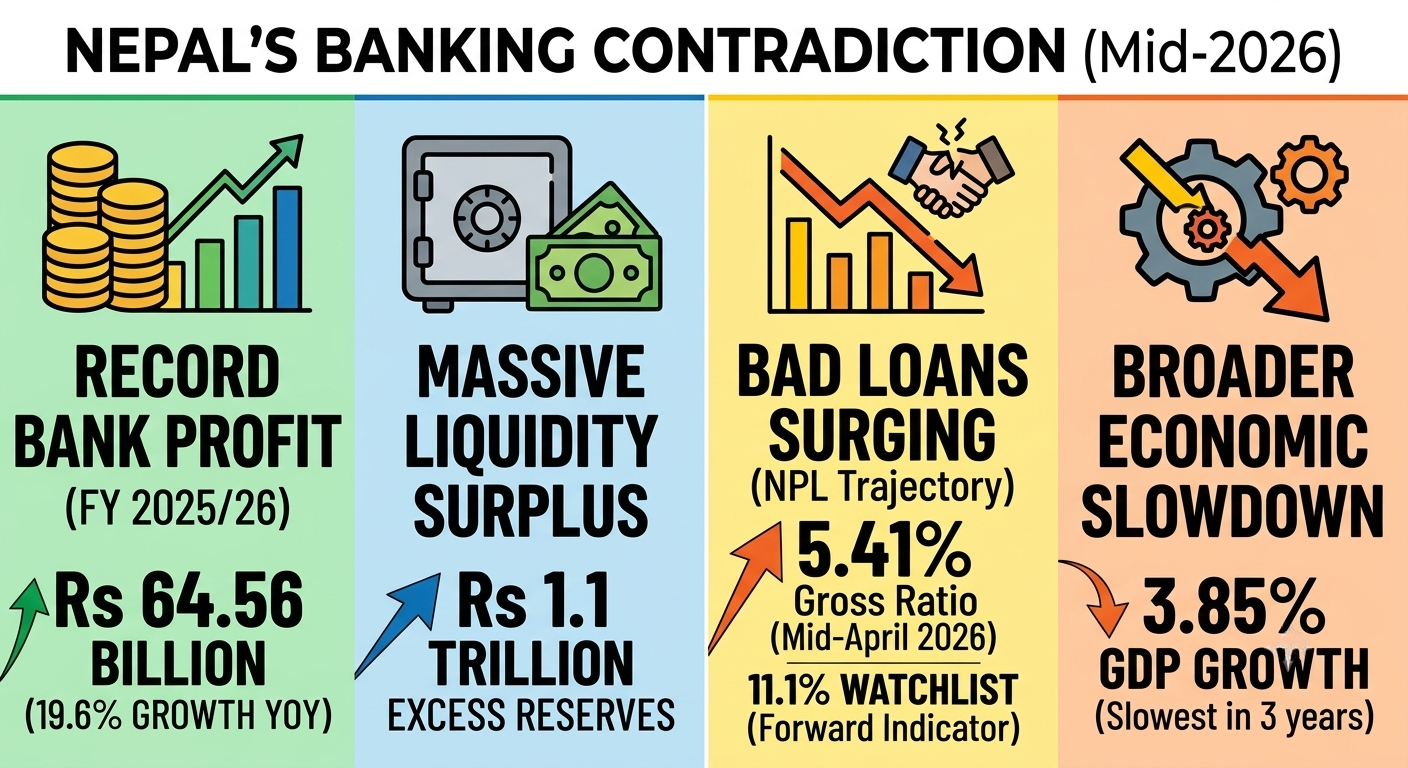
Nepal Rastra Bank (NRB) successfully pulled Rs 170 billion out of the financial market through six separate debt instruments. The central bank implemented the large-scale liquidity sweep for a one-year maturity timeline to manage persistent excess liquidity inside commercial banking channels. Following those operations, an additional notice was published to collect Rs 15 billion under the “NRB Bonds 2084-Chha” facility. Only licensed class ‘A’, ‘B’, and ‘C’ commercial banks and financial institutions are eligible to bid, with a strict minimum investment threshold fixed at Rs 50 million. The bonds pay interest bi-annually and qualify as valid loan collateral.
NEPSE Drops 30.60 Points, Turnover Reaches Rs 7 Billion
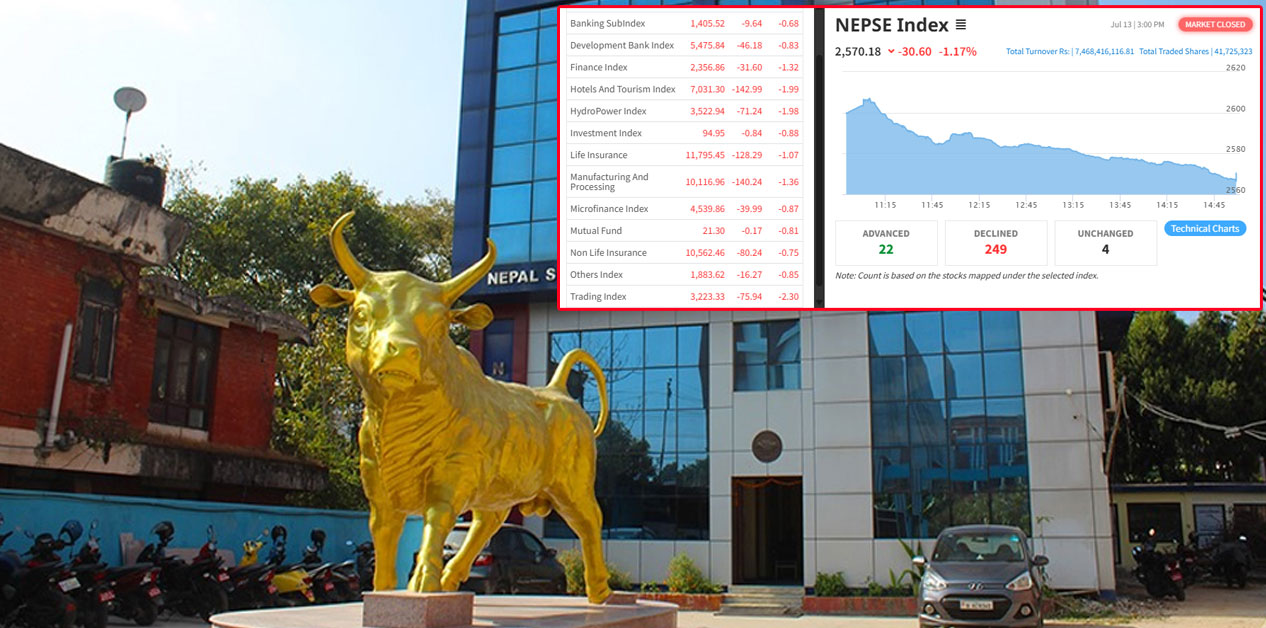
The Nepal Stock Exchange (NEPSE) fell by 30.60 points (1.17 percent) on Monday to close at 2,570.18, with all 13 sector indices ending in the red. The Sensitive Index also declined by 3.04 points to 450.55. Despite the sharp drop, trading activity remained strong, with 41.73 million shares of 368 companies traded through 51,295 transactions, generating a turnover of Rs 7.468 billion. Share prices of 22 companies advanced, while 249 declined and 4 remained unchanged. Samudayik Laghubitta Bittiya Sanstha was the top gainer with a 5.37 percent rise, while Upakar Laghubitta Bittiya Sanstha posted the steepest loss, falling 11.28 percent.
Koshi Province Records Fiscal Expenditure of Rs 26 Billion
Koshi Province spent a total of Rs 26.252 billion during the fiscal year 2025/26. Although the initial budget was set at Rs 36.098 billion, the provincial administration revised the ceiling downward to Rs 32.45 billion during its midterm economic review. The preliminary expenditure report shows that recurrent spending consumed Rs 13.821 billion, while capital development expenditure reached Rs 12.385 billion, representing 72.24 percent budget utilization. The Ministry of Physical Infrastructure Development led ministry-level outlays by utilizing Rs 7.453 billion.
Sudurpashchim Province Freezes Rs 12 Billion
Sudurpashchim Province froze a total of Rs 12.593 billion after failing to execute its capital development budget. The provincial administration had arranged a total fiscal budget of Rs 33.432 billion but closed the fiscal year with a capital execution rate of just 62 percent. The Provincial Comptroller Office reported that actual expenditures reached Rs 20.839 billion. The Ministry of Physical Infrastructure Development held the largest portfolio of Rs 15.28 billion but managed to spend only 60 percent of its allocation, leaving Rs 6.1 billion unused.
Karnali Province Returns Over Rs 12 Billion to Treasury
Karnali Province achieved a 61.97 percent budget execution rate during the fiscal year 2025/26. Out of the total available budget of Rs 33.193 billion, the provincial administration successfully utilized Rs 20.571 billion. The remaining unspent balance of Rs 12.622 billion was returned to the central state treasury as frozen capital. Recurrent expenditure execution stood at 73.48 percent, while capital development expenditure reached 55.74 percent. The Ministry of Internal Affairs and Law marked the highest spending efficiency at 93.67 percent, whereas the Ministry of Physical Infrastructure recorded the lowest at 49.20 percent.
Army Secures Rs 3.3 Million for Hetauda Textile Trial
The Ministry of Finance approved an immediate funding release of Rs 3.3 million to the Army to prepare the dormant Hetauda Textile Industry for trial production. The state enterprise was originally established back in the fiscal year 1975/76 with economic assistance from China but ceased all operations in the fiscal year 2002/03 due to financial losses. A feasibility study confirms that the mill holds around 84,449.65 square meters of industrial land and features functional building structures that can be revived using the Army’s Welfare Fund. The long-term rehabilitation plan aims to manufacture uniforms directly for military personnel and public civil servants, utilizing domestic raw materials to ensure market demand.
Property Inquiry Commission Proceeds with Political Investigations Despite Court Order
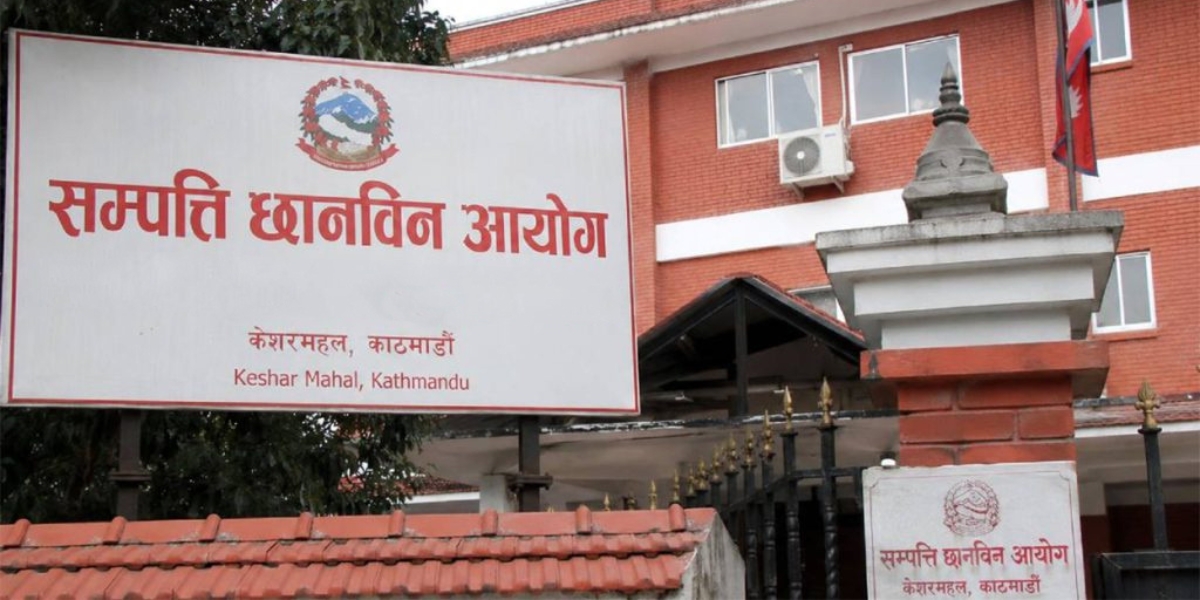
The Property Inquiry Commission, 2026, clarified that its mandate to investigate political leaders and public officials remains active, despite a recent Supreme Court interim order. Established on April 15 this year to collect property declarations, the commission faces a July 10 stay order halting investigations strictly for individuals with separate constitutional oversight such as judges, constitutional body officials, and Army personnel. The court order, responding to a writ by Advocate Prem Raj Silwal, maintains the status quo for those exempted categories. However, the commission emphasized that investigations into politicians face no legal halt and will proceed as scheduled.
NRB Issues Rs 15 Billion Bond to Absorb Excess Liquidity
The Nepal Rastra Bank (NRB) today issued bonds worth Rs 15 billion to absorb excess liquidity in the banking system. The NRB issued the ‘NRB Bonds 2084 Chha‘, with Class ‘A’, ‘B’, and ‘C’ banks and financial institutions eligible to participate. Online bidding concluded at 3 PM on Monday, while the interest rate will be determined through the bidding process. The bond has a maturity period of one year, with the principal to be repaid on July 13, 2027. Interest will be paid semiannually. According to the NRB, bids could be submitted for a minimum of Rs 50 million and up to the total issue amount, provided the bid amount was divisible by Rs 50 million.
Insurance Authority Solicits Complaints Over Claim Irregularities
The Nepal Insurance Authority urged policyholders and stakeholders to file formal complaints against insurers, employees, or surveyors engaging in irregularities or delaying claim payments. According to a public notice, action will be taken under the Insurance Act, 2022, against parties that cause distress, falsify details, distort facts, or conduct biased assessments. Complainants must submit their name, address, contact information, the concerned company’s name, the problem details, and the insurance claim and policy numbers. Submissions backed by evidence, including documents, photographs, or videos, can be delivered in person, by email, or via the post office.
House Construction Costs in Kathmandu Rise to Over Rs 10 Million
The cost of residential construction inside Kathmandu increased by 14 percent over the past year due to rising global fuel and transport prices. Building a standard two-and-a-half-story house covering an 800 square foot footprint now requires approximately Rs 10.7 million, up from the previous average of Rs 9 million. Official data from the National Statistics Office highlights that brick prices surged by an unprecedented 13.41 percent, taking up nearly 11 percent of total residential building budgets. Simultaneously, copper price fluctuations drove electrical wire costs up by 24.89 percent, while average daily wages for skilled construction laborers rose slowly to Rs 2,000.
111 MW Rasuwagadhi Hydropower Suspends Power Generation
Electricity generation at the 111-megawatt Rasuwagadhi Hydropower Project was suspended as a precaution after water levels rose in the Lhende Stream on Sunday (Asar 28), triggering a mud-laden flood. Project officials closed the intake gate to protect infrastructure from possible damage, which follows repairs from separate flood damage sustained in July last year. Concurrently, rising levels in the Bhote Koshi River prompted the relocation of freight and newly imported vehicles from the Rasuwagadhi Customs Yard. The District Administration Office advised travelers heading to and from Kerung to avoid the Mailung road section and use the alternative route instead.
Simara Airport Faces Flight Reductions Due to Aging Infrastructure
Simara Airport in Bara District is experiencing frequent delays and reduced flight options due to severe infrastructure constraints, including a narrow terminal and short runway. The current facilities restrict night flights and full-capacity ATR-72 operations, particularly during adverse weather. Consequently, Yeti Airlines and Shree Airlines suspended their Simara-Kathmandu routes, leaving Buddha Air to operate just four daily flights. The airport currently serves roughly 400 daily passengers, down from more than 1,500 passengers a few years ago. The airport authorities are awaiting expansion approval from the Civil Aviation Authority of Nepal.
Sukilumba Airport Suspends Flight Services Disrupting Ilam Economy
Commercial flight operations collapsed at Phalgunananda Sukilumba Airport in Ilam, with no aircraft landing at the facility since last March. Following the suspension of regular routes, Nepal Airlines Corporation officially recalled its station staff back to Kathmandu and transferred all ground office equipment over to its Biratnagar branch. Built with a public investment of Rs 400 million, the regional airport previously offered crucial transportation options for citizens traveling across Ilam, Panchthar, Taplejung, and neighboring districts in India. The total lack of air connectivity has deeply impacted local tourism revenues and discouraged major commercial investors from expanding in the region.
Free 24-Hour Bird Flu Hotline Launched
The Nepal Veterinary Association has launched a free 24-hour hotline and teleconsultation service following the confirmation of bird flu infections in various districts, including the Kathmandu Valley. The service aims to provide official information, scientific consultation, and emergency technical assistance on bird flu, with a focus on animal health, public health, and protecting the poultry industry. The hotline targets farmers, poultry entrepreneurs, meat and egg consumers, and the general public, as bird flu is a highly infectious zoonotic viral disease that can directly affect the poultry sector. The service is available through the toll-free hotline number 1159, with voluntary support from veterinary specialists in poultry science, avian diseases, epidemiology, and animal health. The association has urged farmers, poultry entrepreneurs, and consumers to rely on official information and expert advice rather than rumors.
Local Unit Installs 250 Clean Energy Biogas Plants
Belauri Municipality, Kacnchanpur, successfully installed clean energy biogas plants in 250 households during this fiscal year to reduce firewood and liquefied petroleum gas consumption. The Alternative Energy Promotion Centre managed 76 percent of the total installation costs, while the municipality provided 14 percent, and beneficiaries contributed 13.66 percent. The local unit prioritized livestock farmers, executing 70 installations in Ward No. 10 and 38 in Ward No. 1, compared to 28 plants completed in Ward No. 5 during last year. Deputy Mayor Jogram Chaudhary stated the initiative protects the environment, reduces respiratory health risks, and yields organic fertilizer.
Ghorahi Allocates Rs 859 Million for Infrastructure
Ghorahi Sub-Metropolitan City allocated Rs 859.1 million specifically for infrastructure development in its upcoming fiscal budget 2026/27. The investment focuses heavily on road blacktopping, drinking water systems, irrigation networks, and power line expansion. A massive block of Rs 541.7 million is dedicated strictly to completing lingering, multi-year pride projects. To maximize civic engagement, the local government set aside Rs 205 million for neighborhood-level initiatives using cost-sharing partnerships. Additionally, Rs 6 million was prioritized for drainage construction to curb seasonal monsoon flooding along the Kathekhola corridor.
Salyan Vegetable Exports Generate Rs 520 Million Annually
Commercial vegetable farming has transformed the rural economy of Salyan, bringing over Rs 520 million into the district annually. Local farmers cultivate vegetables across 8,200 hectares of land, generating an annual harvest of 119,765 metric tons. Out of this total yield, 65,549 metric tons of seasonal and off-season produce are exported out of the district via the Rapti Highway to major markets like Dang, Butwal, Pokhara, Kathmandu, and border towns in India. While modern polytunnels and drip irrigation setups have boosted crop volumes, fluctuating market rates and sudden outbreaks of late blight disease remain significant financial risks for local growers.
Gayatri Katwal Wins Itahari Chamber of Commerce Presidency
Gayatri Katwal won the presidency of the Itahari Chamber of Commerce and Industry, defeating her close opponent by a narrow margin of 15 votes. Out of 1,543 valid votes cast during the weekend election, she successfully secured 758 votes to break a 16-year streak of uninterrupted male leadership at the institution. Her immediate competitor obtained 743 votes. Although she clinched the top executive seat on a platform of transparency and institutional reform, candidates from the opposing panel won the majority of the open executive committee member seats.
Om Megashree Pharmaceuticals Approves Royal Pharmaceutical Acquisition
The special general meeting of Om Megashree Pharmaceuticals approved a formal acquisition proposal to purchase Royal Pharmaceutical. To navigate regulatory guidelines set by the Securities Board of Nepal, which dictates that public entities can only merge with corporate entities, Royal converted its business structure into a limited company. Om Megashree previously floated 30 percent of its paid-up capital to the general public during its initial public offering. Following the final audit, the acquisition will create production synergies to meet strict state regulations on dedicated pharmaceutical manufacturing lines. The central securities registry will monitor the transaction to ensure transparent public trading.
Gold Traded at Rs 285,200; Silver at Rs 4,375
Gold and silver prices decreased in the market today. According to the Federation of Nepal Gold and Silver Dealers’ Association, the price of gold dropped by Rs. 2,800 per tola (11.66 grams), trading at Rs. 285,200. On Sunday (previously), gold was traded at Rs. 288,000 per tola. Similarly, the price of silver has also gone down by Rs. 100 per tola. Silver is currently trading at Rs. 4,375 per tola, compared to its previous trading price of Rs. 4,475 per tola.