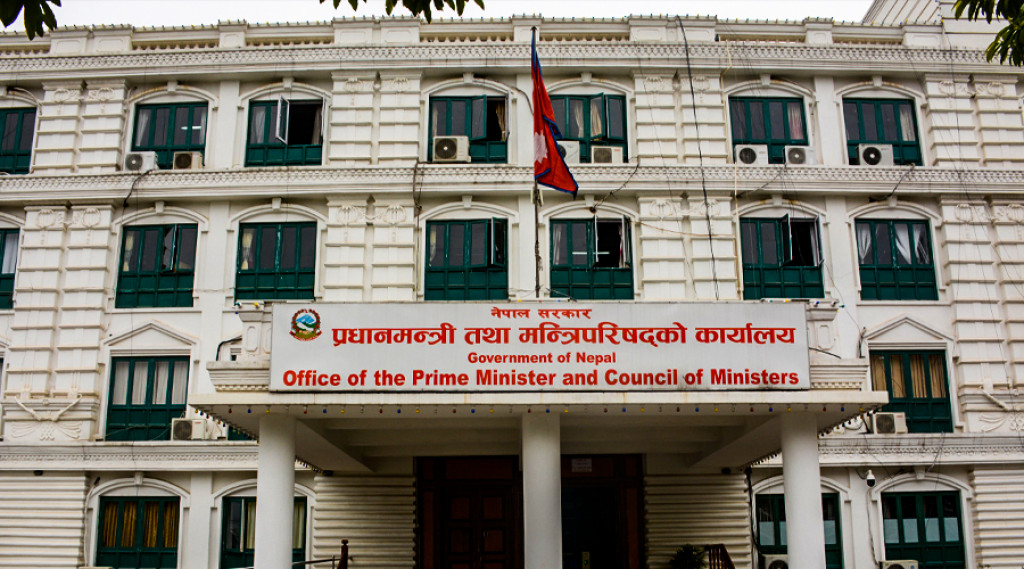
Kathmandu
Tuesday, July 14, 2026





Based on an IIDS study, this explainer unpacks the Nepali diaspora in Australia, from rapid population growth and economic profile to remittances, investment behavior, and ties with Nepal

KATHMANDU: Australia is now home to more than 213,000 Nepal-born residents, a community that has grown more than fivefold in barely a decade. The report, Nepali Diaspora in Australia, produced by the Institute for Integrated Development Studies (IIDS) in May 2026 with support from the Australian Government’s Department of Foreign Affairs and Trade, examines who these people are, how they live, what they earn, how they stay connected to Nepal, and what it would take for them to contribute more meaningfully to their country of origin.
Drawing on 1,089 survey responses, 18 key informant interviews, and two focus group discussions, it is the most comprehensive evidence-based portrait of this community to date.
This Nepal News explainer is based on the IIDS report on the Nepali diaspora in Australia and delves into their demographics, livelihoods, migration patterns, remittances, investment behavior, and links to Nepal.
How fast has the Nepali community in Australia grown, and what drove that growth?
The growth has been remarkable by any measure. In 2014, there were roughly 42,900 Nepal-born people living in Australia. By June 2025, that number had climbed to 213,580, representing more than a fourfold increase in just over a decade.
The pace accelerated sharply in the years between 2016 and 2021, a period that accounts for 58.5 percent of the entire current population, making it the single most important phase in the community’s formation. Before 1990, only a small number of highly qualified Nepalis, mostly scholarship recipients and skilled migrants, had made it to Australia.
In the 1990s, Australia opened its doors to South Asian international students, and Nepalis began arriving in increasing numbers to study, with many going on to transition into work and permanent residency, particularly through occupations on the Shortage List.

Australian Government’s Department of Foreign Affairs and Trade
Survey data confirms that higher education is still the dominant reason for migration, cited by 61 percent of respondents. Family reunification is the second most common reason at nearly 23 percent, while job opportunities and vocational training account for much of the rest.
The result is a community that is still relatively new, in the process of establishing itself economically and socially, but growing with extraordinary speed.
Where do Nepalis settle in Australia, and where do they come from within Nepal?
Settlement patterns in Australia follow a recognisable logic. Many Nepalis initially choose regional or smaller cities because Australia’s immigration points system rewards residence outside major metropolitan areas, helping applicants build the points needed for permanent residency. Once that residency is secured, though, there is a strong tendency to move toward major urban centres.
This distinction between where people first land and where they eventually settle reflects what migration literature calls the difference between policy-driven spatial dispersal and longer-term socioeconomic reconcentration.
Canberra is an interesting case within this pattern, having attracted a notable Nepali population in part because it qualifies as a regional area under the points framework even though it is a significant city in its own right.
Within Nepal, the Bagmati province, which includes the Kathmandu Valley, is by far the largest source region, accounting for 43.8 percent of survey respondents. Gandaki province comes second at 17 percent, followed by Lumbini at nearly 12 percent and Koshi at close to 11 percent. Representation from Madhesh is notably low at under 6 percent, a pattern the report attributes to differences in income distribution and education levels across provinces rather than any lack of interest in migration.
This geographic concentration within Nepal means the diaspora skews toward communities that already had greater access to education and resources.
What does the demographic profile of the diaspora look like in terms of age, gender, and ethnicity?
The diaspora is young, educated, and fairly diverse in its ethnic composition. On gender, ABS data indicates the Nepali-born population in Australia is approximately 54 percent male and 46 percent female, a gap that has narrowed significantly over time.
Earlier migration waves were more heavily male-dominated, driven by student and early employment pathways, while subsequent family reunification and partner migration have gradually balanced the picture.
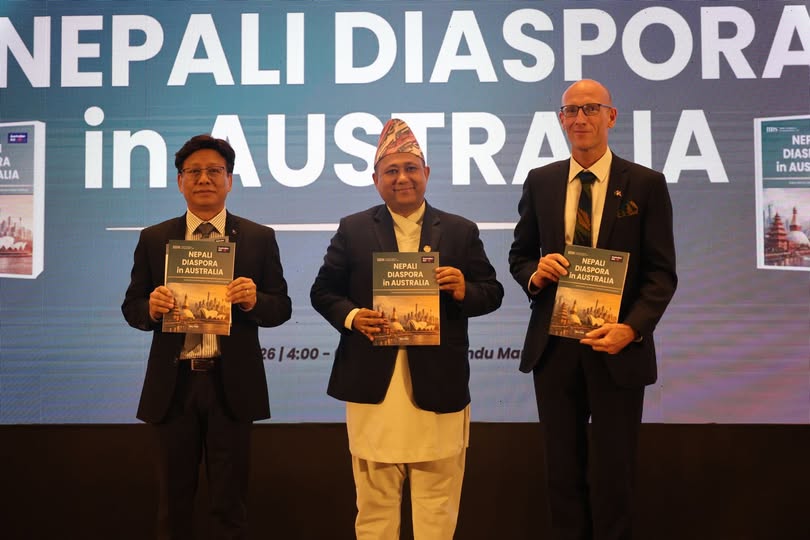
Biswash Gauchan (left), Foreign Minister Shishir Khanal (center), and Simon Ernst, Australian Ambassador to Nepal (right). Photo courtesy: IIDS
Within the IIDS survey sample, the split was 61 percent male and 39 percent female, a disparity the researchers attribute partly to sampling bias rather than a true reflection of the actual population structure.
Ethnically, Brahmins are the largest group at about 37 percent of survey respondents, followed by Kshetris at around 21 percent. Newars make up roughly 11 percent, and the remainder is spread across Tamangs, Gurungs, Rais, Thakuris, Magars, Dalits, Tharus, and others, reflecting a broad cross-section of Nepali society even if the higher-caste groups remain somewhat over-represented relative to their share of Nepal’s population.
The majority of respondents trace their origins from Bagmati, which aligns with the province having higher income and education levels and therefore producing a disproportionate share of outmigrants.
How educated and economically active is the Nepali diaspora in Australia?
This is one of the most striking aspects of the community. Before arriving in Australia, nearly half of all respondents already held a bachelor’s degree, and more than 26 percent had a master’s degree. Only about 9 percent had only a high school qualification. After arrival, approximately 65 percent enrolled in the Australian education system, most commonly in information technology, nursing and health sciences, and business and finance. This pattern makes the community unusual among migrant groups: it arrived already highly educated and then invested further in qualifications once in Australia.

In terms of employment, ABS data shows that around 84 percent of Nepali-born people in Australia are in the labour force, with part-time work at 45 percent and full-time at 41 percent. Unemployment sits at 5.7 percent, which is higher than the national average but not unusual for a relatively new and rapidly growing migrant group.
IIDS survey data paints an even more active picture, with 69 percent of respondents working full-time, 19 percent working while studying, and 6 percent self-employed. The healthcare and care sector absorbs the largest share of workers at nearly 47 percent, followed by IT and computer engineering at 12 percent, hospitality and tourism at 9 percent, and engineering at 6 percent.
Most workers are concentrated in entry to mid-level roles, though a meaningful proportion have already moved into managerial and administrative positions, pointing to a community steadily building upward professional mobility.
What are Nepalis in Australia earning?
Income levels within the diaspora are concentrated in the middle ranges of the Australian earnings distribution. The estimated median annual income among survey respondents is approximately AUD 77,000, which translates to a weekly median of around AUD 1,480.
The largest single bracket, accounting for 45 percent of respondents, falls between AUD 65,001 and AUD 120,000 per year. Another 23 percent earn between AUD 45,001 and AUD 65,000. Very high earners above AUD 250,000 are a small group at under 2 percent, while those earning less than AUD 9,000 are similarly rare.
This income profile suggests a community that is comfortably settled within middle-income Australia rather than concentrated at either extreme. The survey-based median weekly income of AUD 1,480 is somewhat above the ABS national median for all employees, which the report explains by noting that respondents are more likely to be economically active individuals working in better-paying roles.
ABS census data, which covers the entire Nepali-born population including those in part-time and low-income work, shows a lower median personal income of AUD 855 per week. At the family level, combined income rises to around AUD 2,042 per week and at the household level to AUD 2,337, reflecting the multi-earner nature of many Nepali households in Australia.
Do Nepalis in Australia plan to return to Nepal?
The data shows that most do not. Nearly 62 percent of survey respondents said they do not intend to return, while 38 percent said they plan to go back. The likelihood of returning varies considerably by visa type and employment situation. Student visa holders are among the more evenly split, while those on partner or family visas show a stronger tendency to stay.
People who are unemployed or not in the labour force are more inclined to return, as are the self-employed, while full-time workers and working students are more settled and more likely to remain. This suggests that economic integration into Australian society reduces return intent, which is a common pattern across migrant groups globally.
The report also notes that some who do not plan to return permanently still maintain strong ties to Nepal and visit regularly. There is a meaningful group, particularly among students and those on temporary visas, that has not yet made a firm decision either way, suggesting the overall picture is more fluid than the headline split implies.
The report frames this as a community in transition, still consolidating its presence and identity in Australia while navigating ongoing connections to Nepal.
How integrated are Nepalis into Australian society socially and culturally?
The level of integration is substantial and appears to be growing. Survey respondents identified workforce participation as their primary area of integration at 68 percent, followed by education at 64 percent and multicultural festivals and events at 58 percent.
Entrepreneurship and community service are also cited, though at lower rates. This pattern suggests the community is plugging into mainstream Australian life primarily through economic and educational channels, while cultural visibility through festivals and events is also significant.

Khukuri Nepali Restaurant in Campsie, Australia: Photo: Khukuri Nepali Restaurant’s Facebook page
About 41 percent of respondents participate in Nepali organisations in Australia, including charity or volunteer groups at 43 percent, cultural organisations at 32 percent, professional or work-related groups at nearly 30 percent, and sports organisations at 26 percent.
The remaining 59 percent do not participate in organised Nepali community groups, with lack of interest and time constraints being the most commonly cited reasons. The report notes that this is partly a function of the community’s relative youth and newness, with many respondents explaining that they had not yet established community connections after recent arrival.
Self-perception data is broadly positive. Nepalis in Australia are widely seen as hardworking, honest, and friendly, with these traits scoring highest on community perception surveys. Language and accent barriers are acknowledged as a persistent challenge, with moderate agreement that this hinders full participation in Australian society.
The community’s English proficiency relative to other migrant groups is identified as a competitive advantage, particularly in employment contexts.
How do Nepalis feel about their identity and sense of belonging?
The picture here is layered and in some ways poignant. A large majority of respondents, 73 percent, feel that dual citizenship would strengthen their sense of belonging and Nepali identity. Only 4 percent said it would not affect their identity, while about 16 percent remained uncertain.
This response goes beyond a legal preference: respondents consistently described dual citizenship not as a matter of paperwork but as a practical mechanism for maintaining fluid engagement with Nepal, including investment, property, travel, and long-term connection.
Under Nepal’s current rules, acquiring Australian citizenship effectively means giving up Nepali citizenship, which many find deeply uncomfortable. The NRN (Non-Resident Nepali) card exists as an alternative, offering some legal and economic benefits, but respondents widely described it as largely symbolic in practice, with benefits that are poorly communicated and inconsistently implemented.
People said the card is supposed to allow investment, property access, and inheritance rights, but in reality these provisions are rarely enforceable and difficult to navigate. Many in the diaspora feel legally adrift when it comes to Nepal, wishing to invest, support family, or own property but lacking the rights to do so with confidence.
On political engagement in Australia, 42 percent of respondents said they were unsure about their community’s political aspirations, while 20 percent believed the community was actively seeking political representation. Political interest within the diaspora is growing but remains at an early stage, with the community still more focused on building economic and cultural presence than on formal political influence.
How often do Nepalis visit Nepal, and why?
Most respondents maintain some physical connection to Nepal through visits, though the frequency varies widely. The most common pattern is returning every two to three years, cited by 38 percent of respondents.
About 27 percent have not yet had the chance to visit since arriving in Australia but plan to. Around 10 percent visit at least once a year, while 9.7 percent go only rarely, with gaps of more than five years. Just 2.75 percent visit multiple times a year.
When people do visit, the reasons are predominantly personal and relational. Spending time with family and friends is the top motivation at 50 percent, followed by tourism and leisure at 21 percent and cultural or religious events at nearly 16 percent. Weddings account for 11 percent. Professional work, business visits, and managing financial or property matters together account for a very small share of trips.
The report notes that visits also have an economic dimension: migrants spend money locally, support family households, and engage with Nepal’s domestic economy in ways that contribute beyond formal remittances. Visits are therefore simultaneously personal, cultural, and economic in nature, serving as a meaningful thread maintaining connection across distance.
How significant are remittances from the Nepali diaspora in Australia?
Remittances from Australia are a meaningful and growing part of Nepal’s broader remittance economy. Nepal received USD 10.86 billion in total remittances in fiscal year 2023/24, an amount representing roughly 26 percent of GDP.
Australia accounts for approximately 6.1 percent of total remittance value, corresponding to around 1.5 million transactions with a mean transfer size of NPR 436,868 and a total flow exceeding Rs 64 billion, or roughly AUD 744 million annually.

Among IIDS survey respondents, 66.94 percent reported sending remittances to Nepal, while 33 percent did not. The pattern of transfers is predominantly irregular rather than scheduled: half of remitters send money occasionally, and another 17.7 percent send only when there is an emergency.
Regular monthly and quarterly transfers are less common at 9 and 11 percent respectively. In terms of amounts, the most common transfer range is AUD 1,000 to 5,000, accounting for 45 percent of senders, followed by AUD 5,001 to 10,000 at 33 percent. Higher transfers above AUD 20,000 are uncommon.
Most remittances go toward household and family support, covering food, health, parental needs, and emergencies, with smaller shares going toward loan repayment, cultural activities, and education.
How do Nepalis in Australia transfer money home, and what channels do they use?
The dominant method is through formal financial institutions, with 84.6 percent of respondents reporting use of banks or financial service companies to transfer money to Nepal.
Nearly 30 percent also use informal channels at some point, primarily through friends, relatives, or community networks. These informal methods, often called hundi, remain embedded in diaspora practice partly for reasons of trust, cost, and accessibility, even where formal options are available.
The report notes that this high formal channel usage may slightly overstate the reality, since respondents in a survey setting may be less willing to disclose use of unofficial transfer methods.
National-level data from the Nepal Living Standards Survey shows that for remittances specifically from Australia, formal channel usage runs at around 90.9 percent, though hundi (informal channel)still accounts for 5.5 percent.
Gender-wise, both men and women primarily use banks, though women are slightly more likely to rely on community-based informal networks. The strongest factor that would encourage more transfers through formal channels, according to respondents, is a reduction in transaction and digital fees, cited by 52 percent. More secure and user-friendly transfer systems were the second priority at nearly 49 percent. Diaspora incentive schemes came third at 40 percent.
How much and where does the Nepali diaspora in Australia invest?
Just under 35 percent of survey respondents reported having made formal financial investments beyond simple savings. Of those who have invested, 51 percent have done so exclusively in Australia, 26 percent in both countries, and 22.5 percent exclusively in Nepal.
The concentration of investment in Australia reflects confidence in Australian institutions, transparent markets, and accessible financing rather than a lack of interest in Nepal.
In Australia, the investment profile is heavily skewed toward real estate and property, which accounts for 56.8 percent of diaspora investments there, and stock markets and financial services at 25.6 percent. Business and franchise investments follow at 16 percent.
The scale of these investments is substantial: nearly 60 percent of investor respondents hold portfolios above AUD 350,000, and about 31 percent hold portfolios above AUD 750,000. These are not marginal savers; they are participants in sophisticated financial markets using mortgages and structured finance to build wealth.
In Nepal, investment is more evenly spread across the distribution, with the largest cluster in the mid-range between Rs 1 million and Rs 20 million, reflecting investments in SME development, agricultural operations, and diversified commercial enterprises. Stocks and banking absorb the largest share at 39 percent, followed closely by real estate at 38 percent, with smaller allocations to agriculture, construction, education, and tourism.
What stops Nepalis in Australia from investing more in Nepal?
The barriers are institutional, not financial. Bureaucratic delays are the single most frequently cited obstacle, mentioned by 51 percent of respondents who have invested in Nepal. Policy and legal unpredictability and economic uncertainty follow at 32 percent each.
Difficulty finding trustworthy partners on the ground is a concern for 29 percent, and corruption or demands for informal payments are raised by 28 percent. Complex tax and legal systems are cited by 22 percent, and repatriation difficulties, meaning the inability to bring profits back out of Nepal without legal complexity, concern 12.5 percent.
Qualitative responses deepen the picture considerably. Respondents consistently described Nepal as a market with real opportunities but impossible operating conditions. The challenge is not identifying where to invest but navigating unpredictable tax authorities, shifting municipal regulations, and bureaucratic processes that change without warning.
For a diaspora investor who cannot be physically present to manage these relationships, the risk is not just financial but operational. Every engagement with Nepali state structures requires local intermediaries, political navigation, and personal networks that cannot be managed remotely from Sydney or Melbourne.
The practical result is that many diaspora investors retreat to real estate land purchases, which protect capital from inflation while bypassing much of the bureaucratic apparatus, but which generate no employment, no technology transfer, and no productive spillovers into Nepal’s broader economy.
What policies would encourage the diaspora to invest more in Nepal?
The response to this question is dominated by one answer: dual citizenship. A full 66 percent of respondents named it as the single most important policy measure that would encourage greater investment in Nepal. The margin is so wide that the report treats this finding separately from all other policy preferences. Respondents were consistent in framing citizenship not as an identity question but as a practical economic tool.
Dual citizenship determines land ownership rights, the ability to transfer assets, capital mobility, legacy planning, and the ability to collateralise property. Without it, diaspora investors operate in Nepal with fewer enforceable rights than resident nationals, making any long-term capital commitment structurally riskier.
Investment security guarantees were the second priority at 33 percent, followed by easier repatriation of funds at 21 percent, one-stop service centres at 21 percent, clear land ownership and property rights at 24.7 percent, and tax incentives for diaspora at 19 percent.
Simplified and fast-track investment processes were named by 13 percent, and diaspora bonds or special foreign direct investment schemes by 14 percent. Together, these preferences point toward a consistent underlying demand: a predictable, rules-based investment framework that allows diaspora members to calculate and manage risk without relying on personal or political connections.
Respondents cited Southeast Asian economies, particularly in IT services and outsourcing, as examples of what Nepal could achieve with the right regulatory environment and sustained government commitment.
What is the profile of the second-generation Nepali diaspora in Australia?
The second generation accounts for 3.31 percent of survey respondents, and their profile is strikingly different from first-generation migrants. They are almost evenly split between male and female, with nearly 90 percent holding a bachelor’s or master’s degree. Most are working full-time in professional and managerial roles, and about 89 percent live in either their own home or a family-owned property, suggesting substantial economic stability. Their relationship with Nepal is culturally and emotionally engaged but less financially transactional than that of the first generation.
The second generation rarely sends remittances, and 64 percent have no intention of returning to Nepal. Their investments, when they occur, are concentrated in Australia rather than Nepal, though many express interest in future investments in real estate, shares, and technology in Nepal. They maintain strong demand for Nepali products, particularly food and snacks, and show interest in service sector opportunities.
Fifty percent of second-generation respondents named dual citizenship as the most critical policy for engagement. The report frames this cohort as an important long-term asset for Nepal-Australia relations: more deeply embedded in Australian professional and social life than their parents, but still meaningfully connected through culture, trade, and business potential rather than through direct remittances.
What does the bilateral economic relationship between Nepal and Australia actually look like?
The report characterises the relationship as fundamentally mobility-driven rather than goods-trade driven. Human capital movement is the primary vehicle through which value flows between the two countries, both in the form of remittances and in the form of skills, qualifications, and professional networks built in Australia that can eventually be channelled back toward Nepal.
Formal goods trade between Nepal and Australia remains minimal, constrained by logistics, small market size, and limited export infrastructure on Nepal’s side. However, the diaspora sustains demand for specific Nepali products in Australia, particularly food and spice products, with 69 percent of respondents regularly purchasing Nepali goods. Spices and snacks are the dominant categories.
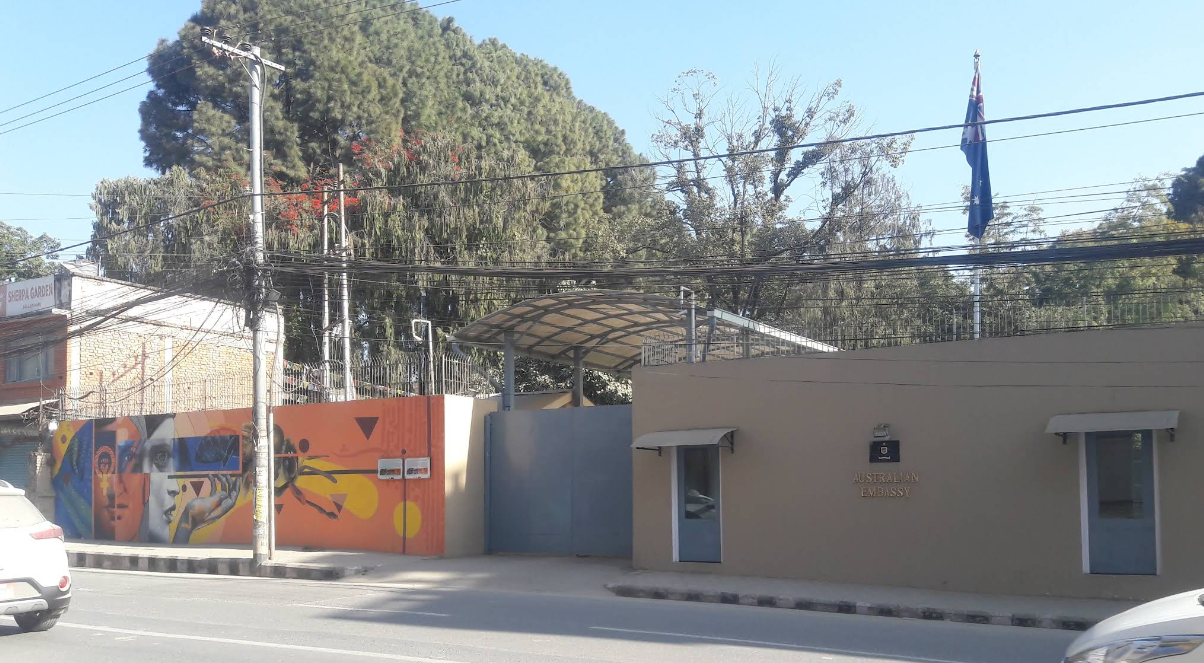
Australian Embassy in Kathmandu. File photo
This diaspora-driven consumption represents a foundation for building more structured trade and export promotion, though the report notes that logistics and quality certification barriers make scaling this difficult.
Digital services and professional linkages represent the more scalable and strategic opportunity. With a large proportion of the diaspora working in IT, engineering, health, and finance, there is potential for knowledge transfer, professional mentorship, and outsourcing arrangements that connect Australian enterprises with Nepali talent and vice versa.
The report identifies this services-driven trade potential as the most promising avenue for deepening bilateral economic ties, noting that it requires far less capital infrastructure than goods trade and can be built largely through diaspora networks.
What are the report’s main recommendations for deepening diaspora engagement?
The report’s recommendations emerge naturally from what the data reveals about the gaps between diaspora aspiration and actual engagement. The highest-priority reform, backed by an overwhelming majority of respondents, is dual citizenship.
The argument is not sentimental but structural: without dual citizenship, diaspora investors cannot hold land, cannot move capital in and out predictably, cannot make long-term commitments that require collateralised rights. Every other investment facilitation measure is rendered less effective by this foundational legal gap.
Beyond citizenship, the report calls for investment security guarantees and legal protection mechanisms that allow diaspora members to hold the Nepali state accountable for protecting their capital. It recommends simplified, single-window service centres that consolidate documentation, approvals, and information into accessible digital platforms, removing the need for costly and unreliable local intermediaries.
On remittances, it urges both governments to reduce transaction costs and develop diaspora-specific incentive schemes. On trade, it recommends support for export readiness among small Nepali producers wanting to access diaspora-driven demand in Australia, including assistance with packaging, certification, and distribution. On knowledge transfer, it recommends structured programmes that create pathways for Nepali professionals in Australia to contribute through mentorship, research collaboration, and professional networks.
The overarching finding is that the Nepali diaspora in Australia is not passive. It is willing, resourced, and eager to contribute more deeply to Nepal. What it is waiting for is an enabling environment that makes that contribution legally secure, institutionally predictable, and practically achievable.