Kathmandu
Thursday, July 9, 2026





While meteorologists forecast below-average rainfall and drought risks, rising temperatures keep the threat of flash floods, landslides, and heatwaves high.

KATHMANDU: It is estimated that senior citizens above 60 years of age will be the most affected by this year’s monsoon. The Monsoon Preparedness and Response National Action Plan 2026 of the National Disaster Risk Reduction and Management Authority (NDRRMA) has projected that 47,000 elderly citizens will be affected by monsoon-related disasters.
This number accounts for 21 percent of the total elderly population across the country according to the 2021 Census. Similarly, 18,000 children under five years of age, 4,900 persons with disabilities, and 4,500 women of reproductive age could also be affected.
During disaster events, pregnant women, children, elderly citizens, single women, persons with disabilities, and households headed by women are considered the most affected groups. Shanti Mahat, spokesperson for the Authority, said the action plan has been prepared to protect these groups from monsoon-related disasters and to prioritize them in rescue and relief distribution.
She said, “We have sent circulars to all concerned ministries, provincial governments, and local governments regarding disaster risk reduction and response, emphasizing that damages should be prevented as much as possible, and if they do occur, the vulnerable group must be the first priority for immediate rescue and relief.”
Elderly citizen activists, rights advocates, and stakeholders have urged local governments to arrange medicine, easily digestible food, and toilets during disaster preparedness, keeping the health condition of elderly citizens in mind. Mohan Lal Shrestha, General Secretary of the National Senior Citizens Federation, said, “Municipalities across the country must identify the status of elderly citizens in their respective wards and make necessary preparations; the facilitation before or after a disaster should be something they can comfortably experience.”
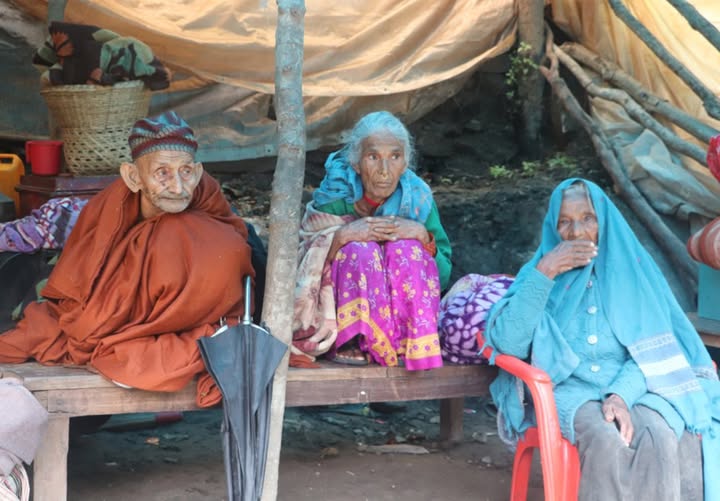
Senior citizens of Mahakali Shribagad spending the night under tarpaulins after floodwaters from the nearby Nijangad River entered the village in Aug 2021. Photo: Narendra Singh Karki/RSS.
According to the Monsoon Climate Assessment released by the Department of Hydrology and Meteorology on May 8, below-average rainfall is predicted in most parts of the country this time. On this basis, it is assessed that the impact of disasters driven by heavy rainfall will be less compared to previous years. However, as there is a possibility of an increase in average temperatures across the country, the risk of monsoon-related disasters such as floods, landslides, inundation, land erosion, and flash floods due to glacial lake outbursts in high Himalayan regions remains. The rise in temperature also poses a risk of extreme heat or heatwaves in the Terai regions.
According to Bibhuti Pokharel, spokesperson for the Department of Hydrology and Meteorology, there is a 55 to 65 percent probability that maximum temperatures will be above average in the north-eastern parts of Sudurpashchim Province, northern parts of Karnali, western parts of Lumbini, and north-eastern as well as southern parts of Gandaki Province. This probability also exists in the western parts of Bagmati, eastern and western parts of Madhesh, and eastern as well as southern parts of Koshi Province.
During the monsoon period, there is a 55 to 65 percent probability of below-average rainfall in the southern parts of Karnali Province, eastern parts of Madhesh, southern parts of Koshi, and most parts of Lumbini Province. There is a 45 to 55 percent probability of below-average rainfall in the western parts of Madhesh Province, central parts of Koshi, and most parts of Sudurpashchim Province.
An analysis of this year’s monsoon forecast shows a similarity to the weather patterns of 2014, 2016, and 2022. According to Meteorologist Binod Pokharel, who is also an associate professor at Tribhuvan University, when El Niño developing in the Pacific Ocean is active, the rainfall system over South Asia, including Nepal, remains weak, thereby increasing the risk of drought during the rainy season. In a Facebook post on May 15, while making a seasonal forecast for the next six months, he mentioned that signs of a terrifying dry drought have appeared starting from the month of June. He wrote, “If the monsoon turns out dry, it could bring famine to South Asia itself.”
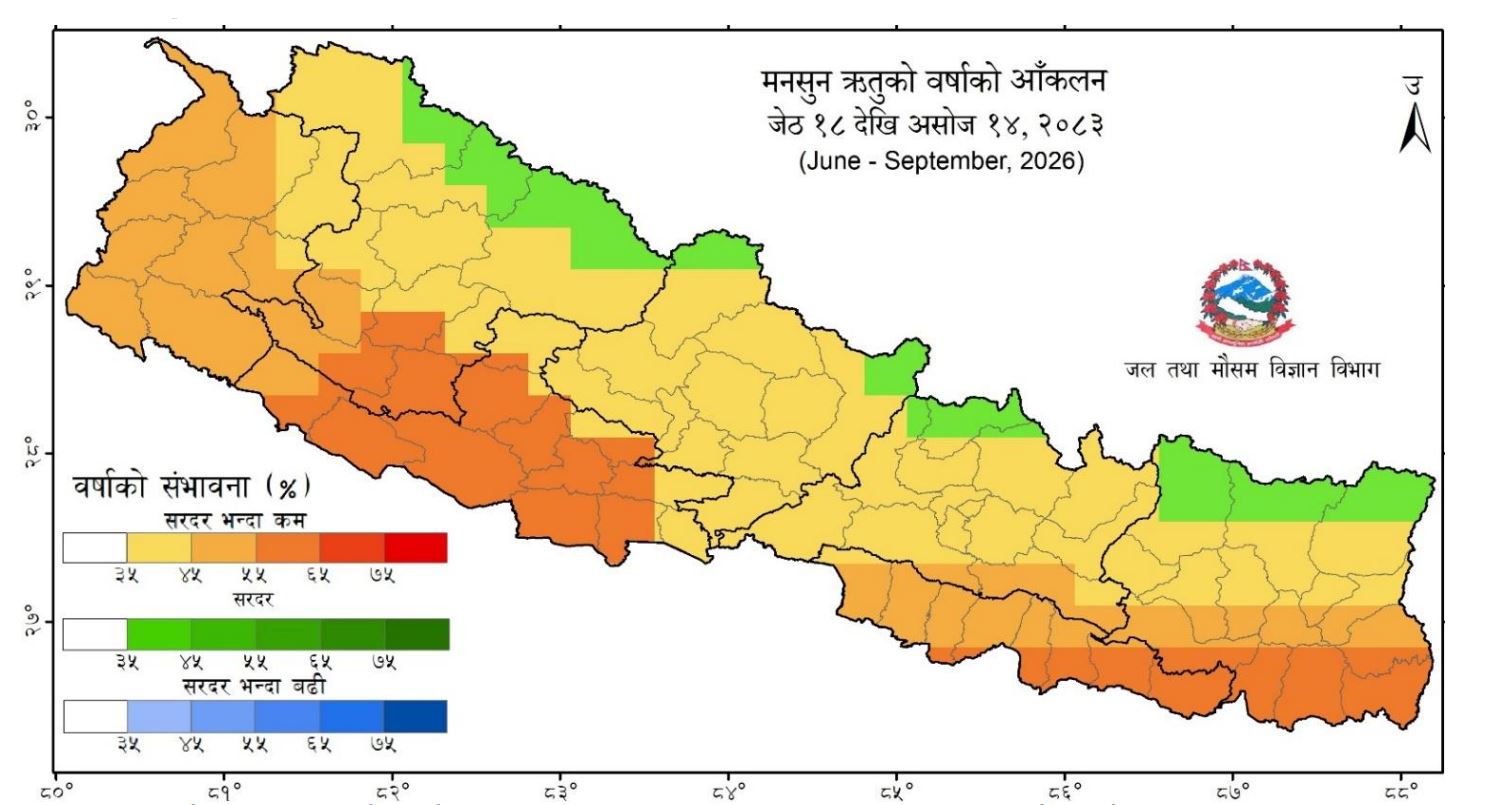
Photo: Department of Hydrology and Meteorology
During this year’s monsoon period, it is estimated that 226,661 individuals from 51,006 households across the country will be affected. Based on this, it is estimated that one thousand to four thousand families could be directly affected. “This is equivalent to about 10 percent of the scenario representing the worst-case situation,” the Authority’s action plan states.
During last year’s monsoon, 5,995 families across the country were directly affected by monsoon-related disasters. The most affected were 2,196 families in Koshi Province.
Around 80 percent of the annual rainfall occurs during the monsoon period. Generally, the monsoon process in South Asian countries, including Nepal, operates through seasonal influences brought by moisture-laden winds blowing from the Bay of Bengal. It enters through eastern Nepal around the end of mid-June. Spreading across the country within a few days to a few weeks, it remains active for about four months. After that, it exits via western Nepal in the month of October.
According to the Department of Hydrology and Meteorology’s records on monsoon arrival and withdrawal, the monsoon, which is normally active for an average of 112 days in Nepal, has started withdrawing 10 to 15 days later than usual in recent years. According to the analysis of the Department of Hydrology and Meteorology, the monsoon has withdrawn later than average since 2016, while it has been entering earlier than average since 2017.
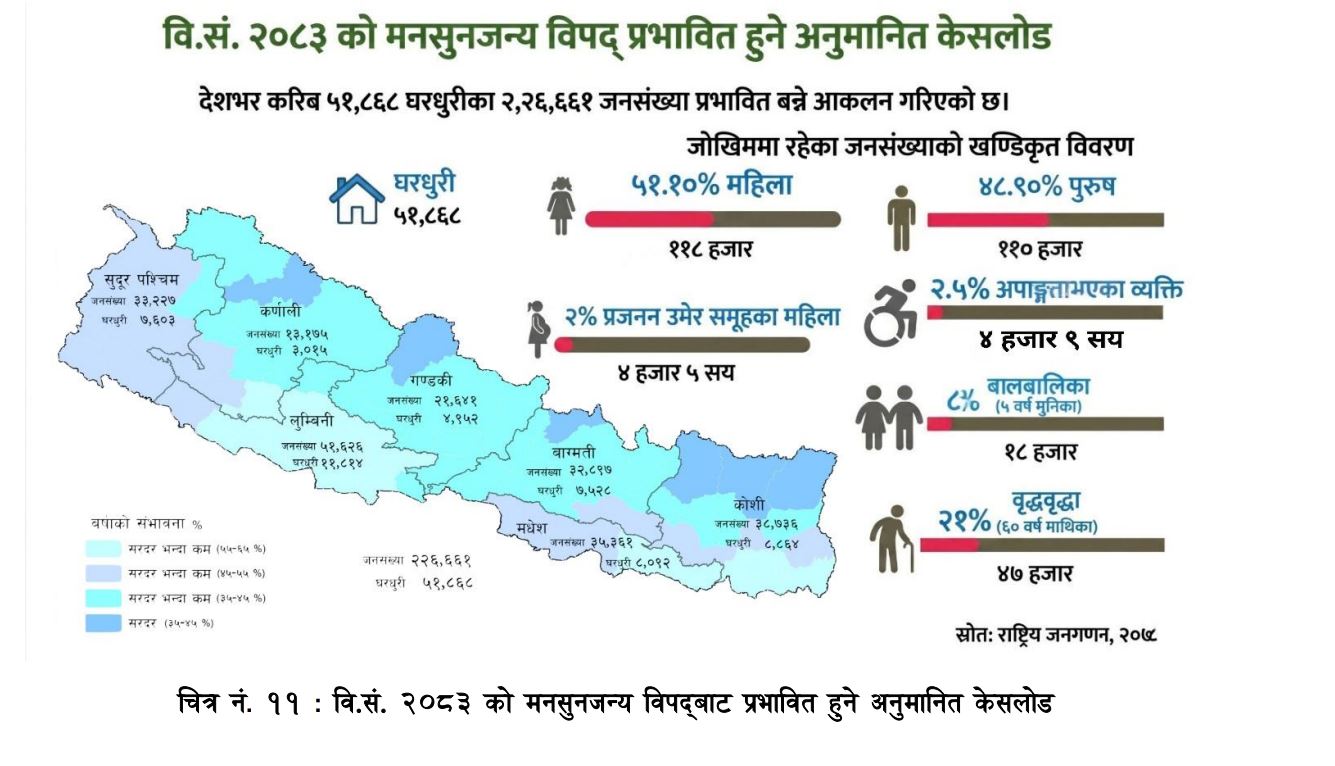
Photo: National Disaster Risk Reduction and Management Authority
In Nepal, heavy rainfall during the initial and final phases of the monsoon frequently causes floods, landslides, and inundations, resulting in massive damage. Due to climate change, extreme rainfall occurring within short periods is increasing the risk and uncertainty of floods and landslides.
Meteorologist Pokharel has stated that there is a possibility of this year’s monsoon entering Nepal about two weeks ahead of average. Last year as well, the monsoon had entered on May 29, 15 days ahead of average. It had withdrawn on October 11, eight days later than average withdrawal date.