Kathmandu
Tuesday, June 30, 2026





The government is searching for an implementation "modality" once more for a project that has been mired in studies, reports, and court battles for three decades.
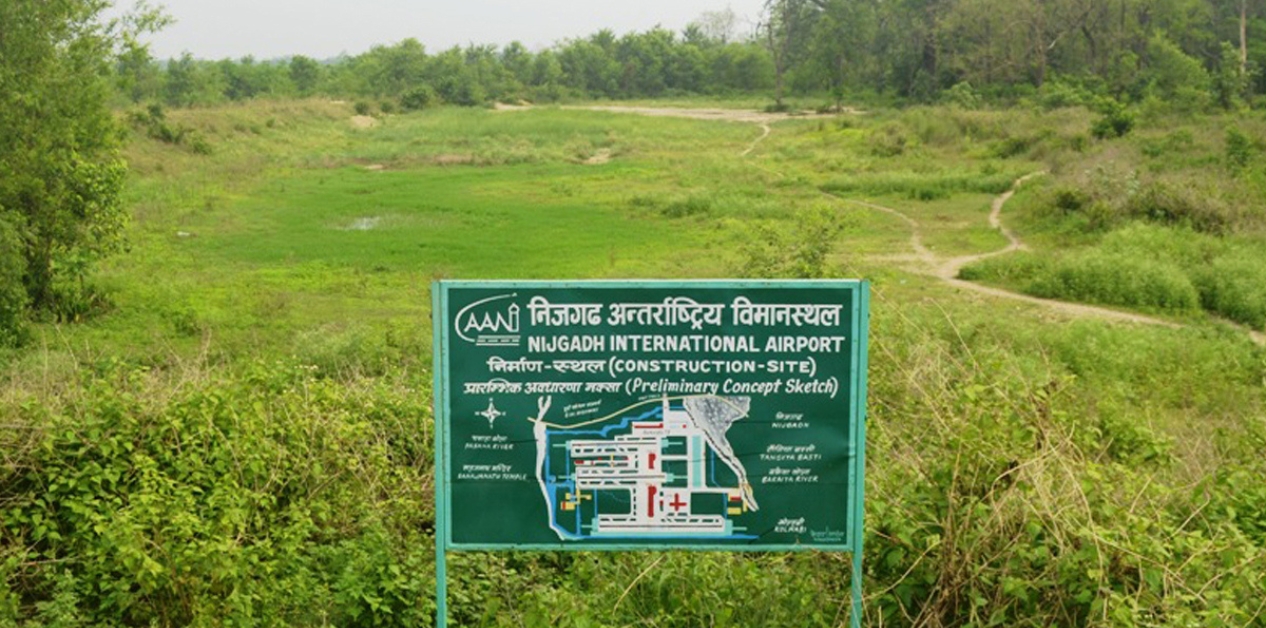
KATHMANDU: Through the budget speech, Finance Minister Swarnim Wagle has placed the Nijgadh International Airport in Bara back on the government’s priority list. Although he announced that the construction modality would be finalized within six months, the project—which has been stalled for three decades amidst studies, environmental disputes, court orders, and unimplemented reports—is still devoid of a clear direction.
It has been over three years since the Supreme Court ordered that the airport project proceed only after identifying a technically suitable location with minimal environmental impact. Yet, the government has neither clarified the total project area nor answered pressing questions regarding tree logging, environmental degradation, and the investment framework. Instead, by including it in the budget statement, the project has regressed to its archaic phase: determining the “modality.”
Immediately following the Supreme Court’s verdict on May 26, 2022, the government formed an expert group to conduct a study. However, that report remains unimplemented. Bikram Raj Gautam, spokesperson and director of the Civil Aviation Authority of Nepal (CAAN), states that there has been no concrete progress beyond what is written in the budget speech.
“Regarding Nijgadh Airport, the government has done nothing apart from what is mentioned in the budget statement,” he says. “The Authority will formulate and submit its policies and programs in accordance with the budget.”
Most recently, on August 10, 2025, the then Minister for Culture, Tourism, and Civil Aviation, Badri Pandey, had stated that the government would soon finalize the construction and operation modality of the airport. However, following the Gen Z protest on September 8 and 9, 2025, the government collapsed, and the work ground to a halt once again.
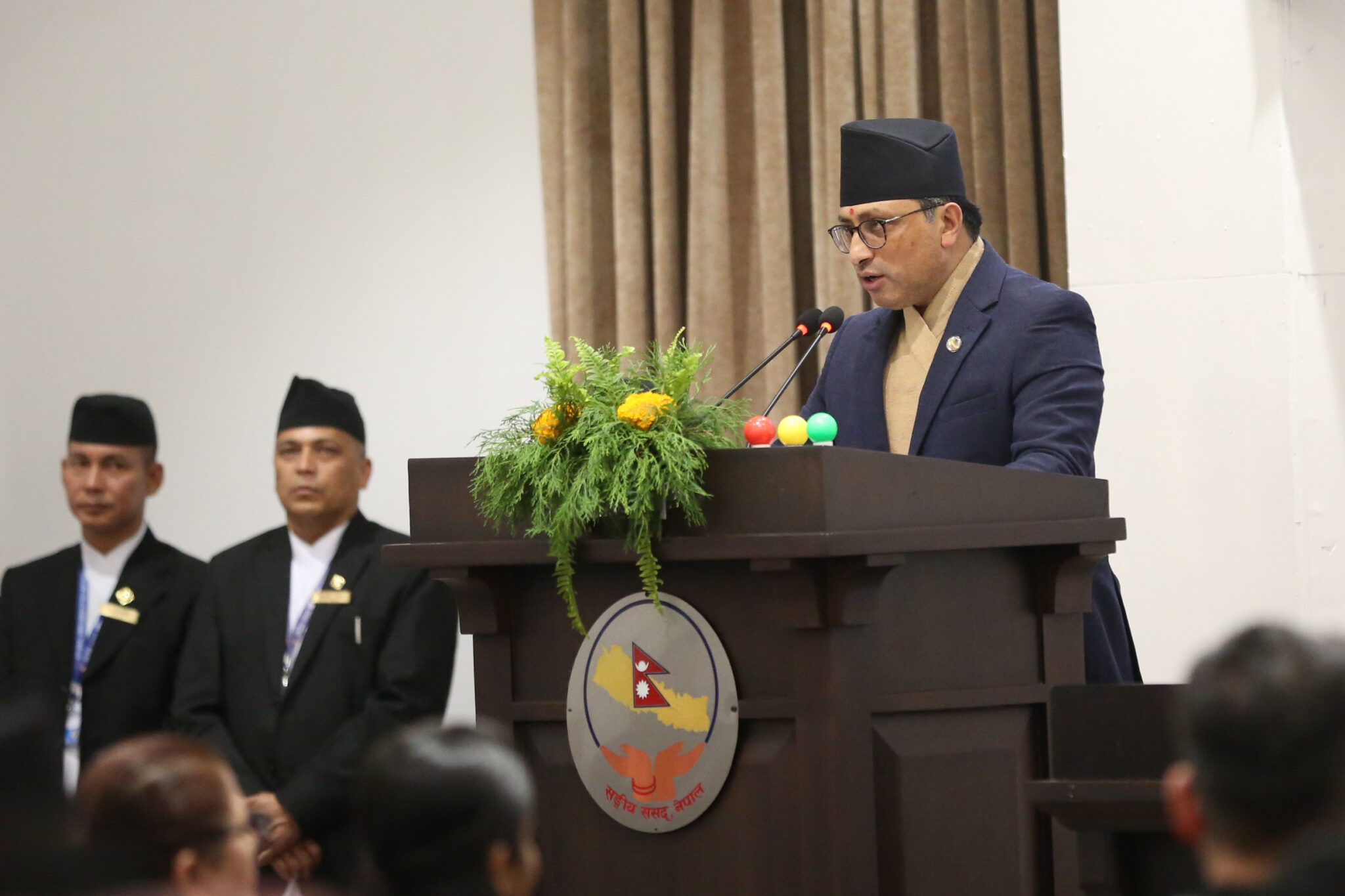
Finance Minister Swarnim Wagle. Photo: RSS
The government had formed an expert committee coordinated by Birendra Bahadur Deuja to study the construction of the international airport. The committee submitted its report to the then Prime Minister Sher Bahadur Deuba on September 18, 2022. The report warned that continuous delays in constructing the airport would escalate costs.
Following that, another committee was formed under the leadership of former Tourism Secretary Shankar Prasad Adhikari. That committee submitted its report on April 21, 2024, recommending that the airport be built under the ‘BOOT model’—Build, Own, Operate, and Transfer—where a private investor builds and operates the project for a fixed period before handing it over to the government. However, neither report has been made public.
History of the plan
The plan to build an international airport in Nijgadh is 31 years old. Seeking an alternative to Tribhuvan International Airport, the government of the day commissioned a study in 1995 across eight locations in the country for a second international airport. The study conducted by Nepal Engineering Consultancy Services Center Pvt. Ltd. pitched Nijgadh as the most viable location.
Even after that study, the project remained confined to paper for a long time. Roughly 15 years after the report was submitted, the Council of Ministers decided on December 17, 2008, to commission Landmark Worldwide Company to conduct a detailed feasibility study. An agreement was signed between the government and the company on February 25, 2010. The company submitted its report on August 2, 2011.
The report specified that the airport would require 24,045,000 square meters—equivalent to approximately 2,404 hectares—of land. It also stated that 2,450,319 trees would need to be felled in that area.
Deeming Nijgadh in Bara as the most suitable location, the Council of Ministers formally decided to build the international airport there on March 13, 2015. A master plan was prepared to build the airport on approximately 1,900 hectares out of the proposed 8,045 hectares. The government had also claimed that it had established a baseline standard requiring 10 saplings to be planted for every single tree cut down.
Subsequently, an eight-point Memorandum of Understanding (MoU) regarding tree logging and security surveillance was signed between the Nepali Army and the Civil Aviation Authority of Nepal on September 4, 2017. The Ministry of Forests and Environment approved the Environmental Impact Assessment (EIA) report on May 23, 2018, with a list of 15 conditions. However, various studies and reports began showing conflicting data regarding the land and forest area required for the airport.
Arguing that the EIA was deeply flawed and would cause massive forest destruction, Senior Advocate Prakash Mani Sharma, Ranju Hajur Pandey Chhetri, and others filed separate writ petitions in the Supreme Court. Following the registration of the writs on September 9, 2019, the Supreme Court issued an interim order to immediately halt all construction work related to the airport.
The writ petitioners claimed that deforestation under the guise of airport construction would inflict severe damage on the environment. They argued that the loss of carbon sequestration capacity alone could cause damages ranging from Rs 8 billion to 75 billion.
The supreme court’s verdict
The Supreme Court ruled that the government had failed to conduct adequate studies and adopt sufficient environmental safeguards while moving forward with the Nijgadh Airport project. However, the opinions within the five-judge Large Full Bench were divided.
Justices Ishwar Prasad Khatiwada, Prakash Man Singh Raut, and Bishwambhar Prasad Shrestha opined that since the environmental damage of building the airport in Nijgadh would be excessive, an alternative location with lesser impact should be sought. On the other hand, Justices Hari Krishna Karki and Manoj Kumar Sharma opined that the airport could still be built around the Nijgadh area by ensuring minimal environmental damage.
In its final verdict on May 26, 2022, the Supreme Court issued a mandamus order instructing the government to: “Ascertain where, in which location, on how much land, and of what capacity the international airport needs to be built, and to undertake or cause to be undertaken the construction of the airport at a technically feasible location that ensures minimal environmental damage.”
The verdict noted that out of the 80,457,900 square meters of land, approximately 79,900,000 square meters consisted of trees, plants, and forest. The court highlighted that the area was home to numerous wildlife species, vegetation, and a distinct ecosystem.
The Supreme Court further pointed out that the presence of rich biodiversity, including a massive, 200-year-old Bhim Sakhuwa tree, was a proven fact in that region. The court concluded that the Environmental Impact Assessment report failed to provide sufficient, logical arguments regarding the consequences of destroying such natural heritage and its alternative management.
“Development work is not merely a matter of desire, whim, impulse, or emotion; it is an issue that must remain objective, realistic, fact-based, justified, and sustainable,” the Supreme Court interpreted.
The three-decade-old Nijgadh Airport project has now once again regressed to a single line in the budget speech. But even though the government claims it will finalize the modality within six months, core questions regarding the Supreme Court’s order, environmental damage, clarity on total land area, tree logging, and the construction framework remain completely unanswered.