Kathmandu
Thursday, July 16, 2026





Even if others transformed the geographical term "Sindhu" into "Hindu" and later gave it a religious meaning, once the community itself accepted the name, others had little choice but to recognize it in the same way.
KATHMANDU: The term ‘Hindu’ is currently used to denote a specific religion-sect or the followers of that religion. Although it appears as if this word has been used in this same sense since ancient times, that is not the case. The word Sindhu, which was prevalent as a geographical term, eventually changed in pronunciation over time to become ‘Hindu’.
There are many questions and commentaries stating that this word is not mentioned in any ancient Hindu scriptures, nor has it appeared in the scriptures of other religions. Both proponents and opponents are found to interpret it to their own advantage. However, this is an ancient word, and if its antiquity is not brought into publication, the endless debate regarding this matter will seem to drift across various levels.
Matters of Hindu religion-philosophy are written in the Sanskrit language, but the use of the word ‘Hindu’ is not found in those religious texts. Because of this, some people hold the concept that ‘Hindu’ is a new religion. However, it is not just two or three hundred years old, as critics claim. The Vedic religion, which has been in practice since the Vedic period, was later named Hindu.
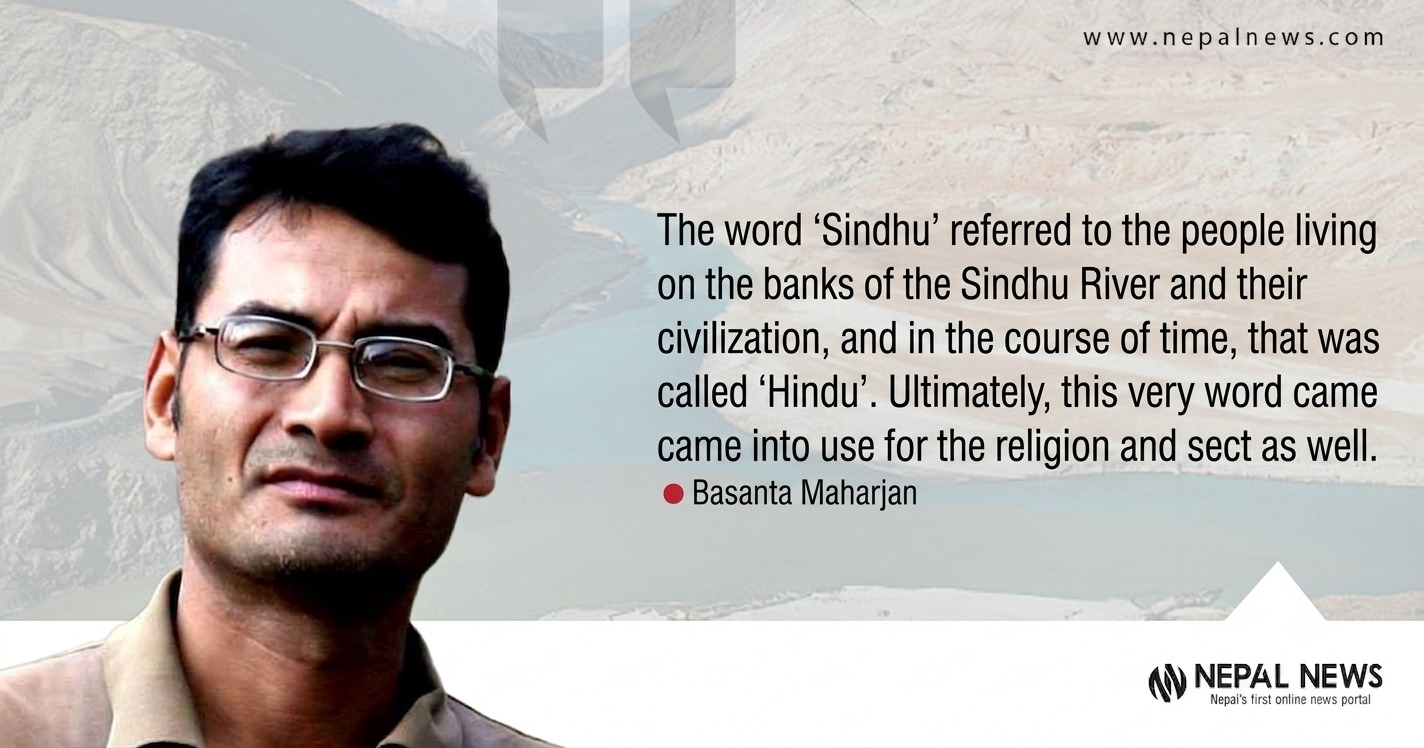
Let us discuss how the ancient word ‘Sindhu’ came to be called ‘Hindu’ over time. The origin of Hindu from the word Sindhu occurred due to geography and changes in pronunciation. The word Sindhu referred to the people living on the banks of the Sindhu River and their civilization, which in the course of time came to be called Hindu.
The inhabitants of this region were identified by the name of the Sindhu River (modern-day ‘Indus’) mentioned in ancient Vedic texts. In the ancient Persian language, there was a tendency for the Sanskrit ‘S’ sound to change into ‘H’. For example, the Sanskrit ‘Sapta’ becomes ‘Hapta’ in Persian. It is through this process that ‘Saptaha’ came to be called ‘Hapta’ (week). Similarly, the word ‘Sindhu’ became ‘Hindu’ in Persian.
Initially, this word referred only to the Sindhu River and its surrounding areas (modern Punjab, Sindh, and northwest India). The Persians considered the Sindhu River as the boundary and began calling a certain specific region beyond it ‘Hindustan’ (the land of Hindus, meaning the land of Sindhus). Later, the word Hindu began to signify the entire Indian subcontinent.
The use of the word ‘Sindhu’ is found mentioned more than 150 times in the Rigveda. It is mentioned in that manner to denote the Sindhu River and this region. ‘Sindhu’ has not been used there as a religious identity. In other Vedic literature as well, particularly in the Samaveda, Yajurveda, and Atharaveda, the word ‘Sindhu’ is found used only in a geographical context.
The ‘Hapta Hindu’ is mentioned in the Avesta, the core text of the Persian religion (Zoroastrianism). This terminology is a synonym for the Sanskrit language’s ‘Sapta Sindhu’. It denotes the Sindhu River and its tributaries. The mention of the word ‘Hindu’ is found in the ‘Yasna’ section of the Avesta. The word ‘Hindush’ is found used in the inscriptions of Darius I (522-486 BC). This word was used precisely to understand the Sindhu River region. A geographical and administrative context is understood in this.
The context of when the word Hindu began to acquire a religious context or meaning is important and interesting. This word, which once gave a geographical meaning, acquired the meaning of religion only in the medieval period. In the medieval period, especially during the time of Islamic invasions and rule (8th-11th century), it took concrete form as a religious sect.
The Persian scholar Al-Biruni, in his text Kitab-ul-Hind (circa 1030 AD), used the word ‘Hindu’ as a cultural and religious identity of the inhabitants beyond the Sindhu River. He described the word Hindu as a community that believes in the Vedas, Puranas, and other philosophical traditions. He conducted the most detailed study regarding the use of the word Hindu as a religious community. Al-Biruni described various aspects of Hinduism such as karma, moksha (salvation), and idol worship.
In the eighth century, Arab invaders (such as Muhammad ibn al-Qasim) and later Turkish rulers addressed the inhabitants of Sindh and Punjab as ‘Hindu’. However, at that time, Hindu was also used in the sense of the inhabitants of India.
In the colonial period (18th-19th century), British and other European scholars used the word ‘Hindu’ even for the non-Muslim, non-Christian, non-Jain, and non-Buddhist communities of the Indian subcontinent. In fact, when the British started the census in India, due to the lack of a clear definition of the Hindu religion, they kept Jainism, Sikhism, and Buddhism under Hinduism for a long time. This word began to signify various sects like Vedic, Shaiva, Vaishnava, Shakta, etc., in an integrated form. It is found that those who were called the Hindu community accepted this word gladly.
The work of defining the Hindu religion in the 19th century was done by Swami Vivekananda (1863-1902), Dayananda Saraswati (1824-1883), Raja Ram Mohan Roy, Keshab Chandra Sen, etc. Swami Dayananda Saraswati, the founder of Arya Samaj, brought forward the idea that it would be more appropriate to call it Vedic religion rather than Hindu religion. That is, Hindu religion and Vedic religion are the same, only the noun differs. However, the word Hindu itself came into prevalence.
Swami Vivekananda defined Hinduism as universal spirituality and tolerance, considering the Vedanta philosophy as the core soul of Hinduism. He presented Hinduism on the world stage expressing universality, tolerance, and respect for all religions at the Parliament of the World’s Religions held in Chicago, USA, in 1893.
According to him, Hinduism is a lifestyle that provides the realization of the unity of the soul and Brahma. Other thinkers also made extensive reforms in Hinduism, emphasizing education and morality, and interpreted it in a modern way. They raised their voices against social evils such as casteism, the Sati system, child marriage, and considered religion as an instrument of social reform.
Even if someone else turned the geographical name Sindhu into Hindu during the period that can be taken as the renaissance period, and even if they characterized it as a religion by altering the meaning of ‘Hindu’ which gave a geographical meaning, after the concerned community has accepted it, there is no alternative for the external party but to take it in the same form. The Hindu thinkers of that time presented Hinduism in a modern context by giving a new interpretation to it and connecting it with philosophy, ethics, and spirituality. This refutes the notion that there was no such thing as Hindu religion in the olden days and that it is a new religion developed only recently.
It must be understood that it was the Vedic religion before being given the name Hindu religion. However, understanding that it had modified itself a lot by the time it adopted the name Hindu and had come under the influence of Jain and Buddhist religious philosophies is another aspect of religious history.