Kathmandu
Tuesday, July 21, 2026





Although amendments can be made by forging consensus while remaining within a certain boundary designated by the constitution, the current Parliament does not possess the mandate and authority to overturn the constitution itself
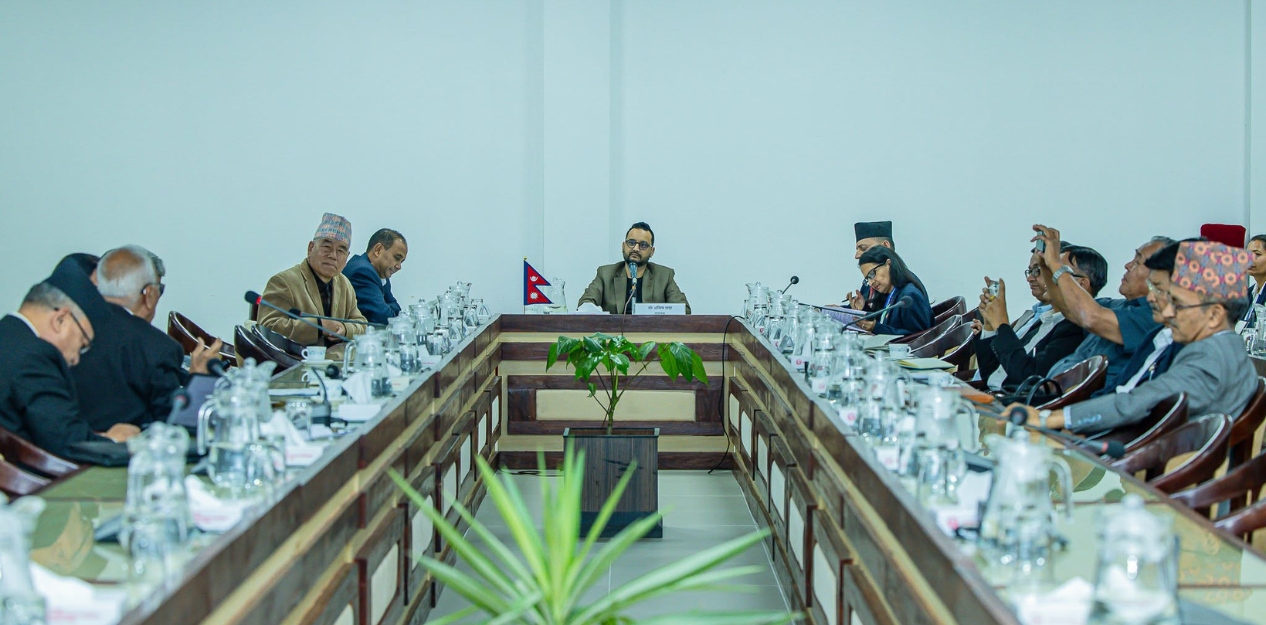
KATHMANDU: The government has initiated discussions with political parties and various quarters to draft a shared debate paper on amending the constitution, sparking a critical debate on whether the process entails an amendment or a complete rewriting. While a constitutional amendment remains legally permissible within defined limits, there is currently no mandate or authority to rewrite the nation’s core statute.
Through numerous movements, sacrifices, the 10-year ‘People’s War,’ and the joint people’s movement of 2006, the Constitution of Nepal, 2015, was formed after the election of the Constituent Assembly was held on the foundation of the Comprehensive Peace Accord. While taking the mandate of the people itself, the constituent assembly election was held precisely to formulate the constitution.
The constitution is made by the Constituent Assembly, and that is an important historical sequence of events. The election of the House of Representatives, meanwhile, keeps taking place from time to time. The election of the National Assembly also keeps taking place at the designated time. From the periodic election held on March 5, 2026, the parliament was elected to formulate policies and laws for legislative works. Acts and laws are formed under the purview of the main law, the constitution. Therefore, the House of Representatives elected to serve for five years does not possess the mandate to overturn or rewrite the constitution. Looking at the provision of the constitution, the authority to rewrite has not been given. It appears that amendment, however, cannot be done. Even while amending, the people have not given the mandate to the current Parliament to amend the basic aspects of the constitution. The values of fundamental rights cannot be changed. Article 274 of the constitution has designated the limitations that an amendment can be done in a manner not becoming adverse to the sovereignty, geographical integrity, independence of Nepal, and the sovereignty vested in the people.
In the fourth point of the 100 agendas of administrative reform made public by the government, it is mentioned to form a task force to prepare a constitution amendment debate paper to gather national consensus on matters connected with constitution amendment and to make the debate process participatory, transparent, and fact-based. After the task force was formed, discussions were held with various quarters, including the parties. However, due to the matter of the debate paper, rather than amending the constitution, it appears as though it is trying to conduct a debate centered on the upcoming local level and provincial assembly elections. If consensus happens among the parties for a constitution amendment, it happens; if not, it appears the government will take the matters that were not agreed upon into discussion through the process of election.
In the course of making amendments, the Council of Ministers has not come by making a decision or opening up the subjects. After the task force was formed, nothing has come as an exact proposal from the side of the government. In the course of discussion, we said that the process of amendment must be brought forward by remaining precisely within as much jurisdiction as Article 274 of the constitution has given.
The thing that the government needs to think about is that the constitution is not a subject to be fiddled with whenever one finds time. After fiddling with it, it must be brought to a logical conclusion. Otherwise, a risk can remain of fiddling with the constitution, opening it like opening a ‘Pandora’s box,’ and making it a prisoner of indecision. That can invite instability, anarchy, and conflict in the country. Since the matter of amendment is extremely sensitive, I feel that the government must have engaged in understanding it well.
Even then, our concern and question remain: Is now the appropriate time to fiddle with the constitution or not? Although we parties as well have written about constitution amendment in our respective election manifestos. However, the matter of writing in the manifesto and the matter of entering the process of amendment depend on the situation. We had asked whether now is a suitable situation or not. It has been said from the side of the government that on whatever number of subjects consensus happens, advancing that much may not bring trouble.
In the course of initial discussions, some constituents like Gyanendra Shahi from the side of the Rastriya Prajatantra Party (RPP) had raised the matter that since one gets to amend the constitution, then one must get to conduct an open discussion on all subjects such as republic, monarchy, federalism, and secularism, right? After that, the law secretaries had given the answer that Article 274 does not give the authority to touch upon the basic subjects, and one must remain limited within the horizon. Similarly, the Rastriya Janamorcha had asked whether it has become the time to review federalism or not. In that too, the secretaries clarified that federalism can be made systematic, effective, and dynamic; things like adding jurisdiction can happen, but the constitution has not given the authority to alter federalism itself.
In the course of the discussion on the debate paper connected with the constitutional amendment, a questionnaire has been prepared from the side of the government regarding the governance system, election system, number of seats of the House of Representatives, whether MPs can become ministers or not, number of seats of the provincial assembly, reform of the judiciary, whether to keep the Constitutional Council or not, how effective to make the Hearing Committee, and whether to keep a Vice President or not. Some have already given suggestions. Some political parties are working by forming a committee. We are in the course of discussion. The Nepali Congress has not even participated in the debate paper preparation task force and discussions connected to this.
During the course of the constitution formulation of the year 2015, the Rastriya Swatantra Party (RSP) was not there. It does not appear to have advanced with that much commitment in favor of the constitution and this system. At the time of the Gen Z protest, things up to abolishing the constitution altogether were also heard. It is understood as if the constitution and the amendment have been taken lightly. Only those who made it know how the constitution was formed.
Since the constitution is a dynamic document, it is not that it cannot be amended at all or must not be done at all. This very constitution has made the provision that amendment can be done by remaining within one boundary. Staying in that very horizon, amendment can be done, but the authority to rewrite is not there at all. The mandate given by the people through election is to make acts and laws and run the government. The House of Representatives does not get to overturn the constitution itself.
(Based on the conversation conducted by Special Representative Bhasha Sharma of Nepal News with former Law Minister and leader of the Nepali Communist Party Gurung.)