Kathmandu
Tuesday, July 21, 2026





Forced displacement is not a solution for those who have nowhere else to go; treating the landless as encroachers ignores their structural struggles and fails the constitutional promise of fundamental housing rights
KATHMANDU: When Balendra Shah (Balen) was the mayor of Kathmandu Metropolitan City, he did not treat the urban indigent populations and menial laborers well through the municipal police. For this reason, when he was made the prime minister candidate from the Rastriya Swatantra Party (RSP) in the last parliamentary election, fear increased among the landless settlers. During the election campaign, when Shah reached the landless settlements of Jhapa, he did not only listen to the problems but also asked how to solve them. He also gave a promise to solve the problems in 1000 days. This gave a glimmer of hope to the landless community, who had been waiting for landownership certificates for years, that something might happen.
On the other hand, in Chitwan, RSP Chairman Rabi Lamichhane had said, “If someone comes to evict the squatter settlement, I will come first to offer my chest.” This ignited trust toward the RSP among the landless settlers. That was also manifested in the electoral votes.
It has been a month and a half since the RSP took power. The 100 agendas of governance reform brought by the government were indeed praised. In that, the subject of announcing reform-oriented programs along with a formal apology within 15 days, acknowledging the injustice and discrimination that has been happening against the Dalit and marginalized communities for centuries, had gained popularity. RSP Chairman Lamichhane’s refined presentation on the day of the first meeting of the new Parliament earned praise. The hope that something would now happen had become even wider.
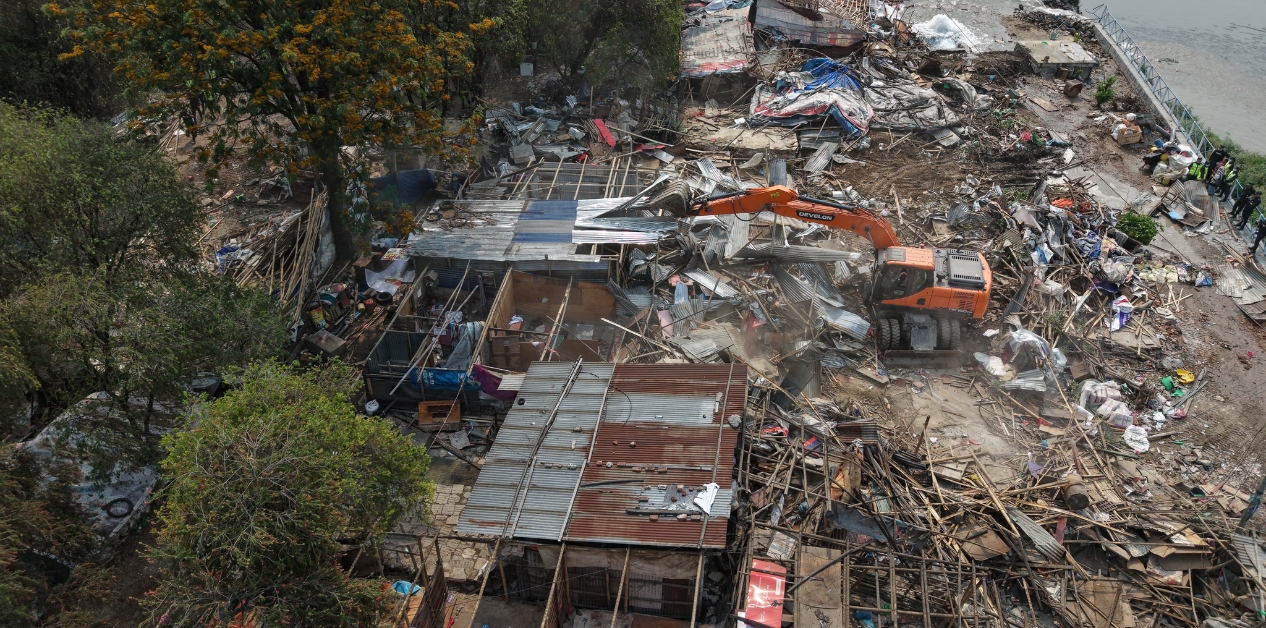
Around 9 PM on the night of April 22, news started trending that Prime Minister Shah called the security chiefs and told them to vacate the ‘encroached’ squatter settlements on Saturday and Sunday. It was a matter of great concern that the head of the government, who should protect citizens, himself gave orders to demolish the houses of citizens. This was the matter of Wednesday evening. On Thursday, a command was issued through microphones in the squatter settlements to vacate the huts by Saturday morning. On Saturday morning, before the sun rose, bulldozers ran in the settlement by mobilizing a large number of security personnel. Neither was a notice pasted anywhere, nor was any time for preparation given. Nor was there any dialogue. Running bulldozers on the housing of one’s own citizens was entirely wrong. With what heart would Prime Minister Shah, who is also an artist, have given instructions to do such a thing?
There are not the same types of people living on government land. If some people were living there by capturing it despite having houses and land elsewhere, they should have been selected and punished. What was the fault of the landless and urban poor who came and lived in the settlement after suffering many blows and hardships because no other way worked anywhere? What was the reason that they had to be treated like anti-nationals?
Some have argued that if they had not been forcibly removed like this, the eviction of the squatter settlements would not have been possible, and requests and notices were not going to work. However, this problem could be solved through dialogue. If the local level had performed the task of taking records according to the procedure prepared by the Land Commission in accordance with laws and rules, a door would have opened to relocate and manage the landless and unsettled residents in a dignified manner.
Nepal is a country where social security programs are weak. There is no reliable employment. Cheap and affordable housing programs have not been operated. Education and health are very expensive. In such a situation, where do poor people stay?
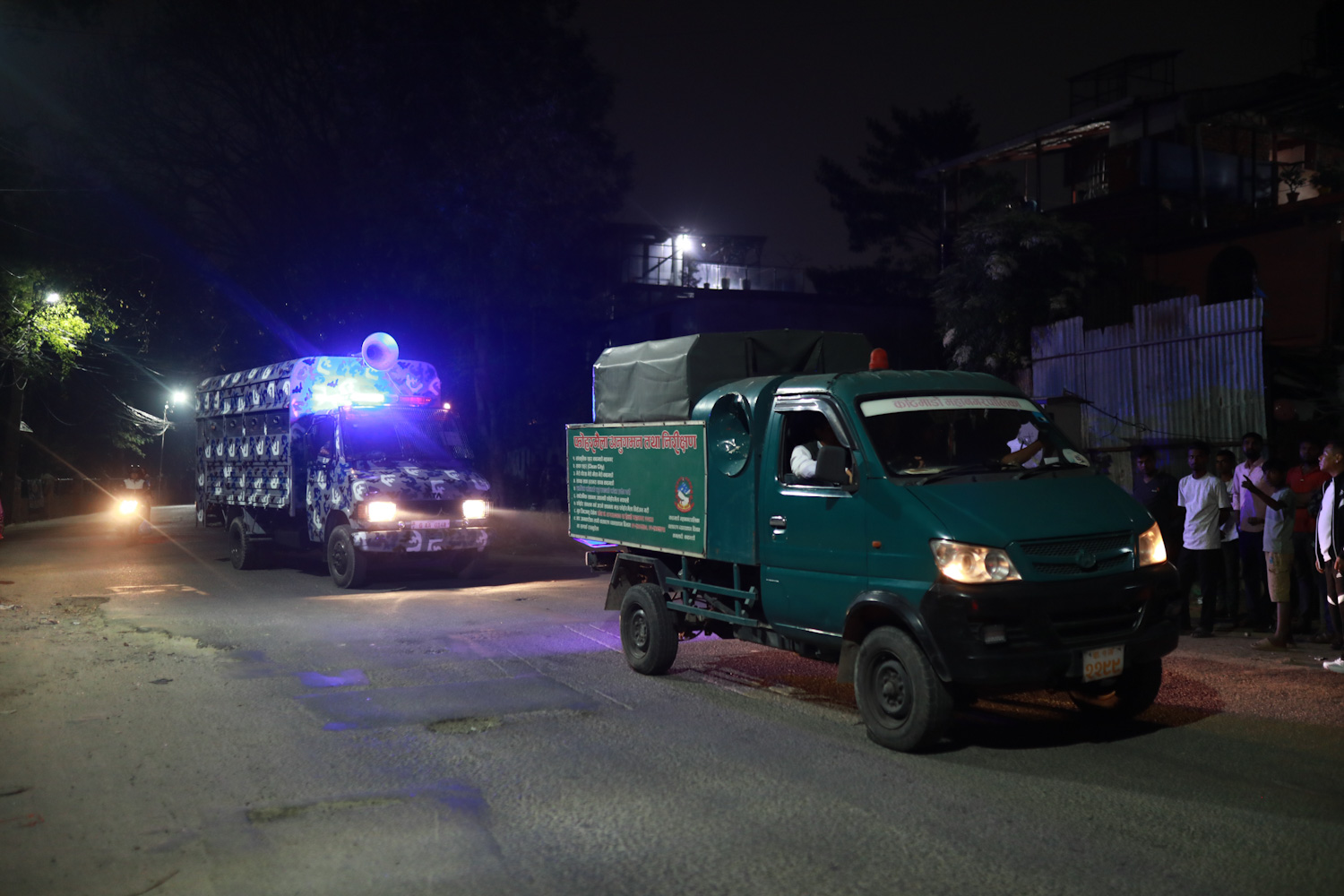
Municipal Police announcing the eviction order at the Thapathali squatter settlement. Photo courtesy: Nepal Photo Library
Many are heard saying the following:
-Just because one doesn’t have a house, should they encroach on government land and stay? In that case, I also don’t have land in Kathmandu; I am also staying by paying rent. I am also landless. If one were allowed to occupy such empty land and stay, I would also stay!
– They are wearing good clothes, how are they squatters?
With what humanity would this have been said? To understand this subject, go to the ‘holding center’ where the displaced landless settlers are temporarily kept and listen to the story of at least one or two individuals; the answer to all doubts will be found.
The Dalit and other marginalized communities, who were staying with hope for compensation for historical injustice from the government, instead faced displacement. For Dalits, it is difficult even to get a room. What kind of thing is this? Why was it done? In the name of proving the justification for this displacement, a very inconsistent argument has been made that they were removed to be managed in a safe place so that disaster does not occur in the coming monsoon. Why would such an argument, which no one believes, be made? At least it would have been better if the chairman of the RSP had not spoken like this. What would have forced them to speak such a lie?
Families who have been living for years on government land in various locations of Kathmandu had pleaded, “Let our records be taken; let there be an investigation. Let us stay here if possible. If not, make arrangements elsewhere.” This is all they said. How good it would have been if their records had been taken in the settlement itself according to the existing acts, rules, and procedures? Furthermore, if photos had been taken including the house and, as far as available, the family members of that house, it would also have been easy to distinguish between the real and the unreal. This work should have been done by the local government. The weakest class, whose house has been demolished, has to stand in line at the stadium to register their names. And that too with the Kathmandu Valley Development Authority? The very authority that wanted to demolish their settlements for many years. In this regard, it is clear that the Metropolitan City has failed to fulfill its guardian role toward marginalized citizens.
Forced displacement can only be for encroachers whom the state does not need to manage. There is a method for that too. Which law and rule has allowed taking landless Dalits, squatters, and unsettled residents out of their existing residence and keeping them in a holding center? The meaning of this became clear: there are indeed landless people there, and is it right for the state to give them trouble?
In urban settlements, there are small and large unsettled residents. Again, we are not citizens of a wealthy country either. Citizens of a country where a fourth of the population is poor come to the city in search of a livelihood. Even those from within the city end up becoming homeless.

Holding Center. Photo: Lokendra Bishwakarma/Nepal News
The number of our urban unsettled residents is not large. In many other countries, this problem is dire. In the 2017 data of India’s Odisha state, two million people were living in an unsettled manner in 2,900 places. There were problems with drinking water, toilets, and sewage in the settlements. People didn’t even have a place to stand like this. The Odisha government is working hard with a concrete plan to change such unhealthy life, informal settlements, poverty, and social exclusion. And it is also becoming successful. For this, the government has operated the ‘Jaga Mission’ campaign. There, the work of land rights, housing improvement, and their empowerment has been taken forward together.
The Odisha government has not taken the urban poor as a burden. Rather, they have been taken as the backbone of urban area development. On a large hoarding board kept in Odisha’s capital Bhubaneswar, it is written, ‘The value of life is more than the value of land.’ Displacement of the urban poor or empowerment? We decided to empower them by ensuring land rights.
The post made on social media by the then chief minister Naveen Patnaik after the decision in the Council of Ministers meeting regarding the Jaga Mission to provide a suitable living environment with dignity to the urban poor is also very touching. In which it was written, ‘Today’s Council of Ministers we have dedicated to the people who played on the land to make the lives of our cities vibrant.’ Urban poor who keep our houses safe and comfortable. Only through their sacrifice and hard work does the kitchen run. The garden blooms. The city breathes and we feel safe. For them, we have decided to operate a mission to provide land and housing rights.’
Forced displacement is violence. Whether a solution to any problem will happen or not largely depends on how the agencies sitting in the state view that problem. In that too, how the people’s representatives and employees in the government understand it makes a difference to a great extent. Here, primarily, the perspective toward looking at the urban poor and squatters has been made wrong. No one has discussed how they are contributing to the house, family, society, and country. As far as possible, only sarcasm is used; using various words, they are made objects of jokes, and only defamation is done.
The task of taking records and verifying landless Dalits, landless squatters, and unsettled residents mentioned in point no. 91 of the government’s 100-point governance reform was very important. The government’s attention should have gone toward completing this. The depth in which work should have happened in this has not happened. The point in no. 92 regarding immediately vacating encroached land was brought into implementation. No law has said that citizens who sought the right to housing are encroachers. Is keeping land more than the ceiling a capture or not? Yes, if the government wanted, it should have been able to take this land back.
Currently, the core concern of the displaced community is how they are going to make arrangements for employment, children’s education, and permanent residence. Now, those who evicted them might also feel that managing this is not easy. It is not difficult to demolish. It is difficult to build. After demolishing, one must also manage. For this, there must be a special branch for the management of unsettled residents within the metropolitan city. That branch should work by even collaborating with the organizations of urban squatters and their leaders. Also, it may be necessary for the government to bring a separate act for their management. Fundamentally, until they are managed in permanent residence from the holding center, how do you manage? For this, how much the current rules and laws cover or do not cover should also be studied.
Currently, the core concern of the displaced community is how they are going to make arrangements for employment, children’s education, and permanent residence.
The records and investigation taken by the government must be transparent and impartial. Force should not be used to show a small number. If investigation happens only by seeing whether land appeared or didn’t appear somewhere in the software system of the Department of Land Management and Archive, it will be another injustice. It should be seen for how many years they have come to Kathmandu and what the employment is. Some difference can be made in the facilities given to those who have land and those who don’t, but the matter of sending them back to the village is not judicial. For those who have no other way, the government must arrange land and housing if possible, and if not, housing and employment.
This is a matter of the immediate present. Overall, it is necessary to address the problem of urban unsettled residents, semi-urban and rural area landless squatters, and informal residents by analyzing the structural reasons. Work without deep study and sufficient preparation might calm yesterday’s ‘ego,’ but the wound in the hearts of the landless and urban poor will never heal.
This issue of landless and unsettled residents should go toward a solution, not toward complicating the problem, through the efforts of the government, political parties, provincial governments, and local governments. The government must ensure that there will be no forced displacement. Collaboration for rehabilitation should be taken forward by building a reliable environment with those who have already been displaced.
Forced displacement is not only losing a house or land. It is also losing security, respect, identity, and hope. The effects of forced displacement are extremely serious and long-term. Families lose not only their house but also their livelihood, social relationships, children’s education, and access to drinking water, sanitation, and health services.
The solution is not in displacement but in inclusion. The government should prioritize poor-oriented land reform, affordable housing programs, settlement regularization through land use planning, and community-based development. Forced displacement is not just a technical or administrative subject. It is a question of humanity, justice, and equality. A just society should not make citizens further weak in the name of development but should work to make their lives safe and dignified. In a country where rights and respect are guaranteed, a situation should not arise where any family has to cry for shelter. The solution should be done through dialogue, not by a bulldozer.
Any modern state can never move forward in civilization and development by further victimizing and insulting those living at the bottom of society. The matter of the state, which should protect citizens, making citizens themselves displaced and homeless, is something that cannot even be imagined. Since tradition, it has been said that there is humanity in Nepali society. Today, let work not be done from the state’s side to prove that wrong. In the name of protecting government land, no one has the right to violate fundamental rights such as housing, food, education, and employment for citizens.
(Deuja is a land rights activist.)