Kathmandu
Saturday, July 4, 2026





Balen Shah's government has shown signs of administrative momentum, yet its governing style, marked by ordinance rule, parliamentary disengagement and pressure on independent institutions, has become the bigger story

KATHMANDU: Three months ago, Balendra Shah (Balen) stepped into Singha Durbar carrying the strongest parliamentary mandate any Nepali prime minister has held in the federal era, a near two-thirds majority born out of a youth-led backlash against the country’s established political class. The expectation attached to that mandate was straightforward: that a leader untethered from old party machinery would use his numbers to reinforce the institutions he had promised to fix, not sidestep them.
A hundred days later, the picture is mixed. There is real delivery in a few narrow areas, but it sits beside a consistent pattern of behaviour toward Parliament, the opposition, the press and some of the country’s poorest citizens that has left even patient observers uneasy.
Assault on parliamentary dignity?
The government chose, on its own terms, to be judged on legislation. It set itself the goal of enacting a dozen laws within its first hundred days, part of a widely publicized hundred-point programme. By the close of that period, only three laws had actually taken effect, and two of those were amendments the government inherited rather than authored, originally issued as ordinances by the outgoing caretaker administration before the election and simply carried through Parliament by the new one.
The single genuinely new law to pass was a piece of legislation on alternative infrastructure financing. Everything else on the list, a national integrity policy, a federal civil service law, measures on digital governance, data protection, urban development, waste management and corporate responsibility, remained stuck somewhere between drafting and silence.
What filled that gap was not debate but decree. Having summoned a session of Parliament, the government abruptly postponed it days later, and used the intervening period to push through roughly eight ordinances covering matters as varied as anti-money-laundering rules, the functioning of the Constitutional Council, procedures for removing public office-holders, procurement reform, and the abolition of trade-union rights for civil servants and teachers.
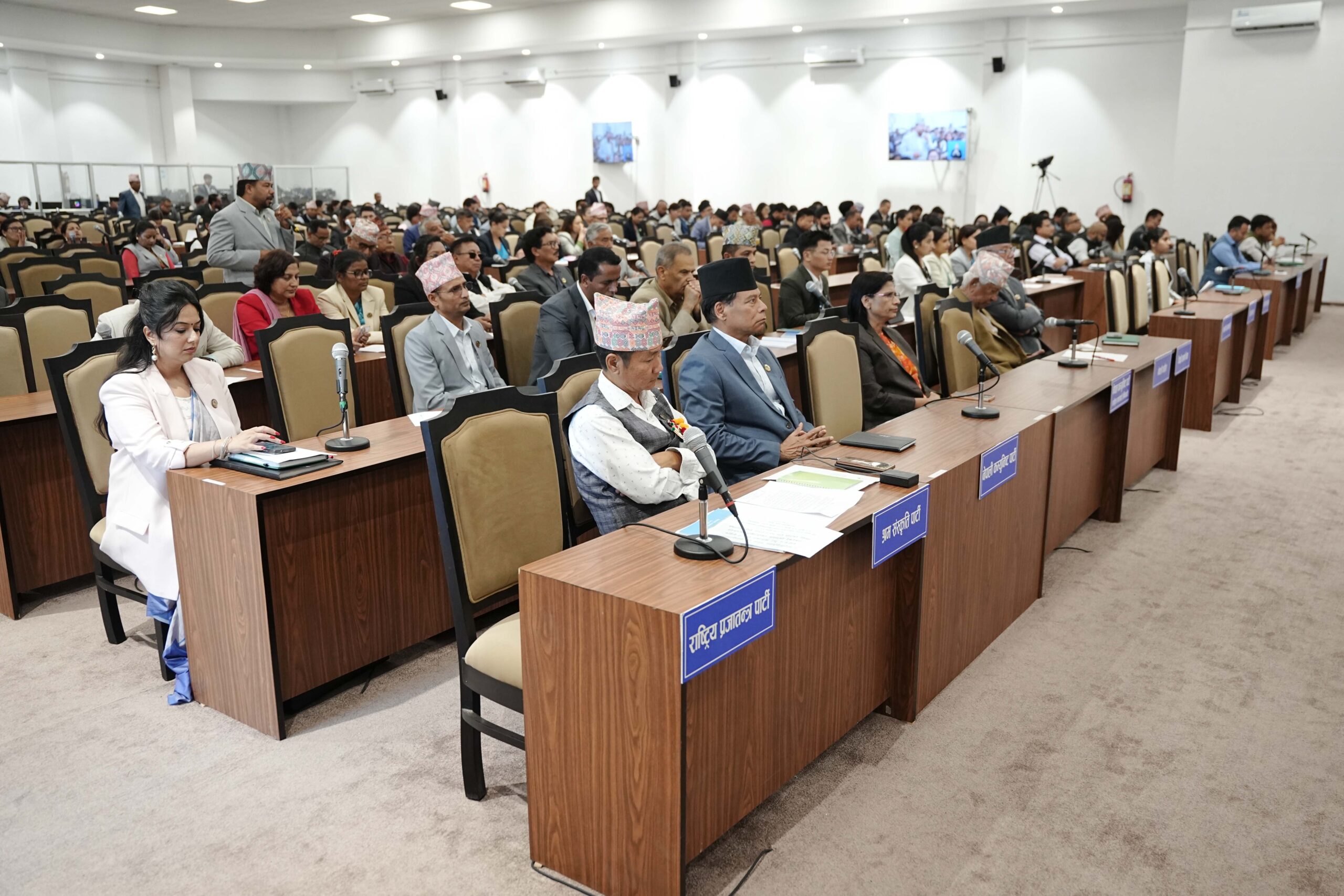
HoR meeting on Wednesday (June 17, 2026). File photo
The leader of the largest opposition party has argued from the floor that suspending a session it had itself called in order to legislate through more than a hundred and fifty separate ordinance provisions amounts to an assault on parliamentary dignity, warning that the long-term damage such a habit could do to democratic practice would be difficult to undo. The government’s own chief whip in the House takes the opposite view, insisting that the pace of ordinances reflects urgency rather than avoidance, and that a young, largely inexperienced Parliament has nonetheless managed to debate a full budget and multiple bills in its first two sittings.
What makes the pattern notable is precisely that the government did not need to govern this way. With almost two-thirds of the seats in the House, it could have passed nearly anything it wanted through ordinary legislative process. That it chose ordinances instead, even while holding the numbers to avoid them, is what has drawn the sharpest criticism, including from within the opposition benches, where it has been read as evidence that the government does not trust the very chamber it dominates.
A prime minister absent from his own parliament
If the reliance on ordinances raises questions about intent, the government’s handling of parliamentary attendance raises questions about temperament. Shah did not address the very first sitting of the newly elected House on April 2, a decision that startled political observers precisely because such a step breaks with the basic courtesy every incoming prime minister before him has extended to a new Parliament.
A more serious moment followed roughly six weeks later. As the President stood before a joint sitting of the federal legislature to read out the government’s first policy and programme for the coming fiscal year, the prime minister rose partway through the address and left the chamber, not the building itself, but a private room set aside for him inside the parliamentary complex, where he remained while the head of state continued reading out his own government’s agenda to the assembled lawmakers. Neither the prime minister’s office nor his personal staff has ever offered a public account of why he left mid-address.
When the House later opened debate on that same policy document, he stayed away again, delegating the finance minister to answer questions on his behalf and declining to appear himself. By that point he had gone through two full sessions of Parliament without personally addressing the chamber even once since taking office, a pattern that struck many, including retired parliamentary officials, as unprecedented for a sitting head of government barely weeks into a term.
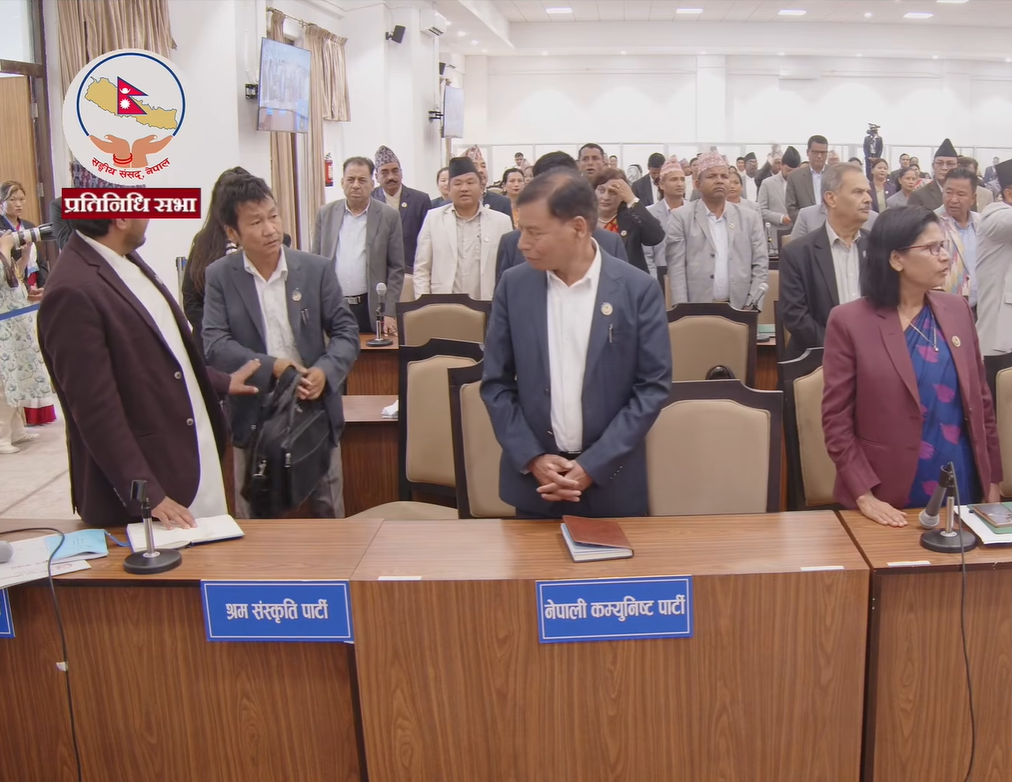
Chair Harka Sampang of the Shram Sanskriti Party walking out from Parliament on May 13 protesting PM Balen’s continued absence in HoR. File photo
The procedural gap that allowed this was real: existing House rules do not explicitly require a prime minister to appear in person during such debates, and the Speaker repeatedly declined opposition requests to issue a ruling compelling Shah’s attendance, citing a provision that permits delegation to another minister. Opposition lawmakers argued this reduced parliamentary scrutiny to a formality, asking why a prime minister confident in his own policy document should find it difficult simply to sit, listen and respond.
When Shah did eventually return to answer accumulated questions, the appearance produced the single most damaging episode of his tenure so far. Responding to lawmakers, he remarked that Nepal itself had, in certain places, encroached upon Indian territory along the shared border. The reaction inside the House was immediate and furious. The opposition’s parliamentary leader described the remark as irresponsible and humiliating, arguing that it damaged the country’s claim to disputed territories that the same Parliament had, in an earlier resolution, formally mapped as Nepali soil, and said that watching ruling-party members thump their desks in apparent approval was among the most painful scenes he had witnessed in his political life.
The fallout consumed weeks of the budget session. On the same day, physical disorder broke out on the floor as a new procedural rulebook was pushed through despite protests, with lawmakers shoving one another and climbing onto furniture before the Speaker forced a majority vote. Opposition parties refused for a long stretch to let ordinary business continue unless the prime minister returned to correct or retract his remark; the government’s position was that a clarification issued through the foreign ministry, describing the comment as a reference to cross-border occupation rather than any formal territorial concession, was sufficient. It took an unusual all-party meeting convened by the ruling party’s own chairman to partially defuse the standoff. Even so, the prime minister has not personally returned to the floor of Parliament since making that remark.
“We have not even been introduced”
The clearest illustration yet of how threadbare institutional courtesy has become surfaced only this week, not inside Parliament but in a meeting of the Constitutional Council, a body on which both the prime minister and the main opposition’s parliamentary leader sit. Discussing long-vacant leadership posts at the Election Commission, the opposition leader told Shah directly that in his capacity as chair of that council, the two men had never so much as had a formal introduction, that basic courtesies such as sitting down together over tea with council members had simply never occurred, and that while he knew the prime minister personally, no such relationship existed between them in their official capacities. He noted this was not the first time he had raised the concern, and expressed hope it would not need repeating a third time. He also objected to being asked to help recommend commissioners for a constitutional body without any prior consultation on the process.
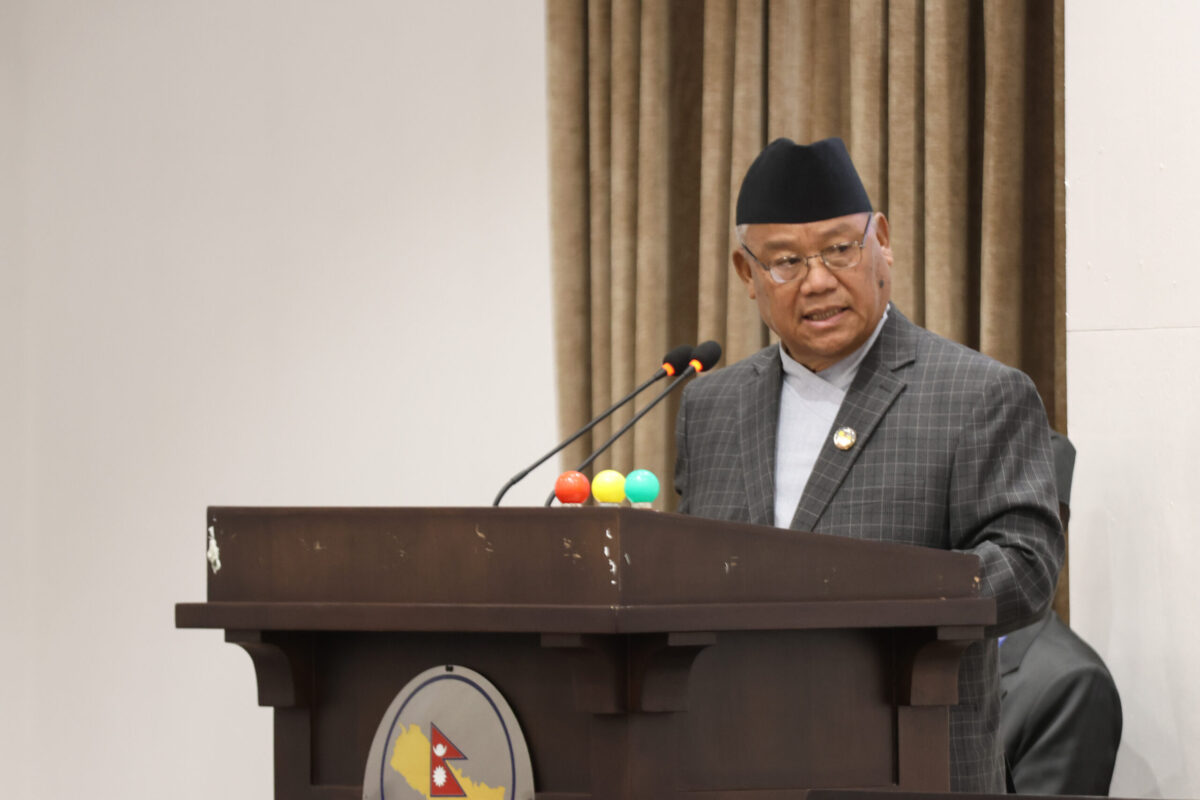
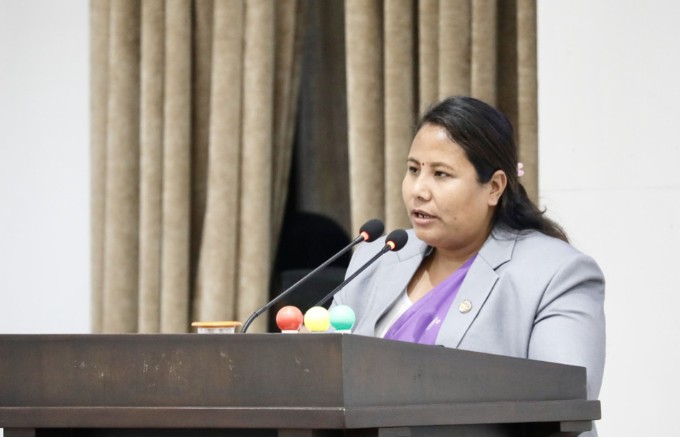
Nepali Congress parliamentary party leader Bhisma Raj Angdembe. File photo
Taken alone, this might read as a minor personal grievance. Set against the walkout during the President’s address, the boycotted first sitting of Parliament, and weeks of governing by decree while the legislature stood adjourned, it fits a wider picture that has been building for weeks: a head of government who, by multiple accounts, has yet to hold a single one-on-one meeting with any foreign ambassador since taking office, whose first substantive interaction with the leader of the opposition came only at that same council meeting nearly three months into his term, and who is known to most of the political establishment more through visible habits, sunglasses at public functions, a small and tightly guarded inner circle built around one long-time friend and adviser, than through any regular channel of engagement with the institutions and individuals he must eventually work with. Whether this reflects a genuine, if unconventional, governing style or a deeper discomfort with institutional accountability is a matter still open to interpretation. What is not in dispute is that it is an unusual way to begin a five-year term.
Bulldozers and the landless
The government’s handling of the country’s landless settler population shows the same duality running through its record elsewhere. Officials count the distribution of land tosettler communities among their flagship achievements of the first hundred days, alongside cooperative depositor refunds and a shift toward merit-based appointments in some public bodies. Yet the same policy has, in practice, produced demolitions that critics describe as carried out without adequate resettlement planning or basic humanitarian regard for the families affected.
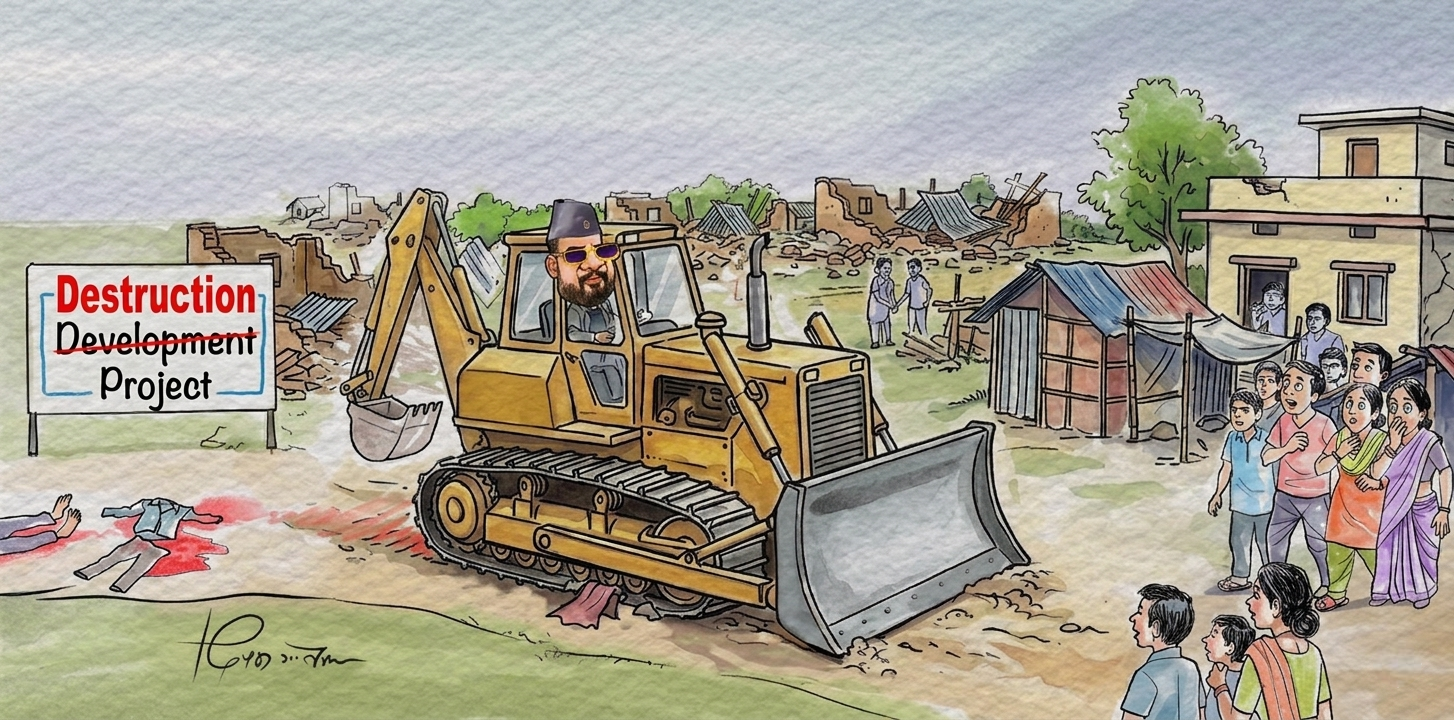
The opposition’s parliamentary leader has accused the administration of running heavy machinery through poor and informal settlements in a manner that trampled on ordinary human sensitivity, describing the state in that moment as acting less like a guardian to its citizens than like an agent of destruction. The tension is not unique to Nepal: formalizing land tenure and clearing informal settlement can be framed simultaneously as reform and as dispossession, depending on who is telling the story. So far, the government’s own communications have leaned entirely on the reform framing, while the human cost on the other side has been left largely undocumented by the state itself.
A press under growing pressure
Nowhere is the gap between declared good-governance intentions and actual conduct sharper than in the government’s relationship with the media.
During his first 100 days in office, Prime Minister Balen Shah has not held a single press conference, spoken to the media, met with editors, or granted any interviews. As a result, the public has had little opportunity to hear him explain his government’s priorities, justify its decisions, or respond to growing criticism. The absence of formal media engagement has also limited public scrutiny of the government’s performance, leaving many key questions unanswered during a crucial period of its tenure.
Likewise, on assuming his post for a second time, the Home Minister opened with language warning that his ministry would treat any perceived insult to a citizen’s character in the press as a matter for direct ministerial intervention, effectively asserting authority over territory that legally belongs to the body actually responsible for monitoring media conduct and recommending action.
He went further, framing future scrutiny of the press in terms of preventing suicides linked to media coverage, phrasing that press-freedom advocates read as personal rather than legal in character, part of a broader habit among senior ministers of saying “I will handle it” in place of “the law will handle it.”
That shift in tone has been accompanied by concrete measures. A directive restricting all government advertising to state-owned outlets has been in force since early spring, a move the country’s journalists’ federation has called a form of economic strangulation aimed at the independent press, and against which it has organized sustained nationwide protests demanding reversal.
An international gathering of journalists’ organizations in Europe took up the directive in early May and concluded that it threatens editorial independence and the broader autonomy of the press; the policy has not been withdrawn. Court action has added further pressure: one former newspaper editor received a months-long jail term and a substantial fine over a years-old report concerning military officers, and a separate order this year directed a news website to delete dozens of previously published articles outright, an instruction that runs against standard editorial ethics.
Alongside this, sustained online harassment of journalists by supporters of the ruling party has, according to media researchers, pushed newsrooms toward a quieter form of self-censorship, in which individual reporters increasingly decide, story by story, that a question is not worth the backlash it might invite.
What the government can point to
None of this erases the areas where the administration has genuinely delivered. Cooperative depositors have received refunds in troubled institutions, school-leaving examination results were published on schedule, some appointments have shifted toward merit rather than pure political loyalty, a handful of costly public institutions have been shut down, and prosecution has advanced in what is described as the country’s largest financial crime case, a rare instance of an investigation actually reaching the courts rather than stalling indefinitely, as similar cases so often have in the past.
These achievements are not trivial in a country where institutional follow-through is frequently the exception. The ruling party’s own chairman has defended the record by arguing that a government elected on a five-year plan cannot fairly be judged after a hundred days, and that groundwork is being laid even where visible results still lag.
The argument is not unreasonable on its own terms, even if it sits awkwardly beside the government’s own decision to publicize a hundred-point, hundred-day programme as a measurable yardstick in the first place.
An old pattern in new clothing
Nepal’s present moment is shaped by circumstances entirely its own, but the underlying friction between a popular executive and a legislature it treats as an obstacle rather than a partner is not new, and history offers useful, if imperfect, points of comparison.
Peru in the early 1990s remains one of the starkest warnings available. An elected outsider president, frustrated with a Congress he considered slow and self-serving, eventually suspended the constitution altogether and ruled by decree, a move that won short-term public approval for its promise of efficiency before curdling, over subsequent years, into one of the most studied cases of democratic backsliding through executive overreach in the region.
Nepal’s hundred days of ordinance governance are nowhere near that scale, but the underlying instinct, a conviction that one’s own judgement is a faster route to good outcomes than the slower, messier work of parliamentary process, echoes uncomfortably with that history’s early chapters.
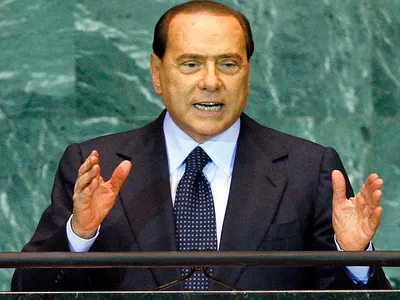
Silvio Berlusconi addressing the United Nations General Assembly in New York City, 2009. Photo courtesy: Britannica
A gentler parallel can be found in Italy during the years when former Prime Minister Silvio Berlusconi dominated Italian politics. His style of governing centred on speaking directly to the public through channels he controlled, treating parliamentary and judicial scrutiny as adversarial noise rather than legitimate oversight, and building a personal following that responded more to personality than institutional argument.
That pattern, a leader more comfortable posting directly to millions of followers than engaging the ordinary back-and-forth of a legislative chamber, describes a recognizable type of contemporary populist leadership, of which Nepal’s current experience offers a distinctly local variant: strong on direct public messaging, thin on institutional dialogue, and seemingly reluctant to treat either the opposition or the press as genuine partners in governance rather than constraints upon it.
The closer historical echo, and one some Nepali commentators have themselves reached for, is the emergency period in India during the mid-1970s, when a government facing political resistance leaned heavily on decree rather than ordinary legislative process and imposed sweeping restrictions on the press in the name of order and discipline. Nepal today is nowhere near anything resembling that period, and the comparison should not be overstated.
But, the instinct it revealed, that a government convinced of its own good intentions may begin to see a free press and an assertive legislature as inconveniences rather than as the very mechanisms that give a mandate its legitimacy, is precisely the instinct that opposition figures, press bodies and former parliamentary officials say they are now watching for in Kathmandu.
Where the verdict stands
A hundred days is a short period, and fairness requires acknowledging that the government has delivered tangible results in a handful of areas. Those achievements deserve recognition. But they cannot obscure a broader pattern that has become increasingly difficult to dismiss. Across law-making, parliamentary accountability, engagement with the opposition and relations with the press, the government’s conduct no longer appears to be a series of isolated lapses. It increasingly resembles a governing style.
A prime minister who skipped the opening sitting of the very Parliament from which his government derives its legitimacy, walked out during the President’s address, governed for weeks through ordinances while Parliament remained suspended, declared from the House floor that Nepal itself had encroached on a neighbour’s territory, and waited a full hundred days before holding his first substantive conversation with the leader of the opposition can hardly be portrayed as a leader merely settling into office. The accumulation of these decisions raises legitimate questions about how he understands democratic institutions and the role they are meant to play.
Whether this amounts to something more serious remains to be seen. The most alarming conclusions drawn by his critics are, at this stage, not established by the evidence. What the evidence does show, however, is a prime minister who has yet to demonstrate—to Parliament, to the opposition or to the press—that he sees scrutiny, dissent and institutional checks as essential components of democratic governance rather than inconveniences to be bypassassed or managed.
That unresolved question may ultimately prove more consequential than any ordinance, budget announcement or hundred-point commitment unveiled during the government’s first hundred days.
The long-term health of Nepal’s democracy will depend less on what this government promises than on whether it chooses to govern through institutions or around them over the remaining four years and eight months of its mandate.

![140 MW Tanahun Hydropower Project under construction [Photo feature]](https://english.nepalnews.com/wp-content/uploads/2026/07/Tanahu-Hydropower-8.png)