Kathmandu
Saturday, July 25, 2026





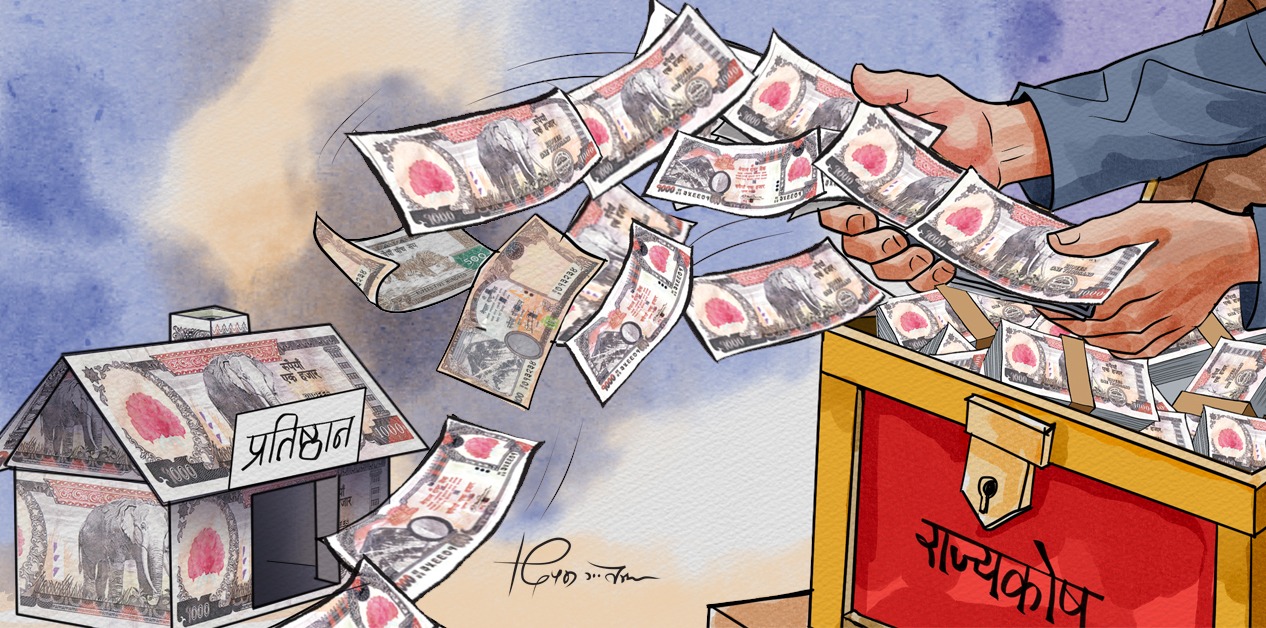
In Karnali, which is awaiting sustainable development, arbitrary spending in the name of party-affiliated memorial foundations raises questions about the provincial government's priorities.
A five-story building is currently under construction right next to the Madan Bhandari Highway in Lekhparsa, Lekbeshi Municipality-1, in the eastern region of Surkhet. Although it looks like a large structure being built for commercial or service purposes, the building belongs to the “Krishna Prasad Bhattarai Memorial Foundation,” established in the name of the late Nepali Congress leader.
The Karnali Province government is spending around Rs 80 million to construct this building, which includes an auditorium capable of holding nearly 500 people. For this project, a contract worth Rs 76 million 444 hundred and 895 was approved through the province government’s Infrastructure Development Directorate. In accordance with this, RC-RRC JV signed the agreement in August/September 2024 and commenced construction. According to the Directorate, approximately 80 percent of the technical work has been completed so far on the building, for which the construction deadline is set for the end of Ashad in the current fiscal year.
According to Dilip Rana, an engineer at the Infrastructure Development Directorate who oversees the construction site, Rs 50 million was allocated in the fiscal year 2024/2025 and Rs 20 million in the fiscal year 2025/2026 through the province’s Ministry of Physical Infrastructure and Urban Development. However, he stated that no funds were allocated under this heading in the current fiscal year.
Noting that all the funds allocated in previous fiscal years have not yet been spent, Rana mentioned that an additional Rs 30.4 million is required to fully complete the building’s construction.
Among the party-affiliated memorial structures being built by the Karnali Province government, this represents the largest investment to date.
Memorial buildings in various districts
Since the fiscal year 2022/2023 alone, the Karnali Province government has spent Rs 95 million 444 thousand and 895 on constructing buildings and structures for foundations affiliated with various political parties.
Through this funding, nine memorial foundation buildings and structures have been constructed in Surkhet, Humla, Kalikot, Jajarkot, and Salyan in the name of deceased leaders and martyrs affiliated with political parties.
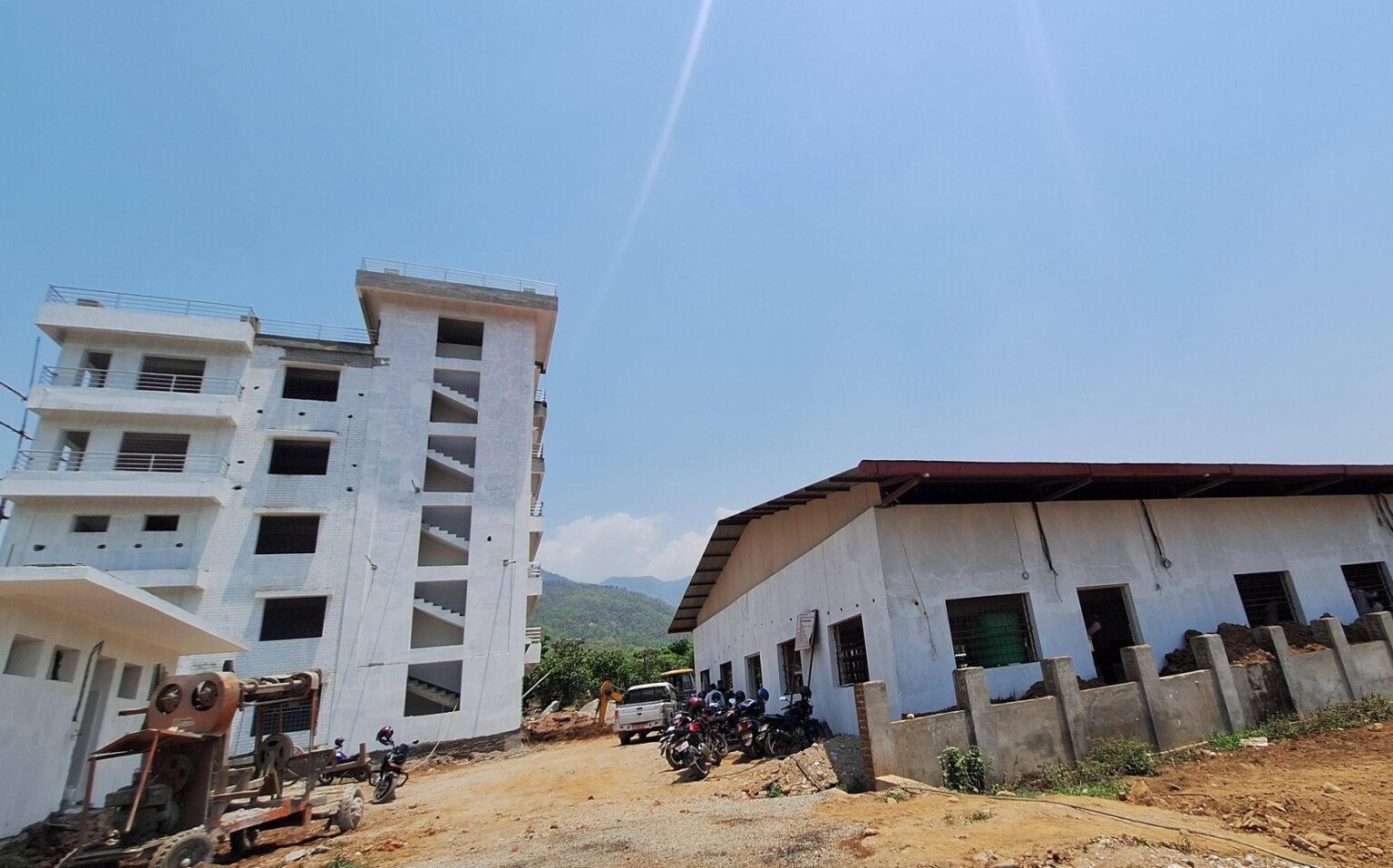
The building of the Krishna Prasad Bhattarai Memorial Foundation under construction in Lekbeshi, Surkhet. Photo: Deepak Jang Shahi
Foundations linked to the former major parties—Nepali Congress, CPN (UML), CPN (Unified Socialist), and CPN (Maoist Centre)—have received such budgets from the provincial government. Following the merger of the Maoist Centre and the Unified Socialist, the Nepali Communist Party has been formed. Based on information regarding the political backgrounds and sources of individuals connected to the respective structures, these foundations appear to be party-affiliated. It is evident that the provincial government has spent between Rs 1.5 million to Rs 4 million per district for such foundations.
In Jajarkot, the province government spent Rs 3 million to construct a building under the name of the ‘Socialism Study Foundation’. This foundation was established in alignment with the ideology of the former CPN (Maoist Centre). The amount was allocated in the fiscal year 2022/2023 through the province’s Ministry of Industry, Tourism, Forest, and Environment. A two-story building has been constructed in Jagatipur of the district using these funds.
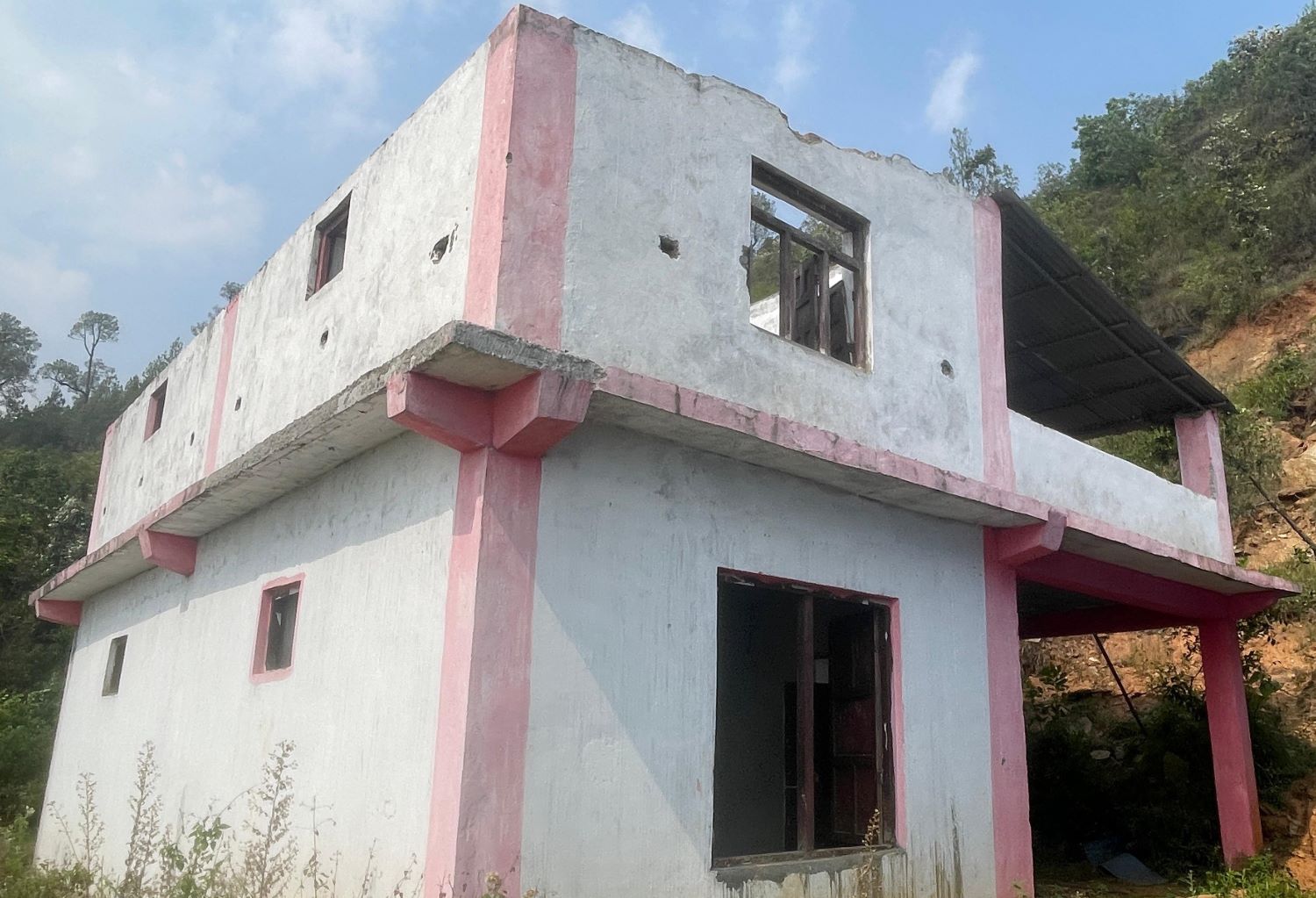
The building of the Socialism Study Foundation constructed in Jajarkot. Photo Courtesy: Saroj Oli
In the same fiscal year, Rs 1.5 million was allocated for the construction of the Jeet Memorial Foundation building in Nalgaad Municipality, Jajarkot. The foundation is said to be affiliated with the former CPN (Maoist Centre).
Using the budget allocated in the fiscal year 2022/2023, four memorial foundation buildings were built in Humla.
A total of Rs 2 million was spent on constructing the building of the Pushpa Lal Memorial Foundation, which is affiliated with the former CPN (Unified Socialist). Similarly, Rs 4 million was spent on the construction of the Manmohan Memorial Foundation building, affiliated with the CPN (UML). In Humla itself, Rs 2 million was spent on constructing the building of the BP Koirala Memorial Foundation, which is affiliated with the Nepali Congress.
The province government also spent Rs 2.5 million on constructing the building of the Martyr Posta Bahadur Bogati Memorial Foundation, affiliated with the former CPN (Maoist Centre).
In Salyan, a building for the Netra Lal Abhhagi Memorial Foundation, affiliated with the former CPN (Unified Socialist), has been built. The foundation’s building was constructed in Sharada Municipality of the district using a Rs 2.5 million budget from the Karnali Province government in the fiscal year 2022/2023.
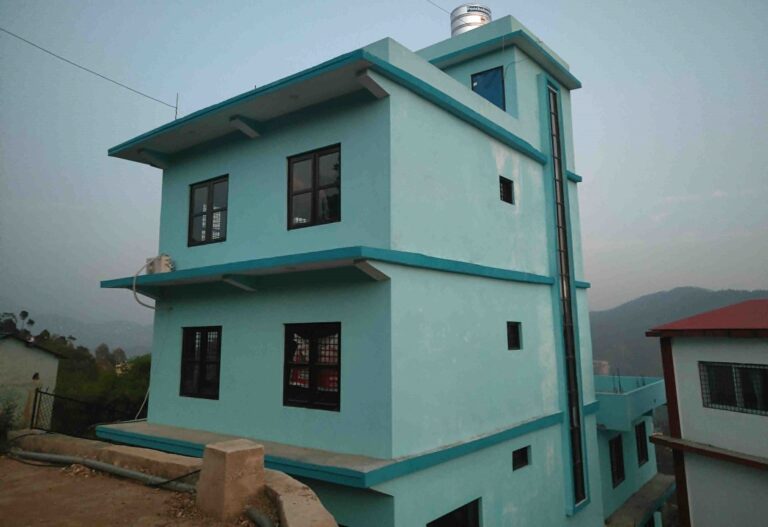
The building of the Netra Lal Abhagi Memorial Foundation constructed in Salyan. Photo Courtesy: Amrit Babu Budhathoki
In Kalikot, a building for the Ratna Memorial Foundation, affiliated with the CPN (UML), has been constructed. The structure was built in Shubhakalika of the district with Rs 1.5 million allocated by the Ministry of Industry, Tourism, Forest, and Environment. The Ratna Memorial Foundation was established in the name of a local teacher killed by state forces during the past armed conflict.
Thus, the expenditure on constructing party-affiliated memorial structures in Karnali is not confined to a single location or party. Foundations connected to the major parties in both the ruling coalition and the opposition have received government budgets.
‘Expenditure outside the scope of official responsibility’
The Office of the Auditor General has raised questions regarding the expenditures made by the Karnali Province government in the name of foundations affiliated with political parties.
The Auditor General’s report for the fiscal year 2022/2023 pointed out that such expenditures are unrelated to the ministry’s official responsibilities. The report highlights that funds were spent on constructing memorial foundation buildings that were not included in the annual policies, programs, and budgets.
The report states: “Expenditures have been made on the construction of memorial foundation buildings that are unrelated to the ministry’s scope of responsibility and are not included in the annual policies, programs, and budgets.
At a time when there is a lack of necessary resources for the annual programs prioritized by the province government, constructing memorial foundation buildings does not appear appropriate.”
The Auditor General recommended controlling such budget expenditures that fall outside long-term policies and plans.
However, even after the Auditor General’s comments, the Karnali Province government does not seem to have stopped this trend.
The trend unchecked, headings altered
In the fiscal year 2024/2025, Rs 1.5 million has been allocated by the Ministry of Industry, Tourism, Forest, and Environment for the construction of a Martyr Memorial Building in Dolpa. Similarly, Rs 1.5 million has been allocated for the construction of the Martyr Indralal Acharya Memorial Garden in Jajarkot, Rs 1.5 million for a Martyr Gate also in Jajarkot, Rs 1.5 million for a Martyr Memorial Park in Surkhet, and Rs 1.5 million for a Martyr Gate in Dailekh.
However, it has not been disclosed which political parties these structures are affiliated with, or in the name of which protected organizations or deceased martyrs they are being built.
In the fiscal year 2023/2024, a budget of Rs 1 million was allocated by the Ministry of Industry, Tourism, Forest, and Environment for the construction of a Green Park in Panchapuri Municipality, Surkhet, in the name of the late Congress leader Tapta Bishta. Under this same heading, Rs 1.5 million has also been allocated for the fiscal year 2025/2026.
This demonstrates that despite the questions raised by the Auditor General, the practice of pouring budgets into structures named after leaders or party-affiliated entities under various headings remains ongoing.
Regulations forbid it, spending continues
The Financial Procedures Rules, 2019 of the Karnali Province government stipulates that “government funds must not be spent in a manner that benefits any specific individual or group.” Rule 43 of the regulations discourages such expenditures.
The province government appears to take on financial liabilities to construct structures for foundations or institutions affiliated with various political parties. Legal professionals state that there is no clear legal provision for such expenditures.
According to Advocate Sher Bahadur Khatri, investing in foundation buildings or similar sectors by undermining the government’s own financial procedures constitutes a misuse of the state treasury.
“Doing this means that the Karnali Province government itself is raising questions about good governance and transparency,” Khatri says. “It shows a disregard for citizens’ expectations and a neglect of its own duties.”
According to him, both the ruling and opposition sides lobby to have structures built for party-affiliated foundations. He has learned that in some cases, pressure is even exerted on the government. “For the government to spend the state treasury by violating its own laws is purely a misuse,” Khatri states.
Who benefits from the completed buildings?
There is no clear answer to the question of whether these buildings, constructed using the provincial government’s budget, are being used for the public good or for partisan interests.
According to Rana, the engineer from the Infrastructure Development Directorate, the five-story Krishna Prasad Bhattarai Memorial Foundation building under construction in Lekbeshi will contain 20 rooms. A separate hall with a stage, capable of accommodating around 500 people, is also being built.
Once the work is entirely finished, the construction company will hand over the building to the Directorate. After that, an agreement will be made between the Directorate and Lekbeshi Municipality to hand over the building to the local unit along with an operational modality.
Rana claims that although the foundation is named after the late Nepali Congress leader, the objective of building it is not to host political activities.
“The purpose is to utilize this building for community work,” he says. “We will hand it over to the respective municipality after reaching a mutual understanding on how to operate it. We are confident that the building will not be used purely for political activities under the pretext of being named after a leader.”
However, looking at the current usage of various already completed buildings, there is little ground for confidence. The Socialism Study Foundation building constructed in Jajarkot now lies abandoned. Straw is being stored on the first floor of the two-story building. Similarly, the Ratna Memorial Foundation building built in Shubhakalika Rural Municipality, Kalikot, is not being used for any designated purpose.
“Right now, it is being used to store sports equipment for a local club,” a local resident says. “The building has not been utilized in a proper manner.”
Locals in Humla report that the influence of affiliated political parties is evident in various foundation buildings constructed with the investment of the Karnali Province government. Although it is claimed that the buildings were constructed for community work, the parties acting as patrons of the foundations are seen using those structures themselves.
Questions on priorities
In a province struggling with weak infrastructure, low human development indicators, difficulties accessing health and education, a lack of roads and drinking water, an unemployment crisis, and widespread poverty, spending tens of millions on party-affiliated memorial foundation buildings raises serious questions about the provincial government’s priorities.
The Auditor General has also noted that it is inappropriate to build memorial foundation buildings when there is a shortage of resources required for the province government’s priority annual programs.
The question is not just about the construction and utilization of the buildings; it is about which priorities the province’s limited resources are being funneled into. The continued flow of budgets into these headings, even after the Auditor General has raised red flags, casts doubt on the province’s planning discipline, transparency, and public accountability.
Data indicates that partisan pressure dominates the provincial budget. A cycle where the Auditor General repeatedly raises questions while the trend goes on uninterrupted is becoming firmly entrenched in Karnali.