Kathmandu
Sunday, July 26, 2026





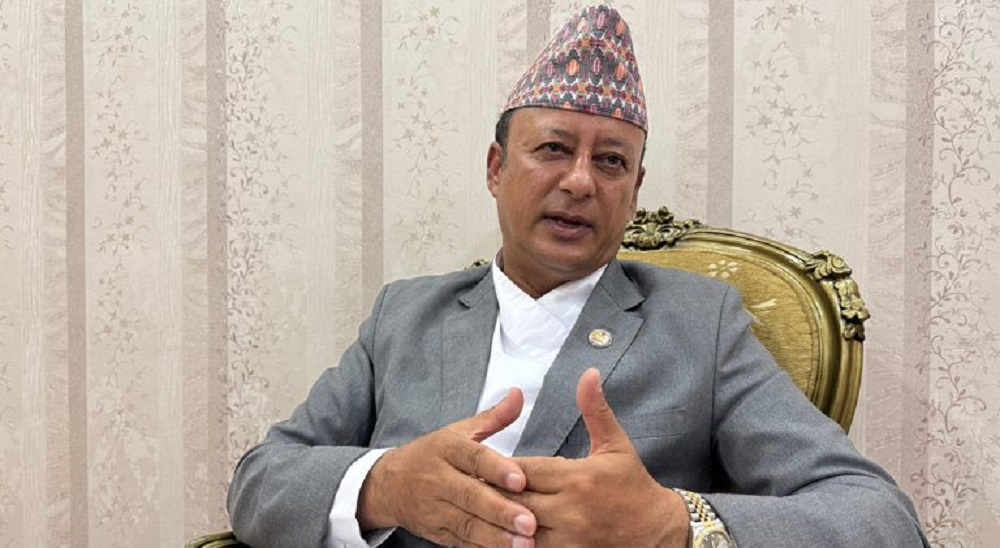
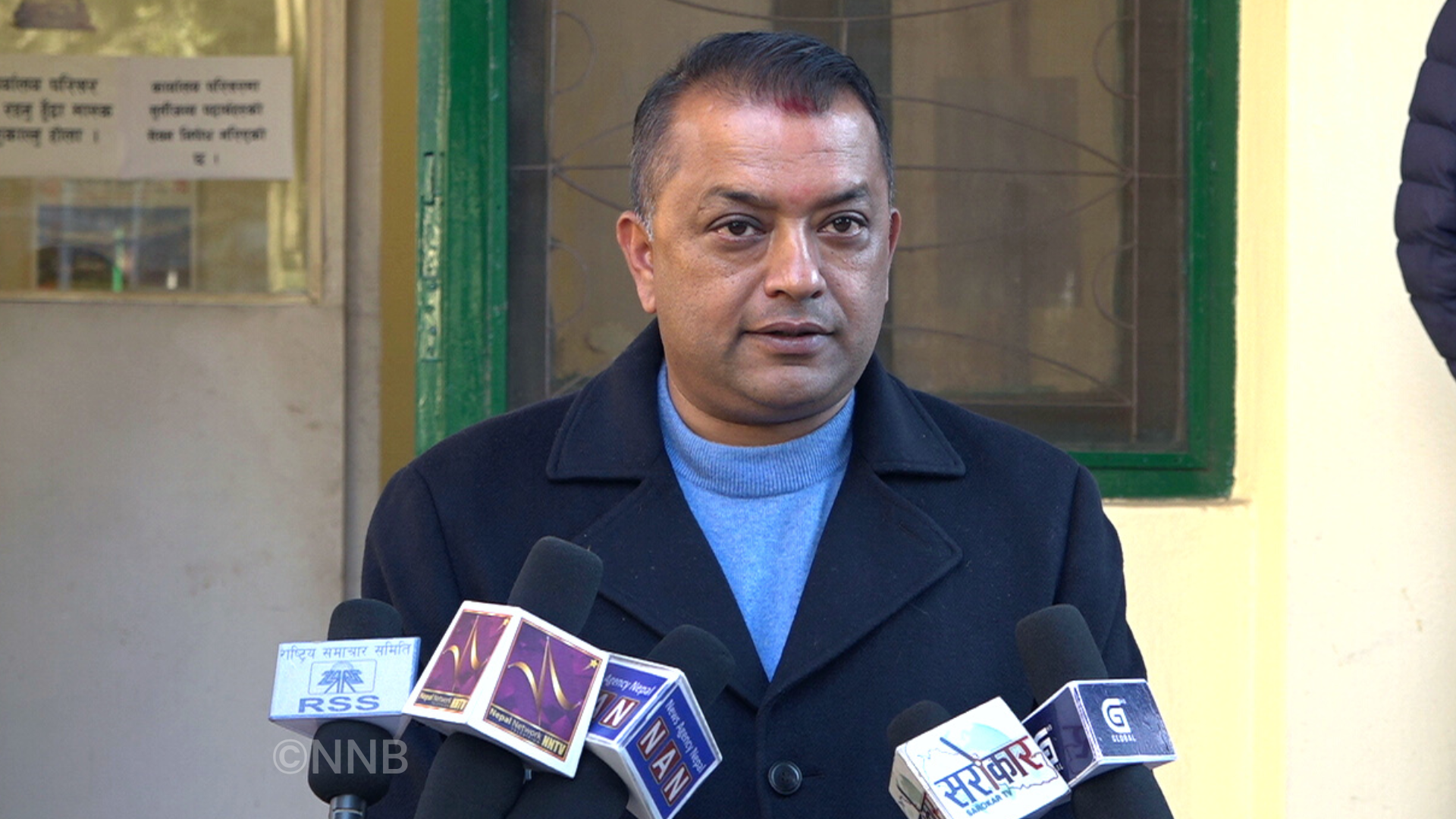
KATHMANDU: The Supreme Court has ordered the immediate release of former minister and Nepali Congress leader Deepak Khadka.
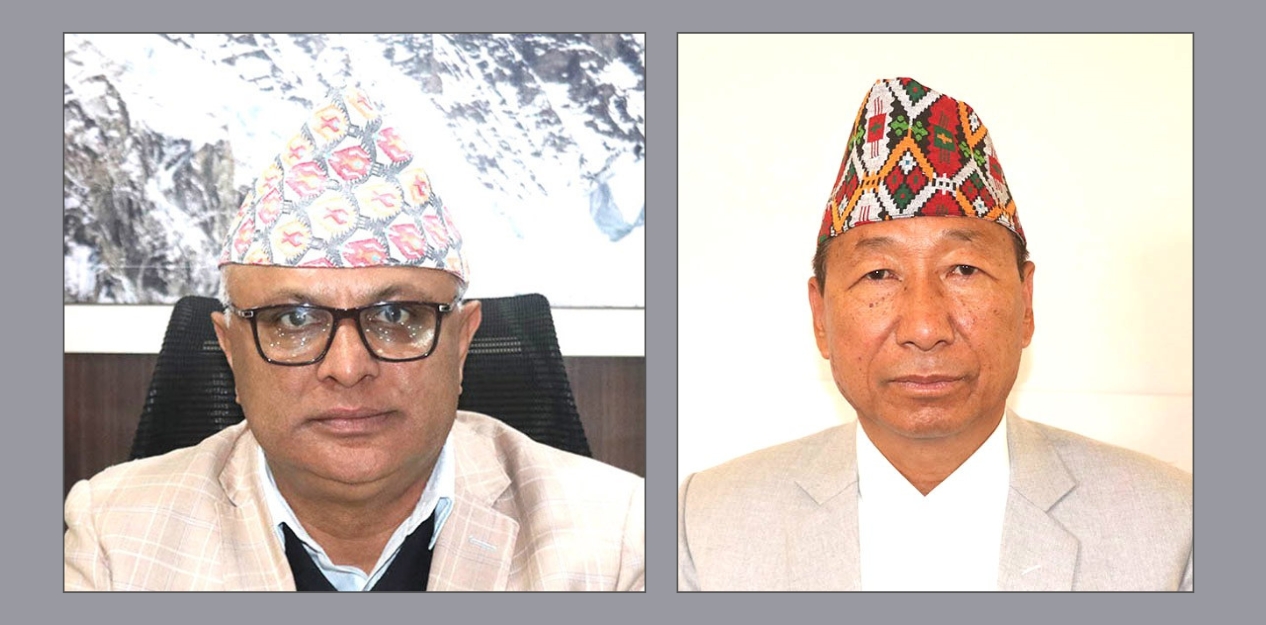
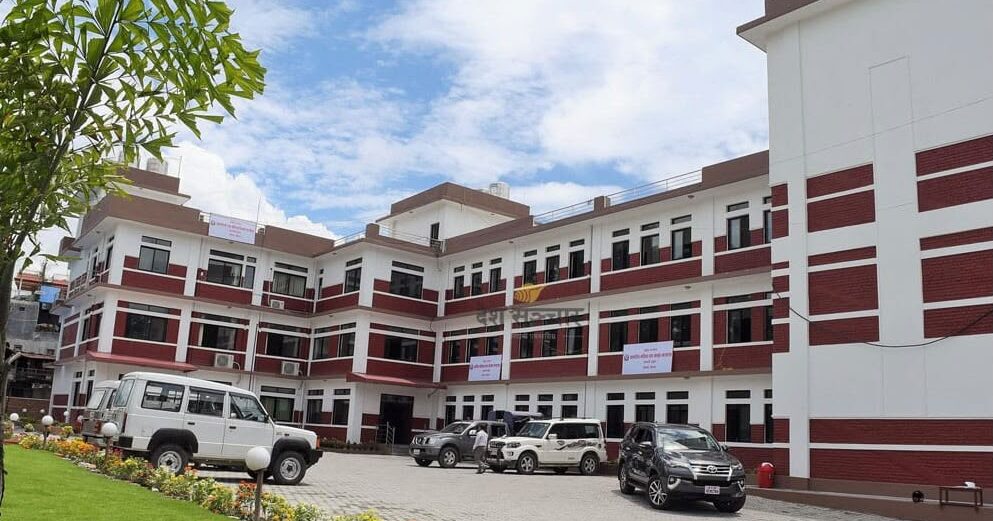
A joint bench of Acting Chief Justice Sapana Pradhan Malla and Justice Shrikanta Paudel found serious flaws in his arrest and remand process, stating that the investigation could proceed without keeping him in custody.
Khadka, arrested by the Central Investigation Bureau on March 29 following a request from the Department of Money Laundering Investigation.
He will be released but must seek court approval before traveling abroad.
Here is Nepal News’ unofficial English translation of the full verdict:
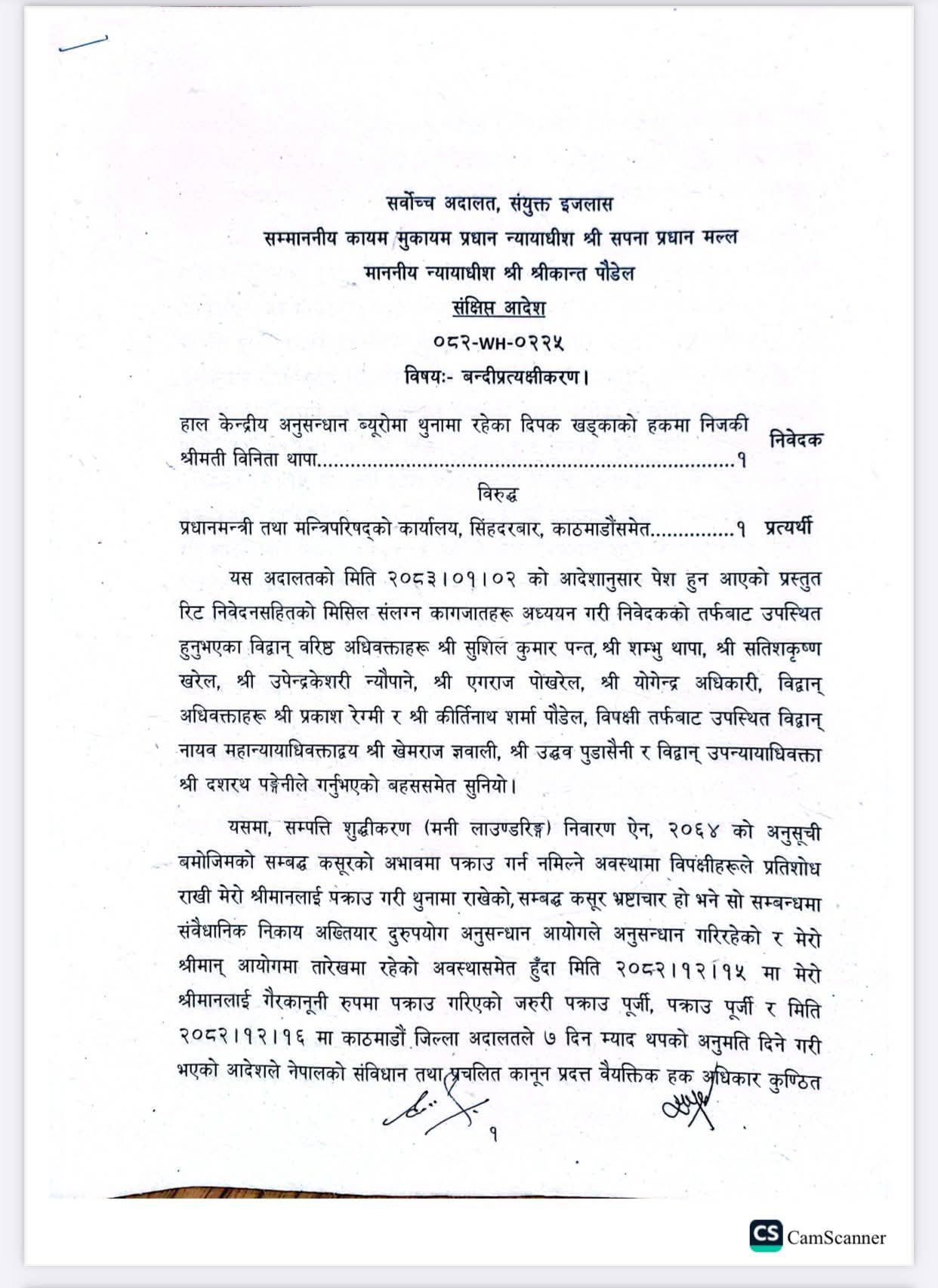
Supreme Court, Joint Bench
Honorable Acting Chief Justice Ms. Sapna Pradhan Malla and Honorable Justice Mr. Shreekanta Paudel
Short Form Order
Case No: 082-WH-0225
Subject: Habeas Corpus
Binita Thapa, on behalf of Deepak Khadka, currently in custody at the Central Investigation Bureau (CIB): Petitioner
Versus
Office of the Prime Minister and Council of Ministers, Singha Durbar, Kathmandu:
Respondent
As per the order of this Court dated April 15, 2026, the case file and attached documents submitted with the present writ petition have been studied. We have heard the arguments presented by the learned Senior Advocates representing the petitioner, Mr. Sushil Kumar Panta, Mr. Shambhu Thapa, Mr. Satish Krishna Kharel, Mr. Upendra Keshari Neupane, Mr. Yagyaraj Pokharel, and Mr. Yogendra Adhikari; and learned Advocates Mr. Prakash Regmi and Mr. Kirtinath Sharma Paudel.
Similarly, the arguments from the respondents’ side were heard from the learned Deputy Attorney Generals Mr. Khemraj Gyawali and Mr. Uddhav Pudasaini, and learned Under-Attorney Mr. Dasharath Pangeni.In this matter, it is claimed that in a situation where an arrest cannot be made in the absence of a related offense as per the schedule of the Money Laundering Prevention Act, 2008, the respondents, acting out of vendetta, arrested and detained my husband. If the related offense is corruption, the Commission for the Investigation of Abuse of Authority (CIAA), a constitutional body, is already conducting an investigation, and while my husband was already on a scheduled court-appearance date at the Commission, he was arrested illegally on March 29, 2026 via an urgent arrest warrant.
Furthermore, the order issued by the Kathmandu District Court on March 30, 2026 granting a 7-day extension of the judicial remand period has curtailed the personal liberty and rights guaranteed by the Constitution of Nepal and prevailing laws.
Therefore, the petition claim seeks to quash the aforementioned urgent arrest warrant, the arrest warrant, and the orders related to the extension of the detention period through an order of Certiorari, and to release my husband from illegal custody by issuing a writ of Habeas Corpus along with other appropriate orders.
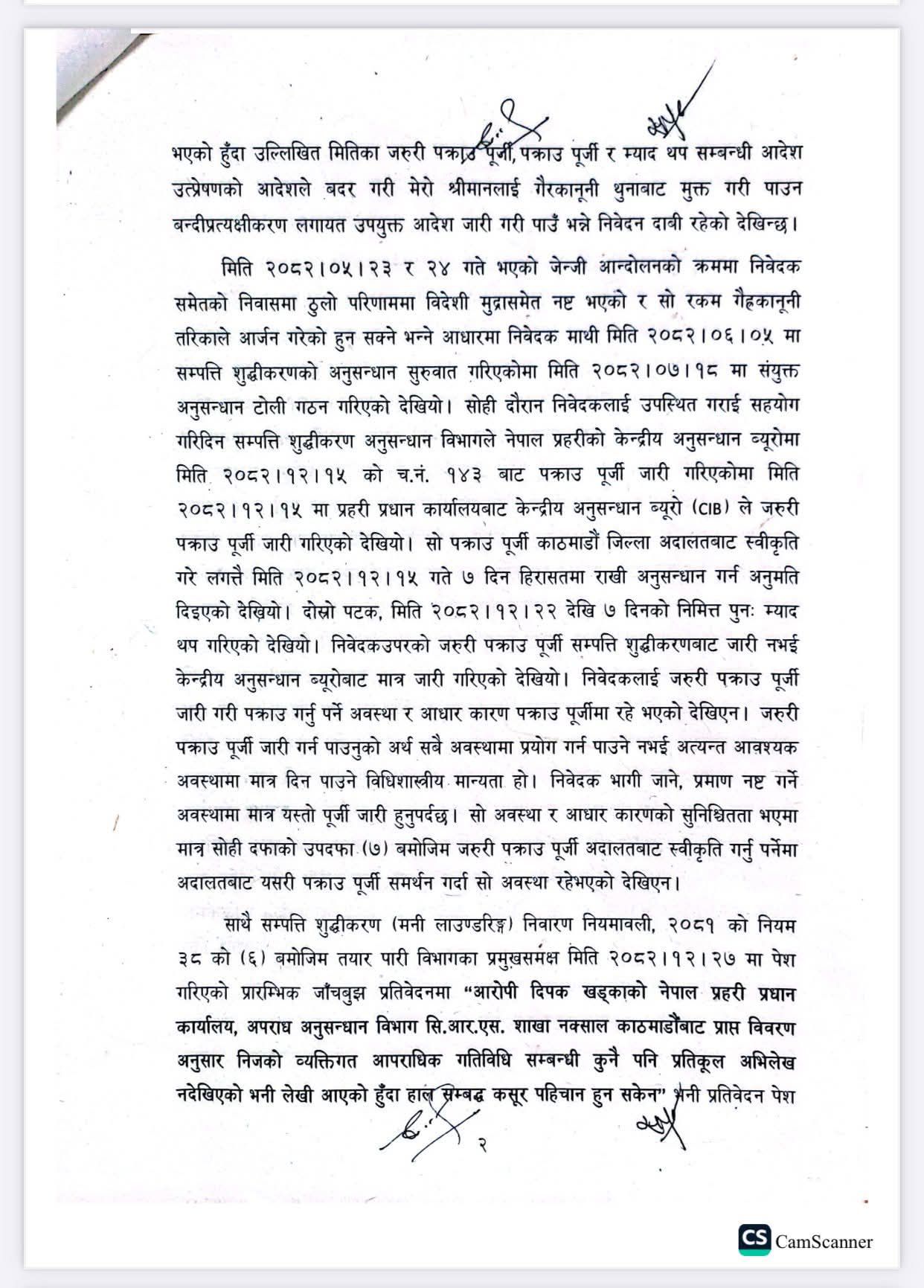
During the “Gen Z” protest that occurred on September 8 and 9, 2025, a large amount of foreign currency was reportedly destroyed at the petitioner’s residence. On the basis that said amount may have been earned through illegal means, an investigation into money laundering was initiated against the petitioner on September 21, 2025, and a Joint Investigation Team appears to have been formed on November 3, 2025. During that period, the Department of Money Laundering Investigation, via Dispatch No. 143 dated March 29, 2026, requested the Central Investigation Bureau (CIB) of the Nepal Police to produce the petitioner for cooperation, following which an arrest warrant was issued. On March 29, 2026, an urgent arrest warrant was seen to be issued by the Central Investigation Bureau (CIB) from the Police Headquarters. Immediately after the endorsement of said arrest warrant by the Kathmandu District Court, permission was granted on March 29, 2026 to keep [the petitioner] in custody for 7 days for investigation.
For a second time, a further extension of the detention period for 7 days was granted from April 5, 2026.
It appears that the urgent arrest warrant against the petitioner was issued only by the Central Investigation Bureau and not by the Department of Money Laundering Investigation. The circumstances and grounds necessitating the arrest of the petitioner through the issuance of an urgent arrest warrant were not found to be present in the said warrant. The legal principle dictates that the authority to issue an urgent arrest warrant is not to be exercised in all circumstances, but only in extremely necessary conditions.
Such a warrant should only be issued in situations where the petitioner might abscond or destroy evidence. While the court must endorse an urgent arrest warrant pursuant to Sub-section (7) of the same Section only upon the assurance of such conditions and grounds, such conditions were not found to be present when the court endorsed this arrest warrant.
Furthermore, in the preliminary investigation report prepared and submitted to the Department Head on April 10, 2026 pursuant to Rule 38 (6) of the Money Laundering Prevention Rules, 2024, it is stated: “According to the details received from the Nepal Police Headquarters, Crime Investigation Department, CRS Branch, Naxal, Kathmandu, no adverse records regarding the personal criminal activities of the accused Deepak Khadka were found.”
Consequently, a report has been submitted stating that “a related offense could not be identified at this time.”
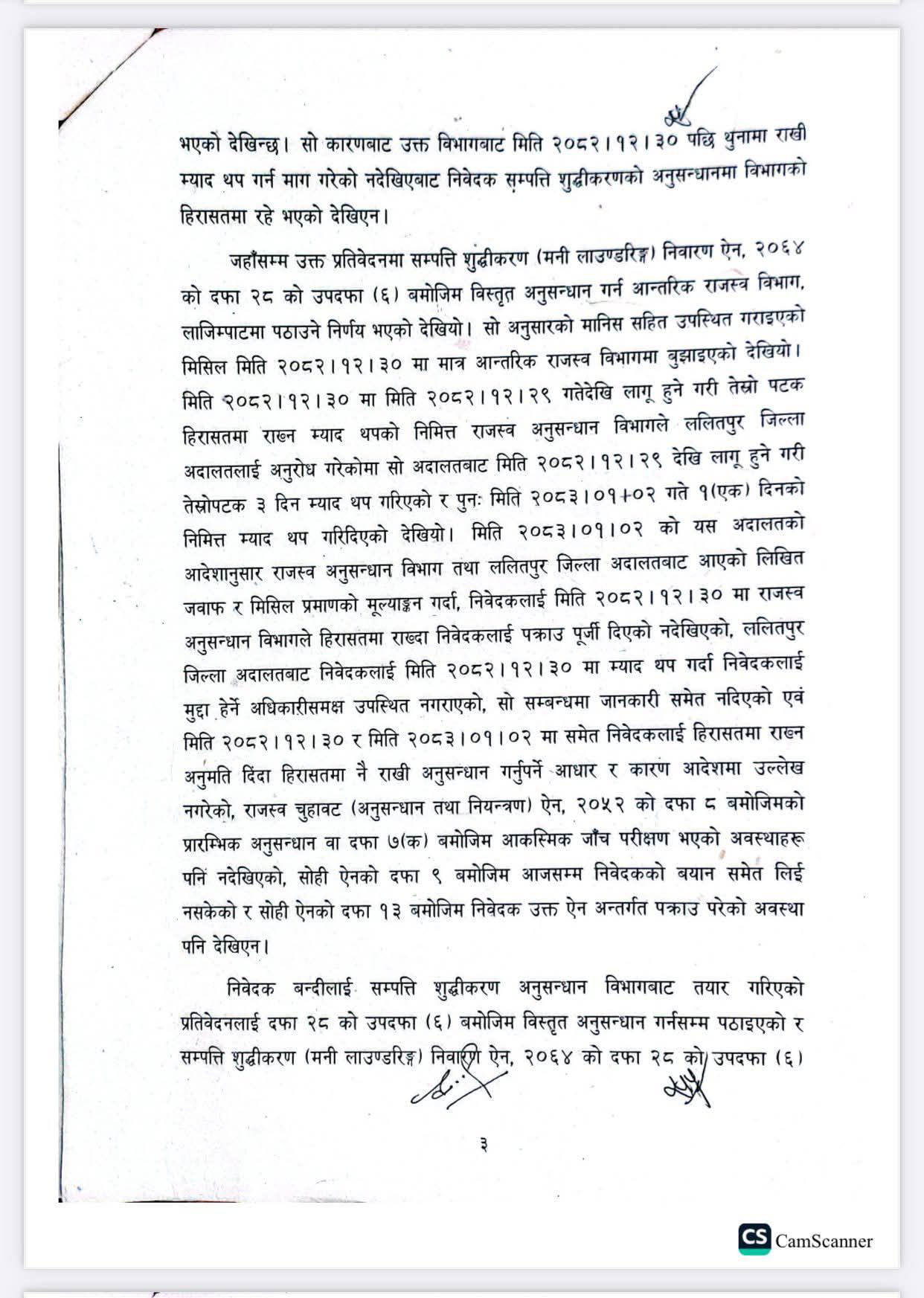
It appears that for the reasons stated, there is no evidence of the said Department requesting an extension of the detention period after April 13, 2026; thus, the petitioner is not seen to be in the custody of the Department for the investigation of money laundering.
As far as the said report is concerned, a decision was made to send the case to the Inland Revenue Department, Lazimpat, for a detailed investigation pursuant to Section 28, Sub-section (6) of the Money Laundering Prevention Act, 2008.
Accordingly, the case file, including the physical production of the person, appears to have been submitted to the Inland Revenue Department only on April 13, 2026. On April 13, 2026, the Department of Revenue Investigation requested the Lalitpur District Court for a third extension of the detention period to be effective from April 12, 2026, and the said court appears to have granted a 3-day extension effective from April 12, 2026, and subsequently, a further 1 (one) day extension on April 15, 2026.
Upon evaluating the written responses and case file evidence received from the Department of Revenue Investigation and the Lalitpur District Court as per this Court’s order dated April 15, 2026, it is observed that the Department of Revenue Investigation did not provide an arrest warrant to the petitioner while keeping him in custody on April 13, 2026, and during the extension of the detention period on April 13, 2026, the Lalitpur District Court failed to produce the petitioner before the adjudicating officer and failed to provide information regarding the same.
Furthermore, while granting permission to keep the petitioner in custody on April 13, 2026 and April 15, 2026, the grounds and reasons necessitating continued detention for investigation were not mentioned in the order, nor were conditions for preliminary investigation under Section 8 or emergency inspection under Section 7(a) of the Revenue Leakage (Investigation and Control) Act, 1995 found to exist.
Additionally, the petitioner’s statement has not been recorded to date as per Section 9 of the same Act, and it does not appear that the petitioner was arrested under the provisions of Section 13 of the said Act.
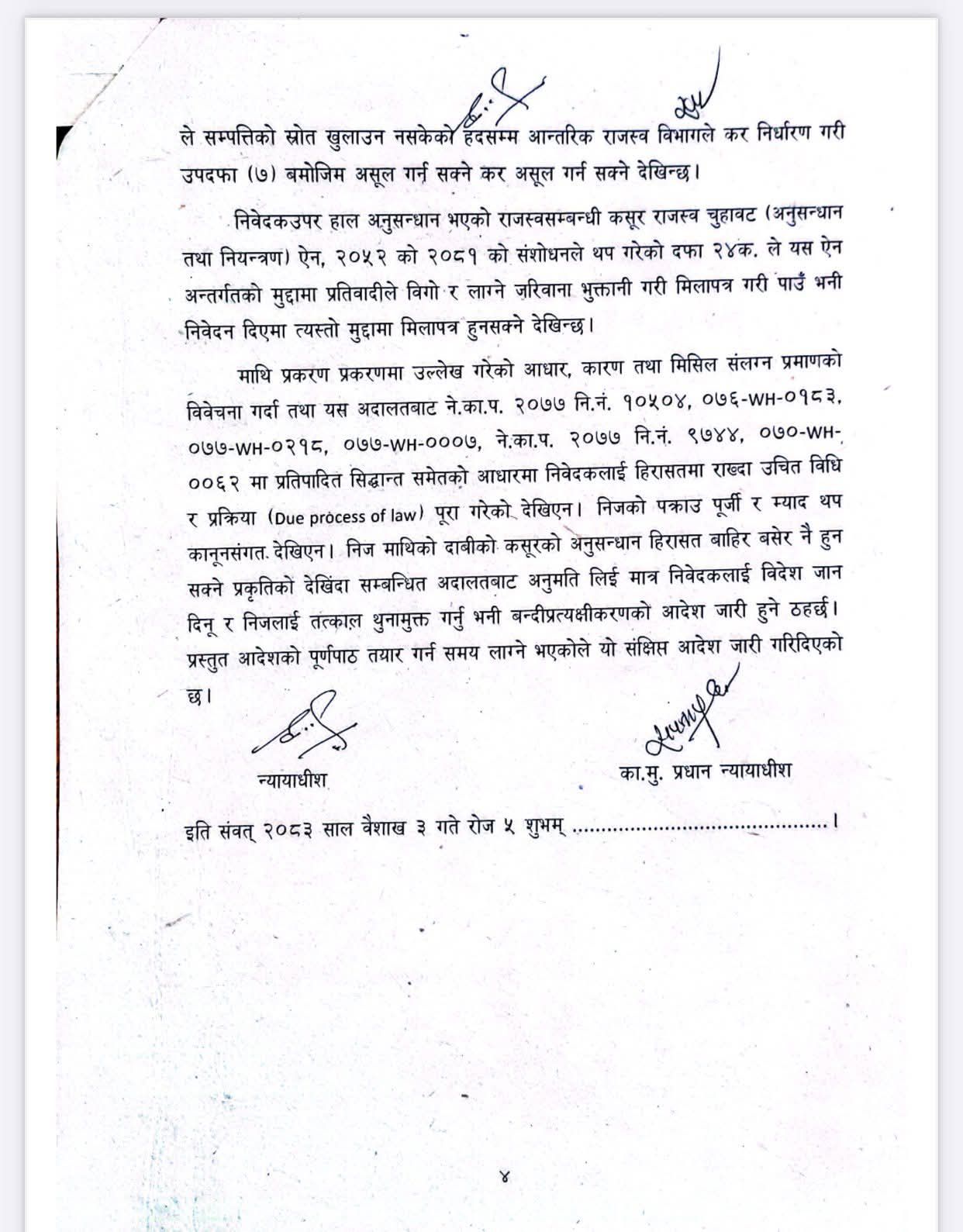
Regarding the petitioner in custody, while the report prepared by the Department of Money Laundering Investigation was sent for detailed investigation pursuant to Section 28, Sub-section (6), and as per Section 28, Sub-section (6) of the Money Laundering Prevention Act, 2008 to the extent that the source of the property cannot be disclosed, it appears that the Inland Revenue Department may determine the tax and collect the recoverable tax pursuant to Sub-section (7).
Regarding the revenue-related offense currently under investigation against the petitioner, Section 24K, added by the 2024 amendment to the Revenue Leakage (Investigation and Control) Act, 1995, specifies that if a defendant in a case under this Act submits an application seeking a settlement upon payment of the claimed amount and the applicable fine, a settlement can be reached in such a case.
Based on the analysis of the grounds, reasons, and evidence attached to the case file mentioned in the preceding paragraphs, and in light of the principles established by this Court in ‘Nepal Kanoon Patrika’ 2019, Decision No. 10504, 019-WH-0183, 019-WH-0218, 019-WH-0007, N.K.P. 2019, Decision No. 9744, and 013-WH-0062, the due process of law was not found to have been followed in keeping the petitioner in custody. The arrest warrant and the extension of the detention period do not appear to be lawful.
As the nature of the investigation into the offense alleged against him is such that it can be conducted while remaining outside of custody, it is hereby ordered that a writ of Habeas Corpus be issued to release him from custody immediately, with the condition that he may be permitted to travel abroad only after obtaining permission from the concerned court.
Since the preparation of the full text of this order will require time, this Short Form Order has been issued.
Signed:
Date: Friday, April 16, 2026