Kathmandu
Monday, July 6, 2026





Citing the federal government's failure to integrate police despite constitutional provisions, the Madhesh government is preparing to recruit its own force, escalating a long-running dispute over the implementation of federalism.
JANAKPURDHAM: Nearly a decade after the promulgation of the Constitution, the Madhesh Province government is preparing to move forward with its own police recruitment process, leaving behind its wait for the federal government.
Concluding that the provincial government has been deprived of its constitutional right to maintain peace and security due to the federal government’s failure to integrate (adjust) the police force, the Madhesh government has allocated funds for recruiting provincial police in the budget for the upcoming fiscal year.
Presenting the budget in the Provincial Assembly on June 15, Finance Minister Yubaraj Bhattarai stated that the Provincial Police Act would be brought into implementation to strengthen peace and security, and the necessary budget had been arranged to initiate the new provincial police recruitment process from this fiscal year itself. For the fiscal year 2026/27, the Madhesh government has allocated Rs. 10 million under the heading “Madhesh Province Police Recruitment and Management.” An additional Rs. 400,000 has been set aside under the heading “Provincial Volunteer Police Mobilization and Management.”
Minister for Home, Communications, and Law Fakira Mahato says that this decision is not just a manifestation of dissatisfaction with the federal government but also the exercise of a constitutional right. “They call us a government and give us the right to maintain peace and security, yet they do not integrate the police? This clearly reveals the federal government’s true intentions toward federalism,” Mahato says. “Peace and security cannot exist without the police. That is why we have reached the decision to recruit provincial police.”
Ever since the formation of the provincial government, Madhesh has made police integration its main political issue. During its first term, an all-party team from the province repeatedly demanded police integration from the federal government. The Madhesh government even staged a sit-in against the federal government in Janakpurdham.

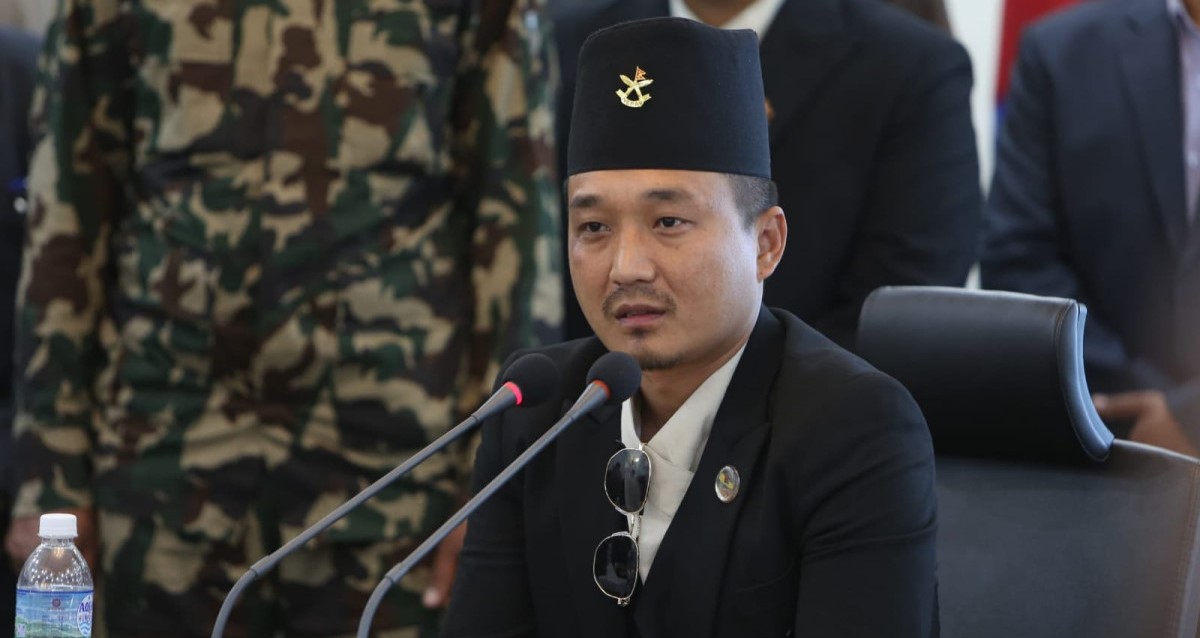
The office of Law Minister Fakira Mahato. File Photo
Mahato adds, “The provincial government is no longer in a position to wait for the center’s decision. Even local levels are allowed to have municipal police. If the provincial government is not given a police force, how can the people truly experience the presence of a provincial government?”
Old demand, new decision
Madhesh Province had enacted its Provincial Police Act back in 2018. The Act, authenticated on December 30, 2018, has already been published in the Gazette.
The preamble of the Act states that the formation of a provincial police force is necessary to maintain peace and order throughout the province, prevent, control, and investigate crime, and enforce the law while respecting human rights.
According to former Chief Minister Lalbabu Raut, although the Provincial Police Act was enacted during his government’s tenure, efforts to move forward in coordination with the federal government failed. “We have met with every Prime Minister. We staged sit-ins against the federal government. However, the center did not seem serious,” Raut says. “How can federalism be implemented without police integration?”
The federal government had also introduced the Nepal Police and Provincial Police (Operation, Supervision, and Coordination) Act, 2019. Published in the Gazette on February 11, 2020, the first amendment to the Act was made in 2022. The Act delineates the jurisdiction and responsibilities of both the Nepal Police and the Provincial Police. Despite the formulation of the Act, its structural integration has not yet been implemented.
While the law envisions a provincial police force, in practice, the provincial government has no police under its command. Raut states that this very gap is what led the Madhesh government to the decision to advance its own recruitment process.
Authority exists, structure lacking
The Provincial Police Act enacted by the Madhesh government provides for five types of police: Civil Police, Technical Police, Tourism Police, Community Police, and Traffic Police. The Act also defines the ranks, posts, structure, approved positions, and functional jurisdictions of the police.
The organizational structure of the provincial police and the total number of police personnel are to be determined by the provincial government with the concurrence of the Government of Nepal. The Act also notes that when such concurrence is sought, the federal government must provide a decision within one month; if concurrence is not received in time, it shall not bar the provincial government from making a decision.
The Madhesh government is trying to move forward based on this specific provision. However, the government has not yet provided clear answers to crucial questions: under whose command the appointed police will remain once recruitment opens; where the training will take place; what the role of the Provincial Public Service Commission will be; how coordination with the Nepal Police will be maintained; and how far the jurisdiction for crime investigation will extend.
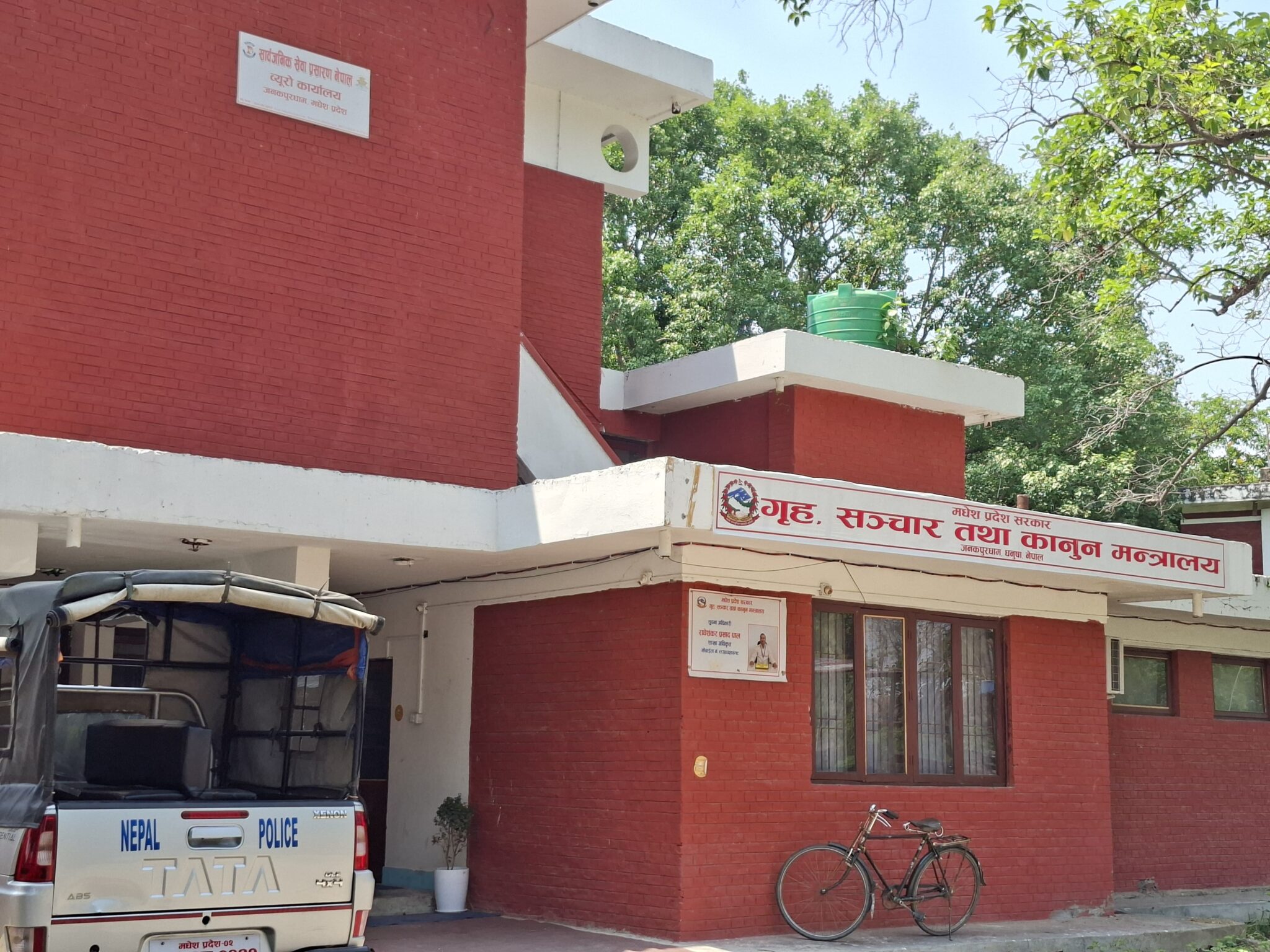
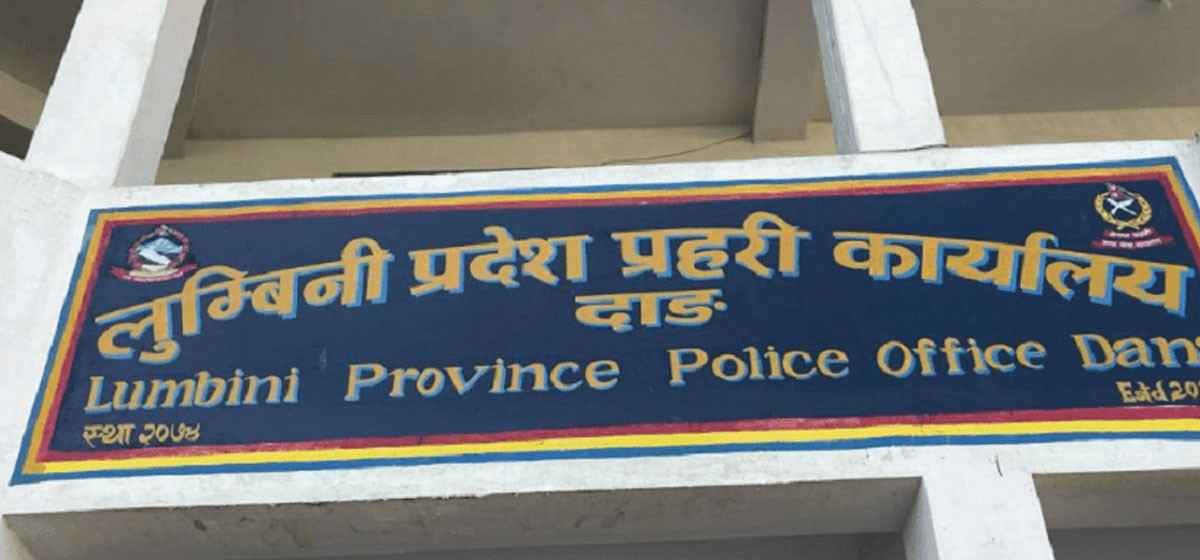
Ministry of Home, Communications, and Law, Janakpurdham. Photo: Ministry’s Website
Provincial government officials argue that the federal government cannot keep the province waiting indefinitely by withholding its decision. In their view, it is entirely natural for the provincial government to advance its legal and budgetary preparations to exercise the rights granted by the Constitution.
Nepali Congress Provincial Assembly member and former minister Ram Saroj Yadav says that although the provincial government is held accountable for peace and security, severe governance issues have arisen because the police force is not under its jurisdiction. “Issues of peace and security are regularly raised in the Provincial Assembly,” Yadav says. “But with the police not under their control, the concerned minister is left in a position where they don’t know how to respond. Therefore, police integration is essential.”
According to him, many issues related to security, borders, crime control, traffic management, and local administration in Madhesh fall within the political accountability of the provincial government. However, because the actual authority to deploy police remains stuck within the federal structure, the provincial government is left looking weak.
Incomplete practice of federalism
In Madhesh, the issue of the provincial police is far more political than administrative. Provincial politics, emerging from the background of the Madhesh Movement, views federalism not merely as a constitutional arrangement but as an explicit opportunity for the devolution of power. Therefore, Madhesh leaders interpret the delay in police integration as a continuation of Singha Durbar’s old, centralized mindset.
JSP Nepal Chairman Upendra Yadav states that the federal government has failed to formulate several laws required for the implementation of federalism, and even the laws that have been made are not federalism-friendly. “Currently, efforts are being made to instill negative sentiments toward federalism,” Yadav says. “But questions are rarely raised about why the federal government is failing to do what it is supposed to do. Several acts and laws of the federal government itself act as obstacles to the implementation of federalism.”
In Yadav’s view, federalism cannot be implemented merely by writing it on paper. Until authority, personnel, resources, and structures are genuinely transferred to the provinces, provincial governments remain governments in name only. The Madhesh government’s preparation for independent police recruitment is the latest manifestation of this profound dissatisfaction.
What can the provincial police do?
The Nepal Police and Provincial Police (Operation, Supervision, and Coordination) Act, 2019 outlines the functions, duties, and powers of the provincial police.
According to the Act, the provincial police are responsible for: Maintaining peace, order, and public tranquility within the province. Protecting the lives and property of citizens, alongside preventing and controlling crime. Collecting and analyzing intelligence related to public security. Securing VIPs, important locations, institutions, or major projects within the province.
Similarly, the responsibilities of the provincial police include managing transport safety, protecting government and public property, conducting rescue and relief operations during disasters, maintaining provincial criminal records, securing provincial prisons and detention centers, managing traffic, monitoring private security providers, and executing community policing activities.
The Act also provides a framework for the exchange of information and coordination with the Nepal Police and other provincial police organizations. However, because the provincial police force has never been formally established, these provisions remain confined to paper.