Kathmandu
Thursday, July 2, 2026





While the state remains completely silent on implementing effective monkey management, local farmers continue to bear massive financial losses from relentless crop destruction
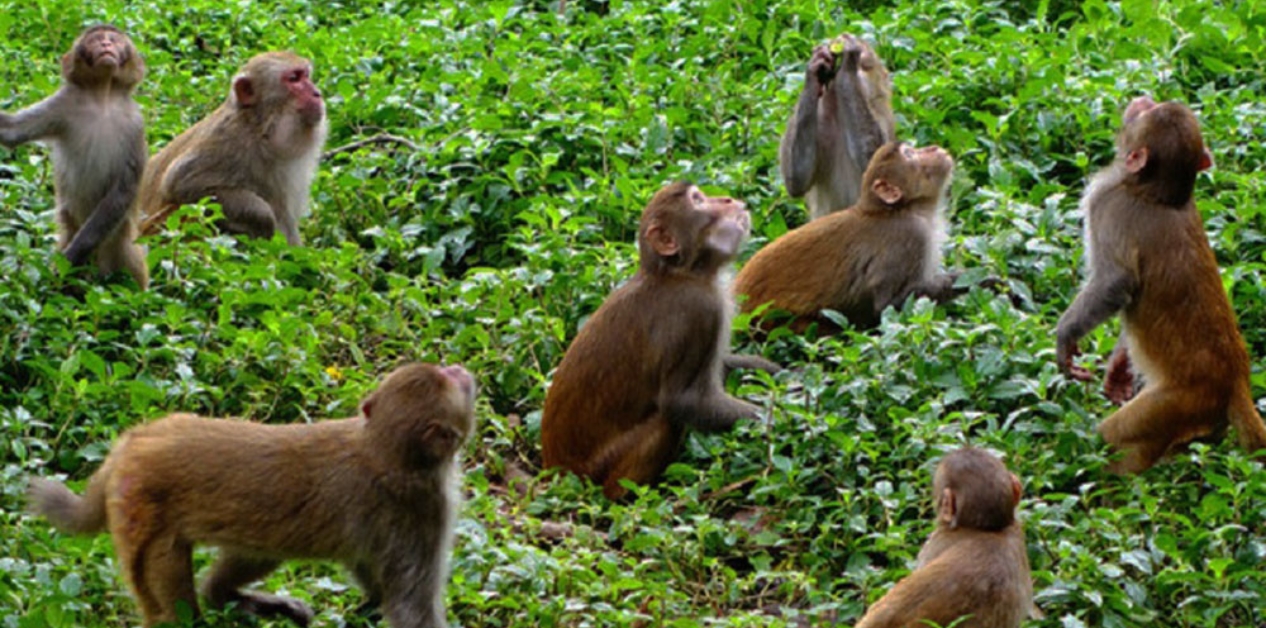
BHOJPUR: While Member of Parliament (MP) Dhruva Raj Rai was arguing in the Parliament that farmers should be allowed to cull monkeys, MP Ashika Tamang raised an immediate objection, stating that monkeys must not be killed. This political clash prompted animal rights activists to take to the streets in a highly publicized campaign to protect the primates. This growing conflict over wildlife management has deeply divided society, driving an even more intense polarization between rural agricultural communities and urban activists.
Farmers in the villages say they must be allowed to kill monkeys. The voice of animal rights activists in the cities, however, sounds angry to the level of saying that those who say monkeys should be killed should themselves be killed. A monkey neither builds its own house nor lets another’s house remain undemolished. Monkey rights activists in the cities neither allow laws to be made to kill monkeys nor take any initiative to protect farmers from monkeys. The government has just returned to the capital after concluding its party’s national convention. There is hope that it might do something, but it has remained silent until now.

Ashika Tamang in Parliament
From lone invaders to full troops
When our generation was growing up, the word ‘monkey’ was not even used in our village. Instead, they were referred to as ‘the lone ones.’ These solitary animals used to raid maize fields near rivers and streams. Wildlife experts state that the strongest male, known as the alpha male, leads a monkey troop. His rivals are always waiting in the wings. The leader constantly struggles to maintain dominance, while competitors fight to seize control. If the leader loses a battle, the victor becomes the new chief. The troop members are worshippers of power, immediately aligning themselves with the new leader. The defeated alpha is banished from the group, forced to survive entirely on his own. He stealthily feeds on crops, eating only what he needs without causing further destruction.
I saw a pack of monkeys for the first time at the age of 13 in Dingla, which could be reached in one full day of walking from home. Bala Guru Shadananda opened a school in Dingla, Bhojpur, in the fiscal year 1875/76. That itself is Nepal’s first formal school opened at the citizens’ level. Along with the school, he had also built a hostel, a Shiva temple, a Ram temple, a pond, water taps, and public shelters. According to seniors, when Balaguru built the Shiva temple, he brought rudraksha saplings, and when he built the Ram temple, he brought Ram’s monkey army from Banaras. It used to be said that the monkeys found in Dingla Bazaar are the descendants of those same Banarasi monkeys. The monkeys found in the sal (Shorea robusta) tree forests of the Arun riverbank below Dingla were considered to be of a different kind. In our region, meaning the upper part of Temkemaiyung, packs of monkeys were not seen. The lone ones were seen only once in a while. Villagers say previously, the lone ones used to come from the forest and enter the fields; nowadays, a platoon of monkeys comes from the road and enters the village.
Monkeys used to be in the lower areas previously too, but they were innocent and less mischievous than the current ones. The monkeys of the past used to eat only maize, legumes, and some fruits. They did not eat millet, paddy, wheat, potatoes, oranges, and cardamom. There is nothing that today’s monkeys do not eat. A monkey rubs the ear of millet with both hands just like rubbing tobacco, blows away the chaff with a ‘phoo,’ and puts grain after grain into its mouth. It strips the ear of paddy with its hand and eats grain by grain. It also picks up the paddy sown in the seedbed in its palm, washes it, and eats it. Chhatra Dev Rai, a former teacher and farmer of Mespang, had shared a few years ago that he himself saw a monkey breaking sugarcane in the field, throwing away the top, and carrying it like a shoulder stick just like a human.
A monkey does not only enter inside houses to search for and eat food items, but it even demolishes houses. A straw roof must not be put on a house at all. It uproots the roof altogether to look for leftover paddy grains in the straw. It takes away bundles of maize from the drying racks. Taking away utensils along with cooked rice, throwing away clothes, and tearing them have become common.
Previously, when monkeys plucked orange fruits, they used to throw them away and run after the juice of the peel fell into their eyes. Nowadays, they hide their faces, peel the skin, and eat them. They tear cardamom plants and turn them into litter just to eat the pulp. They dig up potatoes and sweet potatoes not only with their claws but also using sharp sticks. According to monkey experts, a monkey’s learning capacity is 50 percent less than that of humans. However, this capacity is extremely high compared to other animals. Therefore, a monkey learns quickly to blend into new situations and can quickly separate what is edible or non-edible even for things it has never seen before.
Destruction beyond consumption
After being completely harassed by monkeys, a farmer of Chhinamkhu planted chili peppers to teach a lesson to the monkeys themselves. After the chili peppers turned completely red and ripe, he let the monkeys enter. In the beginning, only the leader came. It inspected the plant and fruit by moving around and plucked a red fruit to taste it. After it was spicy, it gestured while screaming. Later, the entire platoon entered the chili field. Screeching and making sounds, it uprooted and threw away the chili plants altogether. It completely destroyed the chili peppers planted in around 2,543.66 square meters within a moment without leaving a single plant.
A monkey does not only enter inside houses to search for and eat food items, but it even demolishes houses. A straw roof must not be put on a house at all. It uproots the roof altogether to look for leftover paddy grains in the straw. It takes away bundles of maize from the drying racks. Taking away utensils along with cooked rice, throwing away clothes, and tearing them have become common. Farmers are more worried precisely because monkeys destroy much more than they eat. There is also a problem that directly falls upon women and children.
What is the remedy?
MP Mahabir Pun himself, the mass media, and social media heavily publicized that a monkey-scaring gun was successfully tested at the National Innovation Center and its sale had begun. Believing the publicity, many local units bought guns worth hundreds of thousands and distributed them to farmers as well. Hearing the sound of those guns, which are fired with a gas stove lighter after putting calcium carbide chemical inside a pipe, the monkeys initially fled in panic. But the monkeys quickly understood the matter—those guns only make a sound, they do not throw bullets. After that, the farmers kept firing the guns, and the monkeys kept scratching their bodies. Even later, monkeys started coming to snatch the gun itself. Pun, who back then publicized that farmers were liberated from monkeys, has started saying now after becoming the minister for science, “It is easier to reach another planet; it is difficult to control monkeys.”
On the other hand, it brings laughter to hear the remedies suggested by animal rights activists for farmers to get liberation from monkeys. For example, making a fence of wires where electricity flows, planting fruits in the forest for monkeys, carrying and keeping their favorite food items in the forest itself, patrolling, neutering, taming them by building a big net house, catching and delivering them very far from human settlements, keeping them as a hobby just like keeping dogs and cats, humans not giving trouble to them, among others.
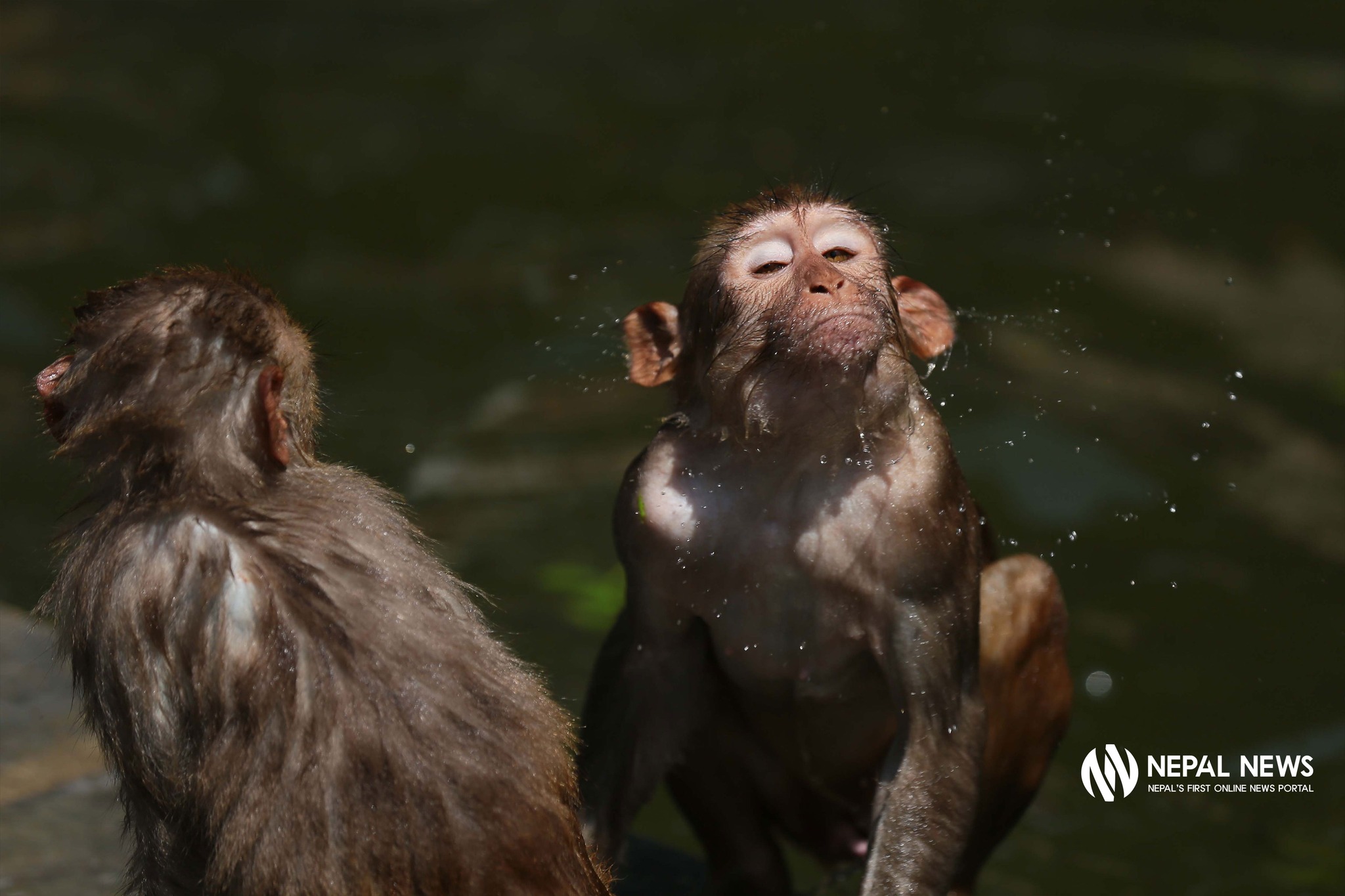
It is not certain how many monkeys there are in Nepal. Although a monkey census was started through a joint project of the National Trust for Nature Conservation and Tribhuvan University, it is said that it cannot state the exact number but will only bring out an estimated average number. The local level has estimated that there are 5,000 monkeys in Melamchi of Sindhupalchowk alone. Experts say that the population growth rate of monkeys is up to 25 percent annually. Whatever the number may be, anyone familiar with villages has experienced that its growth is happening at a frightening rate.
The need for management
First of all, calculating the number of monkeys, humans, forests, and the situation of farming altogether, it must be specified how many monkeys should be there in proportion to the geography and population of Nepal. The number exceeding that must be reduced. In Australia, the government determines the number of kangaroos to be killed every year. Even within protected areas for wildlife, if the number of any one species increases in a way that disrupts the natural balance, the practice of relocating or killing them is found worldwide.
It is not only monkeys that give trouble to farmers. There are also dozens of species of other animals, dozens of species of birds, and hundreds of species of insects. The state addresses the damage caused to farmers by animals and birds of conservation areas, including national parks. The problem of areas not connected with conservation areas has become a subject of debate now. Even among that, the main subject has become monkeys.
The main reason for its widespread presence increasing is not killing and eating it. The damage done by deer, wild boars, porcupines, pheasants, doves, and parrots is also not less to farmers. But people kill and eat them. Although killing any wild animal is an illegal and punishable act, secret hunting keeps going on in every place in the country. Those animals do not get an opportunity to spread elsewhere except inside conservation areas. Village hunters kill and eat them somewhere by trapping them in a snare, somewhere with a gun, somewhere in a net, and somewhere by setting dogs on them.
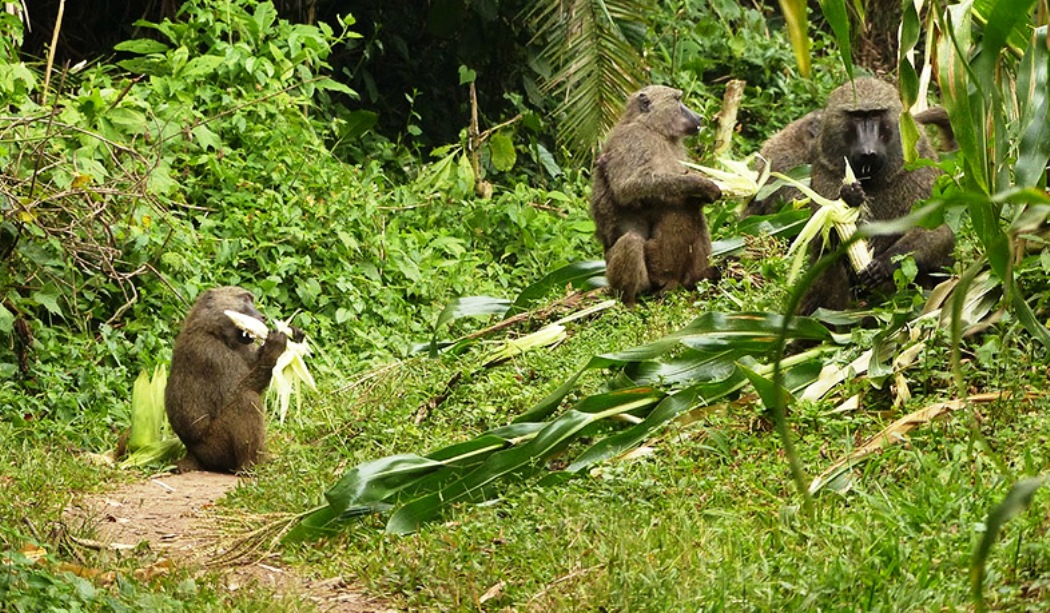
Monkeys raiding and destroying crops. File photo
Monkeys do not fall into the food list of any caste or community in Nepal. Rather, connecting them with myths, religion, and stories, some have made the monkey a god and some their own ancestors. The human community that eats monkeys in Nepal is the people from the Raute community, among whom the number of those living a nomadic life in the forest is less than 200. After the government, non-governmental organizations, and kind-hearted individuals started delivering sacks of food items to their homes, it was no longer necessary for them to kill and eat monkeys either. Now, monkeys have started entering the huts of the Raute themselves.
A monkey makes the forest unrestful as well. It eats all animals it finds and can manage. It eats things from the ground to the sky. It destroys all kinds of plants by twisting, slamming, breaking, shaking, uprooting, and demolishing those it does not eat. Monkeys in Nepal have become like the water hyacinth of water and the mile-a-minute weed of land. If this growing speed of the monkey, which is making others imbalanced, is not stopped in time, there is no possibility for humans to get liberation. The remedy for humans to get liberation is the management of monkeys. Management means pruning by fixing a certain limit.
But in the name of pruning, it is also not easy to kill monkeys. In the year before this constitution was issued, the then Chhinamkhu Village Development Committee had allocated a budget from the Village Council to control monkeys. The whole village joined together and chased monkeys to kill them. When chased from all four sides, the monkeys fell into a tight spot where they could not escape at all. When humans raised sticks, they shed tears from their eyes and folded both hands just like humans, acting as if begging for the final gift of life. Those who share the experience of becoming emotional upon seeing that and being unable to strike are found even now.
Ultimately, monkey populations must be controlled at all costs.