Kathmandu
Thursday, July 2, 2026





FIFA's indefinite suspension has halted Nepal's international football participation and funding, but political leaders and sports authorities remain locked in a blame game instead of pursuing urgent reforms to lift the ban
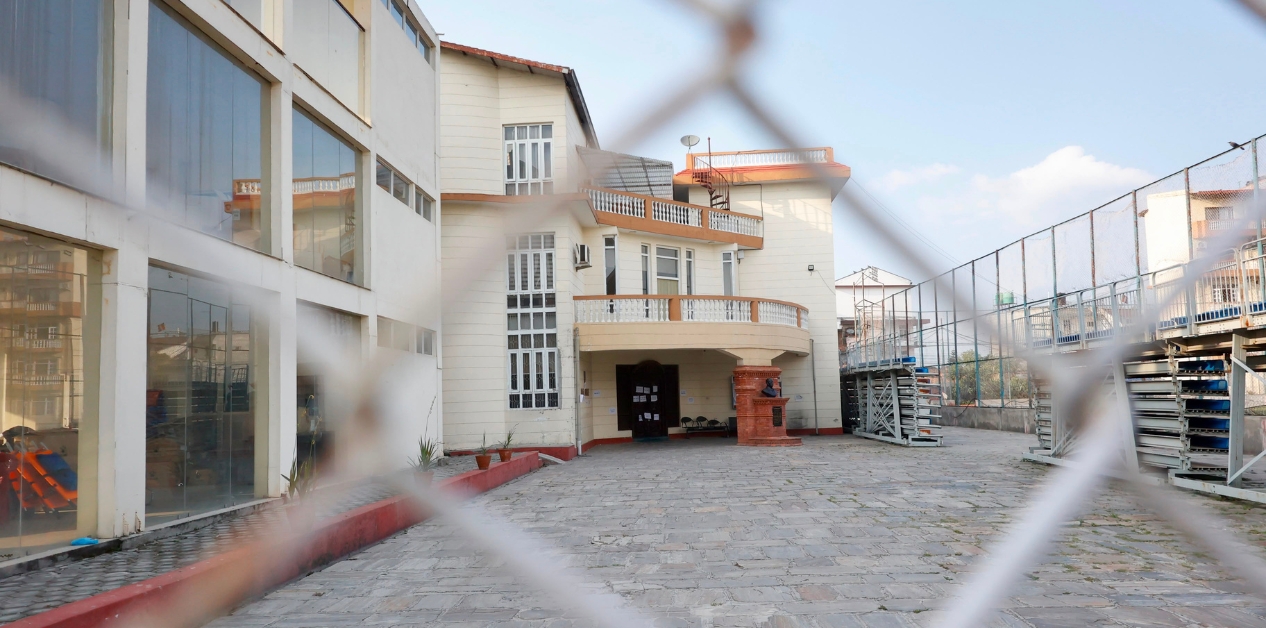
Thank you, ANFA! Hearty congratulations, ANFA officials! The current state of Nepali football will forever honor you!
If you visit the ANFA Complex in Satdobato, Lalitpur right now, you will see such congratulatory posters plastered on the walls. Seeing these congratulations might surprise you. A natural curiosity may arise as to what remarkable achievement Nepali football has attained in the meantime to warrant such congratulations for ANFA officials. One might even think that such praise should only be showered if Nepal had successfully secured a place in the Round of 32 in the ongoing World Cup.
However, the underlying meaning behind these congratulations is entirely different.
Following the suspension of the All Nepal Football Association (ANFA) by football’s supreme governing body, FIFA, dissatisfied national players, former players, and former ANFA officials put up these posters as a form of sarcasm.
“During my 21-year playing career, I played only seven or eight leagues. In the last four years, not even a single league was organized. There was deep-rooted maladministration within ANFA. Since this incident occurred in the midst of all this, we did this to thank them, believing that whatever happens next will be for the best,” says Bikram Lama, a former player and one of those who put up the posters.
Bikram last played in the Sahid Smarak ‘A’ Division League for Three Star Club in 2022. Since then, four leagues should have been organized over the last four years. However, ANFA failed to run the leagues. Touching upon this very issue, the Nepal Football Players Association, led by Bikram, had taken to the streets in protest.
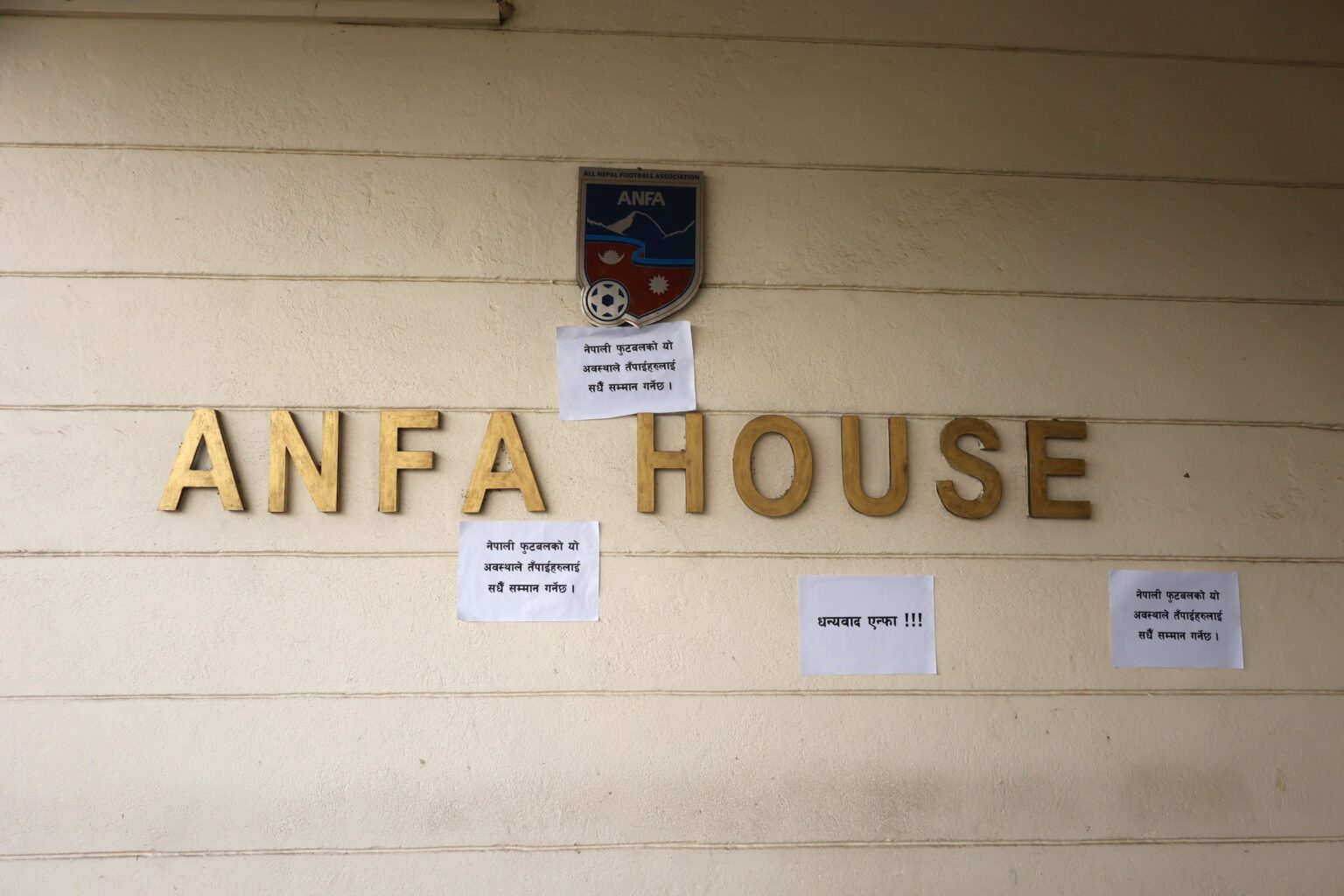
A poster placed in front of the entrance of the ANFA Headquarters by various football associations and enthusiasts following ANFA’s suspension by FIFA. Photo: Nepal Photo Library
With the players’ association protest, the dispute gradually entangled not just ANFA, but also Nepali sports’ supreme governing body, the National Sports Council (NSC), and the government. As the conflict escalated to an extreme, FIFA concluded that there was third-party (government) interference and suspended ANFA indefinitely on June 18. ‘The Bureau of the FIFA Council has decided to suspend ANFA with immediate effect due to a serious violation of the FIFA Statutes relating to third-party interference, in accordance with Article 14, Paragraph 1(i) and 3,’ stated the FIFA decision. Along with the suspension, ANFA is barred from participating in or organizing any international football activities.
The irony is that even though a week has passed since Nepali football had to endure this ‘black day’, the government remains silent. The Sports Minister, who should have been immediately proactive in rescuing ANFA from the suspension as quickly as possible, has neither done anything nor spoken out. The NSC has also not made its formal stance public.
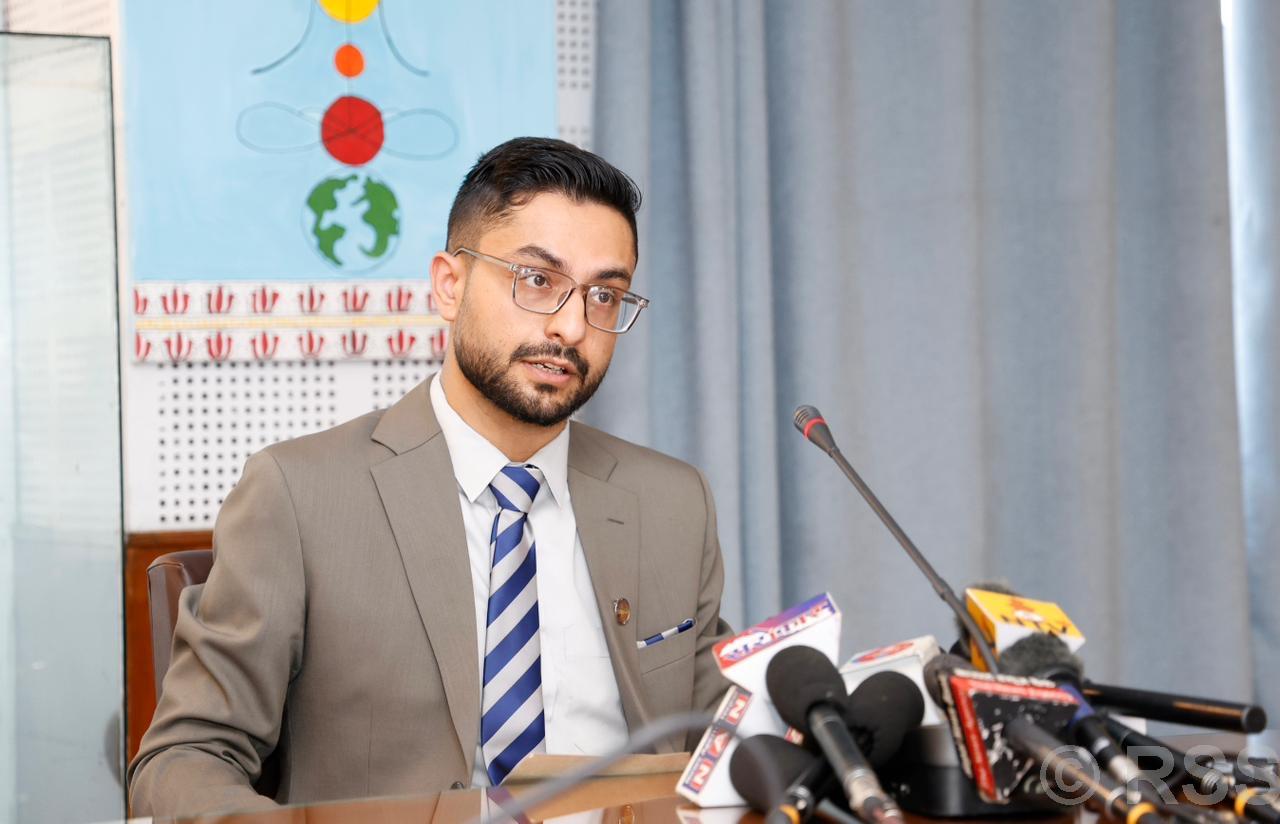
Minister for Education and Sports, Sasmit Pokharel. Photo: RSS
Instead, the issue has been raised in Parliament. Speaking at a meeting of the House of Representatives on June 29, Member of Parliament Shradha Kunwar Chhetri from the ruling Rastriya Swatantra Party (RSP) stated that the ANFA suspension must be investigated immediately. “An international body does not suspend an institution or association over a single day’s incident. There are specific criteria, indicators, and procedures for this. FIFA imposed the ban after those were not met. Therefore, the responsible individuals must be investigated and penalized,” she said in Parliament.
Alongside Chhetri, MP Ahren Rai from the opposition Shram Sanskriti Party also drew the government’s attention to the ANFA suspension in Parliament. However, it appears that Sasmit Pokharel, who has become the Minister for Education, Science, and Sports, is completely oblivious to this incident.
‘Deception by those who understand the game’
Against the backdrop where old political parties showed little enthusiasm for taking charge of the Sports Ministry in the Council of Ministers, the RSP appeared somewhat different. While serving in the government led by Pushpa Kamal Dahal in March-April 2024, the current Minister for Energy, Water Resources, and Irrigation, Biraj Bhakta Shrestha, had led the Ministry of Youth and Sports.
During Shrestha’s tenure, the inactive National Anti-Doping Agency (NADA) was reactivated with the aim of making the sports sector clean and competitive. E-sports was formally recognized, and a budget was even allocated for it. He earned praise by cutting budgets allocated to foundations and tournaments run in the names of political leaders. Additionally, an integrated annual calendar of tournaments organized by the National Sports Council (NSC) and various sports associations was made public for the first time.
In the government formed after the Gen Z protest, current RSP MP Bablu Gupta got the opportunity to helm this ministry. Currently, Pokharel from the same RSP is the Sports Minister, someone who understands the sports sector well. From making appearances at small and large international tournaments to bidding farewell and welcoming players, he is frequently present at Tribhuvan International Airport.
On the opening day of the World Cup, his Facebook status reading “Dream, Nepal in this some day” also clearly reflects his love for football.
Not only him, but individuals with a positive outlook toward sports also hold influence within the Prime Minister’s Office itself. Kumar Banjankar (Ben), the chief advisor to Prime Minister Balendra Shah (Balen), comes from a football background himself. Former national football player Siddhi Banjankar, who is the chief advisor to the Sports Minister, is Ben’s elder brother.
Prime Minister Balen himself is considered a sports lover. When he was the Mayor of Kathmandu Metropolitan City, he used to frequently visit the Dasharath Rangasala to watch the matches of the Nepali national team. On the other hand, Gyanendra Malla, who contributed to Nepali cricket for a long time, is affiliated with the RSP, while former bodybuilder Rajani Shrestha is serving in the role of an MP. However, questions have begun to arise that ANFA has reached the stage of suspension precisely due to the involvement and interference of individuals who are active in the sports sector and understand the subject matter.
The blame game continues
Although ANFA fell short in its responsibilities, ANFA General Secretary Kiran Rai alleges that the NSC’s immature decision was responsible for the recent turn of events leading to the FIFA suspension. According to him, excessive NSC interference in ANFA’s activities, along with decisions like freezing the passports of 24 officials—including himself and ANFA President Pankaj Bikram Nembang—created this situation.
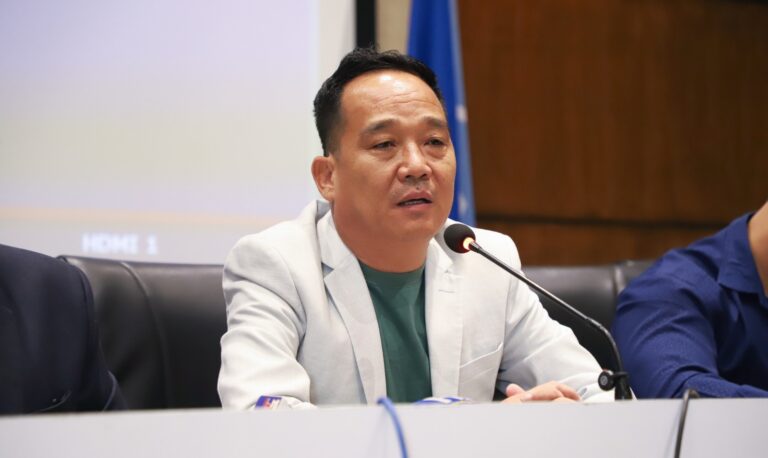
ANFA General Secretary Kiran Rai. Photo: Rai’s Facebook
“Even after repeated directives from FIFA and the AFC, the interference against ANFA did not stop. Turning us back right from the airport was also an undue third-party interference. Had we committed financial, criminal, or treasonous offenses that would put us on the state’s blacklist?” he questions.
FIFA had invited the presidents and general secretaries of its 211 member nations for the opening ceremony and related programs of the ongoing World Cup in Mexico and the United States. On that occasion, a football summit was scheduled to be organized to discuss the budget for the next four years and football development for the representatives of the participating nations. ANFA President Nembang and General Secretary Rai were scheduled to participate in all of these events.
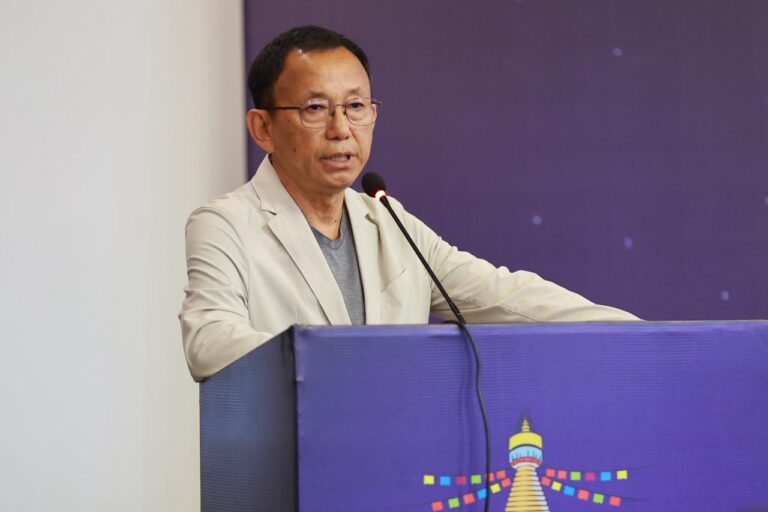
ANFA President Pankaj Bikram Nembang. Photo: Nepal Photo Library
Nembang and Rai had visited the NSC on June 9 to request the release of their frozen passports for the Mexico trip. However, executive Member Secretary Ram Charitra Mehta stated that permission could not be granted. “Football is in such a state, and matters like elections are still pending. In such a situation, they cannot be allowed to go,” Mehta had told Nepalnews at the time.
However, about two weeks after this incident, the FIFA Council Bureau concluded that there was third-party interference and decided to suspend ANFA indefinitely.
Executive Member Secretary Mehta alleges that after being unable to act whimsically, ANFA deliberately got itself suspended by using the excuse of government interference. “As the situation grew complex, we suspected that a suspension from FIFA could occur, which is why we revoked the suspension imposed by the NSC a month and a half ago. However, they failed to hold an executive committee meeting to wrap up the elections and other matters,” he says.
The government does not have a direct relationship with FIFA and the Asian Football Confederation (AFC). However, in the recent dispute, representatives from ANFA, the NSC, and FIFA were holding joint discussions. Regarding the incident where the President Nembang and General Secretary Rai were turned back from the airport, FIFA had sought clarification from the NSC on June 10. However, the NSC did not deem it necessary to respond to the clarification.
However, about two weeks after this incident, the FIFA Council Bureau concluded that there was third-party interference and decided to suspend ANFA indefinitely.
Mehta states that when the NSC lifted ANFA’s suspension, a condition was set to coordinate with FIFA and the AFC to conduct elections, but forgetting the condition, the ANFA President and General Secretary tried to go abroad for personal entertainment. “They were supposed to run ANFA, but they couldn’t. They just wanted to travel and enjoy themselves. Therefore, saying that the NSC did not give this or that is merely an excuse,” he says.
The NSC now appears to be adopting a strategy to form an ad-hoc committee for ANFA and conduct elections through that very committee. However, will FIFA recognize an ad-hoc committee formed by the NSC and the activities carried out by it while ANFA is suspended?
What was lost
The total annual football budget in Nepal stands at Rs 1 billion 563 million (Rs 1,563,209,450). FIFA and the AFC provide an annual grant of around Rs. 650 million to 700 million to ANFA.” Apart from this, ANFA was generating income from various avenues by organizing domestic tournaments and international friendly matches. However, with the suspension, this massive source of income for ANFA will be lost. Furthermore, the Nepali national team and clubs will not be allowed to participate in international football throughout the suspension period.
“The national team and club teams will not be eligible to participate in international competitions until the suspension is lifted. Additionally, ANFA, its member associations, or officials will not be entitled to benefit from any development programs or training from FIFA and the AFC,” FIFA stated.
Along with the suspension, Nepal—which created history five years ago by reaching the final of the SAFF Championship under the coaching of Kuwaiti coach Abdullah Almutairi—will be deprived of participation entirely this time. The upcoming SAFF was reportedly scheduled to take place in Bangladesh from September 21 to October 6. However, SAFF General Secretary Purushottam Kattel states that the tournament has been moved to November as the Indian football team will be participating in the FIFA ASEAN Cup.
Apart from this, Nepal will miss out on the AFC U-17 Women’s Asian Cup and the AFC U-20 Asian Cup qualifiers. Along with this, Tribhuvan Army Club will be barred from participating in the Durand Cup in India, and the women’s team of another departmental side, APF Club, will be barred from the AFC Women’s Champions League 2026/27.
In the list of participating clubs made public by the AFC, league champion APF is not included this time. This marks the first time since the tournament’s inception that a Nepali club has dropped out of this crucial competition. Previously, APF had participated in the tournament twice, in 2024 and 2025.
From South Asia, East Bengal FC of India, Royal Thimphu College FC of Bhutan, and Rajshahi Stars FC of Bangladesh will represent the region in Asia’s top women’s club competition. The draw for the preliminary stage of the AFC Women’s Champions League will take place on July 2 at the AFC House in Kuala Lumpur, Malaysia. The preliminary stage matches are scheduled to be held from August 17 to 23, 2026.
“Now nothing will come from FIFA and the AFC. We can neither participate in international football nor pay salaries to players, referees, and others,” says ANFA Senior Vice President Birat Jung Shahi.
The path to resolution
In football, a team’s win or loss only makes headlines for a few days, but administrative weaknesses can leave an impact for years. Malaysian football is currently undergoing a similar crisis. A dispute that arose over the process of including foreign-born players in the national team ultimately threw the leadership of the Football Association of Malaysia (FAM) into crisis. Following FIFA’s disciplinary action, international pressure, and questions raised over the institution’s reputation, the association’s executive committee decided to resign en masse on January 28, 2026.
FIFA’s investigation revealed discrepancies in the documentation used to field seven foreign-born players for Malaysia. Following this, FIFA suspended the players involved and fined the FAM.
The FAM claimed that it did not commit the error intentionally and that the issue arose due to procedural shortcomings. The responsibility to verify player eligibility in international football lies with the respective association. Therefore, FIFA took the matter seriously. As pressure mounted, the FAM leadership stepped down to protect the institution’s reputation and create an environment for FIFA and the AFC to conduct an independent review.
Former ANFA President Karma Tsering Sherpa states that Nepali football has failed to learn a lesson from this incident. According to Sherpa, FIFA does not favor long-term bans; hence, if reform initiatives are taken in time, Nepali football can be saved from further crisis. “FIFA wants the suspension not to stretch out for a long period. Therefore, there is still an opportunity to improve before the FIFA Congress,” Sherpa says. “For that, ANFA must state that they will head toward tiered elections, ask FIFA to form an ad-hoc committee itself, and agree to step aside.”
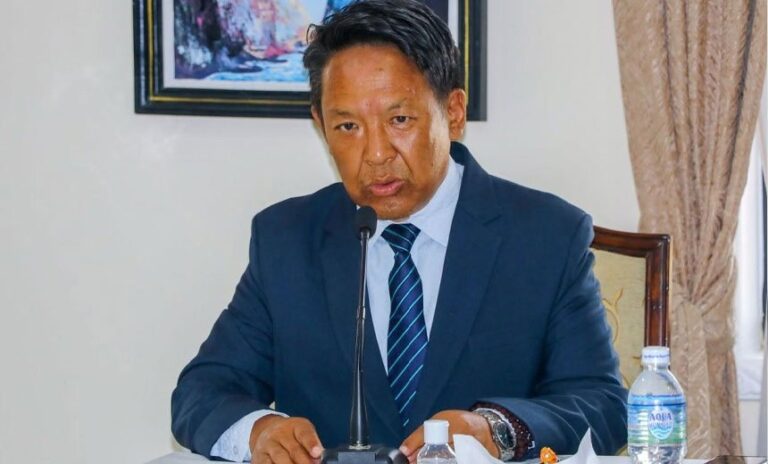
Former ANFA President Karma Tsering Sherpa. File Photo
As Sherpa suggested, if the necessary provisions are met, the FIFA Council could make a decision to lift the ban before the upcoming Congress scheduled for March 18, 2027. However, for this to happen, he notes that the ANFA leadership must prioritize the institution’s welfare, act as a neutral coordinator, and provide clear information regarding Nepal’s legal framework and the actual ground reality.
If a solution seems unlikely under the current leadership, he suggests that the government should form an ad-hoc committee to communicate directly with FIFA and take the initiative to invite a FIFA ‘fact-finding’ team to explain the true situation. “Nepali football can only be guided out of this crisis through institutional reforms, transparent processes, and responsible decision-making. Only this path can secure the future of the players, clubs, and overall Nepali football,” he says.