Kathmandu
Monday, July 13, 2026





Nepal won by 8 wickets (with 25 balls remaining) | Tribhuvan University Cricket Ground, Kirtipur
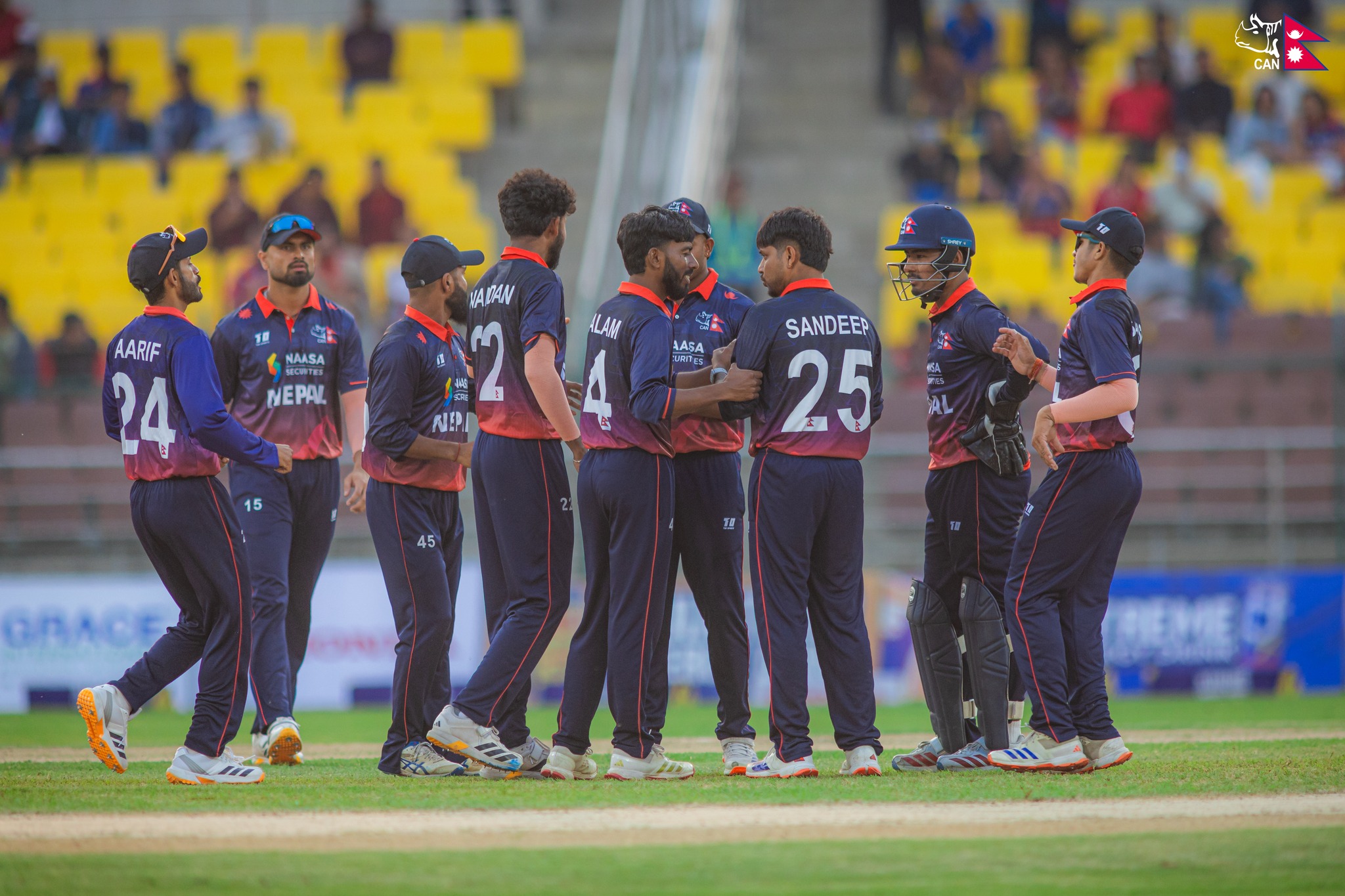
There is a particular kind of victory that tells you everything about where a team stands — not just in a series, but in its broader development. Nepal’s series-levelling eight-wicket demolition of the UAE on Tuesday evening at Kirtipur was precisely that kind of performance. It was controlled, almost surgical, and it came under floodlights in front of a home crowd for the first time in Nepal’s T20 international history. The occasion demanded something special, and Nepal delivered it with overs to spare.
The Collapse That Changed Everything
UAE lost the toss and was asked to bat, a decision by Nepal that, by the end of the third over, had already begun to look catastrophic for UAE. Hemant Dhami — one of the new faces handed responsibility in the absence of regular pace stalwarts Sompal Kami and Karan KC — struck off the very first delivery of the match. Muhammad Waseem, who had played a critical role in UAE’s first-match victory, departed without scoring at 0.1 overs, caught before the innings had even drawn breath.
What followed was a collapse of alarming speed and totality. By the end of the second over, Alishan Sharafu — the man whose 58-run knock had nearly stolen last October’s World Cup qualifier final — was gone for 1, dismissed at 15/2. Harpreet Singh fell at 20/3 in the very next over. In the space of 13 balls, UAE had lost three wickets and their top order lay in ruins.
The numbers tell a brutal story. By the end of the seventh over, UAE were 48/6 — a score that, in T20 cricket, represents near-total institutional failure from a batting lineup. Three wickets fell between 47 and 48 runs, a micro-collapse within a broader catastrophe. Ayaan Usmani (6.3 overs), S. Khan (7.3 overs), and Nilansh Keswani (7.5 overs) all departed in rapid succession. For context: UAE lost their sixth wicket in the fifth delivery of the eighth over, at which point they had consumed roughly a third of their allocation and had fewer than 50 runs on the board.
Dhami’s opening burst (2 wickets, 20 runs off 4 overs, economy 5.00) set the tone. His accuracy and movement in the powerplay phases rewarded Nepal’s selection gamble. Choosing to field him ahead of more experienced names was a calculated risk by stand-in captain Dipendra Singh Airee and head coach Stuart Law. It paid off immediately and emphatically.
Lamichhane’s Masterclass: 3 Wickets, 6 Runs
If Dhami broke open the innings, Sandeep Lamichhane ensured UAE could never mount a credible recovery. His figures — 4-1-6-3, economy rate 1.50 — are among the most suffocating any Nepal bowler has produced in a T20 international. Three wickets at the cost of just six runs across four overs is not merely a good performance; in a format defined by batting aggression, it represents a kind of bowling alchemy.
What makes these numbers more striking is context. UAE, having lost six wickets in their first 48 runs, had every incentive to attack. Their middle-lower order needed boundaries. Lamichhane denied them almost entirely. One maiden over underlines the control he exercised, but the economy rate of 1.50 — in T20 cricket, a format where even the best spinners routinely concede seven or eight an over — speaks to an entirely different level of dominance.
The partnership between Muhammad Arfan and whoever survived alongside him through the middle overs did eventually push UAE to something approaching respectability. The 112/7 and 112/8 markers arrived at 18.2 and 18.3 overs respectively, suggesting the final death-over batting was responsible for the bulk of UAE’s recovery runs. Shahab Alam (3-0-29-1) and Dipendra himself (3-0-16-0) managed the middle overs adequately, though Nandan Yadav’s four overs at an economy of 11.00 gave UAE some breathing room.
UAE’s final total of 128/8 was a product of lower-order defiance rather than any systemic recovery. From 48/6, reaching 128 shows a degree of character — but against a batting lineup of Nepal’s current quality, it was always going to be insufficient.
Bhurtel’s Evening: An 84 That Settled the Series
If the bowling was clinical, the batting was something richer. Kushal Bhurtel’s 84 off 57 balls — unbeaten, unflustered, and ultimately match-defining — was one of the most complete T20 innings a Nepal batter has played at home.
The strike rate of 147.37 is important here. This was not a slap-happy assault; it was a structured demolition. Twelve fours and two sixes across 57 deliveries suggests a man who was scoring predominantly through the field rather than simply clearing it, a hallmark of high-quality T20 batting. He found gaps, rotated intelligently, and accelerated only when the match situation demanded it. Against the UAE’s bowling attack in these conditions, he was, frankly, unplayable.
The opening stand with Kushal Malla (19 off 17 balls, SR 111.76) set the tempo before Malla was dismissed — caught by Muhammad Waseem off Muhammad Arfan — with the score at a comfortable platform. Santosh Yadav’s brief stay (1 off 4 balls before being stumped off Nilansh Keswani) was Nepal’s only true wobble, but the match was already won in any meaningful sense by that point.
Dipendra, entering at number four, played the role of a captain anchoring a finish rather than an architect of the chase. His 23 off 17 balls (SR 135.29) was decisive without being necessary, a luxury innings made possible by Bhurtel’s brilliance at the other end. Nepal reached 129/2 in 15.5 overs, with 25 balls remaining — a 4.1-over cushion that underlines just how completely they dominated the chase.
For comparative context: the target of 129 was chased at a run rate of approximately 8.14 per over. Nepal never looked like slowing down.
What the Series Tells Us
This was a two-match series that ended 1–1, but the aggregate picture is more nuanced than that flat scoreline suggests. UAE won the first match; Nepal won the second with considerable authority. The margin of victory — eight wickets, 25 balls to spare — is the largest Nepal has achieved against UAE in T20 international history, a statistic that carries real weight given the context provided earlier in this series. Their previous record win against UAE was by eight wickets in October 2023, and to replicate that in a high-pressure series decider speaks to genuine growth.
Several structural observations emerge from these two matches taken together:
Nepal’s bowling depth is real. The absence of Sompal Kami and Karan KC — two of Nepal’s most experienced pace bowlers — was not felt. Dhami’s debut-level performance and Lamichhane’s extraordinary figures suggest that Nepal now have bowling resources they can rotate without significant drop-off.
Bhurtel is Nepal’s most dangerous white-ball batter. His 84 today follows his 51 in the World Cup qualifier. In T20 internationals against UAE specifically, he is producing match-defining innings with remarkable consistency. The question for the selection panel is whether they are giving him the structural support he deserves through the rest of the lineup.
Dipendra’s leadership is working. Resting Rohit Kumar Paudel for this series was a calculated gamble by Stuart Law, and Dipendra responded — both with his captaincy decisions (the bowling changes, particularly Lamichhane’s prolonged spell) and with the bat in the second match.
UAE’s vulnerability at the top of the order is a recurring pattern. The rapid wickets of Waseem, Sharafu, and Harpreet echo vulnerabilities seen in earlier encounters. Nepal’s bowlers appear to have mapped this and are exploiting it with increasing precision.
A Historic Evening in Kirtipur
Beyond the cricket itself, the significance of this match should not be understated. Nepal played under floodlights at home for the first time, and they did so by delivering one of their most complete T20 performances. The crowd at Tribhuvan University Cricket Ground witnessed history not just in the administrative sense, but in the cricketing one — a team that, in 2018, fielded teenagers against this same opposition to see what they had, now fields a squad capable of dismantling that opponent in 15.5 overs while resting their captain.
The series ends level, but in terms of the final message sent, Nepal leave the ground with something more valuable than a 2–0 scoreline: they leave with evidence that their progression is not incidental. It is structural, it is deliberate, and under Stuart Law’s stewardship, it is accelerating.
Match played at Tribhuvan University Cricket Ground, Kirtipur | Nepal won by 8 wickets (25 balls remaining)