Kathmandu
Thursday, July 2, 2026





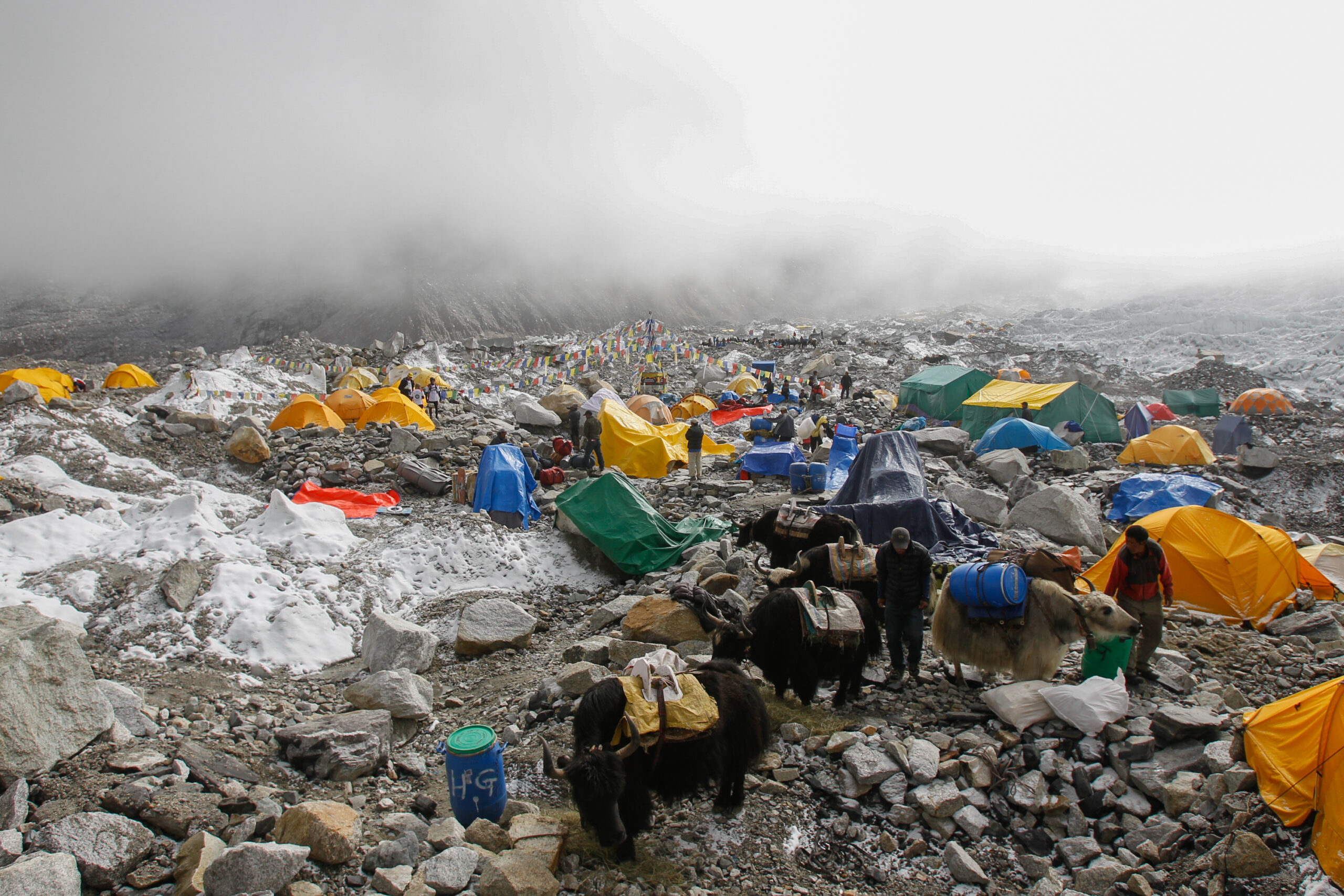
KATHMANDU: Mingma Sherpa (47) is the first Nepali to climb all 14 peaks above 8,000 meters. For the last decade and a half, he has been in the business of helping climbers from around the world summit mountains. Seven Summit Treks, founded in 2009 by Mingma and his three brothers, provides complete packages—from guiding and logistics to climber safety—not only in Nepal but also in Pakistan and Tibet (China).
In this challenging and adventurous work, Mingma’s company stays incredibly busy. “Many people who want to climb mountains used to contact foreign companies first; now they come directly to us,” he says. “It’s not that people don’t come through foreign contacts anymore, but that number is small.”
For the Spring 2026 season, 492 people have received permits to climb Mount Everest as of May 7. Among them, 85 are climbing through Seven Summit Treks.
It’s not just Seven Summit; companies like Asian Trekking, 14 Peaks, 8K, Elite, and Pioneer are considered major players in mountaineering. From the 1990s—when commercial climbing began in Nepal—until 2010, foreign companies held a monopoly. Prominent names included New Zealand’s Adventure Consultants and Himalayan Experience (Himex), America’s Alpine Ascents International and International Mountain Guides, and Britain’s Jagged Globe. During that era, Nepalis worked merely as employees for these firms.
The shift in control
A decade ago, the Everest climbing economy was under foreign control; now, it is in the hands of Nepali companies. Although the law technically required coordination with local agencies, foreign companies previously made all the plans, ran the expeditions, and took the decisions. “Currently, out of those who have come to climb Everest, perhaps 100 came through foreign company contacts. The rest came through direct contact with Nepali companies,” Mingma explains.
Previously, the role of Nepali companies was limited to logistics and acting as porters to get clients to the peak. Climbers contacted foreign firms because large local companies and the necessary specialized workforce did not yet exist in Nepal.
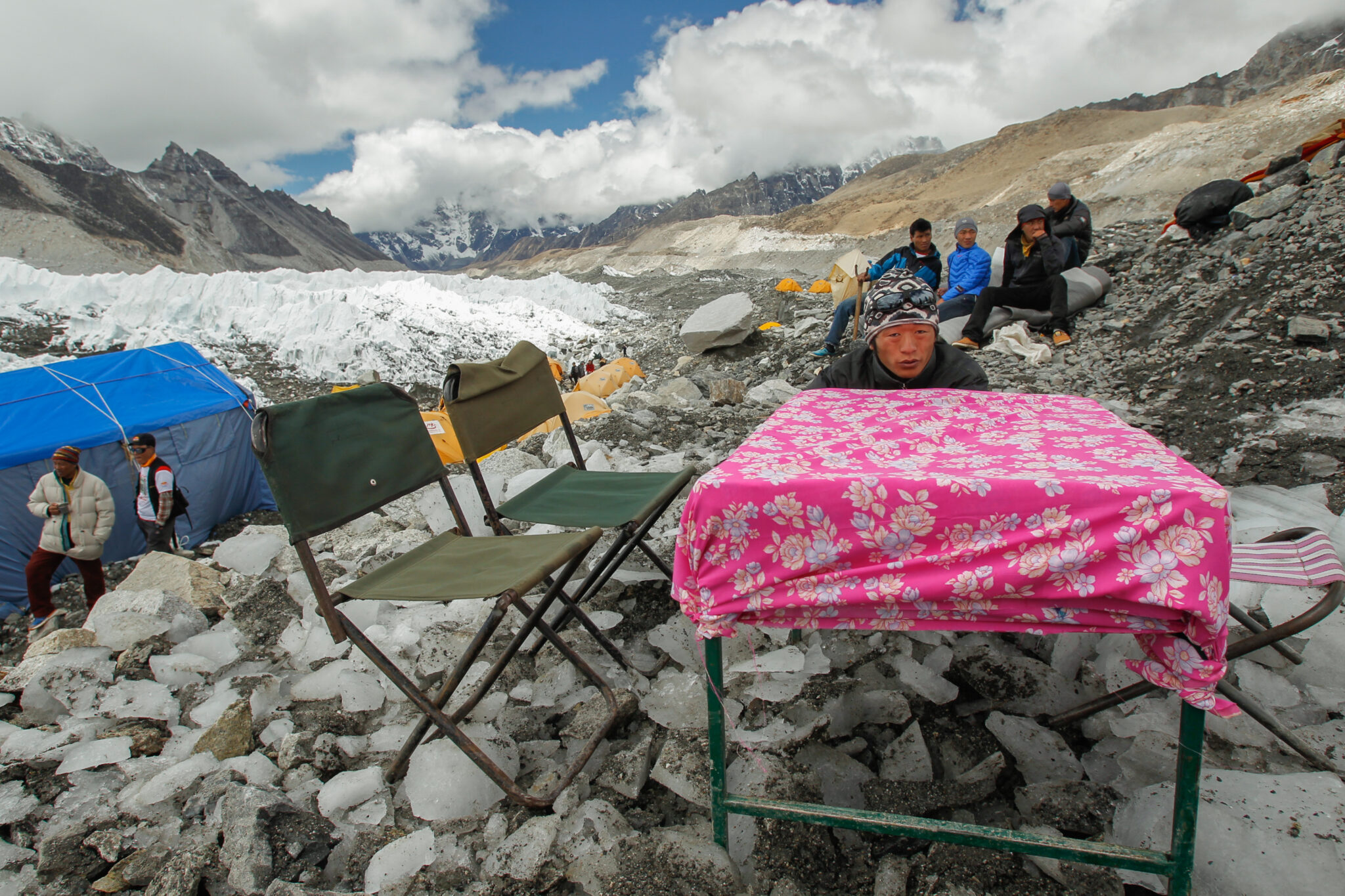
Everest Base Camp. Photo: Bikram Rai
Medhavi Gulati, who has studied mountains and the Sherpa community, states that Nepali companies now control 90% of the Everest climbing economy. “Compared to a decade ago, 80 to 90 percent of the Everest mountaineering economy is under the control of Nepali companies,” Gulati says. “In a sector where international operators once dominated, Nepali operators have gained significant economic power, and foreign companies are slowly exiting.”
Asian Trekking, founded in 2006 by Ang Tshering Sherpa (former president of the Nepal Mountaineering Association), was instrumental in introducing Nepali companies to the international market.
From porters to entrepreneurs
Though attempts to climb 8,000-meter peaks began in the early 20th century, it took over three decades to succeed. Early mountaineering was viewed as a matter of national prestige, involving countries rather than individuals. Nepal used to grant only one permit per route per season. In the early 1990s, Nepal adopted a liberal mountaineering policy, leading to the rise of commercial companies.
According to Will Cockrell’s book Everest, Inc ., the seeds of commercial climbing were sown in 1985 with the success of American businessman Richard Daniel (Dick) Bass. By reaching the summit at age 55 and becoming the first to complete the “Seven Summits” (the highest peaks on all seven continents), Bass proved that with professional help, an “ordinary person” could climb the world’s highest peak. This sparked a desire among the wealthy and adventurous, opening a new door for the guiding business.
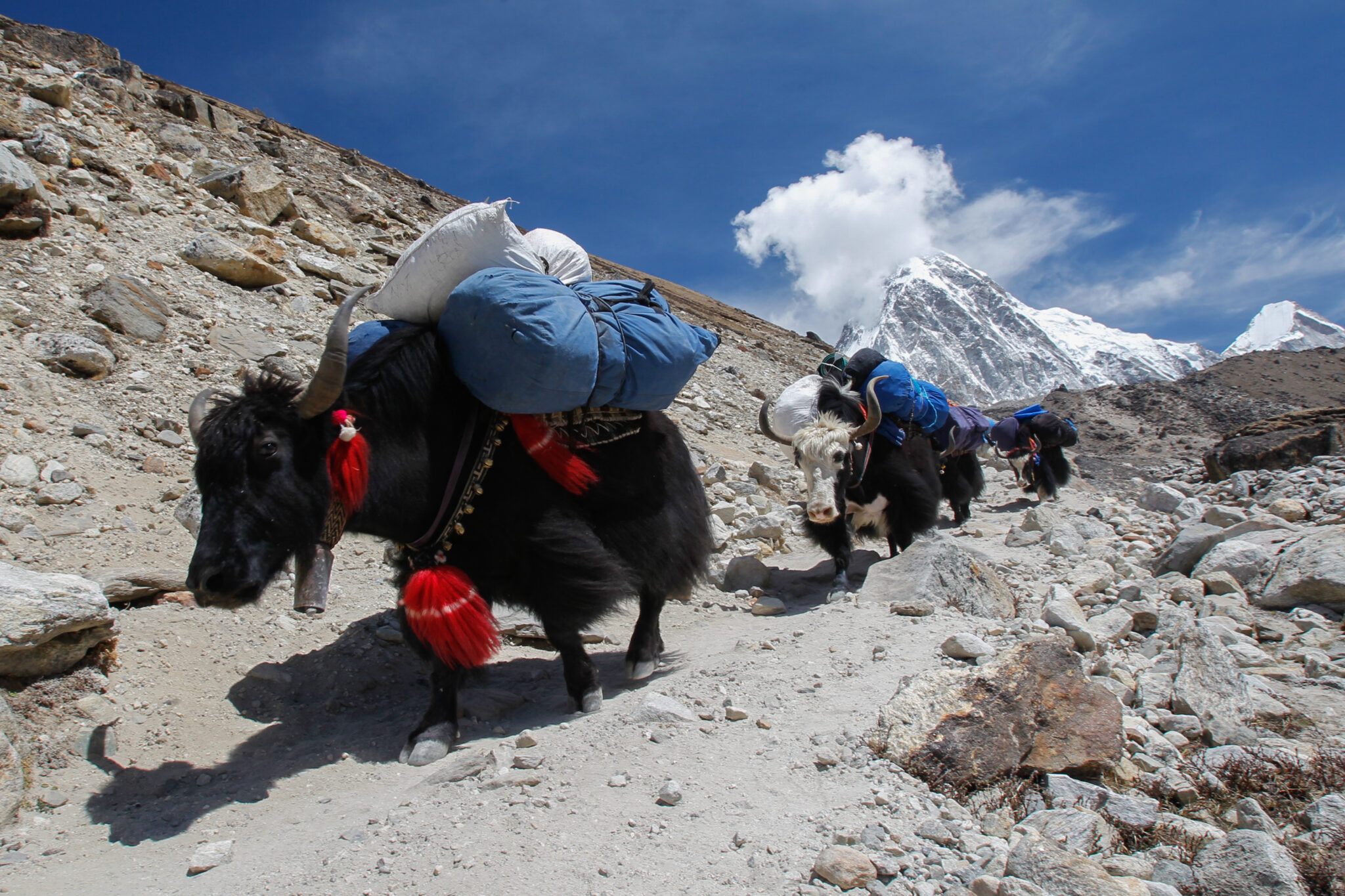
Everest Base Camp. Photo: Bikram Rai
On May 12, 1992, two companies made history. Adventure Consultants brought six clients to the summit. A few minutes later, climbers Hurner, Bowen, and Tejas from Alpine Ascents International (AAI) also reached the summit. According to the book, these were the first two successful commercially guided Everest expeditions carried out at the same time. Adventure Consultants was a New Zealand-based company, while AAI was based in the United States.
The 1996 tragedy
In 1996, a major disaster occurred on Everest. On May 11, eight people, including famous guides Rob Hall and Scott Fischer, died during an avalanche. While many predicted the tragedy would decrease Everest’s appeal, the opposite happened. The news and subsequent books caused an unusual expansion in the business. The presence of risk actually attracted more people. 1996 is considered the greatest marketing event in Everest’s history, causing bookings to skyrocket.
After the accident, a global debate began regarding the dangerous work and contributions of Sherpas. Mountaineering, seen as “heroism” by Westerners, began to be recognized as a high-risk job for Sherpas. As their risks were discussed, their roles also expanded.
From the first successful ascent in 1953 (Hillary and Tenzing Norgay) until 1992, 394 people climbed the peak non-commercially. Commercial climbing only truly began in 1992. According to the Himalayan Database, 13,752 people have reached the summit to date—9,890 from the Nepal side and the rest from China. Ninety percent of these reached the summit through commercial companies.
Today, Everest climbing is a massive industry. Some Nepali companies offer climbs for $17,000 to $25,000, while established Western and Nepali firms charge $50,000 to $100,000. Companies like Seven Summit Treks even offer luxury packages costing up to $300,000 (approximately Rs 40 million).
That turning point
The ‘Everest Fight’ of 2013 and the strike after the 2014 avalanche gave the message that Sherpas are capable of fighting for their rights. From hanging ropes on the mountain to carrying all the logistics, Sherpas now have complete control, and even Western guides have to depend on the decisions they take. “In recent times, many Sherpas have made mountaineering a business, and they have the influence in this,” says Ankit Babu Adhikari, co-author of the book Sherpa . “When going to the Himalayan region, other Sherpas also say with pride that I work in such-and-such Sherpa’s company.”
The ‘Everest Fight’ of 2013 was an incident of dispute on Everest. It occurred at Camp Two between three European climbers and the Sherpa rope-fixing team. The team of Sherpas working for commercial climbing companies was doing the work of hanging ‘fixed rope’ on the Lhotse Face. At that same time, three climbers from Europe were going up through that same path. Even though the Sherpas requested them not to go up, they climbed while ignoring it. In that process, ice fell and hit the Sherpas. There was a verbal spat between both parties on that subject. After the European climbers used abusive language, the Sherpas attacked their tents.
It is written in the book Everest, Inc .: ‘This fight was not just a dispute over an insult or hanging a rope. By that time, Sherpas were feeling that their ownership and control in the Everest climbing industry were increasing. They felt that they were being looked down upon by foreign climbers, and this incident was like a big rebellion they did for their self-respect and rights.’
After the incident, a written agreement was made, and the European climbers returned after canceling their climb. ‘This incident signaled that the power balance between Western climbers and local Sherpas on Everest was changing,’ the book says. In the early times (1920s–1990s), Sherpas were addressed by Western climbers with insulting words like ‘porter’ or ‘cook boy’. Sherpas used to follow the instructions of climbers, but with time, they did not remain limited only to the work of carrying loads. With the start of commercial climbing in the 1990s, Sherpas reached managerial positions like ‘Sardar’ and started leading teams along with Western guides.
In 2014, an avalanche occurred on Everest. After that, those working on the mountain put forward 13-point demands including economic security. “The situation after the 2014 avalanche and the 13-point demands placed after that completely changed the power balance in this sector,” says Gulati. “After this incident, local agencies started competing aggressively with foreign companies and re-established their place in mountaineering.”
Gulati says that expertise and technical education helped establish Sherpas in this sector. “Mountaineering schools established in places like Humde and Phortse prepared the new generation of Sherpas as highly skilled and technical climbers,” she says. “Because of this, they have become more aware and professional towards their work.”
Another important aspect: compared to foreign companies, Nepali companies sell cheaper packages in mountaineering. According to the Mountaineering Regulation, 2002, there is a provision that only Nepali companies can lead climbs. However, in practice, there is also the practice of foreign companies selling packages and them leading climbs through Nepali companies. When buying such a package directly from a Nepali company rather than a foreign company, it is cheaper. Gulati says, “They established their influence in the market by providing ‘summit packages’ at a cheaper price compared to foreign companies, because of which Indian and Chinese customers were attracted to them in large numbers.” Among the 492 who received permission for climbing Everest until May 7, 109 are Chinese and 61 are Indian citizens.
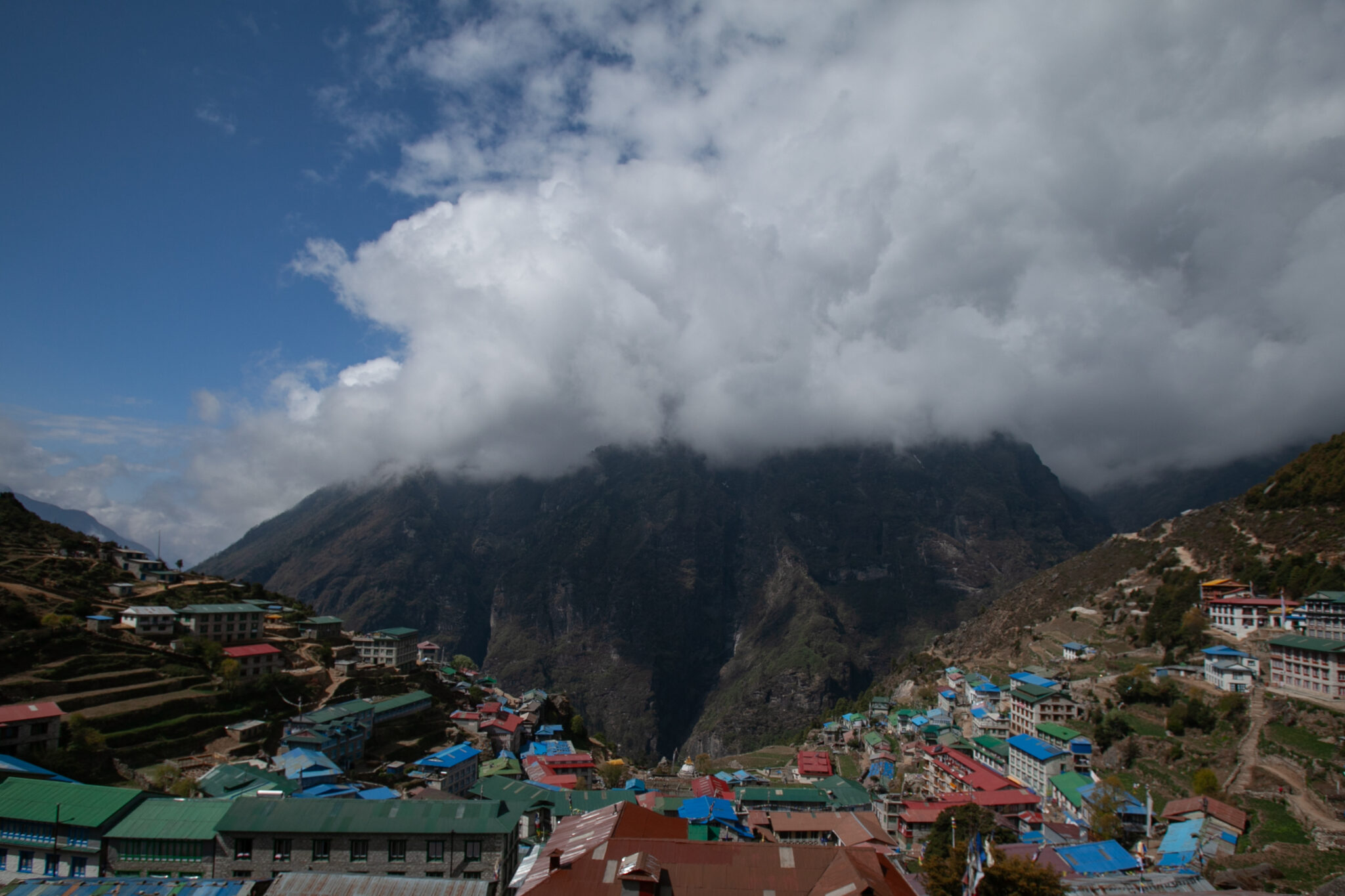
Namche Bazar. Photo: Bikram Rai
The global brand of Sherpas, the records they have made, and the development made in capacity, combined with countries like China and India becoming economically capable, has brought the mountaineering business under the ownership of Nepalis.
The criticism of the rapid commercialization of climbing is also equally present. Especially, criticism occurs saying that the environment has been spoiled when excessive numbers of people go to that area to climb Everest. The demand that Everest should be given a rest also arises from time to time. On the other hand, it is said that there is a situation of having to wait for time for the climb when there is an excessive crowd of climbers on Everest.
Similarly, Gulati says there is widespread exploitation in the mountaineering business. She says that lower-level employees like kitchen boys, porters, and assistant guides appointed for specific tasks are not paid on time.
Writer Adhikari sees security-related challenges when the climbing business becomes overly commercial and reaches the ownership of Nepalis. “There is a competition to lead climbs cheaply because of competition in the market,” he says. “In the process of making the climb cheap, compromises are being made on important aspects of safety and standards, which increases the risk of accidents.”
He expresses concern over whether Nepali companies can maintain international-level safety and quality. “If any major accident occurs because of not paying attention to safety and quality, it can cause disgrace not just for one company but for the whole country,” he says. “In such a situation, there remains a risk that the trust and market currently gained by Nepali companies will go to the lap of foreign companies.”
He says that companies must do ‘check and balance’ at every step to keep their reputation protected.