Kathmandu
Monday, July 27, 2026





Airspace closures across West Asia have halted TIA’s Gulf services, stranded thousands of passengers and triggered worldwide flight cancellations and rising airfares

KATHMANDU: The joint attack carried out by the United States and Israel against Iran on February 28 and Iran’s retaliatory strike have affected air services worldwide, including Nepal. Due to the war, flights from the Tribhuvan International Airport (TIA) to various Gulf nations have been canceled since Saturday.
According to TIA Spokesperson Santusta Kumar Basnet, 16 international flights from Nepal were canceled on Monday alone. From Nepal, four Air Arabia flights, three each of Flydubai and Qatar Airways, two each of Himalaya Airlines and Kuwait Airways, and one each of Jazeera Airways and Nepal Airlines were canceled.
Turkish Airlines aircraft previously entered Turkey via Iran from Pakistan. However, after the war began, they have been entering Turkey via Afghanistan, Tajikistan, Uzbekistan, Turkmenistan, Azerbaijan, and Armenia from Pakistan.
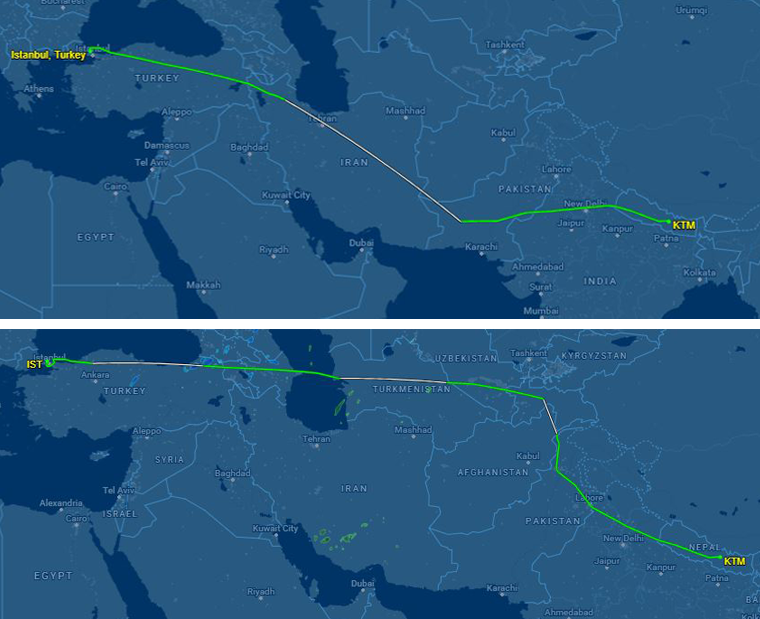
The regular flight route of a Turkish Air flight to Istanbul, Turkey, from the beginning of the war in the Middle East (February 18) (above), to the flight route after the war (March 1). Photo: Flight Aware
The Civil Aviation Office at TIA had already issued a notice on Saturday evening stating that flights of these airlines could be delayed, rescheduled, or canceled, and advised passengers to confirm their flights only after contacting the respective airline representatives.
Due to the war and heightened tensions, the airspace of West Asian countries including Qatar, the UAE, Kuwait, Iran, Iraq, Israel, Jordan, Lebanon, and Bahrain has been closed. Dubai and Abu Dhabi partially reopened their airports on Tuesday. Major airports such as Doha, Tehran, and Ben Gurion remain closed. More than 300,000 international passengers typically travel through these airports daily.
With the sudden suspension of services, thousands of passengers have been stranded in major air travel hubs such as Dubai, Abu Dhabi, and Doha.
Anticipating further escalation of tensions, Emirates, Qatar Airways, Etihad, Flydubai, Kuwait Airways, and Gulf Air have completely suspended their services. Flights of ITA Airways, Wizz Air, and Lufthansa have also been affected. Airlines from the United States, Europe, and Asia have issued notices suspending flights from March 3 to 7.
According to FlightAware.com, more than one thousand flights worldwide had already been canceled by Tuesday morning.
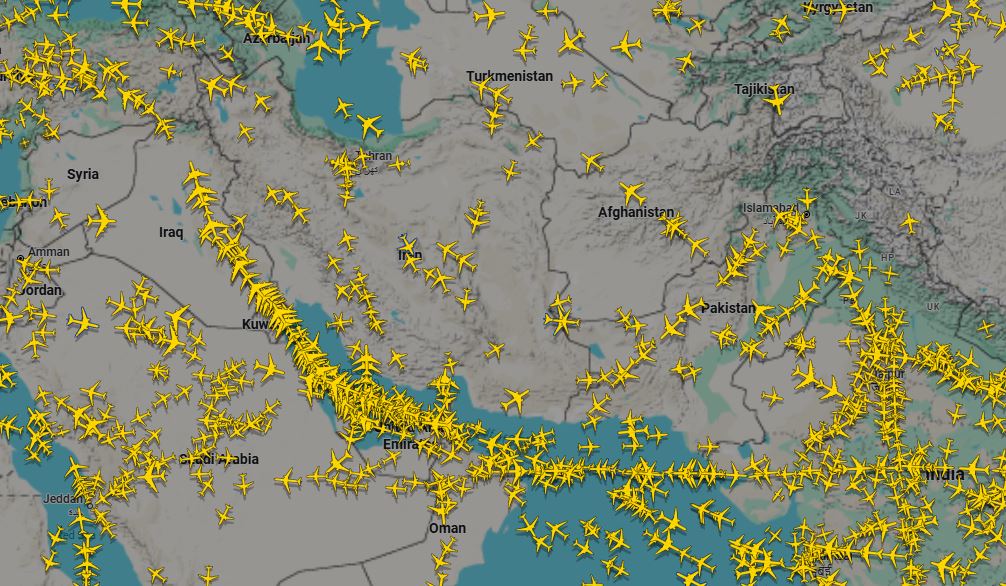
This is the biggest crisis seen in the aviation sector since the COVID-19 pandemic.
With the Gulf region’s airspace closed, more than 50 airlines worldwide have been forced to operate flights south of the Arabian Sea and through the Caucasus mountain region. As a result, Europe–Asia flight times have increased by two to five hours. Fuel consumption has risen by 30 to 50 percent.
According to a report published in The Japan Times, ticket prices for Asia–Europe routes have increased by 20 to 45 percent due to the war. Airfares between Australia and Europe have also risen by 30 percent. The report states that if the situation continues for a week, losses could reach between one to two billion US dollars. If travel disruptions last more than four weeks, the aviation industry is estimated to lose 15 to 25 percent of its profits.
Since the war began in the Gulf, companies affected by the disruption in air services have seen significant drops in their share prices. Travel sector companies have already lost USD 21 billion in the global stock market.
Similarly, air cargo services have also been heavily impacted. Around 30 to 40 percent of global cargo handling is conducted through Dubai and Doha airports.