Kathmandu
Sunday, June 14, 2026





Despite the constitution’s repeated commitment to proportional and inclusive representation, the March 5 election has produced a House of Representatives where marginalized groups, from Dalits and Tharus to women and indigenous nationalities, remain far below their population share, while Khas Arya dominance persists
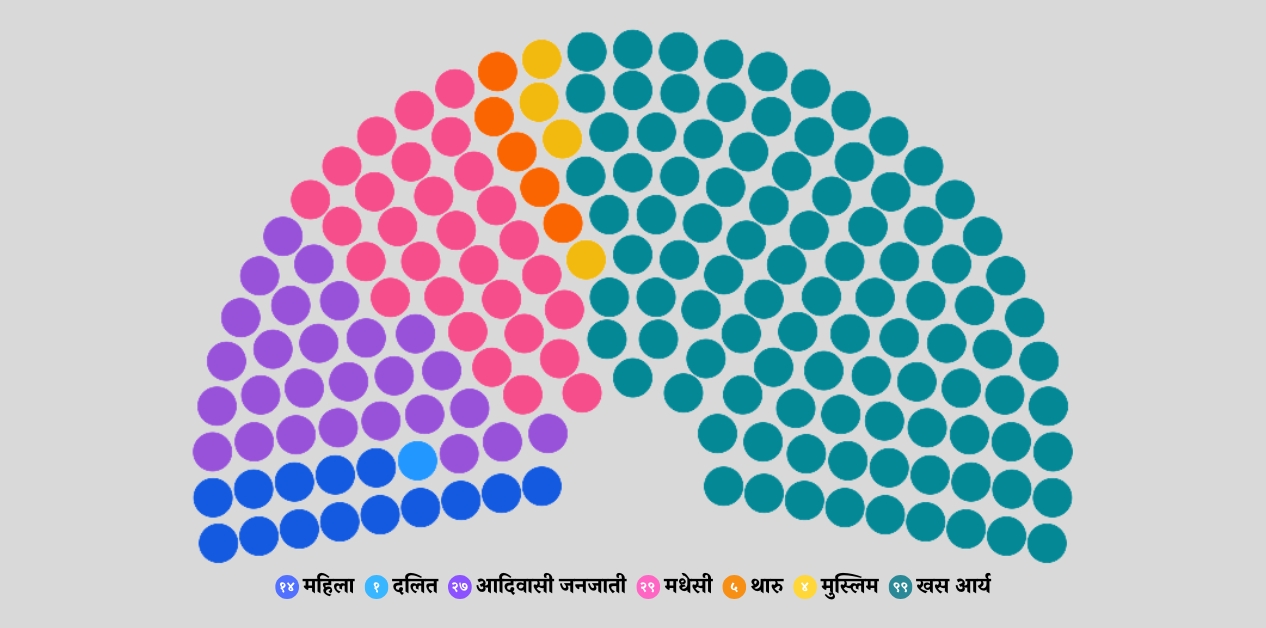
KATHMANDU: The word “inclusive” appears 35 times in the country’s constitution. The preamble itself carries the commitment to “build an equitable society on the basis of proportional, inclusive and participatory principles.”
The constitution guarantees the right of women, indigenous nationalities, Dalits, Madhesis, Tharus, Muslims, and economically disadvantaged Khas Arya to participate in state bodies on the basis of proportional inclusive principles. But when the data of directly elected members in the March 5 House of Representatives election is examined, the new parliament appears to be non-inclusive.
According to the National Census 2021, Dalits make up 13.44 percent of Nepal’s total population of 29.16 million. But in this election’s direct vote, only RSP’s Khagendra Sunar from Banke-3 won nationwide – just 0.61 percent of the 165 directly elected seats. The constitutional provision ensures 15 Dalits are elected through the 110 proportional seats. However, since there is no legal requirement to ensure proportional inclusive representation in the direct election, political parties have been giving tickets to very few Dalit candidates. As a result, the number of Dalits winning direct seats since 2017 has been extremely low.
In this House of Representatives, too, there will be a total of 16 Dalits – one directly elected and 15 through proportional representation. In the 2022 parliament as well, UML’s Chhabilal Bishwokarma was elected directly from Rupandehi-1 while 15 were chosen proportionally. This figure is only 5.82 percent of the 275-member House of Representatives. Dalit representation will again be limited to this level.
It is not only Dalits. The representation of marginalized groups including Tharus, Muslims, indigenous nationalities, and women has also not been in accordance with the spirit of the constitution.
According to the spirit of the inclusive proportional principle set by the constitution, 22 Dalits should reach the House of Representatives through direct election. But in two consecutive parliaments, only one has been directly elected each time. Combined proportional and direct elections, 37 Dalit MPs should be elected to the House. Yet only 16 Dalits are reaching parliament now. Writer and researcher JB Bishwakarma says this makes a mockery of the constitution’s inclusion principle. “Old parties did what they always did, but even in an election after the Gen Z movement’s changes, new parties also paid no attention to inclusion. In fact, they made it worse,” he says.
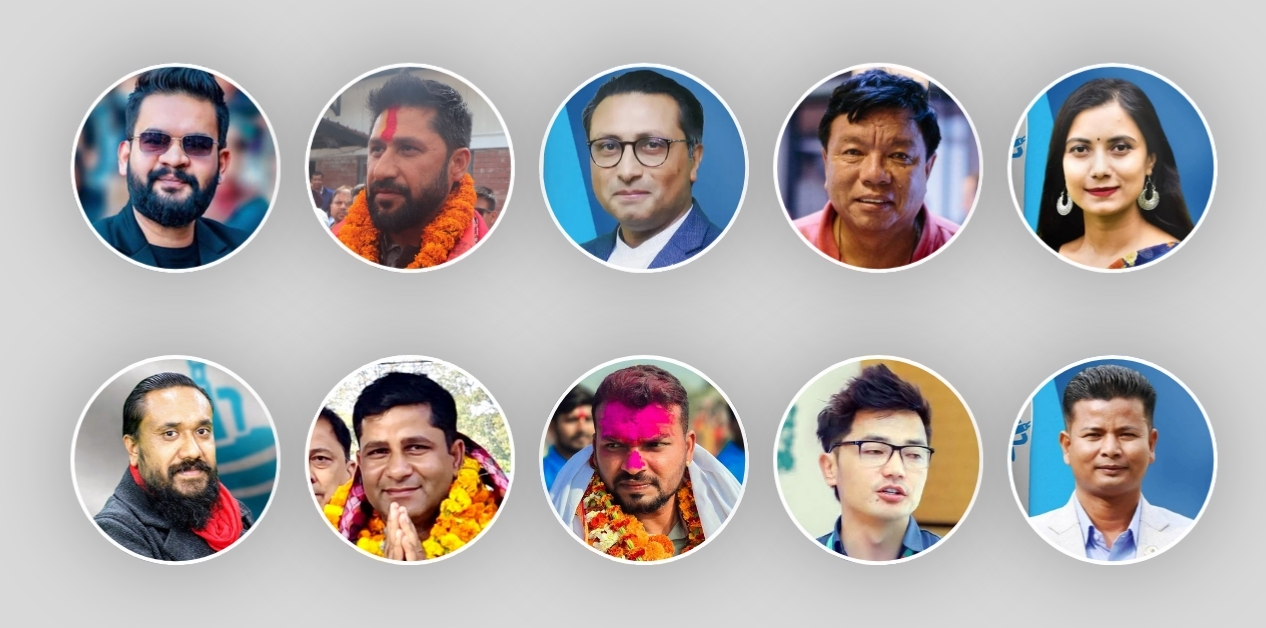
Elected members of the House of Representatives are (from top left): Balendra Shah, Rabi Lamichhane, Swarnim Wagle, Mahabir Pun, Sobita Gautam, Khagendra Sunar, Mohammad Istiaq Rai, Shivshankar Yadav, Niskal Rai and Ashok Kumar Chaudhary.
The Tharu community, which makes up 6.52 percent of the total population, had only five candidates, or just 3.03 percent, win directly in this election. According to Election Commission data, in 2022, a total of seven Tharus, or 4.24 percent, had won directly. Compared to the previous election, Tharu representation in parliament will be even weaker this time, dropping from 4.73 percent (13 people) to just 4.36 percent (12 people). Tharu Commission acting chairperson Subodh Singh Tharu says, “We keep raising our voice that direct representation should also be proportional to population, but we are not being heard.”
Muslims, who make up 4.86 percent of the total population, should have at least five members of the community elected proportionally and eight directly for proportional representation. But only four Muslims, or just 2.42 percent, were elected directly this time. In total, only nine Muslims, or 3.27 percent, will be in the lower house through both proportional and direct routes.
In 2022, not a single Muslim won directly. At that time only 6 Muslims, or just 2.18 percent, reached parliament through the proportional representation system. Although representation has improved compared to last time, it is still below the proportional share of the Muslim population. Muslim Commission acting chairperson Mahamadin Ali says, “It is sad that instead of improving after the new constitution, Muslim representation has become even weaker.”
According to Election Commission data, 27 indigenous nationality candidates won directly this time. This is 16.36 percent of the 165 direct seats of the lower house. In the 2022 election, 35 or 21.21 percent had won directly.
Indigenous nationalities will have shrinking representation in the new parliament. They make up 28.72 percent of the total population, predominantly Magar, Gurung, Tamang, Limbu, Rai, Sherpa, and Newar. Despite their large population share, their representation in the house has not been proportional.
According to Election Commission data, 27 indigenous nationality candidates won directly this time. This is 16.36 percent of the 165 direct seats of the lower house. In the 2022 election, 35 or 21.21 percent had won directly. At that time, total representation was 66 people or 24 percent, including 35 directly elected and 31 elected through the proportional representation system. In the post-Gen Z movement election, only 58 people or 21 percent will be represented from both electoral routes combined.
Women’s representation in the House of Representatives is also weak according to the spirit of constitutional inclusion. According to the latest census, women make up 51.04 percent of the total population. On this basis, at least 84 women should be represented in the 165 direct seats. But only 14 women were elected directly from all parties this time. This is just 8.48 percent. In 2022, only nine women or 5.5 percent had won directly. Although more women reached parliament directly this time compared to the previous election, it still does not reflect the spirit of the constitution.
Although proportional inclusive representation is provided for by population, the constitution has a separate provision for women’s representation. Article 84 of the constitution stipulates that at least one-third of the total elected members from each political party in the federal parliament must be women. If this is not achieved through direct elections, it must be topped up through proportional representation. The constitution thus ensures one-third representation for women. However, rights activists continue to raise their voices demanding that women’s representation also be proportional to their population share. For other inclusion clusters besides women, there is no such mandatory percentage requirement.
Among inclusive groups, Madhesis and Khas Arya have consistently had higher representation in the lower house relative to their population share.
Of Madhesis, who make up 16.15 percent of the population, 29 people, or 17.57 percent of the direct seats, were directly elected this time. In 2022, 27 or 16.36 percent had won directly. Data from the last two elections shows Madhesi representation has been slightly above their population share.
The Khas Arya community, which makes up 30.28 percent of the total population, has the highest representation in the House of Representatives. Khas Arya include Chhetri, Brahmin, Thakuri, and Sanyasi (Dashanami) communities. This time 99 Khas Arya candidates, or 60 percent, have reached the House through direct election, nearly double their population share. In the 2022 election, 95 people from this cluster, or 57.58 percent, had won directly.
After the 2006 People’s Movement, provisions for inclusion were incorporated into the Interim Constitution to address diversity and inequality. In the two constituent assemblies that followed, communities left behind in national development – ethnic, regional, religious, cultural, and gender-based – were represented on the basis of inclusion. The new constitution drafted by the second constituent assembly embraces the spirit of implementing proportional inclusion in all sectors of the state according to population. But more than a decade after the constitution was promulgated, political parties remain unwilling to implement its provisions. So, proportional inclusive representation as mandated by the constitution has not been ensured in the last three House of Representatives elections.
In an article published in the Parliament Journal released by the Federal Parliament Secretariat in June-July 2024, Sabita Kumari Mallik noted that the representation of many communities in the House of Representatives is still not proportional to their population. Mallik wrote that representation of Dalits, Tharu-Muslims, and women remains low, while Khas Arya representation is higher compared to other communities.
Although a mixed electoral system has been implemented, the direct election system dominates over the proportional election in society. The way directly elected and proportionally elected MPs are viewed differs markedly. Mallik’s article in the Parliament Journal also identifies the dominance of the direct system in electoral politics as a reason for problems in achieving inclusive representation.
In the article, Mallik recommends reforming laws on inclusive representation, making transparent the process by which political parties form their inclusive lists, providing political training and opportunities to historically marginalized communities, and conducting regular monitoring and evaluation of inclusive representation.
Researcher Bishwakarma says the current situation will not improve until the mindset of party leaders changes. “If leaders’ mindsets change, it takes no time to implement existing laws and create new ones. For this, political parties must be made accountable and responsible. Until their thinking changes, the House of Representatives will not become inclusive; the situation is heading toward becoming even more non-inclusive,” he says.