Kathmandu
Saturday, July 18, 2026





Established in 2002 under pressure from Dalit activists and the Maoist armed insurgency, the National Dalit Commission has never fulfilled its mandate; starved of funds and packed with party loyalists, it exists in name more than in practice

KATHMANDU: As the Maoist armed insurgency reached its peak, the issue of inclusion in state institutions became increasingly pressing. Dalit community leaders, including then-National Assembly member Man Bahadur Bishwakarma, Society for the Liberation of Oppressed Dalit Castes Chairman Padam Lal Bishwakarma, and Binod Pahadi, staged a hunger strike at Bhadrakali in Kathmandu around the year 2000, demanding the formation of a high-level Dalit commission. Calls for the state to address Dalit community issues were growing louder.
Dalit organizations and leaders of the time raised demands including state reservation for Dalits, making caste-based untouchability a state-prosecutable offence, and the formation of a Dalit commission. The Society for the Liberation of Oppressed Castes even launched a temple-entry movement at Pashupatinath’s Guhyeshwari temple in 2058 BS (2001), with the formation of a Dalit commission among its central demands. That movement was led by former minister Chhabilal Bishwakarma, who also serves as a UML secretary, and Modnath Prashrit, among others.
Under pressure from the Dalit community and the heat of the Maoist insurgency, the government of then-Prime Minister Sher Bahadur Deuba established two commissions 24 years ago in 2002: the National Dalit Commission for Dalit rights, and the National Women’s Commission for women’s rights.
Whichever party forms the government, it hands the Dalit Commission to loyalists of its own leaders. As a result, in the 24 years since its founding, the commission has been transformed from a credible institution for securing Dalit rights into a posting ground for appointing party workers of whichever political party reaches power.
Established with the primary mandate of protecting the human rights of the Dalit community, the commission has since worked to study incidents of untouchability and caste-based discrimination, and to draw the government’s attention toward taking action. Initially composed of Dalit leaders of the time, including Padam Singh Bishwakarma, Jeetu Gautam Darji, Durga Sob, and Min Bishwakarma, the commission has in recent times become a recruitment center for political party workers. Whichever party forms the government, it hands the Dalit Commission to loyalists of its own leaders. As a result, in the 24 years since its founding, the commission has been transformed from a credible institution for securing Dalit rights into a posting ground for appointing party workers of whichever political party reaches power.
Dalit rights activist and writer Hira Bishwakarma says that once the commission became a recruitment center for party workers rather than knowledgeable experts who have contributed to Dalit upliftment, it turned dysfunctional and ineffective. “Officials appointed by one party are simply not accepted by leaders of other parties,” he says. “The Dalit Commission is already neglected by the government, but even leaders from within the Dalit community have practiced untouchability toward the commission itself.”
The 2015 constitution elevated the National Dalit Commission to constitutional status. Prior to that, the Council of Ministers appointed officials to the commission by executive order alone. At one point the commission had as many as 16 members while its staff numbered only 15. Particularly under coalition governments, officials were appointed indiscriminately to distribute shares among the parties in power and their various factions and sub-factions.
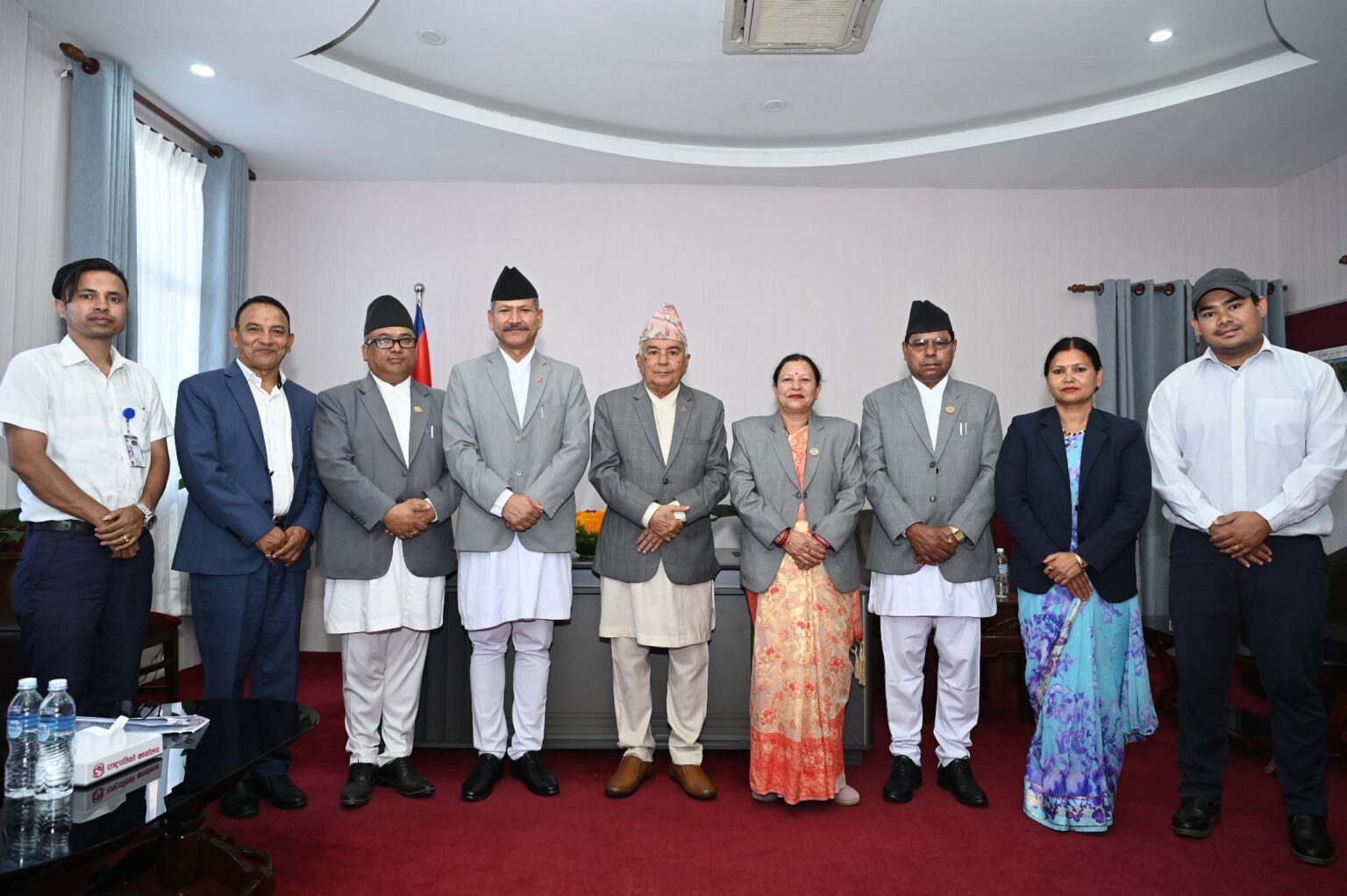
National Dalit Commission officials presenting the annual report to President Ram Chandra Paudel. Photo: Commission’s website
Since gaining constitutional status, the commission has been capped at five members. Yet its effectiveness has remained largely invisible. The commission’s current chairperson and members were all appointed during the tenure of then-Prime Minister KP Sharma Oli. They are: Chairperson Devraj Bishwokarma, and members Sundar Purkuti, Tunj Baraili Kami, Mina Devi Sob, and Mehal Parki. They all are UML party workers.
Budget shortfall is a key factor behind the commission’s ineffectiveness. The government has allocated only Rs 40 million to the commission for the current fiscal year, the bulk of which is consumed by office rent and the salaries and allowances of officials and staff. Commission Chairperson Devraj Bishwokarma acknowledges that the government’s failure to provide adequate funding has left the commission unable to function. According to him, the commission managed only Rs 2.8 million for various programs last year, and the budget this year is expected to be similar. The commission requests Rs 80 to 100 million from the government each year, but the government has been providing a maximum of Rs 30 to 40 million. Chairperson Bishwokarma adds, “Singha Durbar has never been able to understand the concerns of Dalits. The budget it gives is as if to say – draw your salary and sit idle.”
Rights activist Pradeep Pariyar says that following the struggles of earlier generations, securing a constitutional commission for the Dalit community is a significant achievement.
According to the National Census 2021, the Dalit community’s population stands at 3,898,990, or 13.44 percent of the total. Around 1940, Bhagwat Sarbajit Bishwakarma and others launched an anti-untouchability movement. For seven decades since, Dalit leaders have continued to mobilize against caste-based untouchability and discrimination. Although the constitution, as a fruit of those struggles, has provided for the National Dalit Commission, the body has been unable to function effectively due to budget constraints and a range of other problems.
Jeet Bahadur Darji, one of the commission’s founding members, declines to comment on why it has failed to be effective. “To end caste discrimination and untouchability, the commission, the government, and the community must all work together,” he says.
Rights activist Pradeep Pariyar says that following the struggles of earlier generations, securing a constitutional commission for the Dalit community is a significant achievement. “One must think about what can be done with the resources the commission has,” he says. “And accordingly, focus as much as possible on that work.”
Dalit rights activist and writer Hira Bishwakarma, however, sees an urgent need to make the commission effective. His recommendation is that commission officials be appointed through open, merit-based competition, and that the body move forward with a clear action plan. “The government must ensure adequate resources for the commission,” he says. “It should not be a recruitment center for political parties; it must be an institution that genuinely works for the Dalit community.”