Kathmandu
Monday, July 27, 2026






KATHMANDU: Once close allies, the United States and Iran have spent much of the past four decades locked in deep hostility. Relations between the two countries deteriorated sharply after Iran’s 1979 Islamic Revolution, which overthrew the Western-backed Shah and replaced him with a theocratic regime fiercely opposed to American influence.
Since then, ties have been defined by mutual suspicion, strategic confrontation, and periodic crises. The seizure of the US Embassy in Tehran and the ensuing hostage crisis shattered diplomatic relations and set the tone for decades of enmity.
Washington has since relied heavily on sanctions and diplomatic isolation to pressure Tehran, while Iran has projected influence across the Middle East through proxy groups and regional militias.
Though occasional diplomatic openings have emerged, notably the 2015 nuclear deal, hostility has remained the dominant feature of the relationship.
Iran’s clerical rulers have long denounced America as the “Great Satan,” while American leaders have portrayed Iran as a destabilizing force in the region; in 2002, President George W. Bush famously placed Iran in the “axis of evil.”
What follows is a timeline of the major flashpoints that have shaped the fraught relationship between the two countries since 1953:
August 19, 1953: The US and Britain orchestrated Operation Ajax, a CIA-MI6-backed coup that overthrew the democratically elected Prime Minister Mohammad Mosaddegh and restored Shah Mohammad Reza Pahlavi to full power, sowing long-term anti-American resentment in Iran.
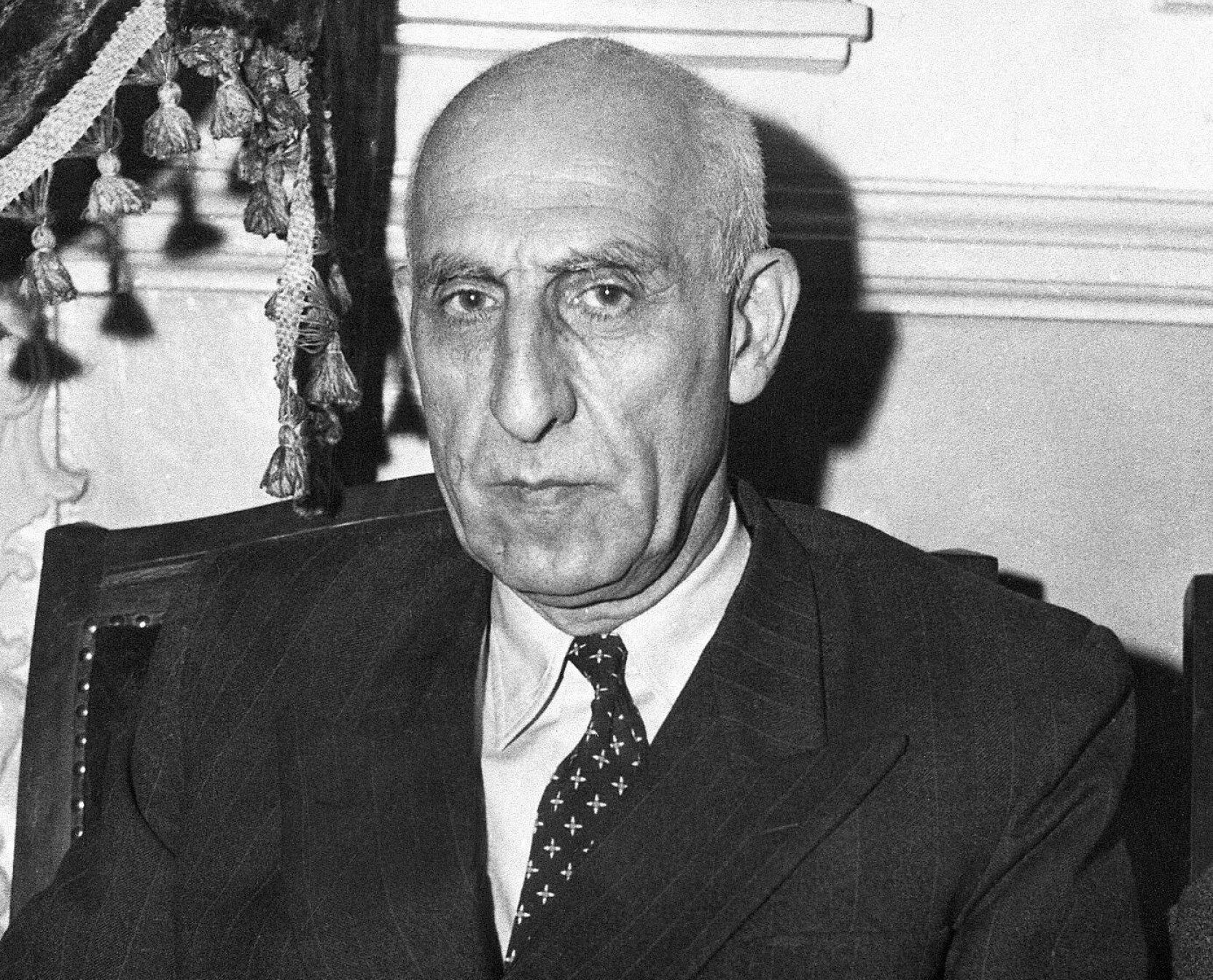
Prime Minister Mohammad Mosaddegh. Photo courtesy: Wikimedia
August 29, 1954: Amid pressure from the United States and the United Kingdom, the shah approved the 1954 Consortium Agreement, granting American, British, and French oil firms a 40 percent stake in the nationalized oil sector for a period of twenty-five years.
March 5, 1957: The US and Iran signed the Agreement for Cooperation Concerning Civil Uses of Atomic Energy under President Eisenhower’s Atoms for Peace program, helping launch Iran’s civilian nuclear program.
December 1, 1959: Shah Mohammad Reza Pahlavi met with US President Dwight D. Eisenhower in Washington, further solidifying the close strategic alliance.
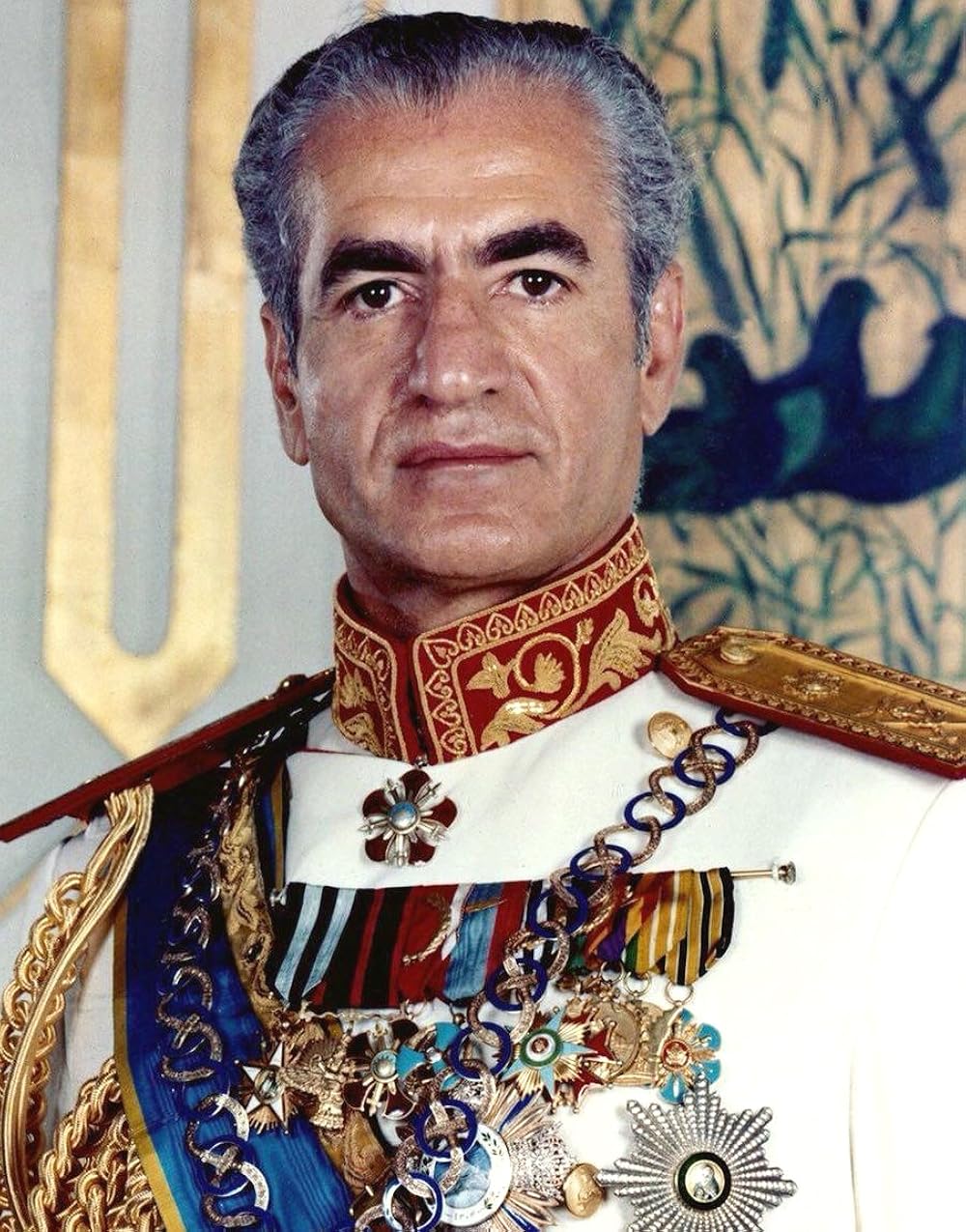
Shah Mohammad Reza Pahlavi. Photo courtesy: IMDb
September 14, 1960: Iran, Iraq, Kuwait, Saudi Arabia, and Venezuela formed the Organization of the Petroleum Exporting Countries (OPEC) to challenge the dominance of largely Western oil companies and regain authority over their own petroleum resources. In the 1970s, the organization’s revenues surged, allowing it to exert significant influence over Western economies.
July 1, 1967: The US provided Iran with the Tehran Research Reactor and enriched uranium fuel as part of deepening military and nuclear cooperation ties.
July 1, 1968: Iran signed the Treaty on the Non-Proliferation of Nuclear Weapons (NPT) in Washington, London, and Moscow.
February 1, 1970: Iran’s parliament ratified the NPT, committing the country to peaceful uses of nuclear technology.
May 1, 1972: During a visit by President Richard Nixon to Tehran, the Shah secured US approval to purchase large quantities of advanced non-nuclear weaponry.
October 1, 1973: The Yom Kippur War and subsequent Arab oil embargo dramatically raised global oil prices, enabling the Shah to fund massive arms purchases from the United States.
November 1, 1977: Under President Jimmy Carter’s human rights policy, the Shah implemented limited reforms, including prisoner amnesties and International Red Cross visits to Iranian prisons.
December 31, 1978: President Jimmy Carter visited Tehran and toasted the Shah as an “island of stability” in a troubled region during a New Year’s Eve speech.
January 16, 1979: The Shah fled Iran amid massive revolutionary protests, marking the collapse of the US-backed monarchy.
February 1, 1979: Ayatollah Ruhollah Khomeini returned from exile in France and assumed leadership of the new Islamic Republic of Iran.
November 4, 1979: Iranian students stormed the US Embassy in Tehran, seizing 52 American diplomats and staff as hostages in a crisis that lasted 444 days.
April 7, 1980: The United States formally severed diplomatic relations with Iran; Pakistan assumed the role of protecting power for Iranian interests in Washington.
April 24, 1980: The US launched Operation Eagle Claw, a failed military rescue attempt for the hostages that resulted in the deaths of eight American servicemen.
September 22, 1980: Iraq launched an invasion of neighboring Iran, which it viewed as an emerging rival, partly out of concern that a Shiite uprising could threaten Iraqi leader Saddam Hussein. Throughout the conflict, the United States backed the largely secular Iraqi government. The war proved devastating, resulting in roughly one million Iranian deaths and between 250,000 and 500,000 Iraqi casualties.
January 20, 1981: The Algiers Accords were signed; the 52 American hostages were released minutes after Ronald Reagan’s inauguration as US president.
April 18, 1983: Iran-backed Hezbollah carried out the bombing of the US Embassy in Beirut, Lebanon, killing 63 people.
October 23, 1983: Hezbollah bombed the US Marine barracks in Beirut, killing 241 American servicemen.
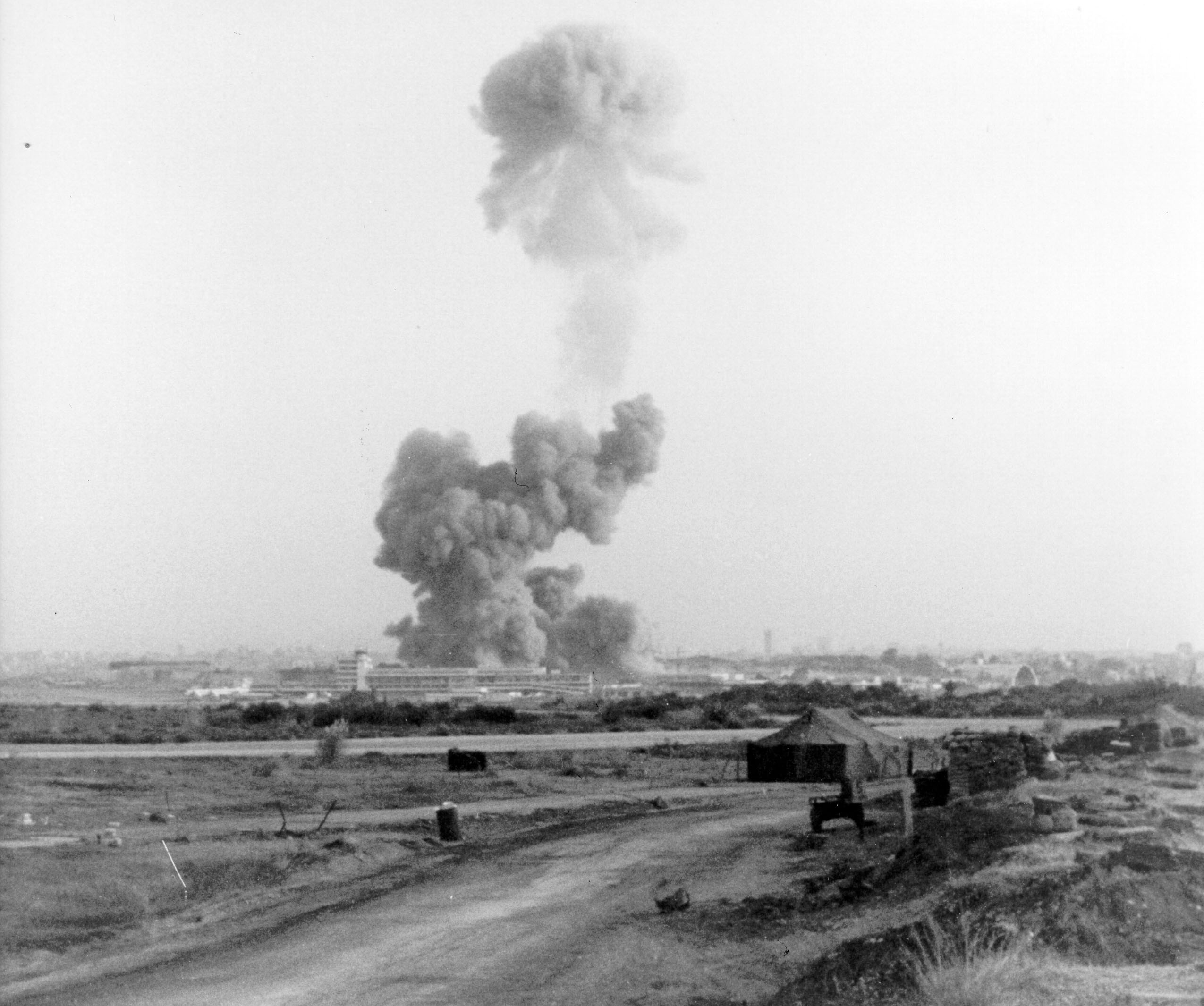
The explosion of the Marine Corps building in Beirut, Lebanon on October 23, 1983 created a large cloud of smoke that was visible from miles away. Photo courtesy: USMC/Website
August 1985: Despite an arms embargo, senior officials in the Reagan administration secretly began selling weapons to Iran in August 1985 to help secure the release of seven Americans held hostage by Hezbollah in Lebanon. The proceeds from these covert sales were then funneled to support the right-wing Contra rebels in Nicaragua, despite Congress having banned further funding for the group.
April 18, 1988: The US Navy launched Operation Praying Mantis in the Persian Gulf, destroying several Iranian naval vessels and oil platforms in retaliation for mining incidents.
July 3, 1988: The USS Vincennes mistakenly shot down Iran Air Flight 655 over the Persian Gulf, killing all 290 civilians on board.
August 20, 1988: Iran accepted a UN-brokered ceasefire with Iraq, ending the brutal eight-year Iran-Iraq War during which the US had tilted toward Baghdad.
May 1, 1995: President Bill Clinton signed comprehensive executive orders imposing a full US trade and oil embargo on Iran.
June 25, 1996: The Khobar Towers bombing in Saudi Arabia killed 19 US servicemen; US investigations later pointed to Iran-backed perpetrators.
January 1, 1998: Newly elected Iranian President Mohammad Khatami proposed a “dialogue of civilizations” with the United States, leading to minor sanctions easing.
December 5, 2001: Following the September 11 attacks, the administration of George W. Bush opened a discreet line of communication with Iran to coordinate efforts against the Taliban, a mutual adversary that had sheltered members of al-Qaeda in Afghanistan. After the U.S.-led invasion of Afghanistan in 2001, Washington and Tehran worked together on the Bonn Agreement.
January 29, 2002: In his State of the Union address, President George W. Bush labeled Iran part of the “Axis of Evil” alongside Iraq and North Korea.
May 1, 2003: Iran sent an unofficial “grand bargain” proposal through Swiss channels, offering comprehensive negotiations on nuclear issues, terrorism, and recognition of Israel.
May 8, 2006: Iranian President Mahmoud Ahmadinejad sends an eighteen-page letter to George W. Bush, the first communication of its kind from an Iranian leader to a U.S. president since 1979. In the message, Ahmadinejad attempts to reduce tensions over Iran’s nuclear program, though Iran makes no move to curb its uranium enrichment, maintaining that it is intended for civilian energy purposes.
September 25, 2007: During a speech at the opening session of the UN General Assembly, Iranian President Mahmoud Ahmadinejad declared the dispute over Iran’s nuclear program “closed” and stated that his government would ignore UN Security Council resolutions calling for a halt to uranium enrichment.
September 27, 2013: President Barack Obama held a historic 15-minute phone call with Iranian President Hassan Rouhani, marking the first direct communication between leaders of the U.S. and Iran since 1979. The conversation focused on reaching a diplomatic resolution to Iran’s nuclear program.
November 24, 2013: President Barack Obama spoke by phone with newly elected Iranian President Hassan Rouhani to discuss Iran’s nuclear program, the highest-level direct contact between the two countries since 1979. Two months later, Iran and the P5+1, the five permanent members of the UN Security Council plus Germany, reached an initial nuclear agreement that provided limited sanctions relief in exchange for constraints on Iran’s nuclear activities.
July 14, 2015: The Joint Comprehensive Plan of Action (JCPOA), or Iran nuclear deal, was signed in Vienna between Iran and the P5+1 nations, limiting Iran’s nuclear program in return for sanctions relief.
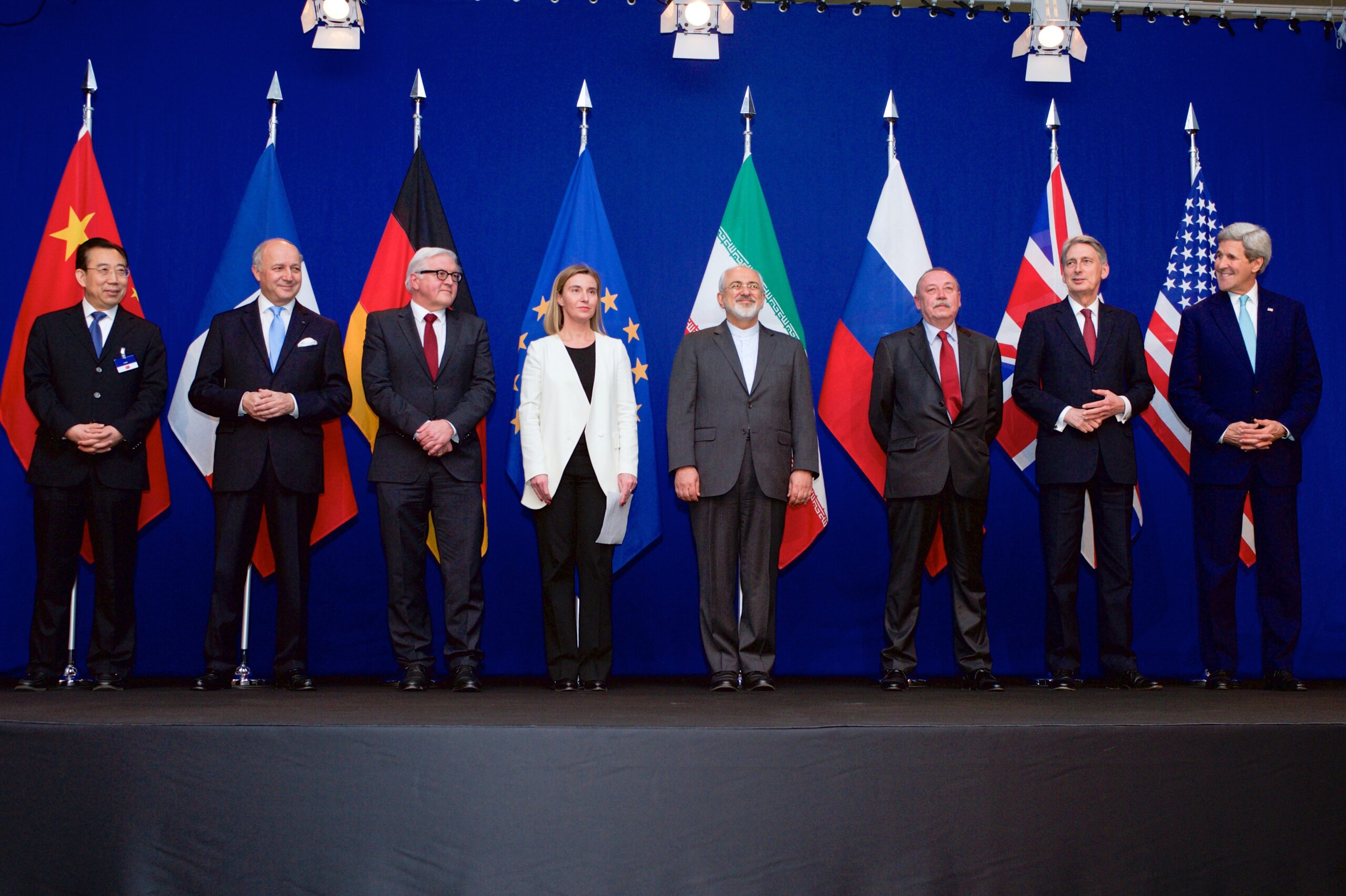
Hailong Wu of China, Laurent Fabius of France, Frank-Walter Steinmeier of Germany, Federica Mogherini of the European Union, Javad Zarif of Iran, Alexey Karpov of Russia, Philip Hammond of the United Kingdom and John Kerry of the United States in the “Forum Rolex” auditorium. Photo courtesy: EU
May 8, 2018: President Donald Trump announced the US withdrawal from the JCPOA and reimposed sweeping “maximum pressure” sanctions on Iran.
April 15, 2019: President Donald Trump formally designates the Islamic Revolutionary Guard Corps, a branch of Iran’s armed forces, as a foreign terrorist organization (FTO). This marks the first instance in which the United States has labeled a component of another country’s government as an FTO.
June 20, 2019: Iran shot down a US RQ-4 Global Hawk drone over the Strait of Hormuz, narrowly avoiding direct US retaliation.
September 14, 2019: Drones strike oil facilities operated by the state-owned Saudi Aramco in eastern Saudi Arabia, hitting the nation’s second-largest oil field and a key crude-oil stabilization center. The assault temporarily shuts down half of Saudi Arabia’s oil production and triggers an unprecedented surge in Brent crude prices.
December 31, 2019: Iraqi demonstrators and Iran‑backed militia members attempted to storm the U.S. Embassy in Baghdad’s fortified Green Zone in response to U.S. airstrikes that had killed fighters from Iran‑aligned groups. The crowds chanted “death to America” and demanded that the United States withdraw its troops from Iraq.
January 3, 2020: The US conducted a drone strike in Baghdad that killed IRGC Quds Force Commander Qasem Soleimani; Iran retaliated days later with ballistic missile strikes on US bases in Iraq.
April 22, 2020: Iran successfully put its first military satellite, Noor-1, into orbit using a three‑stage launcher built by the Islamic Revolutionary Guard Corps, a move that heightened U.S. concerns that Tehran’s space program could bolster long‑range missile technology.
May 23, 2020: Amid severe fuel shortages in Venezuela, a convoy of Iranian tankers arrived to deliver much‑needed oil despite U.S. sanctions targeting both Tehran and Caracas. To discourage ongoing energy trade between the two nations, the White House sanctioned five Iranian ship captains in June 2020 for their role in transporting oil to Venezuela.
October 18, 2020: The Trump administration attempted to prolong a decade-long UN arms embargo on Iran. Washington argued that Iran had violated the agreement and should not be permitted to rebuild its weapons stockpile.
April 17, 2021: Iran began producing 60% enriched uranium at the Natanz pilot fuel enrichment plant, confirmed by the IAEA and Iranian officials. This move followed a sabotage incident at the site and marked a major increase in enrichment levels from previous levels.
June 18, 2021: Ebrahim Raisi was elected president of Iran, securing 62% of the vote in a contest with low turnout and many candidates barred. His election consolidated hardliner control over all branches of government in Iran.
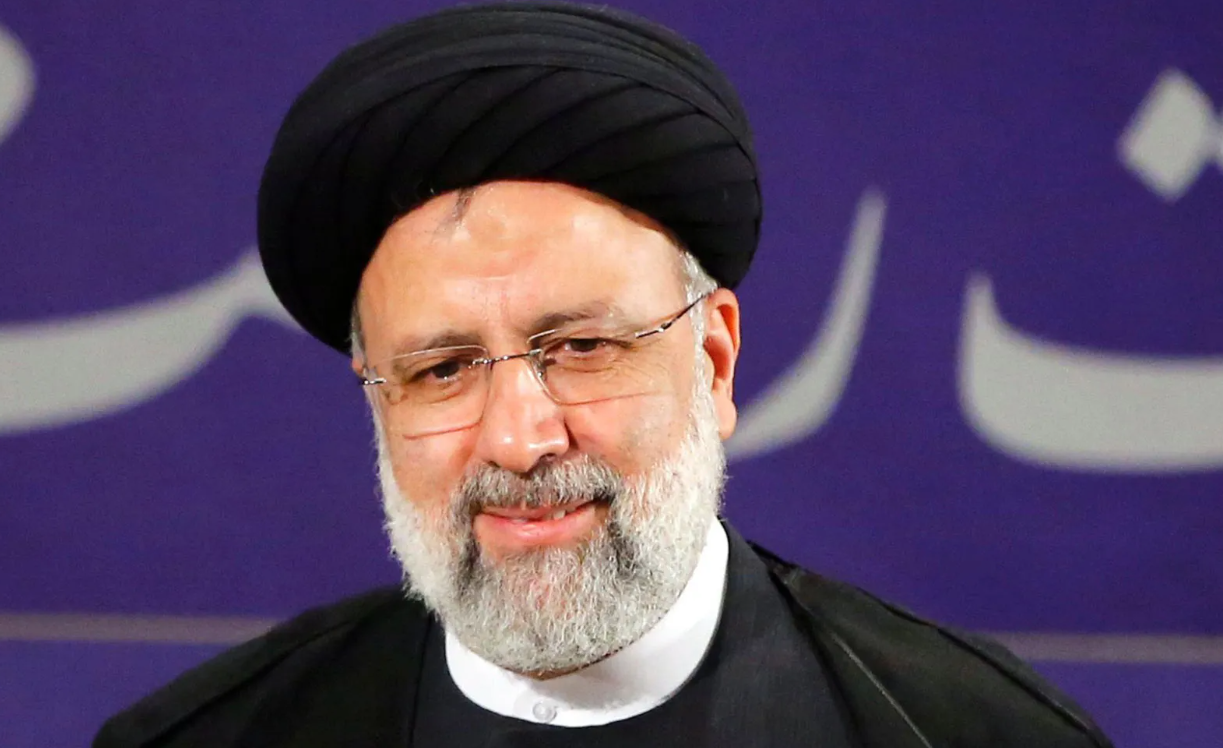
Former President Ebrahim Raisi. Photo courtesy: Raisi Cabinet
March 28, 2022: The United States, Bahrain, Egypt, Israel, Morocco, and the United Arab Emirates (UAE) establish the Negev Forum, a regional cooperation framework that aims to deter Iran, among other goals unrelated to defense.
September–October 2022: During a major wave of protests across Iran, the United States expressed support for Iranian demonstrators, even as efforts to revive negotiations over Tehran’s nuclear program remained stalled.
September 8, 2023: Washington issues a sanctions waiver that frees up USD 6 billion in Iranian funds frozen in South Korea in return for the release of five Iranian American dual citizens detained in Iran. Republican lawmakers criticize the deal said to be mediated by governments including Iraq, Oman, Qatar, Switzerland, and the United Kingdom.
October 7, 2023: Iran-backed Palestinian militant group Hamas launches a surprise assault on Israel in early October that kills more than 1,300 Israelis, the country’s deadliest-ever attack on civilians. The group also captures dozens more Israelis as hostages. After the attack, the United States and Qatar cooperate to block Iran from accessing the $6 billion in humanitarian assistance released to it in September.
July 19, 2024: The Houthis carried out a drone strike targeting Tel Aviv, representing one of the first successful long-range attacks on Israeli territory by the group amid the ongoing conflict. This incident illustrates the growing coordination between Iran-backed proxies and Hamas as part of an expanded campaign against Israel.
April 12, 2025: US-Iran indirect nuclear negotiations resumed in Oman under the second Trump administration.
June 12, 2025: The International Atomic Energy Agency (IAEA) declared Iran in noncompliance with its nuclear safeguards obligations.
June 13, 2025: Israel launched surprise strikes on Iranian nuclear and military sites, igniting the Twelve-Day War.
June 21, 2025: The United States conducted precision strikes using bunker-buster bombs on major Iranian nuclear facilities, including Fordow, Natanz, and Isfahan.
June 23, 2025: Iran launched retaliatory missiles at US forces at Al Udeid Air Base in Qatar; President Trump announced a ceasefire involving Israel and Iran.
June 24, 2025: The Twelve-Day War ceasefire officially took effect, mediated by the US and Qatar.
September 29, 2025: The European Union triggered the JCPOA snapback mechanism, reimposing nuclear-related sanctions on Iran.
November 20, 2025: The IAEA Board of Governors passed a resolution demanding full Iranian cooperation and access to nuclear sites.
December 28, 2025: Widespread protests erupted across Iran over economic hardship, infrastructure damage from prior conflicts, and regime policies.
February 27, 2026: At 20:38 UTC, President Trump issued the final go-order authorizing ‘Operation Epic Fury’ against Iran.
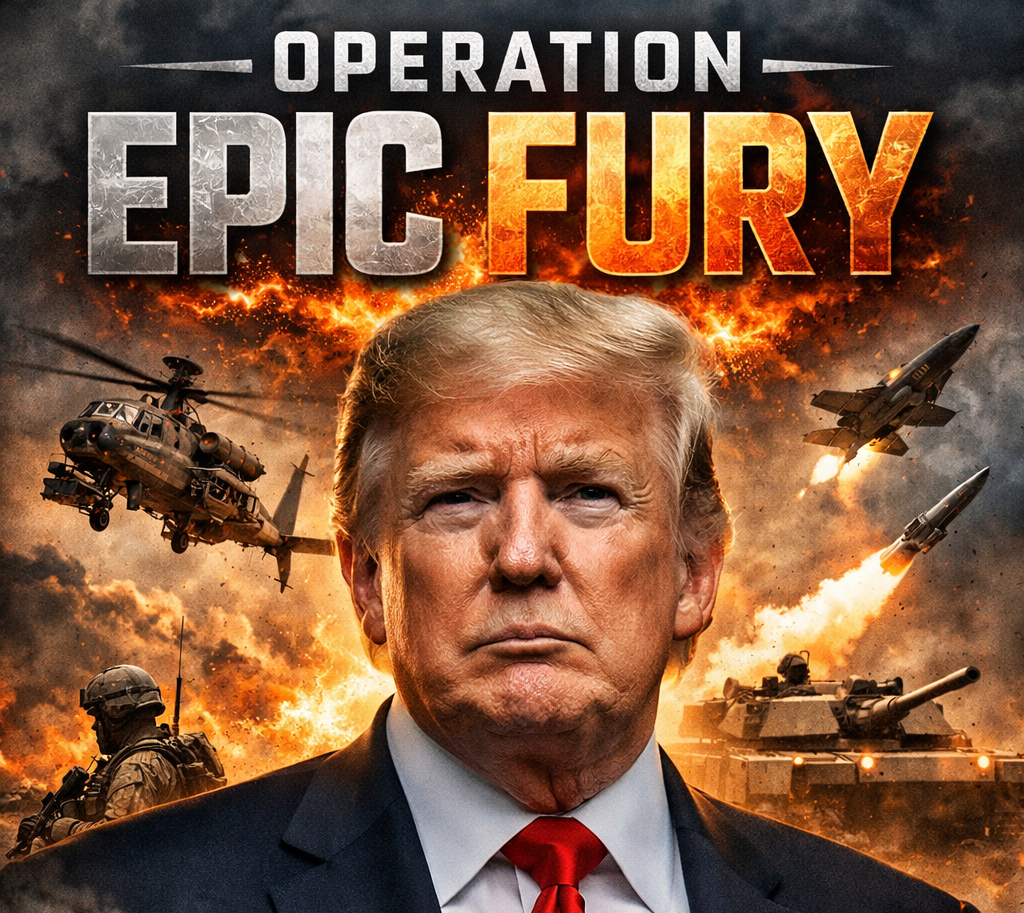
AI-generated image of US President Donald Trump
February 28, 2026: At 06:35 UTC, US and Israeli forces launched massive coordinated airstrikes under Operation Epic Fury, targeting Iranian leadership (including the reported killing of Supreme Leader Ali Khamenei), nuclear sites, missile facilities, and command centers; Iran responded with waves of ballistic missiles and drones against US bases and regional allies.
March 1, 2026: Heavy aerial and naval engagements continued; Hezbollah from Lebanon joined attacks on Israel while Iranian forces struck Gulf oil infrastructure.
March 2, 2026: US strikes further damaged Natanz enrichment facilities; Iranian counterattacks hit oil facilities in the UAE and Saudi Arabia; reports emerged of US casualties.
March 3, 2026: Mojtaba Khamenei assumed or was elected as the new Supreme Leader amid leadership decapitation strikes, and coalition forces targeted additional Iranian infrastructure.
March 4, 2026: US and Israeli naval forces sank multiple Iranian warships in the Persian Gulf; civilian casualties continued to rise across the region.
April 3, 2026: A US F-15E Strike Eagle was shot down over Iranian territory; intense search-and-rescue operations took place amid ongoing bombardment.
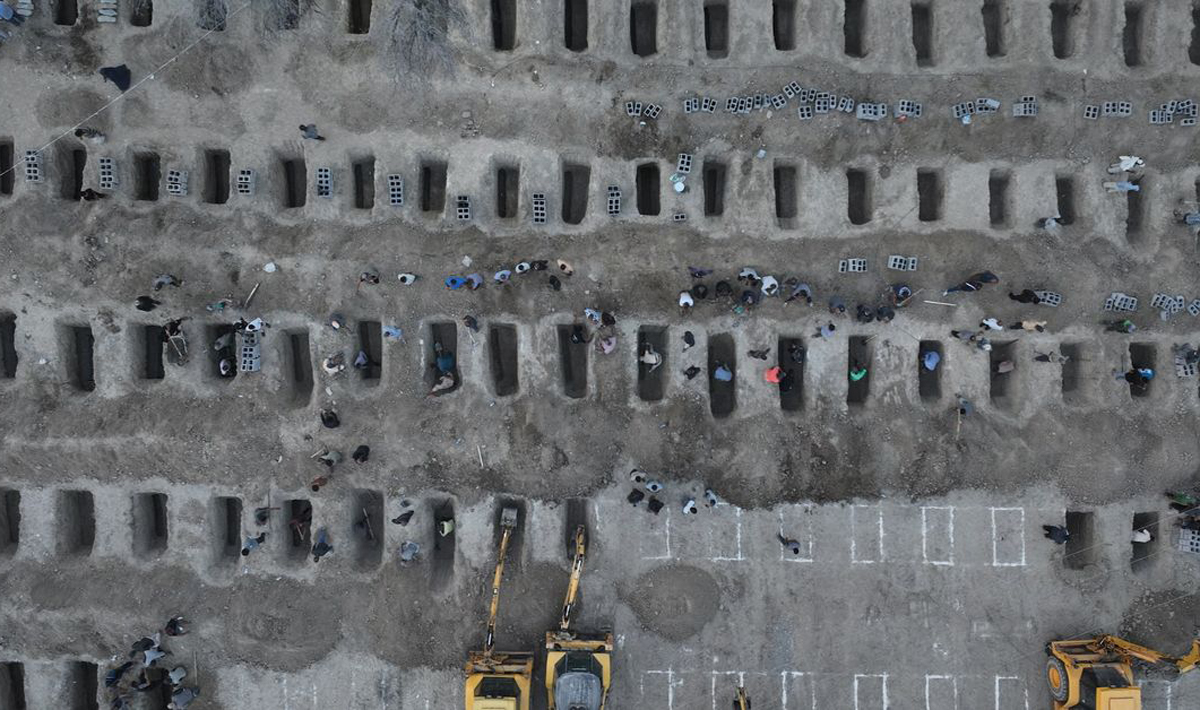
Screenshot of a footage from Minab in Hormozgan Province shows excavators digging fresh graves after Iranian state media reported that more than 160 people were killed in a strike on a girls’ elementary school. Photo credit: Iranian Social Media
April 4, 2026: Iranian forces fired cluster munitions at Israeli population centers; US-Israeli strikes damaged petrochemical complexes near Bushehr.
April 5, 2026: Iranian state media reported widespread destruction of residential areas, hospitals, and schools from coalition airstrikes; additional Iranian drone swarms targeted Gulf shipping and oil infrastructure.
April 6, 2026: President Trump issued a public ultimatum demanding Iran reopen the Strait of Hormuz or face destruction of critical civilian infrastructure by his deadline.
April 7, 2026: Following intense back-channel diplomacy mediated by Pakistan, Trump announced the two-week ceasefire agreement conditional on the safe reopening of the Strait of Hormuz; Iran conditionally accepted, leading to an immediate pause in major hostilities.
April 8, 2026: The two-week ceasefire holds as indirect negotiations begin in Islamabad; global shipping through Hormuz gradually resumes while both sides position for potential longer-term talks on nuclear curbs, sanctions relief, and regional de-escalation.
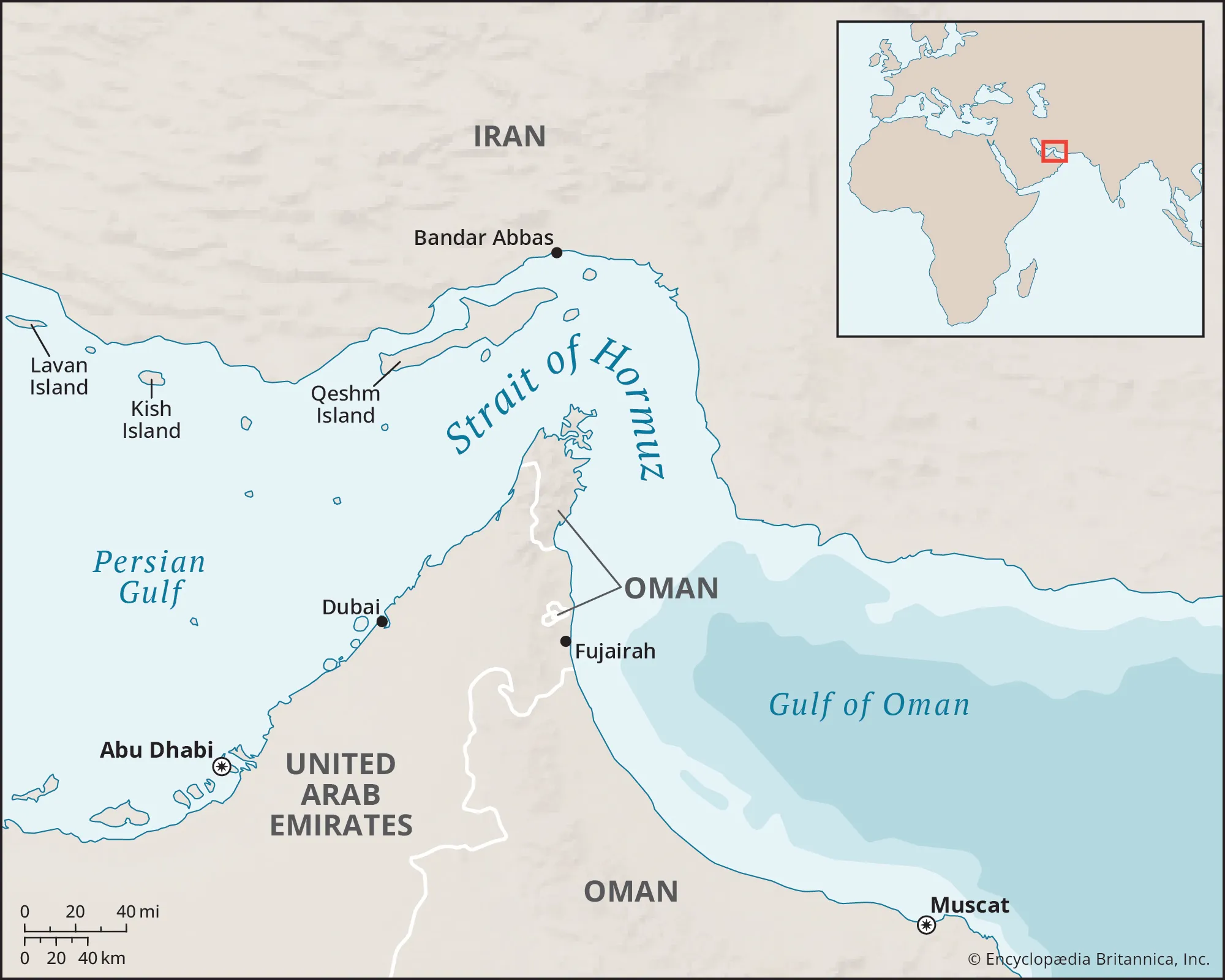
Map of Strait of Hormuz. Photo courtesy:Encyclopedia Britannica