Kathmandu
Monday, July 27, 2026





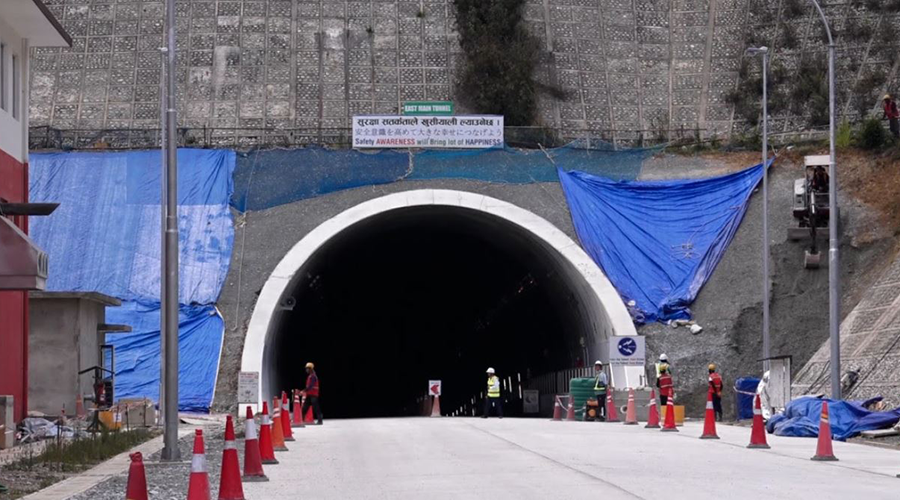
KATHMANDU: The formal inauguration of the Nagdhunga-Sisnekhola tunnel, recognized as the country’s first systematic transportation tunnel, takes place today.
The inauguration ceremony is being held in the presence of senior officials, including Minister for Infrastructure Development Sunil Lamsal, Japanese Ambassador to Nepal Maeda Toru, and the President of the Japan International Cooperation Agency (JICA).
Following the inauguration, the construction company will formally hand over the tunnel to the Government of Nepal, with the program scheduled to begin at 10:25 AM today under the chief hospitality of the Infrastructure Development Minister.
According to the itinerary, Minister Lamsal, the Japanese Ambassador, and the JICA President will inaugurate vehicle movement by driving through the tunnel, with ambulances, security vehicles, and other essential service vehicles permitted entry in the first phase.
The tunnel will undergo a complete testing phase for a few days before being opened to all categories of vehicles, and no tolls will be charged for vehicles operating through the tunnel during this testing period after security conditions and traffic management are evaluated.
Spanning a total length of 2,688 meters, the tunnel features a toll structure set by the Department of Roads where cars and vans will pay 65 rupees entering Kathmandu and 60 rupees exiting, mini-buses, trucks, and tippers will pay 115 rupees coming towards Kathmandu and 80 rupees going outward, and buses and heavy trucks will pay 260 rupees coming towards Kathmandu and 200 rupees going outward.
However, pedestrians, two-wheelers, three-wheelers, and vehicles carrying flammable substances like diesel, petrol, gas, or explosives are strictly prohibited from entering the tunnel.
The project consists of a main tunnel for vehicular traffic and an evacuation tunnel for emergency rescues, constructed by Japan’s Hazma Ando Corporation with Nippon Koei serving as the consulting firm. It is fully equipped with safety measures such as fire engines, emergency rescue services, CCTV cameras, communication systems, security mechanisms, and a continuous flow of oxygen.
Located between Totipakha, Dahachok in Chandragiri Municipality-1, Kathmandu, and Sisnekhola in Dhunibesi Municipality, Dhading, the project is expected to save travelers approximately one hour of time and fuel by bypassing the current highway’s traffic congestion, steep inclines, and winding roads.
Built with a concessional loan of 21 billion rupees from the Government of Japan and an investment of 6 billion rupees from the Government of Nepal, the project features established management businesses, security personnel, and technical staff conducting regular monitoring and inspections.
Necessary arrangements have been made for electronic toll payments, and although the project was originally targeted for completion within 42 months, its timeline was extended due to the COVID-19 pandemic and other operational complexities.