Kathmandu
Tuesday, June 16, 2026





The party that apologized to Dalits has zero Dalit, Tharu, or Muslim representation in its secretariat. And the rest of its structure tells the same story.
“The discrimination until today was not a social mistake; it was an organized crime. Do you know why this country never developed? Because we treated as untouchable the very people who had skills in their hands!”
These are the words RSP chairperson Rabi Lamichhane spoke emotionally while seeking an apology from the Dalit community at the April 2 session of the House of Representatives.
The very first point of RSP’s election pledge published for the March 5 House of Representatives election mentioned seeking an apology from Dalit and marginalized communities who had suffered injustice, humiliation, exploitation, and exclusion, and advancing more concrete legal, policy, and institutional reforms to end structural discrimination. Similarly, the government’s 100-day agenda also mentioned seeking an apology from the Dalit community. True to that pledge, at the first session of the House of Representatives formed after the election, RSP chairperson Lamichhane sought an apology and said, “No Nepali should have to bow in the name of caste anymore. I seek forgiveness on behalf of the entire party, the honorable Prime Minister, and the government. I want to ensure that justice will now honor the value of this apology.”
Eighteen days after chairperson Lamichhane sought forgiveness in parliament with folded hands, the RSP expanded its secretariat on April 20. An RSP central committee meeting held that day nominated Bhup Dev Shah as general secretary and added Sagar Dhakal and Sarita Shri Gyawali as members, creating a 16-member secretariat. But even with 16 members in the secretariat, not a single one represents the Dalit community. All those added in the latest round are from the Khas Arya community.
According to National Census 2021 data, Dalits make up 13.4 percent of the country’s total population. If the RSP, which sought to show itself as sensitive by apologizing to the Dalit community, had ensured proportional representation in the secretariat based on population, there should have been at least two Dalit members. Rights activist and writer JB Bishwakarma says the RSP has not even understood inclusion. He says, “Speaking to be popular and implementing it in practice are different things. The RSP has not studied the state of society deeply, and no debate or commitment is visible.”
Not only Dalits but also Muslim and Tharu community representation in the RSP secretariat is also zero. Muslims make up 4.86 percent and Tharus 6.5 percent of the total population. By this measure, at least one Muslim and one Tharu should be represented in the secretariat.
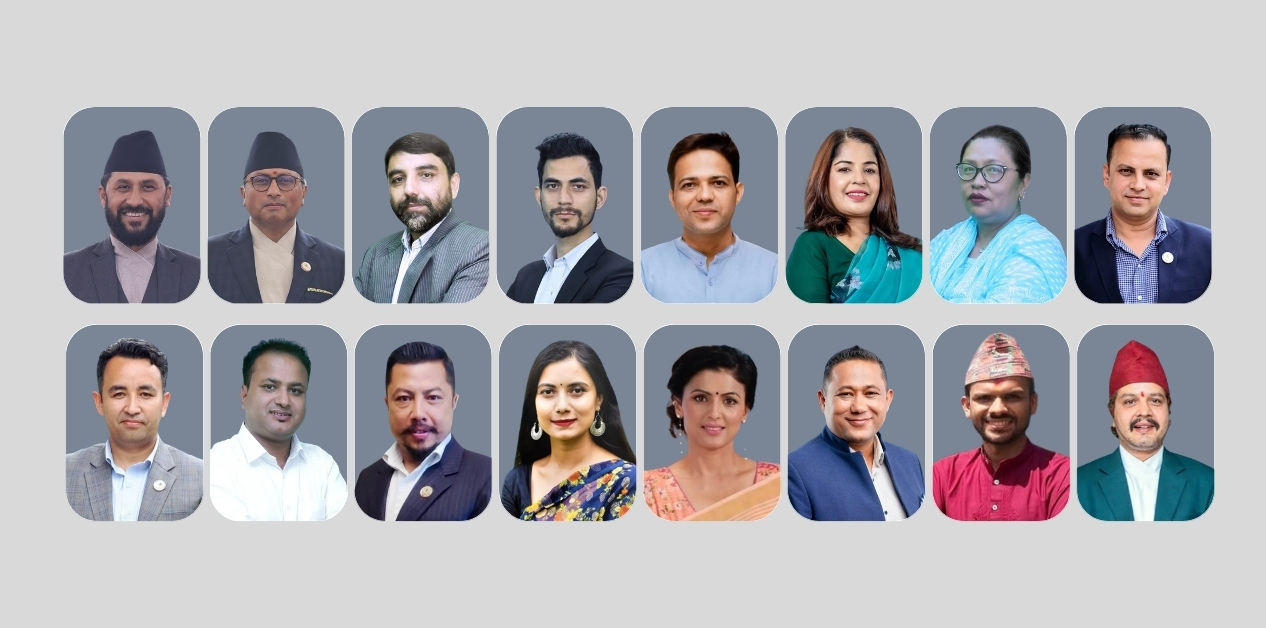
The RSP secretariat consists of chairperson Rabi Lamichhane, vice-chairperson Swarnim Wagle, general secretaries Kabindra Burlakoti and Bhup Dev Shah, joint general secretary Bipin Acharya, treasurer Lima Adhikari, assistant treasurer Basumaya Tamang, spokesperson Manish Jha, and secretariat members Ganesh Parajuli, Deepak Bohora, Biraj Bhakta Shrestha, Shishir Khanal, Sobita Gautam, Hari Dhakal, Sagar Dhakal, and Sarita Shri Gyawali. Rights activist and writer Bishwakarma observes, “Looking at the RSP’s party structure and activities, a tendency is visible of promoting Khas Arya while offering only consolation to other marginalized groups.”
That RSP, which entered politics claiming to be different from old parties and an alternative force, is not sensitive on issues of marginalized communities is made clear by the very composition of its secretariat.
The constitution requires 33 percent women’s representation at every level of the state. At 33 percent representation, the RSP secretariat should have at least five women. But there are only four – just 25 percent. According to census data, women make up 51.4 percent of the population. To make it proportional on the basis of population alone, the RSP secretariat should have at least nine women.
Chairperson Lamichhane had also apologized for failing to make Rai and Limbu community members of parliament. But not only are there no Rai or Limbu in the RSP secretariat, the entire indigenous nationality community has only two representatives – Biraj Bhakta Shrestha and Basumaya Tamang.
Indigenous nationalities make up 28.7 percent of the total population. By this measure, there should have been at least five secretariat members. Similarly, with the Madhesi community’s population at 16.15 percent, at least three representatives of this community should have been in the RSP secretariat. But only spokesperson Manish Jha – one person – is there.
Of the 16-member secretariat, 13 or 81 percent are from the Khas Arya community. Of those, 10 are men. Thus the RSP secretariat is dominated by Khas Arya men.
The RSP’s central committee also lacks proportional representation across clusters such as Dalit, Muslim, Tharu, Madhesi, indigenous nationality, and women. Khas Arya, and men within that, are dominant.
In the RSP, which is leading the government with close to a two-thirds majority in parliament, secretariat decisions carry significant weight. The secretariat can play a role in determining what policies and programs the government makes and what work it prioritizes.
The RSP, which entered politics claiming to be different from old parties and an alternative force, is not sensitive on marginalized communities’ issues is made clear by its secretariat’s composition. Analyst Indra Adhikari says the RSP appears even less inclusive than the old parties. She says, “The secretariat, considered the most important body of the party, is completely non-inclusive. Looking at the party’s structures, it has become an entirely Brahminical party.”
The Central Committee itself is non-inclusive
It is not only the RSP secretariat but also the central committee itself is not proportionally inclusive.
The RSP’s central committee has 92 members including office-bearers. Dalit, Tharu, and Muslim representation exists only at the central member level, and even that is not proportionally inclusive. Seven Dalits are present – Sabina BK, Rupa Shankar, Bijay Jairu, Shiva Nepali, Prakash Chandra Pariyar, Khagendra Sunar, and Laxmi Bardewa – representing 7.6 percent of total members. No Dalit is among the office-bearers.
The Tharu community has three central committee members – Ashok Kumar Chaudhary, Kamini Chaudhary, and Laxman Tharu – representing 3.3 percent. The Muslim community has two members – Asim Shah and Ishra Mulla Miya – representing 2.2 percent. Tharu and Muslim community representation among office-bearers is zero.
Although the RSP claims to be a new and alternative party, the basis to confirm this claim is not visible.
The indigenous nationality community has 11 central committee members – Basumaya Tamang, Biraj Bhakta Shrestha, Kusum Maharjan, Bishnu Kumar Shrestha, Pramila Kuluju, Eliza Gurung, Bindabasini Kansakar, Megh Bahadur Ale, Khusbu Sarkar Shrestha, Ashutosh Pradhan, and Suraj Pradhan, representing only 12 percent. Of these, only Basumaya is among the office-bearers.
Similarly, the Madhesi community has seven central committee members – 7.6 percent. Among the office-bearers is senior leader Balendra Shah, who is also Prime Minister. The other central committee members are Manish Jha, Dr Rakesh Yadav, Nisha Mehta, Dr Nandan Yadav, Dr Namita Yadav, and Shiva Shankar Yadav. Of these, Nisha is the Minister for Health and Population.
The central committee has 26 women – 28.3 percent of total members. Khas Arya number 61 (66.3 percent), of whom 44 are men.
Thus the RSP’s central committee lacks proportional representation across clusters such as Dalit, Muslim, Tharu, Madhesi, indigenous nationality, and women. Khas Arya – and men within that – are dominant.
Even during the Panchayat era, the king used to include Dalits, indigenous nationalities, Muslims, Tharus, and women from within his inner circle in the cabinet to show the notion of representation from all communities. Analyst Adhikari says the RSP’s current party structure and working style is reminiscent of Panchayat-era politics. She says, “Although the RSP claims to be a new and alternative party, the basis to confirm this claim is not visible.”