Kathmandu
Wednesday, June 10, 2026





The atrocity of high fees imposed by private schools against the guidelines issued by the government
KATHMANDU: After complaints arose that private schools had started admitting students and collecting exorbitant fees before the start of the new academic session, the Ministry of Education, Science and Technology issued an instructive notice on April 5, 2026. The notice prohibited schools from charging entrance fees more than once at the same school, admitting students before the start of the academic year, and collecting money from parents under categories other than those permitted.
The notice directed schools to charge fees only according to the Institutional School Fee Determination Standards Directive, 2015, and to refund to parents any admission fees collected before the academic session or any fees collected in excess of the approved amount. The Institutional School Fee Determination Standards Directive, 2015 stipulates that private schools may only collect fees under 14 headings, including admission, annual, monthly tuition, examination, educational tours, meals, and transportation. According to the directive, admission fees may be charged only once, such fee shall not exceed one month’s tuition fee, and the annual fee shall be limited to the equivalent of two months’ tuition fee.
After learning about the government directive through social media, Rabina (name changed), who was worried about how to arrange her daughter’s “admission fee” for Grade 8 in the academic session 2026, felt relieved. She shared this happiness with her husband, who was working hard in a Gulf country.
Rabina and her family, whose home is outside the Kathmandu Valley, have been sending their daughter to Kathmandu Shikshalaya in Imadol, Lalitpur, for a proper education. As the cost of education became more expensive with each grade, Rabina’s husband went abroad to earn money. Rabina, who lives in a rented room in Imadol, also works cleaning other people’s houses to manage household expenses and her daughter’s education costs.
According to Rabina, while her daughter studied from Grade 2 to Grade 7 at Kathmandu Shikshalaya, she was only allowed to enter the classroom after paying the admission fee each year. In the academic session 2025/26, she had to pay Rs 16,000 for her daughter’s Grade 7 admission fee. After the government instructed that no admission fee be charged this time, she felt as though she had unburdened the financial load that had been added each year by paying her daughter’s admission fees.
However, this happiness did not last long, when on April 19, 2026, a staff member from the school where her daughter studies called Rabina and said, “Pay about four to five thousand rupees and get your daughter’s name registered.”
This startled her. She asked that staff member, “The government has asked schools not to take admission fees, so why do I have to pay again?” In response, the staff member said, “Come to the school and talk directly with the administration about this.”
Rabina went to the school the very next day. After about an hour of discussion there, an “annual fee” heading, which had never been paid before, was added. She was told that no fee was required to enroll in Grade 8, but an annual fee of Rs 20,500 had to be paid. “I learned about the annual fee for the first time this year; I didn’t know they charged it before,” she told Nepal News on April 21, 2026. The staff member said that the annual fee is spent on headings such as extracurricular activities throughout the year. The school staff claimed that they had been collecting an annual fee in previous years as well. However, Rabina says that fees for extracurricular activities like Scouts and Taekwondo were already added to the monthly bill, with Rs 2,000–3,000 extra charges each month.
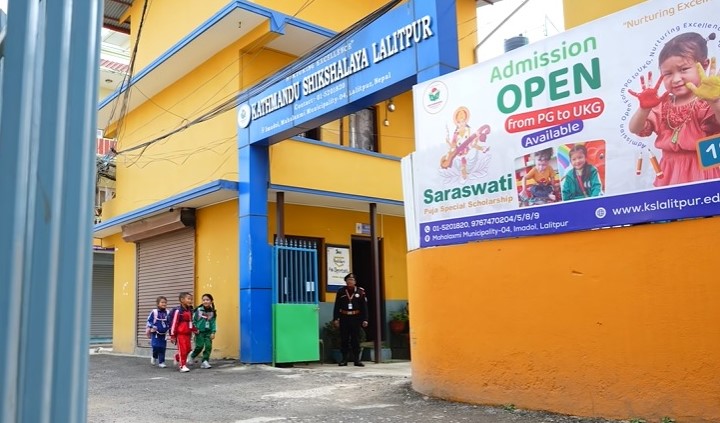
Kathmandu Shikshalaya, located in Imadol, Lalitpur. The school also operates in Baneshwor. Photo: Kathmandu Shikshalaya Lalitpur Facebook page
When asked about this, Premlata Shrestha, principal of Kathmandu Shikshalaya, Lalitpur, stated that they do not charge admission fees repeatedly and that they only collect an annual fee each year. “The fee we collect is an annual fee; some parents might be mistaking it for an admission fee,” she said. “Other schools might have been charging admission fees, but we don’t do that.”
Similarly, Rabina learned that the monthly tuition fee had also been increased by Rs 1,000 compared to the previous grade. Recalling that previously, when moving up a grade, the monthly fees used to increase by Rs 300 to 500, she said, “In Grade 7, my daughter’s monthly fee was Rs 6,500. This year, it has increased by Rs 1,000 all at once.”
By this calculation, even though Principal Shrestha proudly stated that they only collect an annual fee, that fee appears to be against the rules. The Institutional School Fee Determination Standards Directive stipulates that the annual fee cannot exceed two months’ monthly tuition fee. However, at Kathmandu Shikshalaya, where the monthly fee for Grade 8 is Rs 7,500, the annual fee has been set at Rs 20,500, which is Rs 5,500 above the standard.
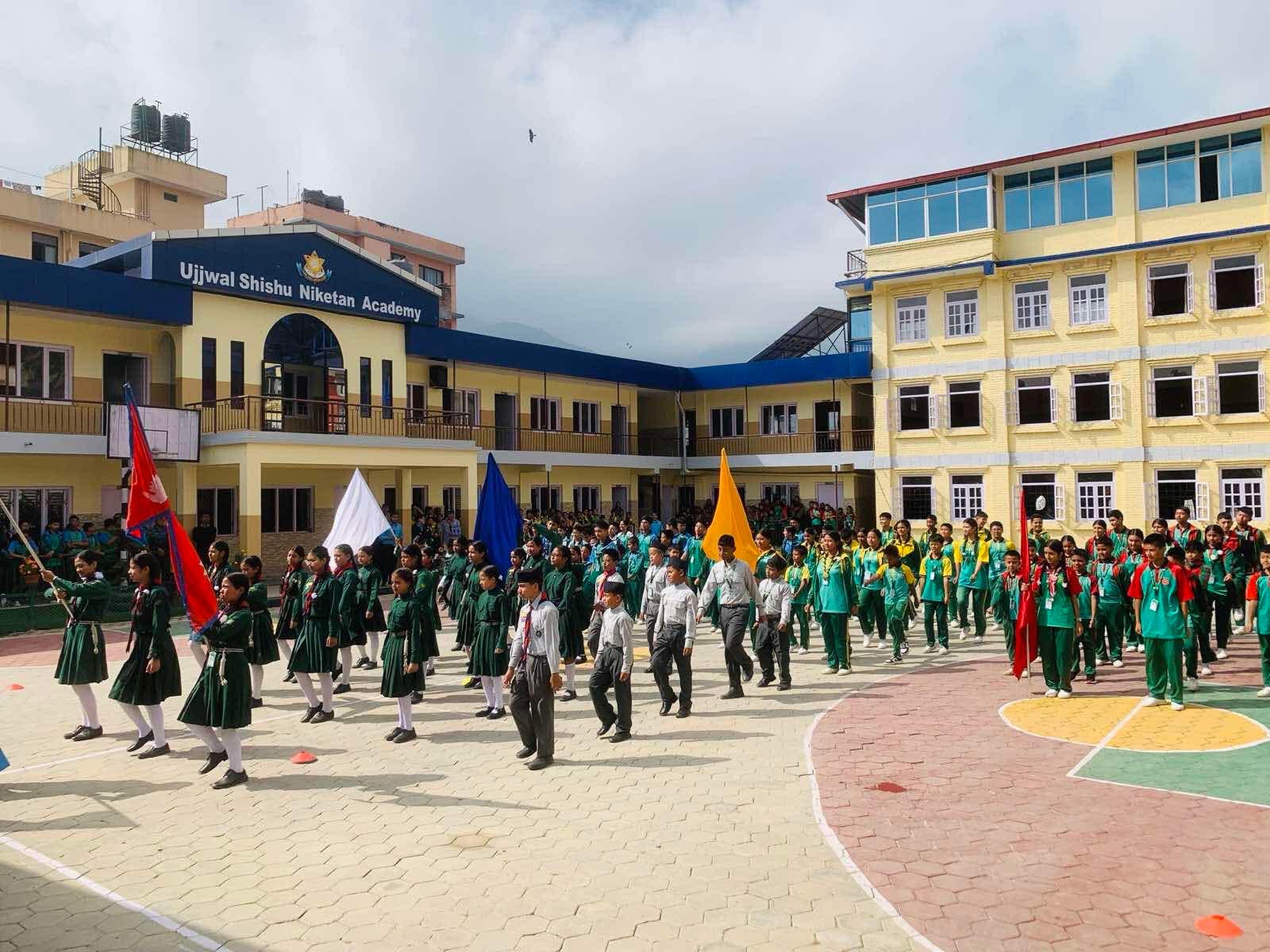
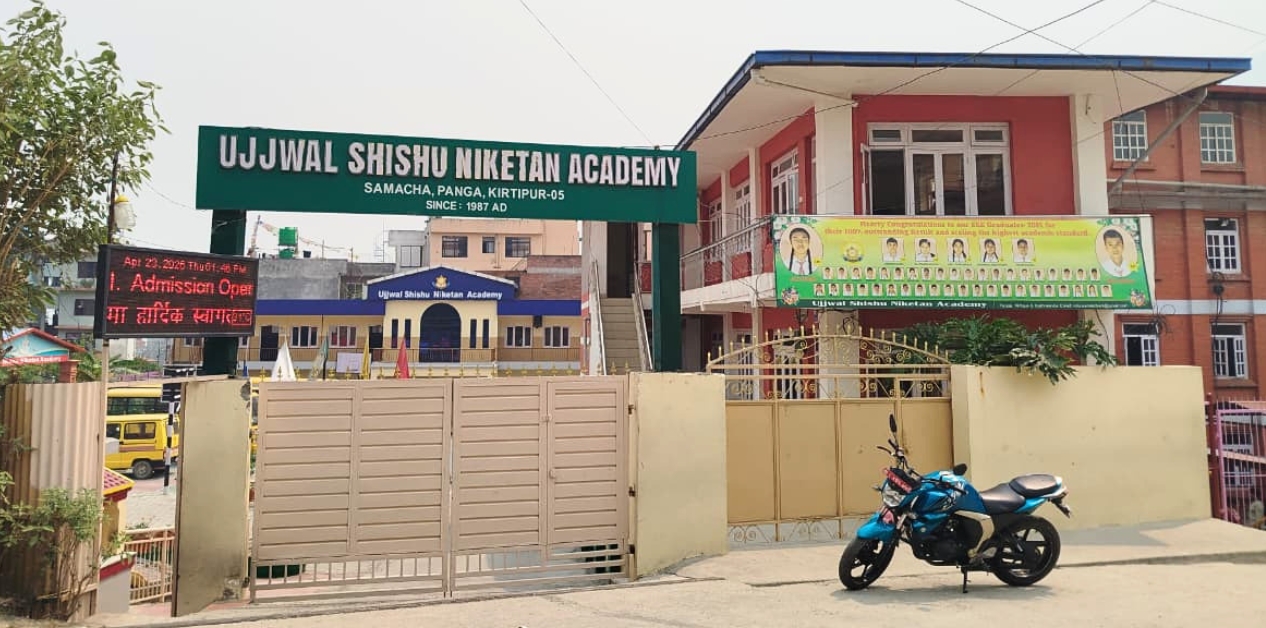
Students of Ujjwal Shishu Niketan Academy. Photo: Ujjwal Shishu Niketan Academy’s Facebook page
According to Rabina, in Grade 8, regular study with tuition is compulsory from morning to evening. This adds Rs 4,000 to the monthly bill. At Kathmandu Shikshalaya, the examination fee for Grade 8 has been raised to Rs 1,500 per exam. With four exams per year, parents must spend Rs 6,000 on exam fees alone.
After calculating all these fees, she is worried and unsure whether to keep her daughter in this school or transfer her elsewhere. “I went to the school to find out about the fees and came back; I haven’t dared to enroll her here,” she says. “The Ministry of Education has said to start admissions from April 28. I’m waiting to see if any new additional directives come.”
The Council of Ministers meeting on April 5, 2026, had decided to start the academic session of 2026-27 from April 28. Meanwhile, after the federal government’s decision caused the academic calendar to be affected, the Kathmandu Valley Mayors Forum issued a press release on April 22, 2026, requesting all municipalities within the valley to conduct student admissions from April 24 and regular teaching from April 28.
Rabina is not the only parent tired of the arbitrary fees charged by private schools. Parents who send their children to private schools for quality education are troubled by fees collected in violation of standards and rules.
Due to the shifting academic session timeline and expensive school fees, most parents are confused and anxious. While the government this year has reminded and cautioned schools about the fee directive standards, private schools continue to set high fees. Parents are waiting for a new government decision regarding these private schools. Parents contacted by Nepal News said they have only gone to the schools to inquire about the fees and are now waiting. One parent says, “Until last year, they used to say that if you enroll on the same day exam results come out, you get a discount of Rs 2,000 to 5,000 on the admission fee. This year, they haven’t mentioned admission fees, but they have drastically increased fees under other headings.” He says he is hoping that if he complains to the government about that, they will take action.
Another parent says, “If I try to enroll my child in the same school they are already studying in, there are all kinds of fees. If I take them out of private school and send them to a community school, the quality of education there is not satisfactory. I am confused.”
‘Looting’ in the name of fees
The Constitution states that every citizen has the right to free and compulsory education up to the basic level. Under Article 31(2) of the Constitution, a fundamental right states: “Every citizen shall have the right to free and compulsory education up to the basic level and free education up to the secondary level from the State.” According to the Education Act, 1971, community schools cannot charge fees from students/parents under any heading. Private schools, however, can only charge fees according to the Institutional School Fee Determination Standards Directive, 2015. But private schools have been exploiting parents by collecting arbitrary and additional fees under various headings in violation of regulations.
While it is argued that it is natural for privately operated schools to set somewhat higher fees for returns, parents who send their children to private schools hoping for a good education accuse them of unfair exploitation. On-site monitoring and action have not been carried out against this.
This year, before the new academic session even began, many complaints were received that private schools had admitted students and collected advance fees for admission. Consequently, the Ministry of Education issued a public notice on April 5, 2026, and directed schools to refund fees collected in violation of the rules. The Ministry also wrote to the Ministry of Federal Affairs and General Administration requesting them to “monitor whether this has been complied with or not, and if not, to make arrangements to take necessary action against the concerned schools by writing to all local governments.”
Chapter 15 of the Education Rules, 2002 clearly states that students cannot be admitted before the academic session begins, nor can advance fees be collected. Schools can only charge approved headings and approved fees. Despite all this, private school operators have turned private schools into hubs of arbitrary fee collection by charging fees under headings different from those approved and in excess of approved amounts, and by charging admission fees every year at the same school.
Bishwa Gyan Pathshala (formerly Global Public School) in Pepsi-Cola, which teaches from playgroup to Grade 10, has increased the monthly fee for Grade 8 by Rs 5,000 in one go. Urmila (name changed), whose daughter studies at that school, says, “Last year the monthly fee was Rs 8,000; this year they have raised it to Rs 13,000.” She has been sending her daughter to the same school since Grade 5.
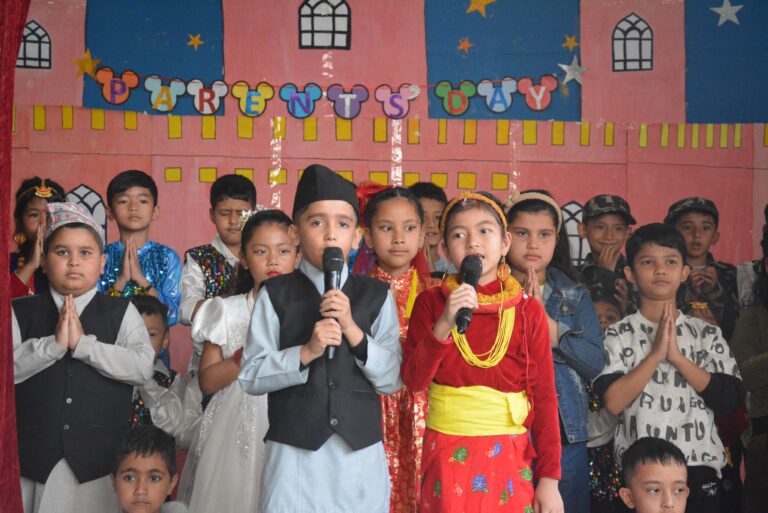
Students of Vishwa Gyan Pathshala (formerly Global Public School), Pepsi Cola, performing a cultural program on the occasion of Parents’ Day. Photo: Vishwa Gyan Pathshala’s Facebook page
After the directives’ provision that annual fees cannot exceed two months’ monthly fees became widely publicized this year, Bishwa Gyan Pathshala drastically reduced such fees to appear within the rules, setting the annual fee for Grade 8 at Rs 24,000. However, Urmila says that last year she paid an annual fee of Rs 36,000 for Grade 7. But because the monthly fee was increased by Rs 5,000 at once, the reduced annual fee has not provided any relief, she says. “Reducing the annual fee but drastically increasing the monthly fee — I’m tensed. How will I manage the education expenses!” she says.
In addition to the monthly tuition fee, she says she has to pay Rs 1,300 for each of the four exams held per year. According to her, even after paying the annual fee, a bill of at least Rs 500 is added each month for extracurricular activities like Scouts. “When the school has dance and cultural programs, they even make us pay rental fees for the clothes they make the children wear,” she says.
However, Matrika Karki, Principal of Bishwa Gyan Pathshala, says that the monthly fee is charged according to the rates approved by Kathmandu Metropolitan City in 2019/2020.
According to the Institutional School Fee Determination Standards Directive, 2015, private schools can collect fees under 14 headings in the specified amounts. The 14 headings are: monthly tuition, annual, admission, security deposit, examination, computer, transfer certificate, special training, hostel, meals, transport, educational tours, inter-school competition conduct, and educational materials.
According to the directive, the monthly tuition fee cannot be charged for more than 12 months per year. The admission fee can only be charged once and cannot exceed one month’s approved monthly tuition fee of the grade concerned. These fees must be presented by the school at a teacher-parent meeting and, after approval, can only be collected once approved by the relevant local government. The annual fee, which is equal to two months’ approved monthly fee, must cover extracurricular activities, laboratory, library, building construction and physical structure maintenance, sports, and first aid expenses.
The directive has provisioned that the examination fee cannot exceed 50 percent of the approved monthly tuition fee per grade. This can be collected annually or in installments. This fee must cover all examination expenses and transfer certificate printing costs. Similarly, the educational materials fee can be charged only once per year and at a maximum of 10 percent of the monthly tuition fee.
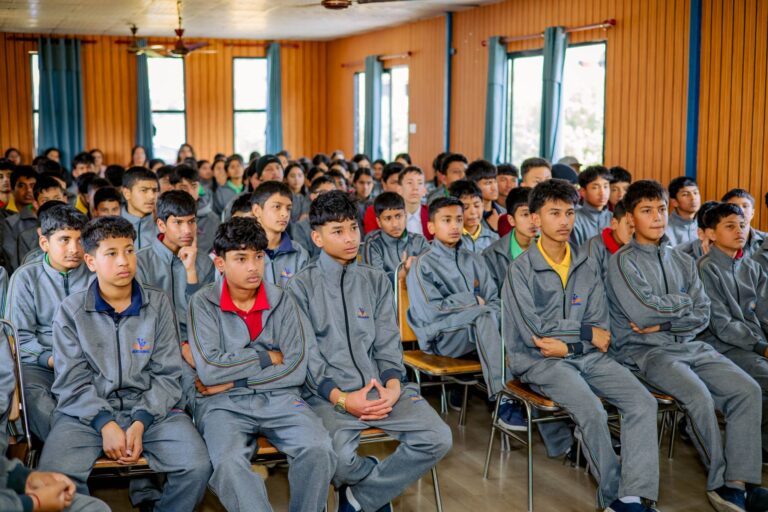
Students of Nexus International School, located in Pepsi Cola, Kathmandu. Photo: Nexus International School’s Facebook page
For private schools, hostel, meals, and transport fees must be determined through parent meetings. When determining hostel fees, there must be an agreement between parents of residential students and the school. However, parents complain that schools determine and increase fees arbitrarily. Transport fees must be passed by two-thirds of the parent meeting.
The directive has provision for penalties including a fine of up to Rs 25,000, cancellation of the school’s permit, and action according to existing laws if the provisions of the fee determination directive are violated in private schools. On the first offense, looking at the severity of the violation, a fine of up to Rs 25,000 (0.025 million) is imposed. If not corrected, on the second offense, the school’s permit is canceled. If fees are charged without meeting the fee basis/process standards, it is considered completely illegal and action is taken according to existing laws. However, before taking such action, the school must be given an opportunity to present its defense.
However, these penalties remain only in the directives. The Ministry of Education and local governments have remained silent spectators regarding arbitrarily collected fees. The Ministry of Education has only been issuing press releases to caution schools that collect arbitrary fees before the academic session begins. Local governments have issued notices about admissions and teaching contrary to the Council of Ministers’ decision.
According to the decision of the Council of Ministers meeting held on April 5, 2026, the Ministry of Education’s, Education and Human Resource Development Center had written to all 753 local governments and schools to start the admission campaign from April 28, 2026 and teaching from May 4, 2026.
On April 3, 2026, the Supreme Court also ordered that admissions should only take place after the academic session begins. Although the Ministry of Education has urged compliance with the court’s order and directed schools to charge fees only according to the Institutional School Fee Determination Standards Directive, 2015, this has not been followed. A parent from Kathmandu says, “Schools that do not follow the directives have not been monitored or acted against. It seems as if the government itself has given private schools a free pass to collect arbitrary fees.”
A parent from Biratnagar states that even though the government has made propaganda, monitoring, regulation, and action have not reached the village level. “The circular the government issued to regulate private schools has not been implemented in the field,” he says. “The government was limited to publicity on Facebook and in the news. Where is the monitoring mechanism at the district, municipality, and neighborhood levels?”
RB Katwal, Central General Secretary of the Private and Boarding Schools’ Organization Nepal (PABSON), who is also Principal of Nexus International School in Pepsi-Cola, Kathmandu, claims that all private schools only charge fees approved by local governments. “PABSON sends awareness notices to every school in February/March not to act against government policies and regulations,” he says.
Shiva Kumar Sapkota, spokesperson and joint secretary of the Planning and Monitoring Division at the Ministry of Education, says that circulars have been sent to municipalities to implement the government’s decision on student admissions, and they have been instructed to monitor and regulate. Regarding fees, he says local governments must monitor, regulate, and facilitate as needed. “Local governments must facilitate fee determination in a way that does not burden students and parents while also managing resources for private schools to operate,” he says.
However, he acknowledges that despite complaints of private schools charging arbitrary fees, local levels have not shown proactiveness or seriousness in regulation. “If municipalities do not become serious about fee regulation, the question has arisen whether the laws themselves need to be redefined,” he says. “If we have to determine fee limits, there is a risk of narrowing the scope of local governments’ work, so local governments themselves must look at it with interest and seriousness.”
Lakshmi Devi Pandey, chairperson of the National Association of Rural Municipalities Nepal, states that local governments are vigilant about regulating fees charged by all private schools. “It is not acceptable to exploit parents by collecting arbitrary fees to make profits. If you cannot operate, merge,” says she, who is also the Chairperson of Hupsekot Rural Municipality in Nawalparasi (Bardaghat Susta East). “All our local governments are monitoring schools.”
She also states that since Schedule 8 of the Constitution places basic and secondary education management under the jurisdiction of local governments, the federal government should not issue notices and circulars that override this. The Education Rules, 2002 had provisioned the new academic session starting from April 14. However, this year the federal Ministry of Education instructed that admissions should only start from April 24. Many local governments, arguing that this would affect the academic calendar and children’s studies, told schools to start the academic session according to their local context. Accordingly, in some local units, admission campaigns have already started and teaching has begun.