Kathmandu
Friday, June 26, 2026





Soaring prices and supply shortages are pushing major road projects in Koshi Province toward a standstill during the peak construction season
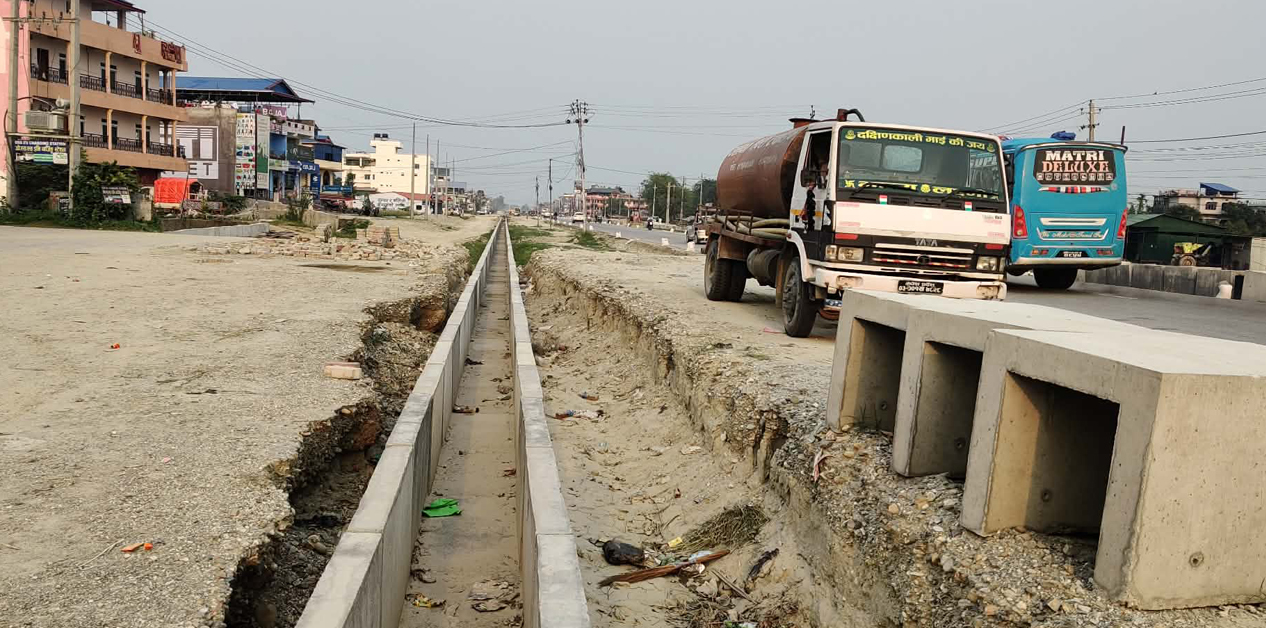
MORANG: Upgrading work on the Kakarbhitta-Laukahi section of the East-West Highway should be in full swing, but progress has stalled. Under a plan to expand the 95.76-kilometer stretch from Kakarbhitta to Itahari into four lanes, about 10 kilometers in the eastern section is ready for blacktopping. Yet rollers and excavators now sit idle along the roadside.
Paving has halted due to a shortage of bitumen, the essential material for asphalt surfacing. At the same time, soaring prices of fuel and construction materials have pushed major infrastructure projects across Koshi Province into crisis.
The disruption extends far beyond a single project. Across the province, both large and small developments are facing similar setbacks. The period from mid-February to mid-June, typically the peak construction season, has instead been marked by sharp cost escalation, effectively slowing the pace of development.
The ripples of the ongoing war in the Middle East have also reached Nepal’s infrastructure sector. With the rise in fuel prices in the international market, the supply chain for construction materials has been disrupted. According to Jansewak Bhandari, president of the Federation of Contractors’ Associations of Nepal (FCAN) Koshi Province, this is not just a normal price hike but an existential crisis for entrepreneurs. “This dire situation arrived right during our peak working season,” he said during a press conference organized in Biratnagar on April 26. “The unexpected price hike of fuel and construction materials has brought a tsunami to the infrastructure sector. On one hand, prices have doubled, and on the other, materials are unavailable even if one is willing to pay. In such a situation, it is impossible to move work forward.”
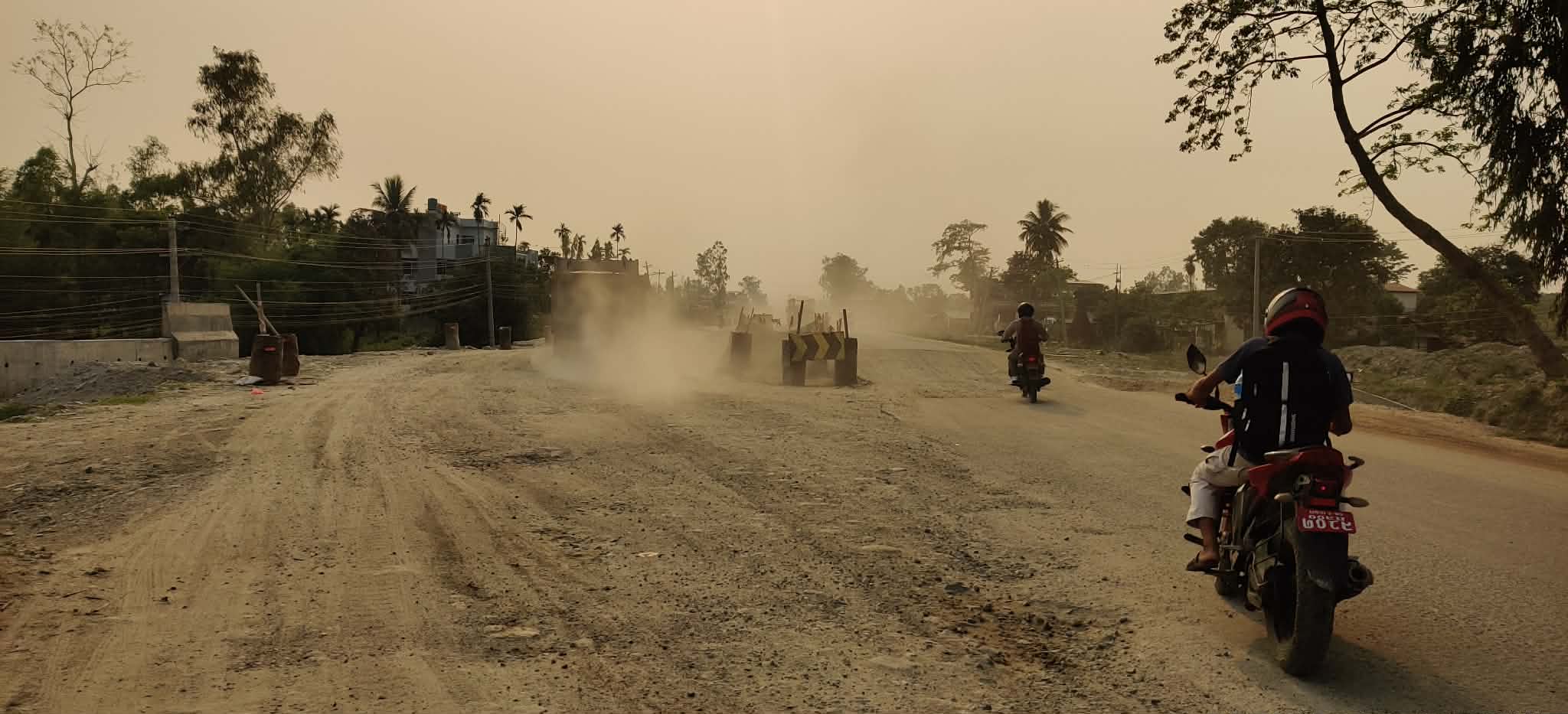
A bumpy dusty road section under the East-West Highway
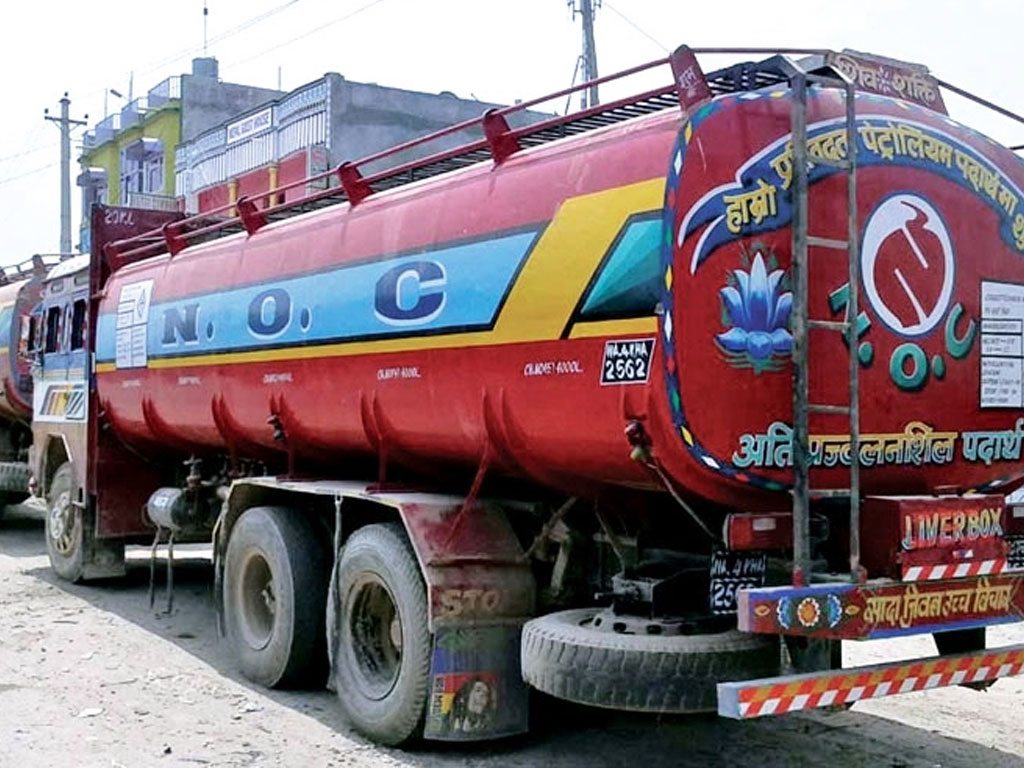
The price of diesel, which was Rs 133 per liter a few months ago, reached up to Rs 204. The price of bitumen has increased from Rs 80 per kilogram to Rs 160. Along with the brunt of price hikes, cuts in fuel supply from government agencies have become another challenge. According to Ujjwal Prasai, Project Manager of Evrascon Kalika JV, the Nepal Oil Corporation is providing only 5 to 6,000 liters of diesel, whereas 20,000 liters are required daily.
“Contract agreements are at old rates, but market prices have already doubled. Continuing work in this situation is like a businessman committing suicide,” says Prasai. Another grievance of the entrepreneurs is toward the price index of Nepal Rastra Bank. They allege that even when material prices increase by 100 percent in the market, government statistics show a decrease in prices.
Ramesh Karki, General Secretary of FCAN Koshi, says, “The prices of iron rods, cement, and fuel in the market are untouchable. However, the index from Nepal Rastra Bank shows prices have decreased. Is this a technical error or intentional? This has placed an additional financial burden on entrepreneurs.”
Koshi’s abandoned large-scale projects
The Kakarbhitta-Laukahi road expansion project, under construction with loan assistance from the Asian Development Bank, is currently in crisis. In this project, which started in February 2024 with a cost of nearly Rs 10 billion, work on six bridges and road expansion is ongoing. Physical progress of 45 percent in the eastern section and 36 percent in the western section has been achieved. Two section offices, eastern and western, have been operated for the road expansion. The eastern section covers 45 kilometers from Kakarbhitta to Kerkha, while the western section covers 50.76 kilometers from Kerkha to Itahari.
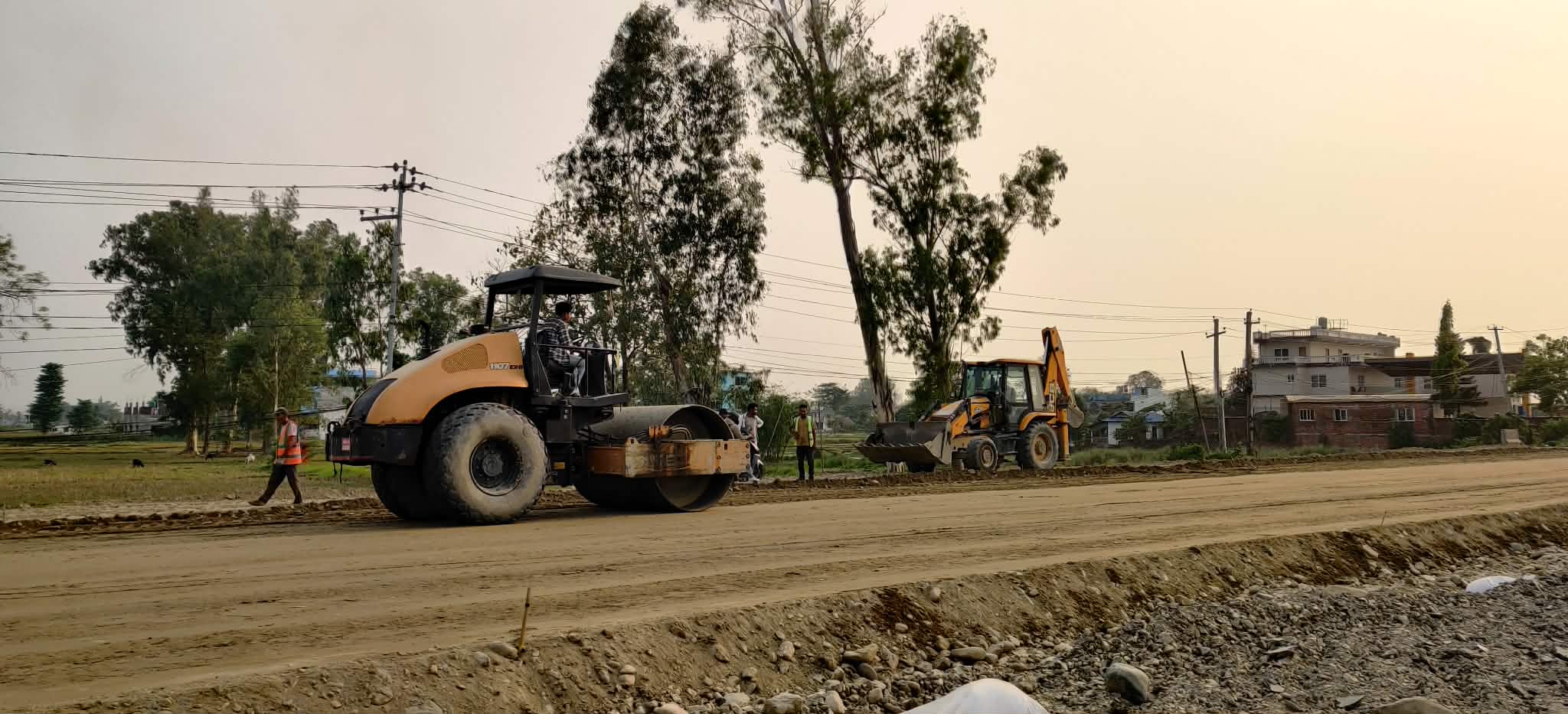
Road section under the East-West Highway
According to Jagat Prajapati, chief of the Kakarbhitta-Laukahi road project (western section), although preparations were made to blacktop 10 kilometers in the Pathari and Kanepokhari areas of Morang and the Padajugi area of Jhapa, work has been stopped for 15 days due to a bitumen shortage. The impact of this crisis has also fallen on other projects worth Rs 10 billion to Rs 12 billion under the Koshi Provincial Government. The problem of increased prices in construction materials has emerged as a national crisis. “Currently, work is somehow continuing from old stock. Once the stock is exhausted, the situation looks to become complicated,” says Prajapati. “Right now, only paving work is happening. Construction is in a state of coming to a halt within the next few days.”
Pradip Kumar Sunuwar, Minister for Physical Infrastructure Development of Koshi Province, admits the provincial government cannot do anything on its own. “The prices of bitumen and fuel have increased unnaturally. A situation has arisen where work will stop on many projects in Jhapa,” he says. “The problem does not seem solvable unless the federal government brings a ‘construction holiday’ or a special relief package according to the Public Procurement Act.”
‘Construction holiday’ threat looming
Entrepreneurs complain that despite repeated correspondence to solve the problem, the government has only given verbal assurances for two months. According to Mahesh Mishra, president of FCAN Morang, if the problem is not solved within 15 to 20 days, preparations are underway to declare a nationwide ‘Construction Holiday’ and launch protests. “No one is in a position to do new paving,” he says. “The government must either adjust prices or provide relief in deadline extensions and interest on bank guarantees, considering this abnormal situation.”
Demand for deadline extension and price adjustment
Construction contractors have urged the government to immediately extend project deadlines and revise contract prices to reflect rising costs. They submitted a memorandum to Chief Minister Hikmat Kumar Karki on March 28, warning that projects across Koshi Province are at risk of shutdown.
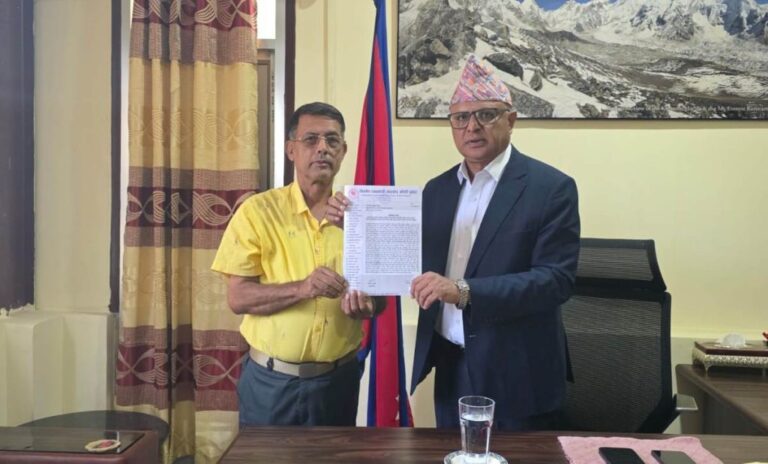
FCAN President Jansewak Bhandari submitting a memorandum to Koshi Province Chief Minister Hikmat Kumar Karki
Janasewak Bhandari, president of the contractors’ federation in the province, said the sector is facing a dual crisis of material shortages and soaring prices. The peak construction window from mid-February to mid-June is being lost, he noted, as projects become increasingly unviable. Rising petroleum costs linked to the Middle East conflict have further disrupted supply chains, making continuation nearly impossible.
Citing Section 55 of the Public Procurement Act, 2007, and Rule 129, contractors have demanded mandatory price adjustments when costs rise beyond 10 percent, calling on the government to implement existing provisions without delay.
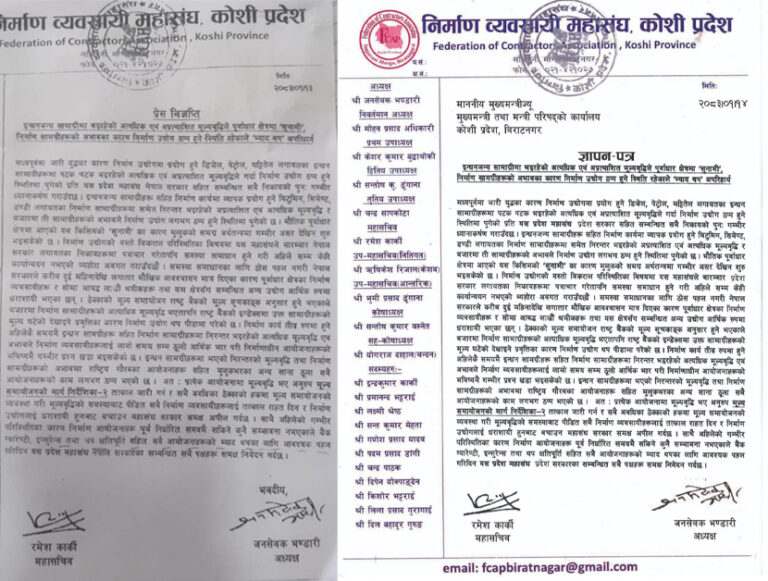
The memorandum submitted by construction entrepreneurs to Chief Minister Hikmat Kumar Karki