Kathmandu
Sunday, June 21, 2026





Soaring fuel prices driven by the US-Iran-Israel conflict, combined with a shortage of chemical fertilizers and a forecast of a weak monsoon, threaten to cripple domestic production and push millions toward hunger.

KATHMANDU: When Krishna Paudel of Sindhupalchowk opened P&P Brothers Food Industry in Bhangal, Budhanilkantha Municipality-8 in 2017, he made a policy: he would sell rice at a fixed price throughout the year, regardless of fluctuations in paddy costs. However, in his nine-year business journey, he has reached a point where he can no longer stick to his own policy. The reason is the sharp rise in fuel prices, which has increased transportation costs and made paddy more expensive.
Paudel has been selling rice at Rs 152 per kg. Despite the rising inflation following the war involving the US, Israel, and Iran—which caused petroleum prices to spike—he has not yet raised his prices. However, he says he will not be able to offer the same price when the next batch of food supplies arrives. “In just two months, transportation costs increased by two to three rupees per kg, and the price of paddy also rose significantly. Because of this, it is no longer possible to stand by the commitment we made when we started the mill,” he says.
Paudel notes that the price of Basmati paddy rose by Rs 700 per quintal (100 kg) in just the mid-April to mid-May period. Basmati paddy, which used to cost Rs 7,200 per quintal in the districts of Madhes, has now reached Rs 7,900.
According to Paudel, not only rice but also the prices of maize and wheat have increased. The surge in transportation and paddy costs over the last two months has forced him to break his promise to customers. Recently, as overall food prices rise, the pressure on consumers’ pockets has been mounting.
However, the inflation caused by fuel prices is not the only factor creating pressure on food items; signs are emerging that will have a deep impact on the production system in the days ahead.
Along with high fuel prices driven by the war in West Asia (the Gulf region), a shortage of chemical fertilizers and a weak monsoon are predicted to cause a decline in food production in Nepal. Experts say this will add challenges to food security.
Food security expert Yamuna Ghale says that due to high petroleum prices and the lack of chemical fertilizers, global production is estimated to decrease by 50 percent this year. “The impact felt globally will inevitably affect Nepal because we import fuel, fertilizers, and seeds from outside,” she says. “Due to the Iran war, we might not get fertilizers and seeds on time, and even if we do, they won’t be of high quality and will be expensive.”
The rise in petroleum prices in the world market has played a major role in the current increase in food prices. In Nepal, which depends on fuel imports, the direct impact of this price hike is becoming visible. Since the attack by the US and Israel on Iran on February 28, 2026, the price of crude oil has risen from 67 dollars to over 100 dollars. In the two months since the war began, fuel prices in Nepal have been adjusted six times.
Following the US attack, Iran closed the Strait of Hormuz, a major waterway for fuel exports. Twenty percent of the world’s crude petroleum passes through that waterway. To increase pressure on Iran, the US has announced a blockade of Iranian ports, further escalating the problem. The impact of the US-Iran war is global. According to the World Food Programme, if US-Iran tensions continue, about 45 million people worldwide could be pushed into severe food insecurity by the end of 2026. Nepal will not remain untouched by this.
Due to the war, remittances and the tourism sector—the main pillars of Nepal’s economy—are also under pressure. During the peak tourist season, tourist arrivals in Nepal have declined. Tourists have been canceling bookings in droves.
There are 1.7 million Nepalis employed in the Gulf region where the war is taking place. Remittances sent by migrant workers contribute one-third to Nepal’s Gross Domestic Product (GDP). If the impact of the war deepens in the Gulf, the flow of remittances could be disrupted. A decrease in remittances could most affect Nepal’s consumers and the poor. Half of the remittances entering Nepal come from Gulf countries.
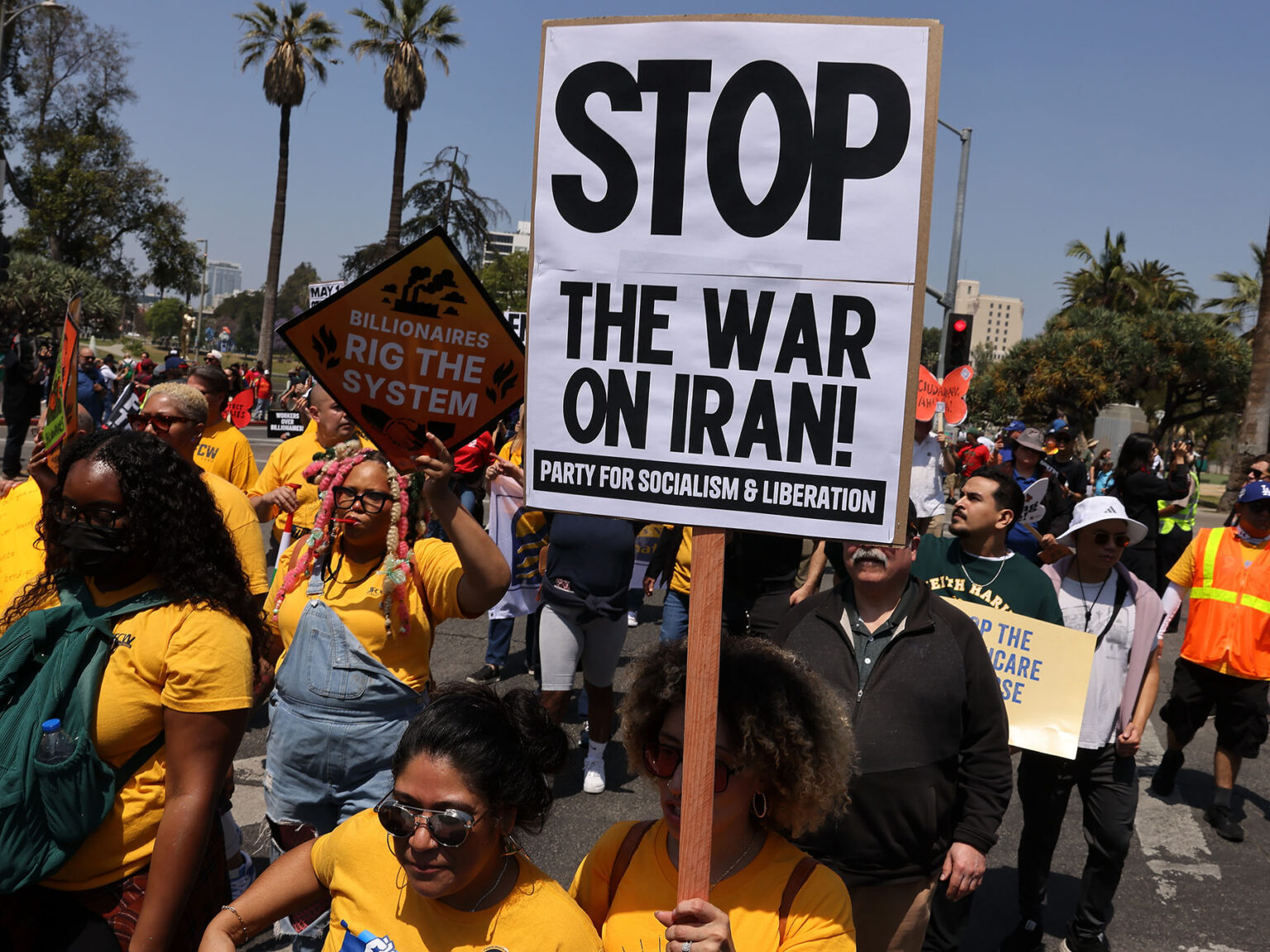
May Day rally in Los Angeles, USA, on May 1, 2026, where protesters demonstrated against the US-Israeli war on Iran and in support of labor and immigrant rights. (Photo: Qiu Chen/Xinhua)
Nar Bahadur Thapa, former Executive Director of Nepal Rastra Bank, says the Iran-US war will have multi-dimensional effects ranging from the overall economy to agricultural production. “If petroleum prices do not decrease, it will have a multi-dimensional impact,” Thapa says. “Public transport fares have already increased twice. This is making the entire sector expensive. As our production costs rise, it makes us less competitive.”
In the semi-annual report ‘Nepal Development Update April 2026’ released by the World Bank’s Nepal office in April, it was estimated that Nepal’s economic growth rate would shrink due to the war in the Gulf.
The World Bank projects that Nepal’s economic growth rate will be limited to 2.3 percent in the current fiscal year 2025/26, down from 4.6 percent the previous year. Meanwhile, the government has set a target of seven percent economic growth.
Economists say that the biggest impact of current price hikes will be on food security. Economist Nishant Khanal says that the food crisis will worsen in the coming days. “Until now, there hasn’t been much of a problem because of old food stocks,” he says. “The impact of the current price hike will be seen in 5-6 months or a year.”
Khanal explains that due to fuel price hikes, the shortage of chemical fertilizers, and the projection of a dry monsoon, the country is at risk of a food crisis.
Rise in fuel prices
Following the start of the new war in the Gulf, petroleum prices in the global market have climbed. After the US and Israel began attacks on Iran on February 28, 2026, fuel prices in the international market started rising rapidly. Before the war, the price of a barrel of crude oil was 67 US dollars. It has been over two months since the war began; despite fluctuations, the price of crude oil has remained above 100 dollars per barrel most of the time.
Since the war started, the Nepal Oil Corporation has increased fuel prices by about 40 percent through several adjustments. The government first increased fuel prices after the war on March 14, 2026. The price of petrol, which was Rs 157 per liter in Kathmandu, has now reached Rs 217. Diesel, which was Rs 142 before the war, has also reached Rs 225. Kerosene, cooking gas, and aviation fuel prices have increased in similar proportions. Economist Khanal says that when petroleum prices increase by 10 percent, inflation in Nepal rises by 2.2 percent.
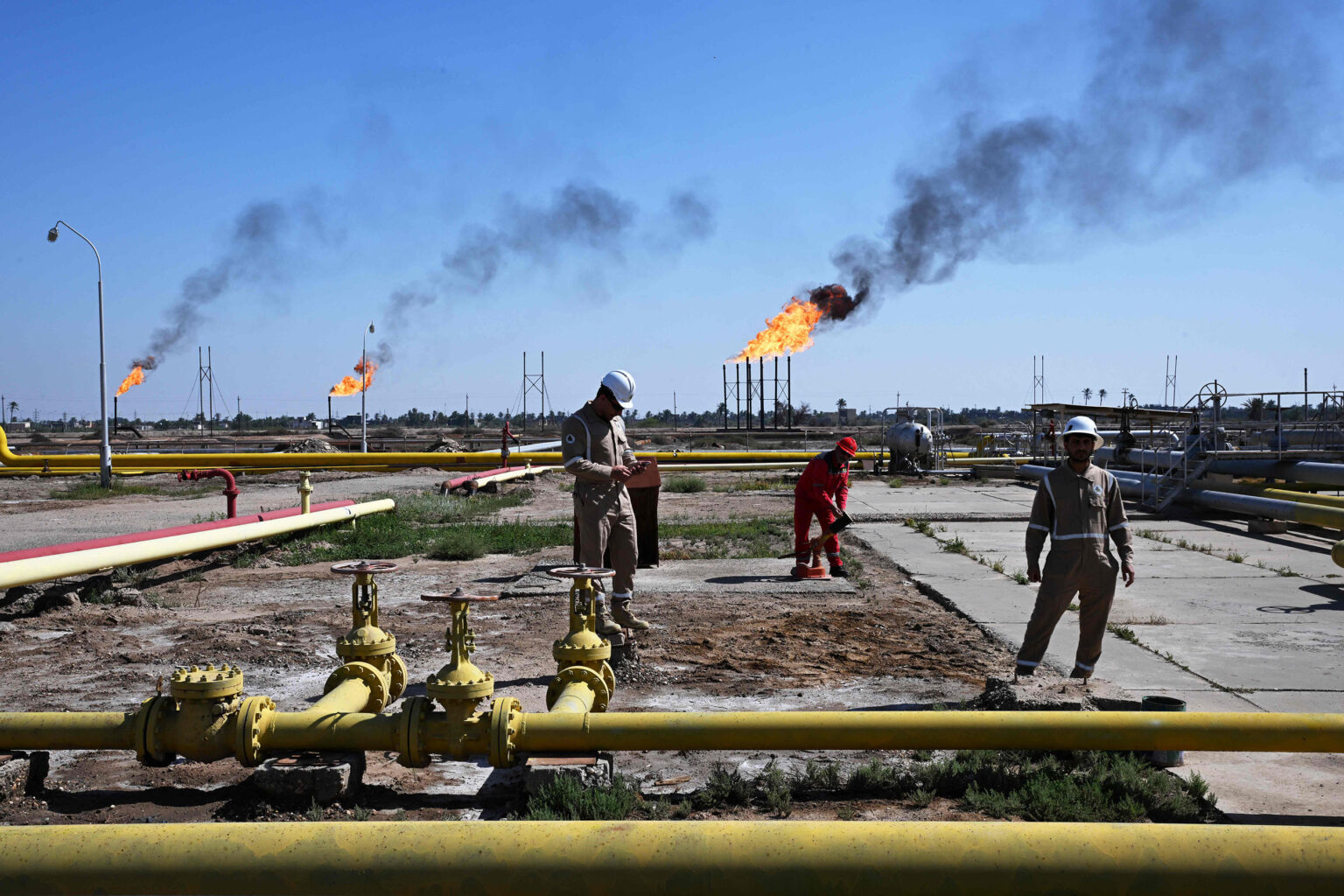
Employees of Basra Oil Company working at the Nahr Bin Umar oil and gas field near the city of Basra, Iraq, in 2026. Photo: Hussein Faleh/AFP
Nepal depends on energy imports, and petroleum imports are equal to about eight percent of the GDP. When fuel prices rise globally, production and transportation costs in Nepal will increase, further driving market inflation. In that situation, inflation will rise, weakening the purchasing power of consumers.
Economist Khanal says that with the mechanization of agriculture in recent years, operating costs have also risen with fuel prices. “In the last five to seven years, mechanization (use of power tillers, tractors, threshers) has significantly increased in Nepal’s agricultural sector. When fuel prices (especially diesel) rise, the cost of using machinery increases, making the cost of farming and plowing expensive,” Khanal says. “Additionally, the transportation cost of seeds and other agricultural materials also increases.”
On the other hand, food is transported by air to remote hilly districts of Nepal. “The rise in aviation fuel prices will make food supplies in remote districts expensive and trigger a food crisis by reducing the purchasing power of residents there,” says Khanal. The price of aviation fuel, which was Rs 127 per liter before the war, has doubled to Rs 269.
Shortage of Chemical Fertilizer
Along with high fuel prices, the shortage of chemical fertilizers is also expected to pressure agricultural production this time. Due to the disruption in methane gas supply caused by the war, the price of urea fertilizer has increased worldwide. According to a report released by the World Bank on April 28, the price of urea worldwide has increased by 60 percent. Overall chemical fertilizer prices are expected to rise by 31 percent in 2026. ‘This has made farmers’ ability to buy fertilizer the weakest since 2022, which will reduce farmers’ income and put future crop production at risk,’ the bank’s report stated. The global market was also affected when the war between Russia and Ukraine began in 2022.
According to the Ministry of Agriculture and Livestock Development, Nepal imports about Rs 40 billion worth of chemical fertilizer annually. However, due to problems in the import and distribution system, Nepali farmers have not been able to get sufficient fertilizer when needed, even when they have the money. Every year, there is a shortage of 300,000 metric tons of fertilizer in Nepal. The annual demand for chemical fertilizer in Nepal is between 750,000 to 800,000 metric tons. This time, the crisis is even more severe. “Due to global supply issues, it is estimated that production could drop by up to 50 percent,” says food security expert Ghale.
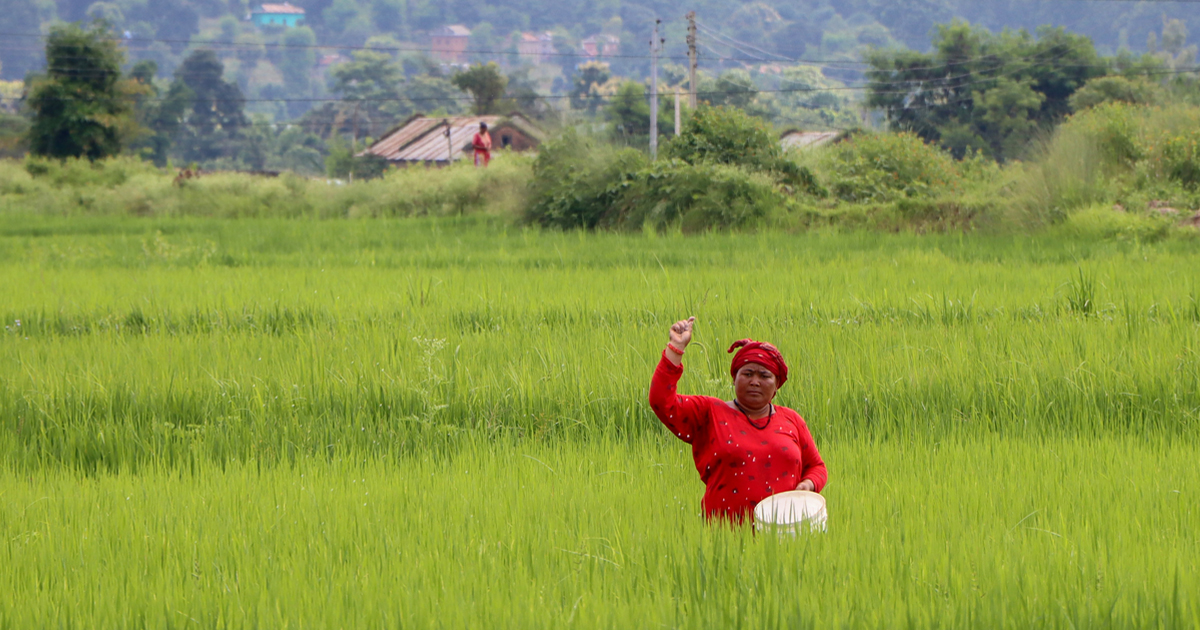
Women spreading fertilizer in a paddy field in Bijauri, Tulsipur Sub-metropolitan City-18, Dang. Photo: Deepak Bohara/RSS
The Government of Nepal decided on May 4 to purchase chemical fertilizer from India through a G2G (government-to-government) process. The Cabinet meeting gave theoretical approval to Agriculture Inputs Company Limited to bring 60,000 tons of urea and 20,000 tons of DAP fertilizer. Due to the lack of raw materials for making chemical fertilizer because of the Gulf war, India itself is struggling with a fertilizer shortage. Although India asked China to lift the quota system on urea fertilizer, it was unsuccessful.
It’s not just fertilizer; the food production crisis in India will also affect Nepal because Nepal imports a large amount of rice and paddy from India every year. Last year, Rs 21.5 billion worth of rice and paddy were imported.
Weak Monsoon
In addition to rising fuel prices and fertilizer shortages, the weather system is also not in favor of agricultural production this time. A meeting of the South Asia Climate Outlook Forum under the World Meteorological Organization (WMO), held in the Maldives on April 28-29, predicted below-normal rainfall and increased heat across South Asia, including Nepal, from June to September. The forum drew the attention of South Asian countries to take necessary steps, citing risks to water distribution and farming.
It is estimated that the ‘El Nino’ weather system, which warms the water surface in the Pacific Ocean, will develop. Bibhuti Pokhrel, spokesperson for the Department of Hydrology and Meteorology, says that a drought occurs when El Nino develops. The department is yet to release an analytical report on this year’s monsoon in Nepal. Pokharel says, “We are analyzing what this year’s monsoon will be like province-wise and the impact of the drought. We will release it by May 8.”
Rainfall in Nepal is estimated to be 8 to 15 percent less than average this year. Meteorologist Binod Pokharel says rainfall from late May to late July is expected to be only about half of normal levels, potentially creating challenges for farmers in paddy transplantation.
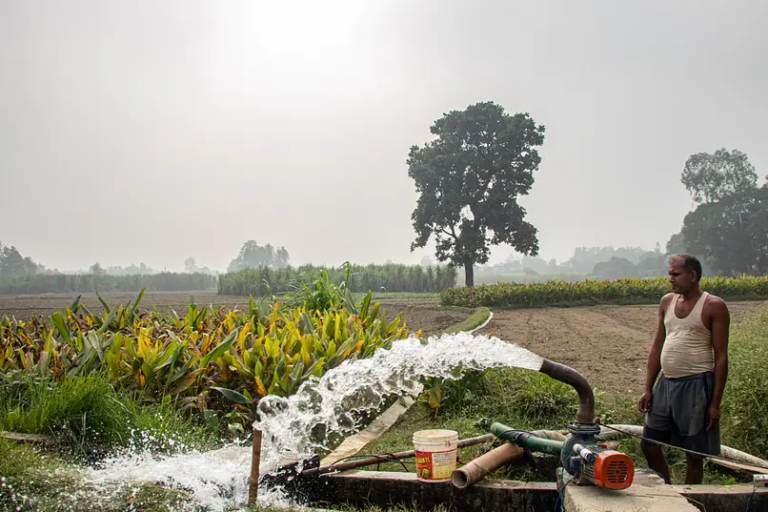
A farmer using an electric pump to extract groundwater for irrigation in Barahathwa Municipality, Sarlahi. Photo Source: Onion Films
Only 40 percent of total cultivable land in Nepal has irrigation facilities. The remaining land depends on rainwater for farming. Last year’s monsoon was predicted to have above-average rainfall, but during the monsoon period, a drought occurred, forcing the government to distribute drinking water in various parts of Madhes Province.
Paddy is grown on 47 percent of Nepal’s cultivable land. In the fiscal year 2024/25, paddy was cultivated on 1.42 million hectares. This year, paddy production is estimated to decrease by up to 10 percent. Rice is the staple food for two-thirds of Nepalis.
This year, a large area of South Asia, including Nepal, will be affected by the war in West Asia and a weak monsoon. The low-income and marginalized groups are expected to be the most affected. Those with money can buy even at high prices, but those without will have to cut back on their food intake.
Food security expert Ghale says that if there are problems in the food supply system or extreme inflation, Bagmati, Koshi, and Gandaki provinces, which rely more on the market, will be at higher risk. “Because these provinces have large cities, high populations, and people depend entirely on the market for food, a major crisis will hit as soon as there is a problem in the supply system,” she says.
Similarly, food insecurity directly impacts people’s nutritional security. When quality and sufficient food are unavailable due to shortages and high prices, it leads to long-term negative impacts on the health and human resource development of vulnerable groups. Another group affected by rising food prices is people in remote areas. Since transportation costs rise excessively when fuel prices increase, the price of food in remote and difficult-to-reach areas becomes even more expensive, further burdening the residents there.
Ghale adds that the food crisis could even affect national sovereignty. “At the national level, in a state of extreme food insecurity, the country itself is affected when conducting political or economic negotiations in the international arena,” she says. “To save the people from hunger, the country might have to back down from its stance and make compromises, which adds a challenge to national security.”
The current price hikes in the market are sustained by old stocks. However, after expensive fuel, fertilizer shortages, and a weak monsoon affect actual production, this pressure will move directly from the fields to the kitchens of ordinary citizens. At that time, inflation will not be limited to mere numbers; it will affect people’s eating habits, nutrition, and standard of living. The most victimized by this will be the economically weak.