Kathmandu
Saturday, June 20, 2026





Unpacking the delicate balance between diegetic realism, background scores, and sync sound with MPSE member Kishor Acharya, who reveals why sometimes the most powerful sound is the absence of sound
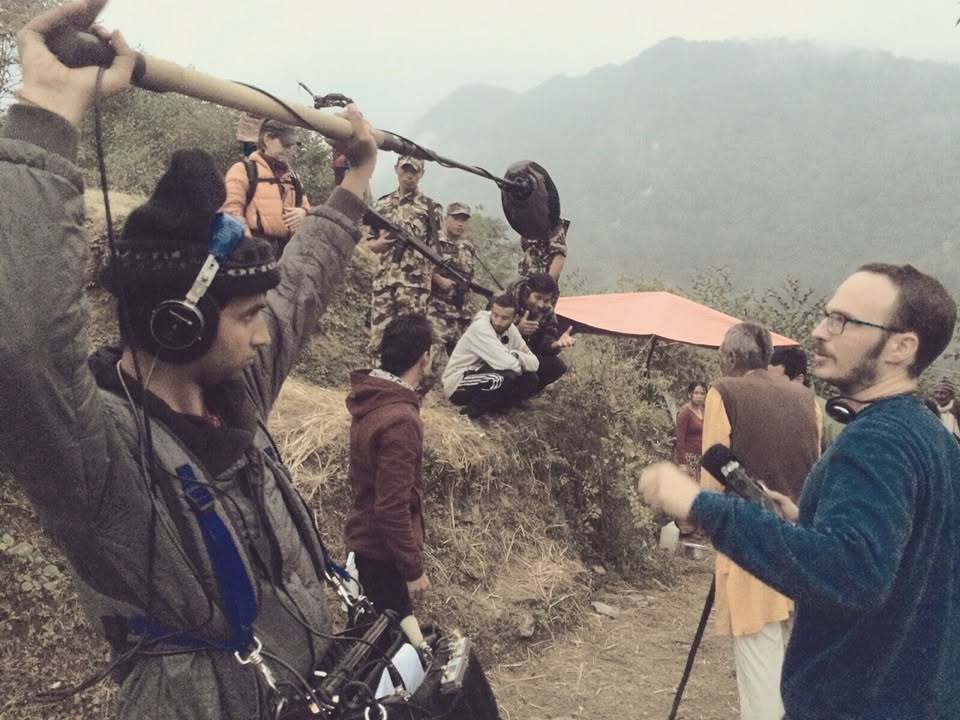
KATHMANDU: Kishore Acharya stands at the forefront of a new generation of sound designers who are actively correcting one of the historically weak aspects of Nepali cinema: sound design. Through his significant contributions and meticulous craft, Acharya has steadily carved out a highly respected artistic identity. His work across dozens of films, including Seto Surya, Ainaa Jhyal Ko Putali, Gaun Aayeko Bato, and the documentary Dhorpatan, has earned him widespread appreciation and awards.
His professional credentials extend to international horizons as well, where he serves as a member of the prestigious international organization Motion Picture Sound Editors.
In an insightful conversation with Nepal News, Acharya talks about the difference between sound and score, the magic of auditory world-building, the transition to sync sound, and the evolving role of artificial intelligence in modern filmmaking.
Nepal News presents this week’s seven questions with Acharya:
What is the distinction between cinematic sound, music, and background score, and where do their roles overlap or diverge?
Sound, music, and background score are all three important elements in cinema whose roles are different. Dialogue, environmental sound, birds chirping, the flow of a river, vehicles, footsteps, and crowds are all audible things that fall within sound design. However, songs and music do not.
Music or songs are sometimes used to advance the story, emphasize emotional moments, or give a break to the flow of the story. Such music, which can be heard by the characters themselves, is called ‘diegetic’ music.
A background score, on the other hand, is music created according to the scene. It works to make emotions like tension, excitement, sadness, and fear even more effective. This type of music, which the character cannot hear, plays only for the audience. Sometimes, directors intentionally blur this boundary. Depending on the director’s vision, all these three aspects connect with each other during the final sound design and mixing stage to give the audience a complete cinematic experience.
What is the main job of a sound designer?
The main job of a sound designer is to construct an appropriate sound world (soundscape) for the film according to the director’s vision and the requirements of the story. By meticulously selecting and combining dialogue, environmental sound, foley, and various sound effects, the story is presented in a believable and effective manner. The sound designer also plays a crucial role in deciding which scene requires music and which scene is more powerful in silence, because sometimes the most impactful sound is the absence of sound itself.
Since cinema is fundamentally an audio-visual medium, sound contributes immensely to storytelling, building atmosphere, and creating emotional impact. Sound without visuals would be like radio, but visuals without sound can feel just like CCTV footage. Therefore, the role of sound design is indispensable to connect the audience emotionally with the story and to make the cinema come alive.
What role does sound play in making what the audience sees on the screen believable?
The human brain perceives a cinematic moment as real only when visuals and sound align perfectly. The punch sounds, gunshots, and collapsing walls on screen are entirely fabricated; using the muffled sound of a real punch would feel weak and ineffective to an audience. Instead, sound designers construct exaggerated audio from unrelated objects, tricking the brain into instant belief.
This auditory illusion also expands the world far beyond the physical frame of the camera. If a character hides in a dark room while the audio tracks gunshots, screams, and a stampede, the audience instantly visualizes a warzone without seeing a single frame of conflict. Sound routinely travels where the camera cannot, breaking visual boundaries to prove it is never just a supporting tool but an independent language of storytelling.
When does diegetic sound outperform a musical score, and in what exact cinematic moments do music or a background score become indispensable to the narrative?
Whether to use sound design or music in a scene, or when to give more priority to which one, depends entirely on the film’s genre, style, and storytelling method. Generally, all sound elements can be divided into diegetic and non-diegetic. Diegetic sounds are sounds that exist within the character’s world and can be heard by the character as well (foley, environmental sound, dialogue, and sound effects), and these create reality by placing the audience inside that world along with the character. To establish the scene as a depth of reality or to make things like the horrors of war or the tension of a crime felt, this diegetic sound is the most powerful. For example, in No Country for Old Men, just the sounds of footsteps, wind, and silence create terror.
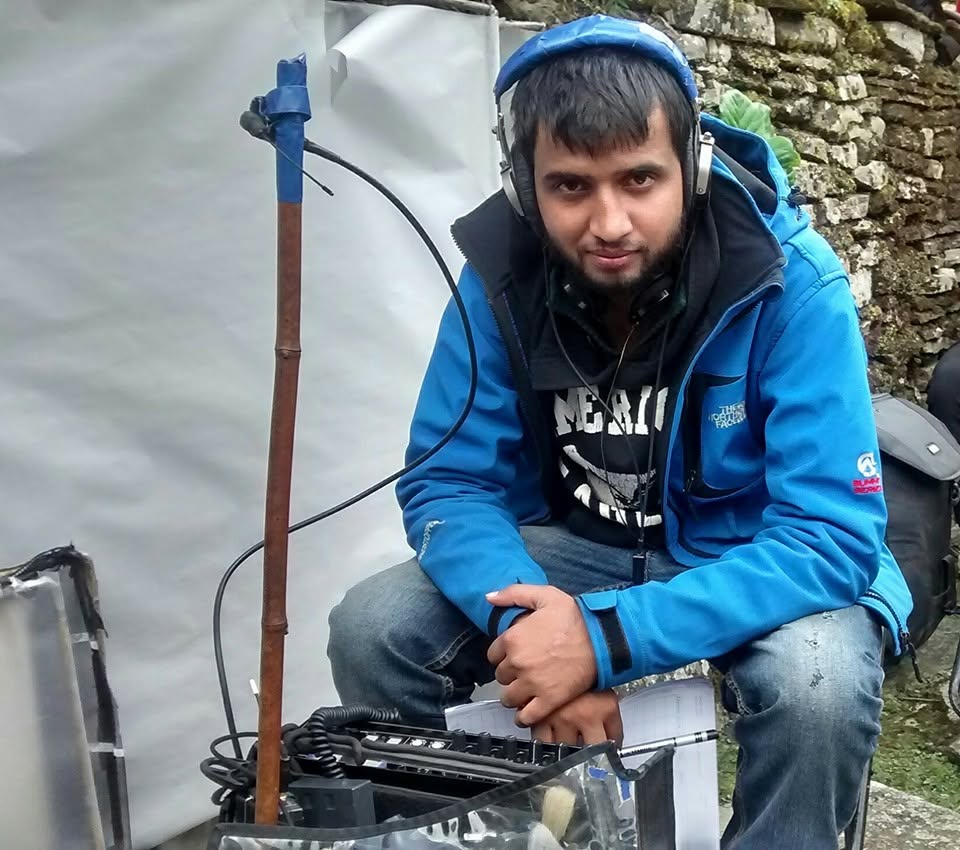
Sound designer Kishore Acharya
Non-diegetic sounds are sounds that do not exist in the character’s world but are used to give an emotional impact to the audience. When the story demands an emotional height that dialogue or visuals alone cannot reach, it becomes indispensable there. For instance, in Interstellar, Hans Zimmer’s music makes the vastness and loneliness of the universe felt simultaneously.
Sometimes, filmmakers change sound from diegetic to non-diegetic or from non-diegetic to diegetic, which is called ‘transdiegetic.’ A character turns off the radio, but that same tune starts playing in the background score. This is one of the most powerful techniques of cinema. Ultimately, sound gives reality, music gives meaning, the score directs emotion, and deciding which scene requires which is precisely the most important skill of a successful sound designer.
What are the different practices happening now in sound design in Nepal compared to the past?
No radical change has occurred in sound design so far, though improvement has certainly taken place. Decades ago, almost all sound and score work was done in Mumbai, where stock music was mostly used and there was no specific sound theme or idea according to the film. Sound was not an integral part of the story but merely an empty space to be filled.
Now that situation has changed. Composers are starting to be hired for background scores, and the presence of sound designers is being sought to supervise sound design right here in Nepal. This has made a significant difference in the overall audio quality of films. Sync sound (the practice of recording dialogue on location) is also slowly being adopted because it brings the real environmental texture and naturalness to the character’s voice, which studio dubbing cannot provide. However, due to cheap dubbing, studio fees, and not paying actors separately for dubbing, many filmmakers are still attracted toward dubbing rather than location sound. This financial constraint is a major barrier to the sound quality of Nepali cinema.
Slowly, sound design is establishing itself as a separate genre. However, the concept of storytelling through sound is yet to be adequately utilized by many filmmakers. The day this can be done, Nepali cinema will take another leap forward.
Which are the three international cinemas that you find outstanding in terms of sound design?
No Country for Old Men is a film that uses extremely minimal music. Here, the very subtle use of silence and real sound builds tension, fear, and discomfort. The animated film Wall-E delivers the robot’s emotions and relationships to the audience through minimal dialogue and effective sound design. Similarly, in Apocalypse Now (1979), sound design is not just reality but a psychological layer of storytelling that builds more meaning, feeling, and mental state than the visuals. It is for this reason that these three films seem extremely impactful to me from the perspective of sound design.
At the current time, is AI an opportunity or a challenge for sound and music?
Artificial Intelligence (AI) remains a nascent tool within the Nepali cinema industry, and its negative impacts have yet to fully manifest. Currently, emerging AI applications are streamlining technical workflows and saving significant time, allowing creators to pivot their focus directly toward creative experimentation.
The true value of AI lies in personalization; those who learn to tailor these tools can harness powerful creative assistance. Without this specific customization, AI relies on repetitive default inputs, which risks producing generic, identical outcomes across the board.