Kathmandu
Saturday, June 20, 2026





The latest Public Debt Management Office report for the eleven months through mid-June 2026 shows total debt actually dipped from the previous month, even as fresh borrowing and debt servicing both climbed, because a partial recovery in the exchange rate clawed back some of the losses recorded earlier in the fiscal year
KATHMANDU: Nepal’s Public Debt Management Office under the Ministry of Finance has released its monthly Government Debt Statistics for mid-July 2025 to mid-June 2026, covering eleven months of fiscal year 2025/26.
The report was prepared as of June 14, 2026. It details total outstanding debt, the split between domestic and external borrowing, annual targets, debt servicing expenditure, net debt mobilisation, and a month-by-month account of receipts and repayments, offering the most current snapshot of the government’s financing position.
How much public debt does Nepal currently owe?
As of mid-June 2026, Nepal’s total outstanding public debt stands at Rs 2,961.20 billion. The fiscal year began in mid-July 2025 with an opening balance of Rs 2,674.05 billion, meaning the debt stock has grown by Rs 287.15 billion over eleven months. This is a notable shift from the previous month’s report, which had placed total debt at roughly Rs 2,975.04 billion as of mid-May.
In other words, the debt figure actually fell by close to Rs 14 billion between mid-May and mid-June, the first such monthly decline recorded so far this fiscal year. The reason lies almost entirely in currency movement rather than any reduction in borrowing, since the government continued taking on new loans throughout the month.
This single data point illustrates how sensitive Nepal’s reported debt level is to exchange rate swings, given that more than half of the total stock is denominated in foreign currency and revalued each month against the rupee.
What is the breakdown between domestic and external debt?
Of the Rs 2,961.20 billion in total public debt, external debt accounts for Rs 1,583.91 billion, or 53.49 percent of the total, while domestic debt accounts for Rs 1,377.28 billion, or 46.51 percent.
Compared to mid-May, when external debt’s share stood at 53.57 percent and domestic debt’s share at 46.43 percent, the external portion has edged down slightly while the domestic share has inched up.
In absolute terms, both categories actually declined slightly between mid-May and mid-June. External debt fell from an estimated Rs 1,593.81 billion to Rs 1,583.91 billion, and domestic debt fell from Rs 1,381.23 billion to Rs 1,377.28 billion.
The external decline is explained mainly by exchange rate movement, while the marginal dip in domestic debt reflects a month in which scheduled principal repayments slightly outpaced fresh issuance of government securities, a pattern that does not happen every month.
What is Nepal’s current debt to GDP ratio?
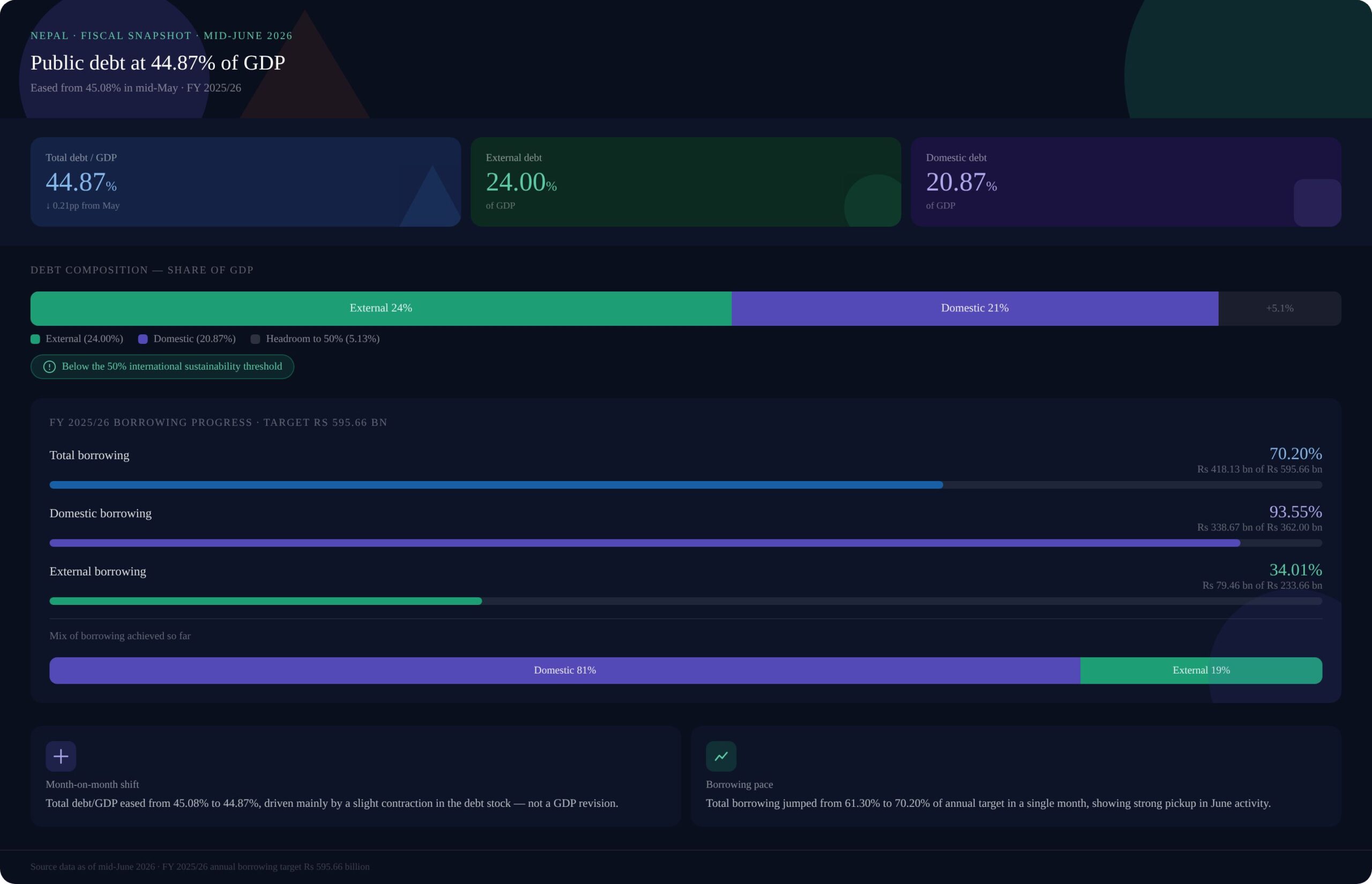
Nepal’s total public debt equals 44.87 percent of gross domestic product as of mid-June 2026. This is broken down further into external debt at 24.00 percent of GDP and domestic debt at 20.87 percent of GDP.
The ratio has eased slightly from the 45.08 percent recorded in the mid-May report. Since the debt to GDP ratio is calculated by dividing the outstanding debt stock by the size of the economy, a small decline can come from either side of that equation, a lower numerator, a higher denominator, or some combination of both.
In this case, the modest decrease in the debt to GDP ratio appears to be driven mainly by the slight contraction in the debt stock itself this month, rather than a fresh upward revision to GDP, since no new GDP revision is mentioned in this particular report.
The ratio remains below the internationally watched 50 percent threshold that is often used as a rough indicator of fiscal sustainability for emerging economies.
How much new debt has Nepal taken on so far this fiscal year?
Against an annual borrowing target of Rs 595.66 billion for fiscal year 2025/26, Nepal had mobilised Rs 418.13 billion in total new loans by mid-June, equivalent to 70.20 percent of the full-year target. This marks a meaningful jump from the 61.30 percent achievement recorded as of mid-May, showing that borrowing activity picked up pace during the latest month.
Domestic borrowing reached Rs 338.67 billion, or 93.55 percent of its Rs 362.00 billion annual target, up from 82.50 percent a month earlier. External borrowing reached Rs 79.46 billion, or 34.01 percent of its Rs 233.66 billion target, up from 28.46 percent in the previous report.
Within total borrowing achieved so far, domestic loans make up 81 percent and external loans make up 19 percent, broadly similar to the split seen in the mid-May figures, confirming that the government continues to rely far more heavily on the local market than on foreign creditors to meet its financing needs.
How much new borrowing came in during the latest month alone?
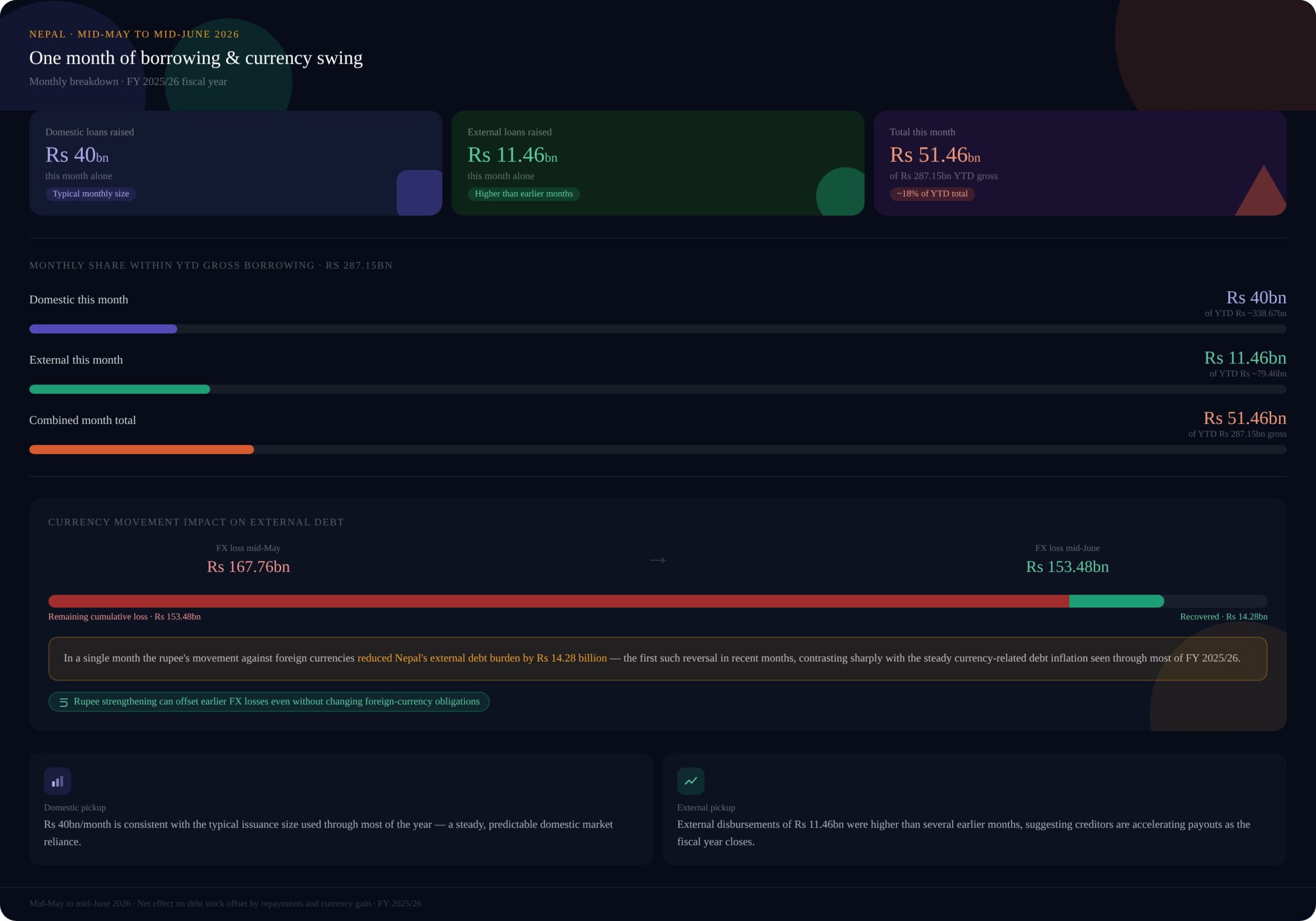
Looking specifically at the month from mid-May to mid-June, the government raised Rs 40.00 billion in new domestic loans and Rs 11.46 billion in new external loans, based on the monthly breakdown in the report.
This single month therefore accounted for roughly Rs 51.46 billion of the total Rs 287.15 billion increase recorded so far this fiscal year on a gross borrowing basis, though the net effect on the debt stock was offset by repayments and a currency gain.
The domestic figure of Rs 40 billion is consistent with the typical monthly issuance size the government has used through most of the year, while the external figure, although still modest in absolute terms, was higher than several earlier months, suggesting a pickup in disbursements from external creditors as the fiscal year approaches its close.
How much has currency movement affected the debt figures this month?
One of the most striking findings in this report is that the cumulative exchange rate loss, which had reached Rs 167.76 billion as of mid-May, narrowed to Rs 153.48 billion by mid-June.
This means that over the course of this single month, the rupee’s movement against foreign currencies actually reduced the local currency value of Nepal’s external debt by close to Rs 14.28 billion, a partial reversal of the losses accumulated earlier in the year.
This is the first such improvement recorded in recent months and stands in sharp contrast to the steady currency related debt inflation seen through most of the fiscal year.
It demonstrates that the relationship between the rupee and the currencies in which Nepal’s external loans are denominated is not a one way drag on the debt figures, and that periods of rupee strengthening can meaningfully offset earlier losses, even if the underlying loan obligations in foreign currency terms remain unchanged.
What is Nepal’s net debt mobilisation for the year so far?
Net debt mobilisation, which is gross new borrowing minus principal repayments, stood at Rs 133.67 billion for the eleven months through mid-June. This is only marginally higher than the Rs 133.24 billion recorded for the first ten months through mid-May, showing that the pace of net borrowing essentially flattened during the latest month.
Within this, domestic net mobilisation actually declined slightly, from Rs 113.00 billion to Rs 109.06 billion, because the principal repaid on domestic securities during the month slightly exceeded the new domestic loans raised.
External net mobilisation rose from Rs 20.23 billion to Rs 24.61 billion, reflecting the pickup in external disbursements during the same period.
The report states that net debt mobilisation now accounts for 46.55 percent of the total debt growth recorded so far this fiscal year, up from 44.27 percent in the previous month, an increase driven largely by the narrowing of the currency loss rather than by a surge in net borrowing itself.
What share of debt growth is coming from currency losses versus actual borrowing?
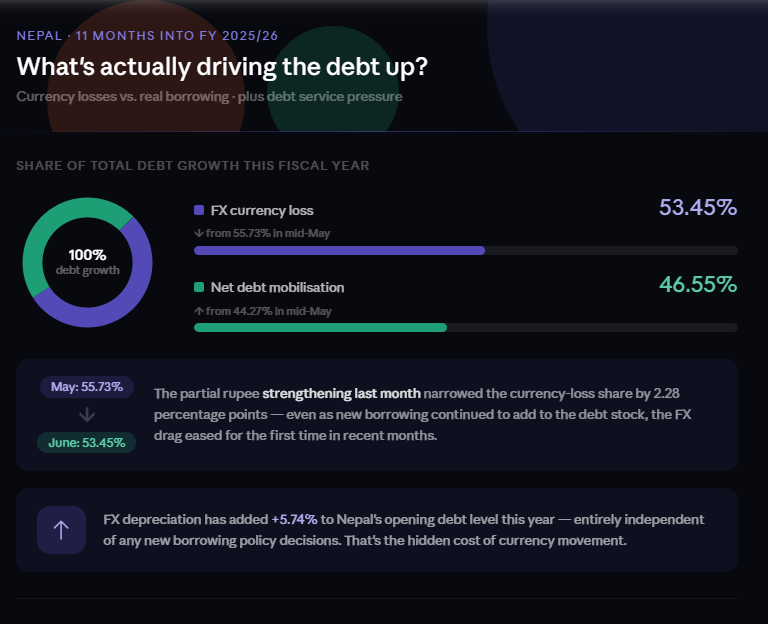
According to the report, foreign exchange loss accounts for 53.45 percent of the total debt growth recorded in the first eleven months of the fiscal year, while net debt mobilisation accounts for the remaining 46.55 percent. This represents a shift from the mid-May report, where currency losses had made up 55.73 percent of debt growth and net mobilisation only 44.27 percent.
The narrowing gap between these two shares reflects the partial currency gain recorded during the latest month, which reduced the cumulative exchange loss figure even as net borrowing continued to add to the debt stock.
The report also notes separately that the foreign exchange loss has added 5.74 percent to the debt level that existed at the start of the fiscal year, a figure that helps illustrate just how large a role currency depreciation has played in driving up Nepal’s debt position over the course of this year, independent of any new policy decisions on borrowing.
How much is Nepal spending on servicing its debt?
The total debt service budget for fiscal year 2025/26 is Rs 411.01 billion. By mid-June 2026, the government had already spent Rs 351.75 billion, which is 85.58 percent of the full year budget used up in just eleven months.
This is a sharp rise from the 71.17 percent recorded as of mid-May, indicating that a substantial chunk of debt servicing was concentrated in the most recent month. As a share of GDP, total debt service now stands at 5.33 percent, up from 4.43 percent a month earlier.
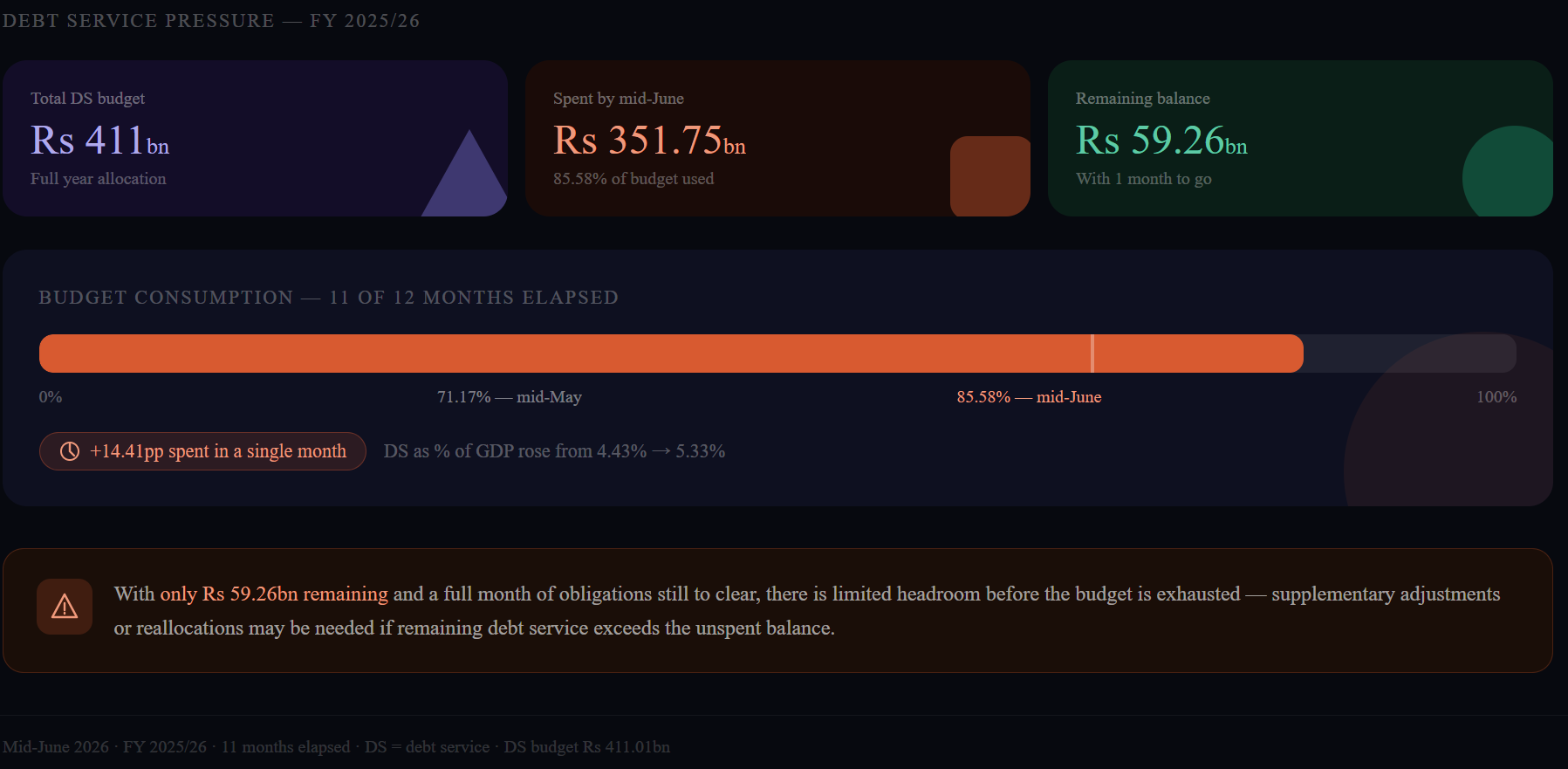
With only one month left in the fiscal year and over 85 percent of the debt service budget already spent, there is limited room remaining before the full year allocation is exhausted, suggesting that supplementary adjustments or reallocations within the budget may be needed if remaining obligations exceed the unspent balance of Rs 59.26 billion.
How is the debt service amount split between principal and interest?
Of the Rs 351.75 billion spent on debt service through mid-June, Rs 284.46 billion went toward principal repayment and Rs 67.29 billion went toward interest payments. On the domestic side, principal repayment totalled Rs 229.61 billion and interest payments totalled Rs 55.61 billion.
On the external side, principal repayment came to Rs 54.85 billion and interest payments came to Rs 11.68 billion. Compared to the mid-May figures, where total principal repaid stood at Rs 231.93 billion and total interest paid stood at Rs 60.60 billion, both categories rose over the latest month, with principal repayment increasing by about Rs 52.53 billion and interest payments increasing by about Rs 6.69 billion.
Of the Rs 351.75 billion spent on debt service through mid-June, Rs 284.46 billion went toward principal repayment and Rs 67.29 billion went toward interest payments.
The much larger jump in principal repayment relative to interest reflects the heavier repayment activity seen in domestic securities during the month, since treasury instruments mature frequently and require continuous rollover.
How close is Nepal to meeting its full year domestic borrowing target?
Nepal has now achieved 93.55 percent of its domestic borrowing target for the fiscal year, having raised Rs 338.67 billion against a target of Rs 362.00 billion, leaving just Rs 23.33 billion still to be raised in the final month.
This is a substantial jump from the 82.50 percent achievement recorded as of mid-May, when about Rs 63.33 billion remained outstanding against the same target.
The pace of domestic issuance through treasury bills, development bonds and other instruments has therefore been strong enough to bring the government within close reach of its full annual domestic borrowing plan with only one month remaining in fiscal year 2025/26.
Given that domestic borrowing has consistently outperformed external borrowing throughout the year, it is likely that the remaining Rs 23.33 billion will be raised comfortably through the usual auction mechanisms before the fiscal year closes in mid-July.
How far behind is Nepal on external borrowing, and what does that mean for the rest of the year?
External borrowing achievement stands at 34.01 percent of the annual target as of mid-June, with Rs 79.46 billion raised against a target of Rs 233.66 billion. This leaves Rs 154.20 billion in external loans still to be disbursed in the final month of the fiscal year.
While this is an improvement from the 28.46 percent achievement recorded in mid-May, it remains far short of what would be needed to fully meet the external target by year end.
External loan disbursements depend on the processing and approval timelines of multilateral and bilateral creditors rather than on the government’s own calendar, so a large portion of this gap may simply carry over as undisbursed commitments rather than being fully closed out.
This pattern has been consistent throughout the fiscal year and suggests that the final external borrowing figure for 2025/26 is likely to fall well short of the original annual target.
How has Nepal’s debt grown since the start of the fiscal year, month by month?
The monthly data in the report shows considerable variation in both borrowing and repayment activity.
Domestic borrowing remained fairly steady throughout most months, generally ranging between Rs 15 billion and Rs 40 billion.
The lowest domestic receipt of Rs 15 billion was recorded in mid-January 2026, while the highest monthly figure of Rs 40 billion was seen in several months, including mid-August 2025, mid-December 2025, mid-April 2026, and mid-June 2026.
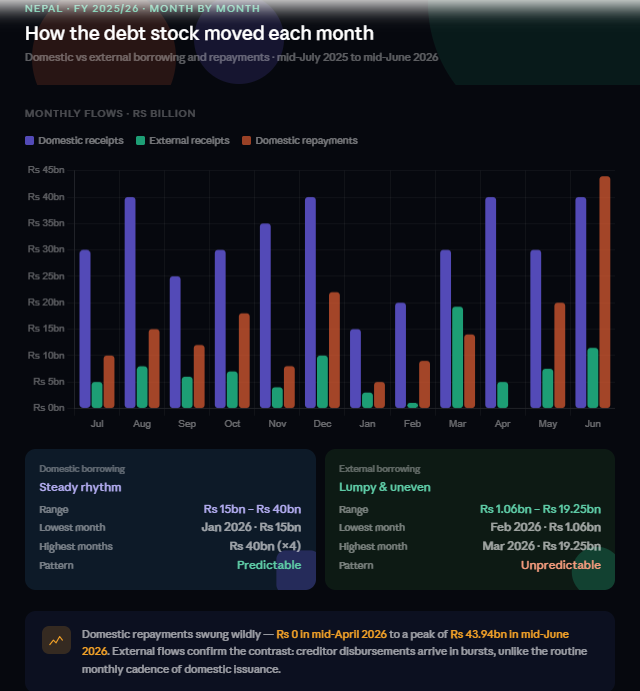
Domestic principal repayments varied more sharply, with mid-April, 2026, recording zero domestic principal repayment while mid-June, 2026, recorded the highest monthly domestic principal repayment of close to Rs 43.94 billion.
On the external side, monthly receipts were generally smaller and more uneven, ranging from as low as around Rs 1.06 billion in mid-February, 2026 to as high as Rs 19.25 billion in mid-March, 2026.
This pattern confirms that external financing flows remain lumpy and unpredictable compared to the more routine rhythm of domestic debt issuance.
What does the eleven month trend suggest about the trajectory of Nepal’s debt this fiscal year?
Taking the full eleven months together, Nepal’s public debt has grown from Rs 2,674.05 billion at the start of the fiscal year to Rs 2,961.20 billion by mid-June, an increase of Rs 287.15 billion, which works out to an average of roughly Rs 26.10 billion per month.
This average pace is somewhat lower than the roughly Rs 30 billion per month pace implied by the ten month figures reported in mid-May, mainly because the latest month brought a partial currency gain that offset continued new borrowing.
With one month remaining in the fiscal year, and given that domestic borrowing is nearly complete against its target while external borrowing still has a large unmet portion, the final debt figure for fiscal year 2025/26 will depend heavily on how much of the remaining Rs 154.20 billion in external loans gets disbursed in mid-July, as well as on whatever further currency movements occur in that final month.
What are the main takeaways and risks from this latest report?
The eleven month report for fiscal year 2025/26 presents a more nuanced picture than the previous month’s data. Total public debt has eased slightly to Rs 2,961.20 billion, helped by a partial recovery in the exchange rate that clawed back Rs 14.28 billion of the losses accumulated earlier in the year.
At the same time, debt servicing expenditure has accelerated sharply, now consuming 85.58 percent of the full year budget and 5.33 percent of GDP, up from 71.17 percent and 4.43 percent just a month earlier.
Domestic borrowing is close to fully meeting its annual target while external borrowing lags well behind at just over a third of its goal, leaving a large pipeline of undisbursed external loans for the final month.
The key risk going forward is that this month’s currency gain could easily reverse in either direction, given how exposed more than half of Nepal’s debt stock remains to exchange rate swings, while the rising pace of debt service spending continues to absorb a growing share of the national budget with only weeks left in the fiscal year.