Kathmandu
Tuesday, July 14, 2026





Nepal’s FY 2026/27 Policy and Program promises sweeping reforms, rapid economic growth, digital governance, and institutional transformation. But beneath its ambitious language lies a familiar problem: vague implementation plans, weak accountability mechanisms, and structural gaps that have undermined decades of reform efforts

KATHMANDU: There is a particular kind of political document that reads beautifully and delivers very little. It is assembled with the right words, organized around the right values, and populated with commitments that, taken individually, seem reasonable and even inspired. Nepal’s Policy and Program for FY 2026/27 is, in many ways, a masterclass in this genre.
Presented by President Ram Chandra Paudel on May 11, 2026, the document arrives at what the government itself calls a rare historical juncture: a single-party majority, a fresh mandate from the March 5 elections, and the moral weight of the 2025 Gen Z uprising pressing on every page. The government is right that this is an unusual window. Nepali governance has lurched from coalition to coalition for the better part of two decades, producing policy documents that were obsolete before the ink dried. The current administration, at least on paper, does not have that excuse.
And yet, when you read this 100-point program slowly, when you hold it against Nepal’s actual institutional record, against its international commitments under the Sustainable Development Goals, against the SAARC Development Goals it helped author, against the Sendai Framework for Disaster Risk Reduction, against the Paris Agreement pledges it has ratified, and against the long, discouraging catalog of previous policy documents that promised identical things, what emerges is not optimism but a familiar unease.
The document is verbose where it should be specific. It is aspirational where it should be operational. It names institutions to be created while the institutions it already has remain broken. It borrows the language of transformation without the architecture that transformation requires.
Targets without traction mechanisms
The headline economic ambition of seven percent average annual GDP growth over the next decade is the kind of number that sounds decisive but reveals very little about how a government actually intends to govern. Nepal’s GDP growth has averaged roughly four to five percent over the past decade, and the periods of stronger performance have generally coincided with post-earthquake reconstruction spending and remittance surges rather than structural economic transformation. The gap between the current trajectory and the seven percent target is not a small adjustment. It is a fundamental reorientation of how the economy functions.
The document does not explain where the additional two to three percentage points of growth will come from in a way that can be traced, tested, or held accountable. It names five sectors: IT-based service exports, hydroelectricity, tourism, high-value agriculture, and green industrialization. But naming sectors is not an economic strategy.
Each of these sectors faces known, documented, structural constraints that this document either addresses vaguely or does not address at all.
Take hydroelectricity. Nepal has been declaring hydropower its future economic engine since at least the 1990s. The government’s ten-thousand-megawatt target within a decade requires approximately eight to nine thousand megawatts of additional installed capacity beyond what exists today. The document promises to reform the laws governing energy, forests, land, and environment simultaneously.
What it does not grapple with is the fact that those reforms have been promised for years, that multi-ministry coordination has failed consistently, that the single-window clearance system it announces has been announced before, and that the financing gap for hydropower infrastructure at this scale runs into the tens of billions of dollars that neither domestic capital markets nor current foreign direct investment flows come anywhere close to covering.

The IT sector commitment has similar problems. Declaring IT a national strategic industry is a policy gesture, not a policy. Nepal’s IT sector currently contributes less than two percent of GDP. For it to become a meaningful export engine, the country needs dramatically improved internet infrastructure, stable electricity, a reformed education system that produces job-ready graduates at scale, and an international payment gateway ecosystem that actually functions.
The document addresses all of these in scattered points, but there is no coherent sequencing, no investment roadmap, and no recognition of how long each prerequisite takes to build. A startup portal that delivers same-day company registration is a welcome administrative reform. But it does not produce software engineers, stabilize the power grid, or fix the bandwidth problem in Karnali province.
Against the SDG framework, the seven percent growth target aligns with SDG 8’s call for sustained, inclusive, and sustainable economic growth. But SDG 8 is explicitly qualified by the word “inclusive,” and the policy document’s growth strategy is heavily urbanist and sector-specific in ways that have historically excluded rural and mountain populations.
The document does not contain a Gini coefficient target or any explicit commitment to reducing economic inequality as the economy grows. That is a significant omission for a country where remittance income masks deep structural inequality.
The formalization fantasy
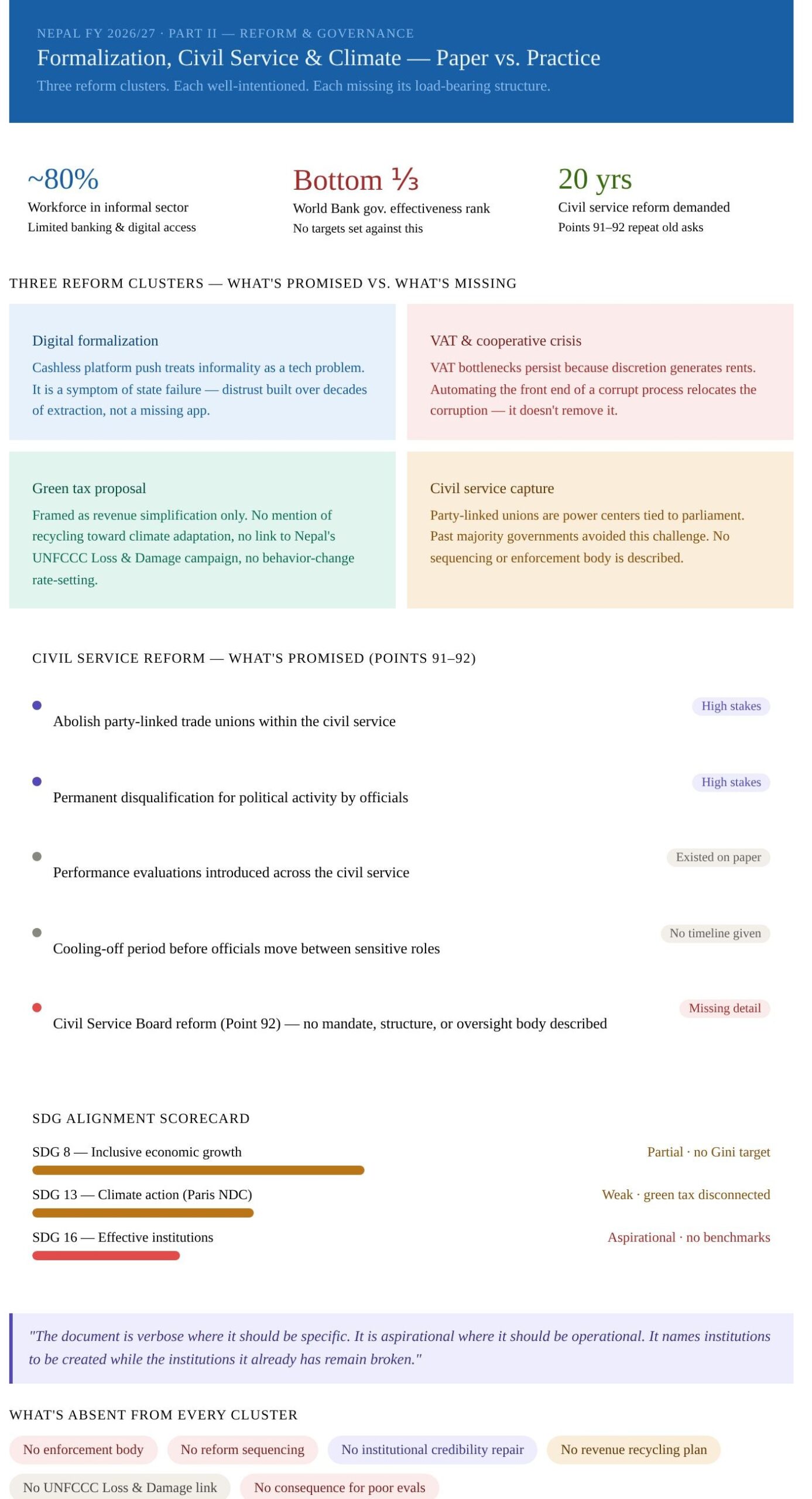
The commitment to moving all economic transactions onto cashless digital platforms is framed as a transparency measure, and in principle it is the right direction. But the document treats Nepal’s informal economy as a technical problem solvable by digital infrastructure, when it is actually a symptom of state failure that cannot be addressed by platforms alone.
Approximately eighty percent of Nepal’s workforce is employed in the informal sector. A significant portion of this workforce has limited access to formal banking, limited literacy in digital financial tools, and limited reason to trust state-administered systems that have historically extracted rather than protected.
The cooperative crisis referenced in the document, where thousands of small depositors cannot recover their savings, is itself a product of exactly the regulatory failure that formal digital systems were supposed to prevent. The government is proposing to solve a trust deficit with a technology deployment, which rarely works without a corresponding institutional credibility repair.
The VAT refund automation commitment is technically sensible but politically naive. Nepal’s VAT refund bottleneck is not primarily a technical problem. It persists because the discretion embedded in the current system generates rents for officials, and those officials are embedded in the same civil service the document is trying to reform. Automating the front end of a corrupt process does not eliminate the corruption. It relocates it.
The green tax unification proposal is worth examining in the context of Nepal’s international climate commitments. Nepal submitted its updated Nationally Determined Contribution under the Paris Agreement committing to reduce greenhouse gas emissions and transition toward renewable energy. A unified green tax structure could be a genuine climate finance instrument if designed well.
But, the document presents it purely as a revenue simplification measure. There is no mention of revenue recycling toward climate adaptation, no connection to the Loss and Damage frameworks under the UNFCCC that Nepal has actively campaigned for internationally, and no indication that the tax rate will be set at a level that actually changes behavior rather than simply replacing scattered levies with a single line item.
Civil service reform: The elephant in every room
Points 91 and 92 are, genuinely, among the most significant commitments in the document. Abolishing party-linked trade unions within the civil service, making permanent disqualification the consequence for political activity by officials, introducing performance evaluations, and establishing a cooling-off period before officials move between sensitive roles are exactly the structural changes that governance reformers have demanded for two decades.
They are also the commitments most likely to remain on paper.
The Nepali civil service has been effectively captured by political parties since the early 1990s. The unions referenced in the document are not peripheral organizations. They are power centers with direct connections to parliamentary factions, with the ability to bring government functions to a halt through coordinated absence and non-cooperation. Previous governments with comparable majority mandates have avoided challenging them precisely because the political cost was deemed too high.
The document does not explain how this government will succeed where others have failed. There is no mention of sequencing, no acknowledgment of anticipated resistance, no transitional support mechanisms for officials whose entire career advancement has been built on partisan networks, and no independent oversight body with enforcement power.
The Civil Service Board reform referenced vaguely in Point 92 is not given any structural description, mandate, or timeline. Performance evaluations have existed on paper in Nepal’s civil service for years. The consistent failure mode is not the absence of an evaluation framework but the absence of any consequence for poor performance evaluations.
Against SDG 16, which calls for effective, accountable, and transparent institutions, Nepal has consistently under-performed on the institutional quality metrics. The World Bank’s governance indicators place Nepal in the bottom third of countries on government effectiveness and control of corruption. The policy document does not cite these indicators, does not set targets against them, and does not explain why this reform cycle will produce different outcomes than previous ones.
Social justice: Rights-based language over rights-based architecture
The social inclusion commitments in Points 50 through 54 deserve sustained scrutiny because they reveal a pattern that runs throughout the document: the government has learned the language of rights-based development without building the systems through which rights are actually realized.
The declaration of zero tolerance toward gender-based violence is morally correct and politically costless to make. What the document does not contain is any funding commitment, staffing plan, or service delivery architecture for the violence response system it promises. Nepal currently has deeply inadequate shelter capacity for survivors of gender-based violence, a justice system with chronic case backlog and low conviction rates for sexual violence, and a police force that has historically been a site of re-traumatization for survivors rather than protection. Zero tolerance as a rhetorical posture does not address any of these.
The commitment to declaring Nepal child-labor-free within the current fiscal year is, frankly, implausible. The International Labour Organization estimates that hundreds of thousands of children remain in various forms of child labor across Nepal, concentrated in agriculture, domestic work, and brick kilns.
Eliminating child labor is not a declaration. It requires sustained economic support for families whose survival currently depends on children’s income, alternative schooling arrangements that work for mobile and rural populations, enforcement mechanisms in sectors that have historically been entirely outside any regulatory attention, and rehabilitation pathways for children already in the workforce.
None of these systems are described in the document. The commitment is either aspirational to the point of being meaningless, or it will produce the kind of paper compliance where children are reclassified rather than actually liberated.
The “Child-Responsible Budget Code” across all three tiers of government is an interesting institutional innovation. But it is announced without explanation of how it will be operationalized, who will audit compliance, what the consequences of non-compliance are, or how local governments with limited technical capacity will be supported to implement it.
Nepal’s fiscal federalism remains deeply uneven, with many local governments lacking the basic accounting infrastructure to implement standard budget classifications, let alone specialized child-responsive coding.
The commitments to persons with disabilities are consistent with Nepal’s ratification of the Convention on the Rights of Persons with Disabilities, but they are not specific enough to constitute implementation. Making all public infrastructure disability-friendly is a commitment Nepal has made before and has systematically failed to deliver on. New government buildings constructed since the 2015 earthquakes routinely fail basic accessibility standards. The document does not address the enforcement gap.
The rights of sexual minorities are acknowledged in a single phrase, grouped with other “targeted groups,” and given no specific commitment beyond “rights-based development.” Nepal has been internationally recognized for constitutional protections of LGBTQ+ rights, including a landmark Supreme Court ruling and explicit constitutional recognition.
But, the gap between constitutional recognition and lived reality remains enormous, particularly in rural areas and particularly in interactions with police, healthcare systems, and economic institutions. The document does not close any part of that gap in any specific way.
The federalism blind spot
One of the most consequential silences in the entire document is on the functioning of Nepal’s federal system. Nepal adopted federalism in 2015 with the new constitution, establishing seven provincial governments and 753 local units alongside the federal level.
After nearly a decade, the intergovernmental system is working poorly. Fiscal transfers are delayed, provincial and local governments lack technical capacity, mandates are poorly defined and frequently contested, and the federal government continues to design and implement programs that overlap with or bypass subnational authority.
This policy document is essentially a federal government document that treats the country as if it were unitary. Program after program is announced with no description of how implementation will be structured across three tiers of government, who bears responsibility at each tier, how disputes between tiers will be managed, or how the significant capacity gaps at local government level will be addressed.
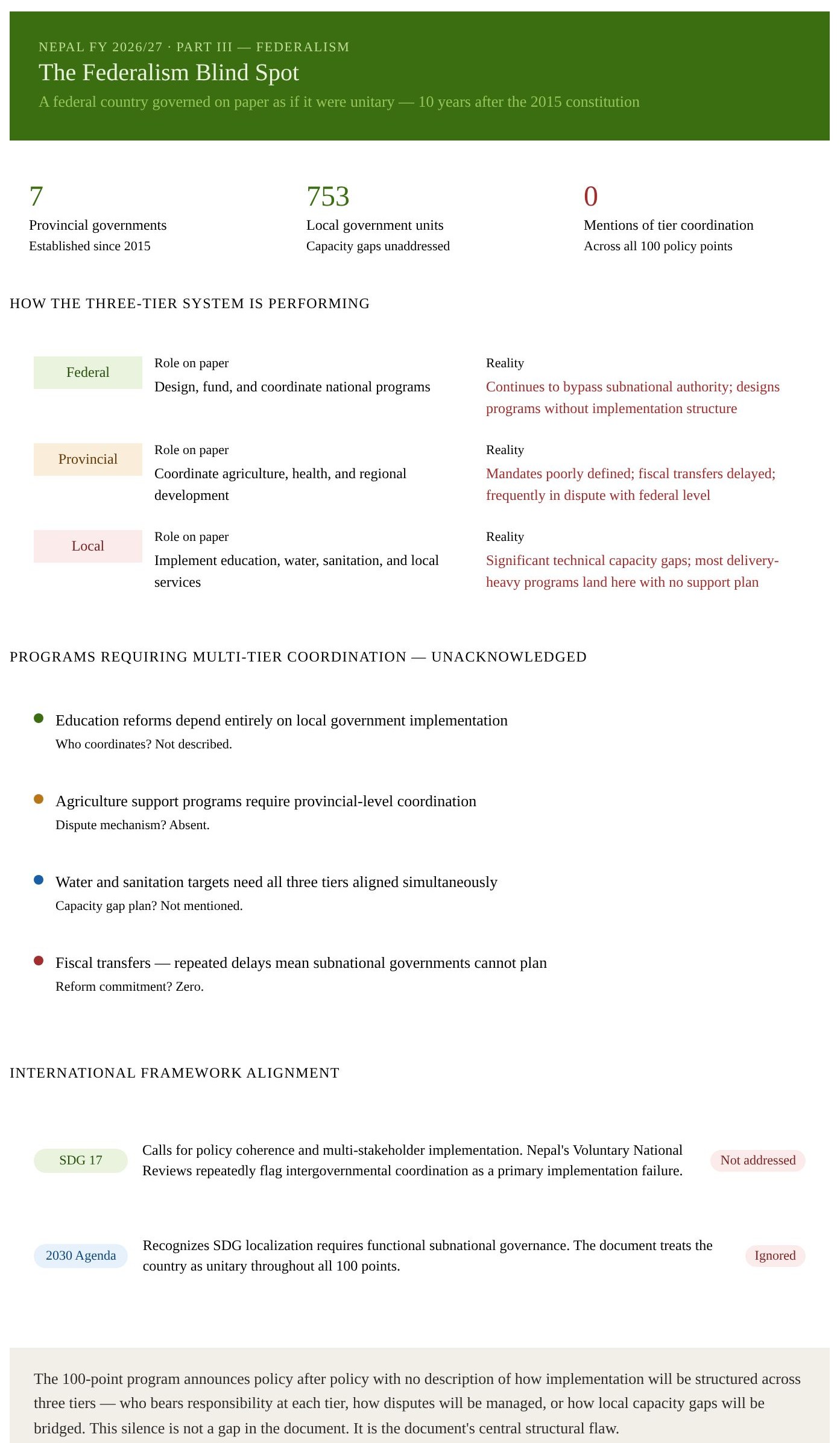
The education reforms require local government implementation. The agriculture support programs require provincial coordination. The water and sanitation targets require all three tiers working in alignment. The document acknowledges none of this complexity.
SDG 17 explicitly calls for coherent policies, policy coherence, and multi-stakeholder implementation. The 2030 Agenda also recognized that effective localization of the SDGs requires functional subnational governance.
Nepal’s Voluntary National Reviews on SDG progress have repeatedly identified intergovernmental coordination as one of the country’s primary implementation challenges. This policy document does not treat that challenge as a challenge at all. It is absent.
Climate commitments and missing adaptation mechanism
Nepal is among the most climate-vulnerable countries in the world. The IPCC’s assessments have consistently identified the Hindu Kush Himalayan region as a climate change hotspot, facing accelerating glacier melt, shifting monsoon patterns, increased frequency of extreme weather events, and growing threats to water security. Nepal’s own National Adaptation Plan process has documented these risks extensively.
The policy document addresses climate and environment in scattered points but does not present anything resembling an integrated climate adaptation framework. The disaster preparedness commitments in Point 71 are welcome but focus primarily on response capacity rather than underlying risk reduction.
The forest fire monitoring center is a useful specific commitment. The human-wildlife conflict measures acknowledge a real and growing problem. But the document does not engage with the systemic climate risks Nepal faces in a way that aligns with its Paris Agreement commitments or with the investment needs identified in its National Adaptation Plan.
The Sendai Framework for Disaster Risk Reduction 2015-2030, to which Nepal is a signatory, calls for a shift from managing disasters to managing disaster risk through prevention, mitigation, preparedness, and resilience building. The policy document still operates primarily in the disaster response paradigm. The risk mapping and early warning commitments are aligned with Sendai priorities, but they represent a very small subset of what comprehensive disaster risk governance requires.
The Carbon Authority and REDD-Plus expansion are genuine climate policy commitments. But they are framed almost entirely as revenue generation mechanisms rather than as contributions to Nepal’s nationally determined contributions under the Paris Agreement.
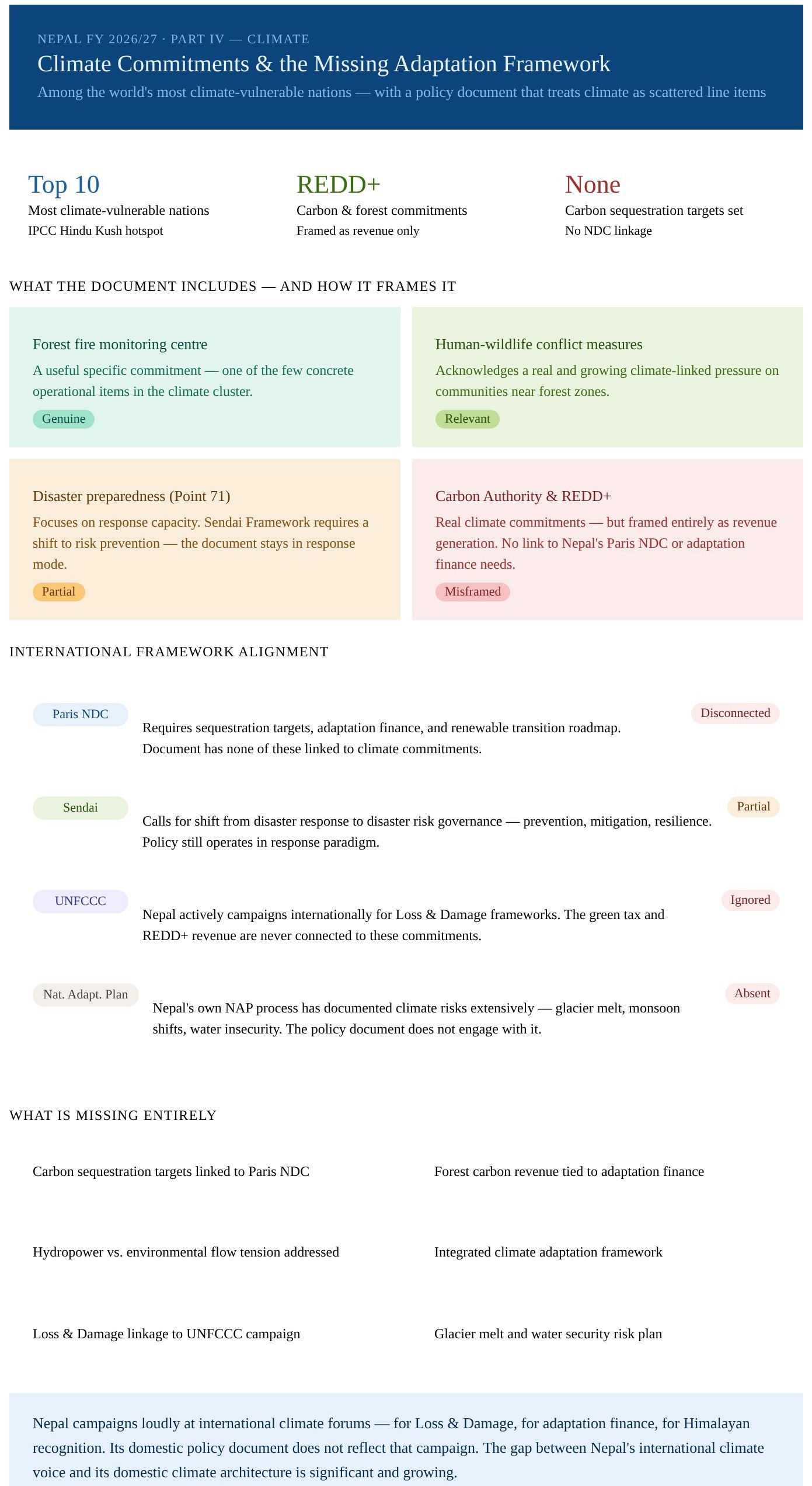
The document does not specify Nepal’s carbon sequestration targets, does not connect forest carbon revenue to adaptation finance needs, and does not address the growing tension between hydropower development and environmental flows in Nepal’s river systems, a tension that is only going to intensify as climate change alters glacier-fed water availability.
Foreign policy: Diplomacy without intelligence
The foreign policy section commits to transforming traditional diplomacy into economic diplomacy. This is the right strategic direction for a country that has historically been passive in its international economic positioning. But the specific commitments reveal a gap between the aspiration and the analytical foundation.
Nepal’s geopolitical situation is unusually delicate. Sitting between India and China, two of the world’s largest and most rapidly evolving economies, Nepal has consistently failed to translate geographic positioning into strategic economic advantage.
The policy document’s statement of principles, referencing the UN Charter, Non-Alignment, and Panchasheel, is constitutionally appropriate but tells us nothing about how Nepal will navigate the increasingly sharp competition between Indian and Chinese economic interests in its territory, or how it will use the leverage it theoretically has to extract better infrastructure, connectivity, and trade terms from both neighbors.
The commitment to expanding double taxation avoidance agreements is sensible. The Diaspora Expert Network and Knowledge Bank are interesting conceptual commitments. But there is no analysis of Nepal’s comparative advantage in the regional economic architecture, no positioning relative to BIMSTEC or SAARC’s stalled integration agenda, and no mention of how Nepal will manage the risks associated with becoming a field of competition between Chinese BRI-aligned investment, American SPP agenda and Indian infrastructure interests.
The “Brand Nepal Campaign” and spiritual tourism diplomacy through Pashupatinath, Lumbini, Janakpur, and Muktinath circuits are culturally appropriate but strategically thin. Nepal’s tourism arrivals have historically been dominated by Indian pilgrimage tourism on one end and Western adventure tourism on the other.
Growing per-tourist spending and average stay duration, the document’s stated goals for Visit Nepal 2028, requires product development, infrastructure investment, and service quality improvement that are not described in sufficient detail to constitute a strategy.
The procurement problem and the June spending carnival
The Zero-Day Procurement Policy announced in Point 72 addresses one of the most damaging features of Nepal’s budget execution architecture. Nepal’s government consistently spends between forty and sixty percent of its capital budget in the final quarter of the fiscal year, and a disproportionate share of that in the final month, June. This is not a quirk. It is a systemic failure that produces wasteful, low-quality spending, drives project cost overruns, and makes meaningful evaluation of development outcomes essentially impossible.
The commitment to beginning procurement from mid-July is correct in principle. But it requires preconditions that the document addresses inadequately. The requirement that detailed project reports, environmental clearances, and land acquisition be completed before budget approval is granted is, if enforced, a genuine structural change.
The problem is that these preconditions are currently not met for the large majority of capital projects because the institutional capacity to produce and process them does not exist at the required scale and quality.
Creating the precondition requirement without building the capacity to meet it simply moves the bottleneck. Projects will sit in the clearance queue rather than in the procurement queue, and the June spending carnival will continue in a different form.
Healthcare: A system without a system
The health commitments in Points 55 through 59 are among the most rhetorically progressive sections of the document. Integrating mental health into public health, establishing a Center for Disease Control, creating a National Health Accreditation Authority, and expanding telemedicine are all the right directions.
The commitment to establishing minimum standards for basic health services at local level is exactly the kind of foundational infrastructure commitment that previous governments have avoided because it is hard, unglamorous, and politically unrewarding.
But, the document does not acknowledge the most basic structural problem with Nepal’s health system: it is chronically underfunded. Nepal spends approximately 5 to 6 percent of government expenditure on health, well below the Abuja Declaration target of 15 percent that African Union members committed to in 2001 and that has become a reference point for health investment adequacy globally.
The WHO’s own guidance on universal health coverage suggests that sustainable UHC requires at least USD 86 per person per year in government health spending. Nepal is far below that threshold and has been for years.
The health insurance program referenced in Point 57 has been a troubled program since its inception, plagued by actuarial problems, provider payment delays, quality concerns, and low enrollment among the populations it is designed to serve. The commitment to restructuring it for sustainability acknowledges the problem without indicating that the government understands its causes or has a reform model that will address them.
The SAARC regional health framework has called for harmonized health surveillance and cross-border disease control cooperation. The document’s Center for Disease Control commitment is aligned with this but does not mention regional coordination at all.
Education: The merit principle and its preconditions
The education commitments contain some genuine innovations. The merit-based teacher recruitment and promotion system, if implemented, would be transformative in a sector where political patronage has been the dominant mechanism for teacher placement for decades. The AI-based learning infrastructure commitment for ten thousand community schools is forward-looking.
But, the document does not address the most fundamental structural problem with Nepal’s education system: the quality gap between urban private schools and rural public schools is vast and growing, and the policy framework consistently fails to address it with adequate resourcing.
Free education through secondary level, free textbooks, midday meals, and uniforms are all welcome measures, but they address the demand side of school attendance without adequately addressing the supply side of educational quality. A child can attend school for free and still learn very little if the teacher is absent, undertrained, or politically placed.
The commitment to making all scholarships merit-based and disbursed directly into student accounts is technically sound but socially blunt. Merit-based allocation without compensatory measures for children from disadvantaged backgrounds, those with disabilities, those from historically excluded communities, and those from remote areas where school quality is lowest risks producing a scholarship system that rewards existing advantage rather than creating opportunity.
The SDG 4 framework calls explicitly for equitable quality education and inclusive learning opportunities for all. A pure merit criterion without equity weighting is not consistent with that commitment.
The Ambition gap in monitoring and evaluation
Perhaps the most telling silence in the entire document is on monitoring, evaluation, and accountability for the government’s own commitments. A 100-point program released as an annual governance blueprint should, at minimum, contain measurable indicators, baselines, and timelines against which progress can be assessed. This document contains almost none.
The seven percent growth target has a timeline: ten years. The child-labor-free declaration has a timeline: this fiscal year. The clean water and sanitation target has a deadline: 2030. But the vast majority of commitments are expressed as intentions with no measurable form at all.
“Strengthen the capacity of X institution.” “Develop a policy for Y sector.” “Establish a system to address Z problem.” These are not commitments. They are statements of intention that can be technically fulfilled by producing a paper, establishing a committee, or launching a portal that nobody uses.
Nepal has a National Planning Commission and a results-based monitoring framework on paper. But the track record on self-evaluation is poor. The country’s own Voluntary National Reviews on SDG progress consistently acknowledge implementation gaps without producing the institutional learning or course corrections that reviews are supposed to generate.
There is no mention in this policy document of how its commitments will be tracked, who will report on progress, whether parliament will receive an annual performance report, or what the consequences of missing targets will be for the government.
Without a functioning monitoring architecture, the 100-point program is essentially self-sealing. It can claim success by citing inputs and activities while leaving the outcomes it was designed to achieve permanently in the future.
The employment decade and the problem of structural change
The declaration of a formal Employment Promotion Decade from FY 2026/27 through 2035/36 is symbolically significant and practically worth examining closely. Nepal’s labor market challenge is not primarily a shortage of employment programs. It is a structural mismatch between the skills the economy produces and the skills a transformed economy needs, combined with a deeply embedded culture of foreign employment as the rational personal strategy for young Nepalis.
Reversing foreign employment dependence in a decade requires creating domestic wage opportunities that are competitive with Gulf Cooperation Council wages after accounting for risk, separation from family, and non-monetary costs. That is an enormously high bar. GCC wages for semi-skilled Nepali workers, adjusted for purchasing power, represent a significant premium over most domestic alternatives.
The Remittance-Investment Matching Fund and the Skill Passport are creative ideas. But they do not change the wage equation. As long as the domestic economy cannot offer comparable returns to labor, the behavioral incentive to migrate will remain, regardless of how well-designed the retention programs are.
The “Learn While You Earn” apprenticeship program is an internationally proven model that works under specific conditions: employers who are willing to invest in apprentice wages, quality standards for training, industry engagement in curriculum development, and a domestic labor market that rewards certified skills with wage premiums.
Nepal lacks most of these conditions today. The commitment to a national apprenticeship program without a plan for building the employer ecosystem that makes apprenticeships viable is putting the cart before several missing horses.
What the document says about itself
Point 100 frames the entire 100-point agenda as a civilizational project, the building of a state that Nepali citizens can genuinely trust and be proud of. This is a high and honest ambition. The tragedy is that the document does not contain the architecture to achieve it.
The moral weight of the 2025 youth uprising is invoked repeatedly and sincerely. The young people who came out in September 2025 were not primarily demanding a better policy document. They were demanding a state that actually functions: where contracts are honored, where corruption is punished rather than rewarded, where merit matters, where public services reach people who need them, and where the connection between paying taxes and receiving governance is legible and reliable.
Those demands cannot be met by 100 points of intention. They require institutional redesign that is specific enough to be implemented, contested enough to generate political resistance, and durable enough to survive the next election cycle. The document gestures toward that redesign in important places.
The civil service reforms, if pursued, would be genuinely significant. The digital governance architecture, if built, would reduce the surface area for corruption meaningfully. The procurement reforms, if enforced, would change how development money flows.
But, gesture and commitment are different things. And commitment and implementation are different things again. Nepal has a long and discouraging history of cycling through reform commitments with each new government, each one announced with fresh moral authority and similar structural vagueness, each one fading as the political economy reasserts itself.
The question this document leaves unanswered is not what the government wants to do. It is what the government will do when what it wants to do becomes politically costly. That is the question that distinguishes a policy agenda from a governance transformation. And it is a question that no policy document can answer alone.
The cost of vagueness
The greatest damage that an ambitious but vague policy document does is not to the government that produces it. It is to the citizens who read it, who hear it announced, who allow themselves to believe that something fundamental is about to change, and who then experience the familiar gap between promise and reality. That experience, repeated across generations, is precisely what the Gen Z uprising of 2025 expressed.
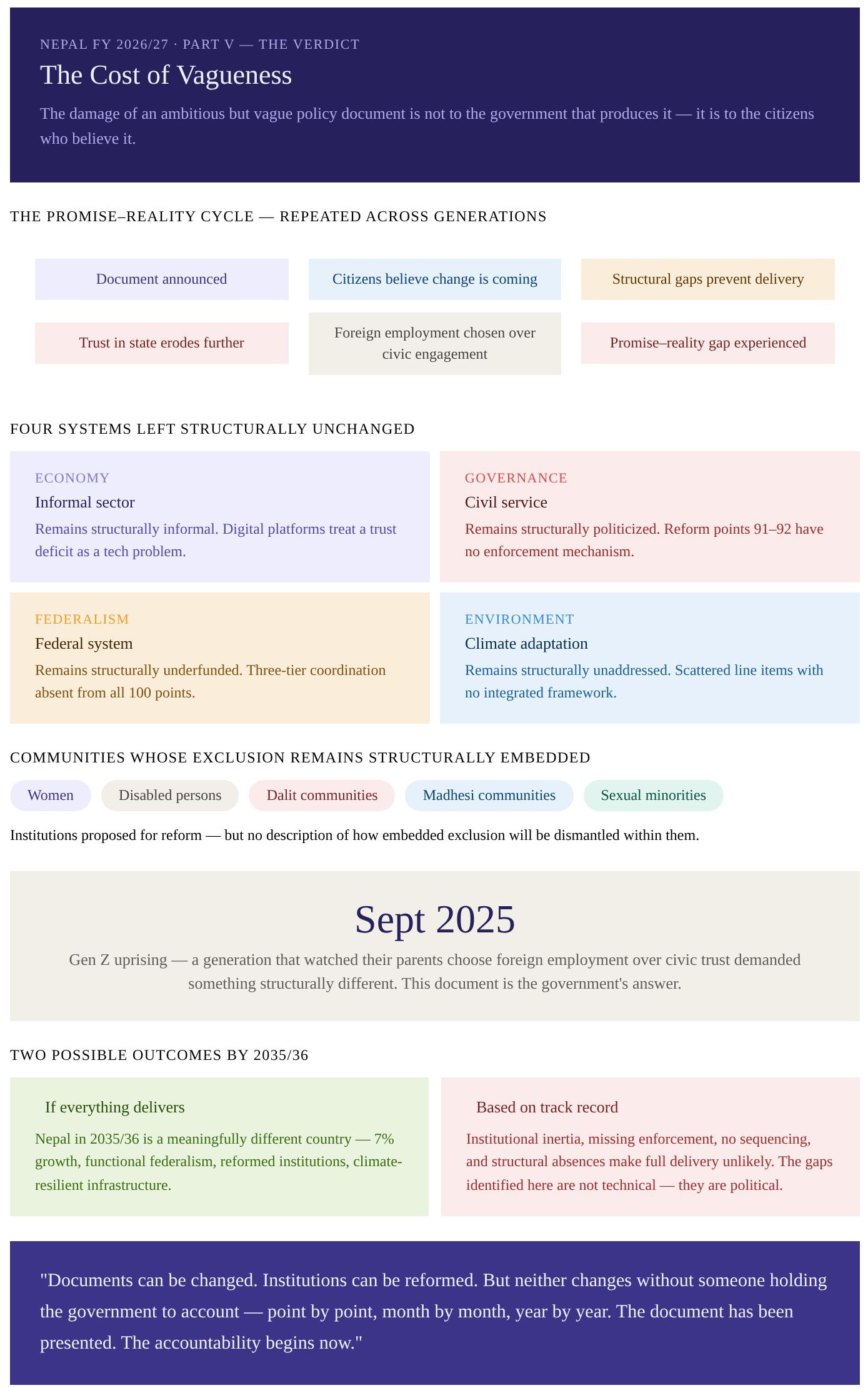
Nepal’s young people have grown up watching their parents’ generation make the rational calculation that the state cannot be trusted and that foreign employment is the only reliable path to economic security. They came out in September 2025 to demand something different. The government has responded with a document that, in its best parts, describes what different could look like.
But, description is not transformation. The loopholes in this document are not merely technical deficiencies. They are structural absences that allow the document to describe transformation while leaving the systems that prevent transformation entirely in place.
The informal economy remains structurally informal. The civil service remains structurally politicized. The federal system remains structurally underfunded. The climate adaptation deficit remains structurally unaddressed. The social exclusion of women, disabled persons, Dalits, Madhesi communities, and sexual minorities remains structurally embedded in institutions that this document proposes to reform without describing how.
If this policy program delivers everything it promises, Nepal in 2035/36 will be a meaningfully different country. The probability of that outcome, based on institutional track record, structural analysis, and the specific gaps identified here, is not high. That is not a reason for despair.
It is a reason for the kind of sustained, specific, democratically engaged pressure that the Gen Z generation showed it is capable of applying. Documents can be changed. Institutions can be reformed. But neither changes without someone holding the government to account, point by point, month by month, year by year.
The document has been presented. The accountability begins now.