Kathmandu
Sunday, July 12, 2026





Rising imports and geopolitical tensions push the nation toward a potential food crisis
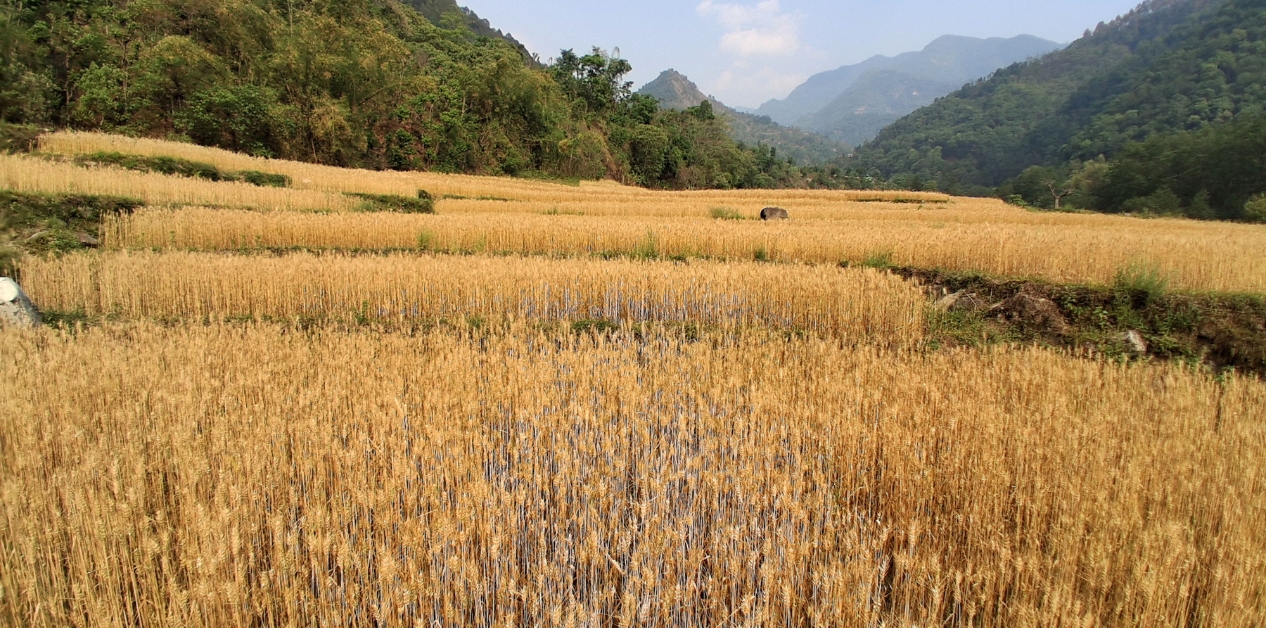
KATHMANDU: In the last nine months of the current fiscal year 2025/26, Nepal has imported rice and paddy worth more than Rs. 32.50 billion. According to Department of Customs data, although the bulk of these imports comes from India, Nepal brings in rice and paddy from 16 different countries.
Despite being called an “agricultural country,” Nepal is becoming increasingly dependent on foreign nations not just for rice, but for basic staples like maize, wheat, lentils, and cooking oil.
Over the last five years, Nepal has imported food worth Rs 1.487 trillion. A report titled “Zero Hunger,” prepared by the Nepal Development Research Institute and the Policy Research Institute, notes that Nepal—once a food exporter—is now dependent on imports even for basic food items. The report states: “The food import dependency ratio, which was 2% in 2002, reached 15% by 2020. Consequently, price hikes in the international market or disruptions in the supply chain directly impact Nepal’s internal security and stability.”
This dependency is clearly visible in the volume of food Nepal imports. The country imports an annual average of about 1.4 million metric tons of food, primarily consisting of 600,000 metric tons of rice, 600,000 metric tons of maize, and 200,000 metric tons of wheat.
The risk of food crisis
This year, Nepal faces not only rising import dependency but also the risk of a food crisis. On one hand, the international supply chain is being affected by the US-Israel and Iran conflicts, while on the other, a drought risk has been projected for South Asia during the monsoon. Countries like Nepal, which import around Rs. 40 billion worth of rice and paddy annually, are affected even by minor issues in the international market. Therefore, pressure on food prices and supply is expected this year.
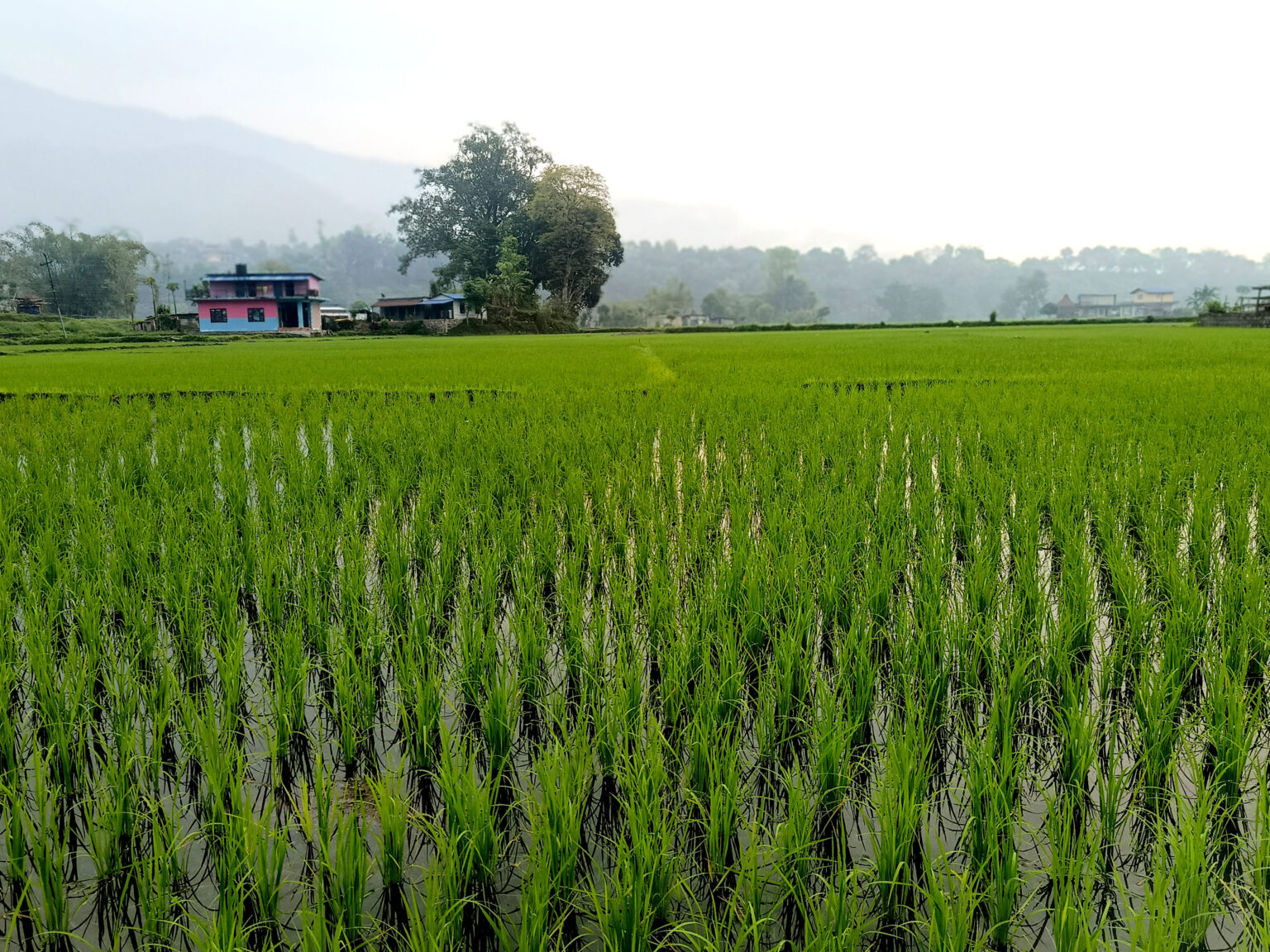
Paddy cultivated by local farmers in the Karaputar plains of Madhya Nepal Municipality-7, Lamjung. Photo: Devendra Gurung/RSS
According to experts, the current crisis in the global food market is not solely linked to West Asia. Factors like pandemics, wars, and “tariff wars” had already created significant instability.
The International Panel of Experts on Sustainable Food Systems (IPES-Food) stated that global market prices had spiked even before the West Asian conflict. According to their report, “New Geopolitics of Food,” released on May 11, global food prices have risen by 35% compared to 2019. The report cites the COVID-19 pandemic, the Russia-Ukraine war, and tariffs imposed by US President Donald Trump as key factors.
Nepal has already experienced these effects during the Russia-Ukraine war. The report notes that supply chain disruptions starting in 2020 and the 2022 invasion of Ukraine had already made the global food market volatile. Following the start of the Russia-Ukraine war, food prices in Nepal surged.
Nepal had been importing agricultural goods from Ukraine, and rising petroleum prices led to expensive transportation costs. The report concludes that other reasons for rising market prices include weak international institutions, climate change, and profit-driven corporate activities.
The India factor and chemical fertilizer
Fluctuations in the global market also affect large food markets like India, which has a direct impact on Nepal. A World Bank report, “Integration and Price Transmission in Key Food Commodity Markets in India,” states that India’s food market is not isolated from the global market and is linked through prices and consumer trends, though domestic policies can mitigate some effects.
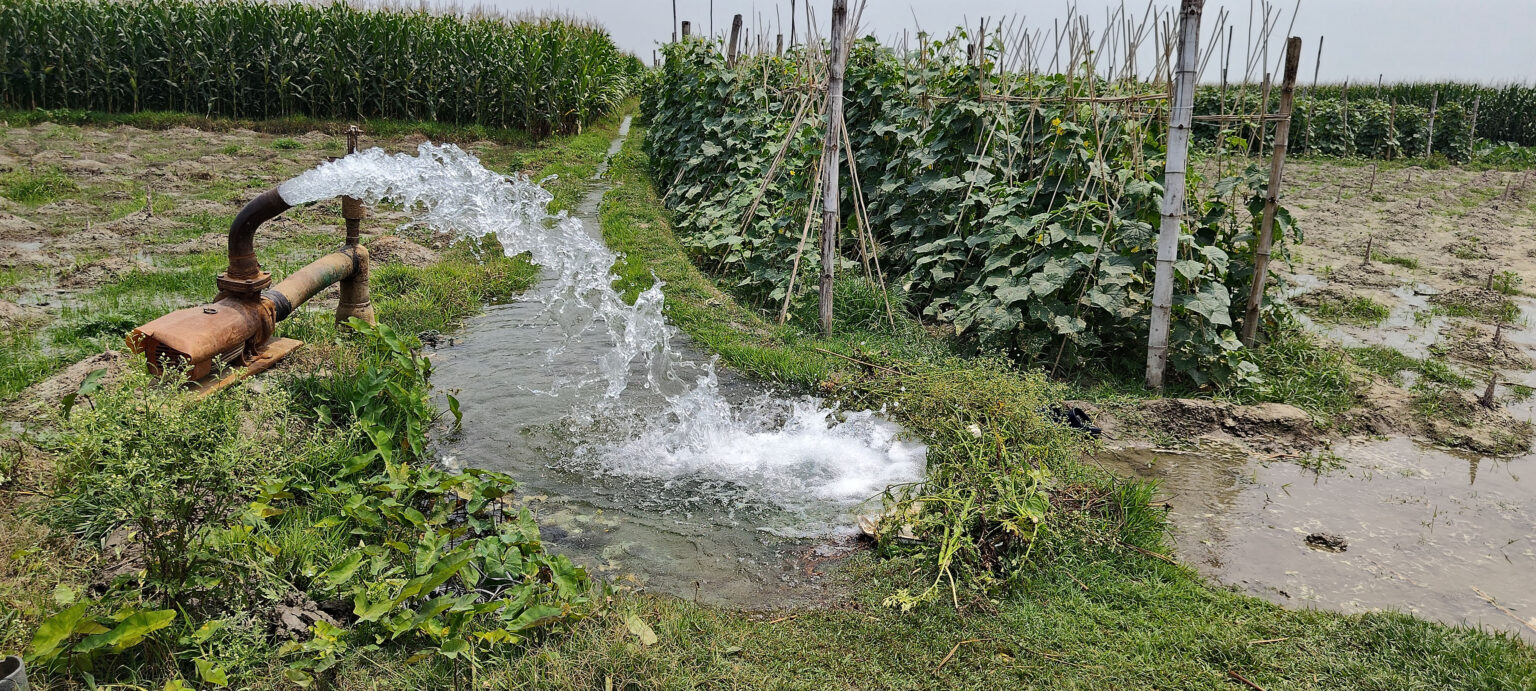
Irrigation underway in vegetable fields using an electric motor pump in Bhokraha Narsingh Rural Municipality-6, Sunsari. Photo: Ajit Kumar Jha/RSS
In 2025, record food production in India helped keep market prices low, which benefited the Nepali market in controlling food prices. However, changes in the supply and cost of chemical fertilizers—essential for production—are expected to directly impact India’s production system. Due to the war, a shortage of raw materials for fertilizer is anticipated. This supply crisis became a political issue in India, leading Prime Minister Narendra Modi to clarify in Parliament that there are sufficient fertilizer stocks.
In response to the risk of shortages, the Nepal government has moved forward with importing fertilizer from India via a Government-to-Government (G2G) process. On May 4, the Cabinet gave theoretical approval to the Agriculture Inputs Company Limited to purchase 60,000 metric tons of Urea and 20,000 metric tons of DAP through G2G.
The Ministry of Agriculture and Livestock Development had corresponded with India to purchase 100,000 metric tons of Urea and 50,000 metric tons of DAP fertilizer through a G2G (Government-to-Government) agreement to ease the supply of chemical fertilizers.
Accordingly, the government has granted theoretical approval for the procurement of 80,000 metric tons of fertilizer. On May 7, Randhir Jaiswal, spokesperson for India’s Ministry of External Affairs, told journalists that India would provide the amount of chemical fertilizer Nepal requested.
Strategic vulnerability
Dependence on India for food, fertilizer, and fuel is not just an economic issue but a sensitive strategic aspect of Nepal-India relations. Krishna Pahari, Coordinator of the Livelihood and Food Security Program at the Nepal Development Research Institute, says: “Being landlocked is a major challenge for food imports. Situations like past blockades mean there is always a risk that food imports could be stopped at any time.”
India has previously used blockades to influence political and strategic goals, such as the 2015 blockade. Even before that, India had also imposed blockades in 1970 and 1989–90. Disputes over territories like Kalapani have resurfaced, and the last-minute cancellation of Indian Foreign Secretary Vikram Misri’s visit (scheduled for May 10) has been interpreted as strained relations.
“Our self-reliance in food and food security is a matter of national security,” says Pahari. Experts argue that Nepal’s food insecurity stems not only from external geopolitics but also from long-term weaknesses in the domestic agricultural system, such as lack of irrigation, labor shortages, and inability to compete with Indian production.
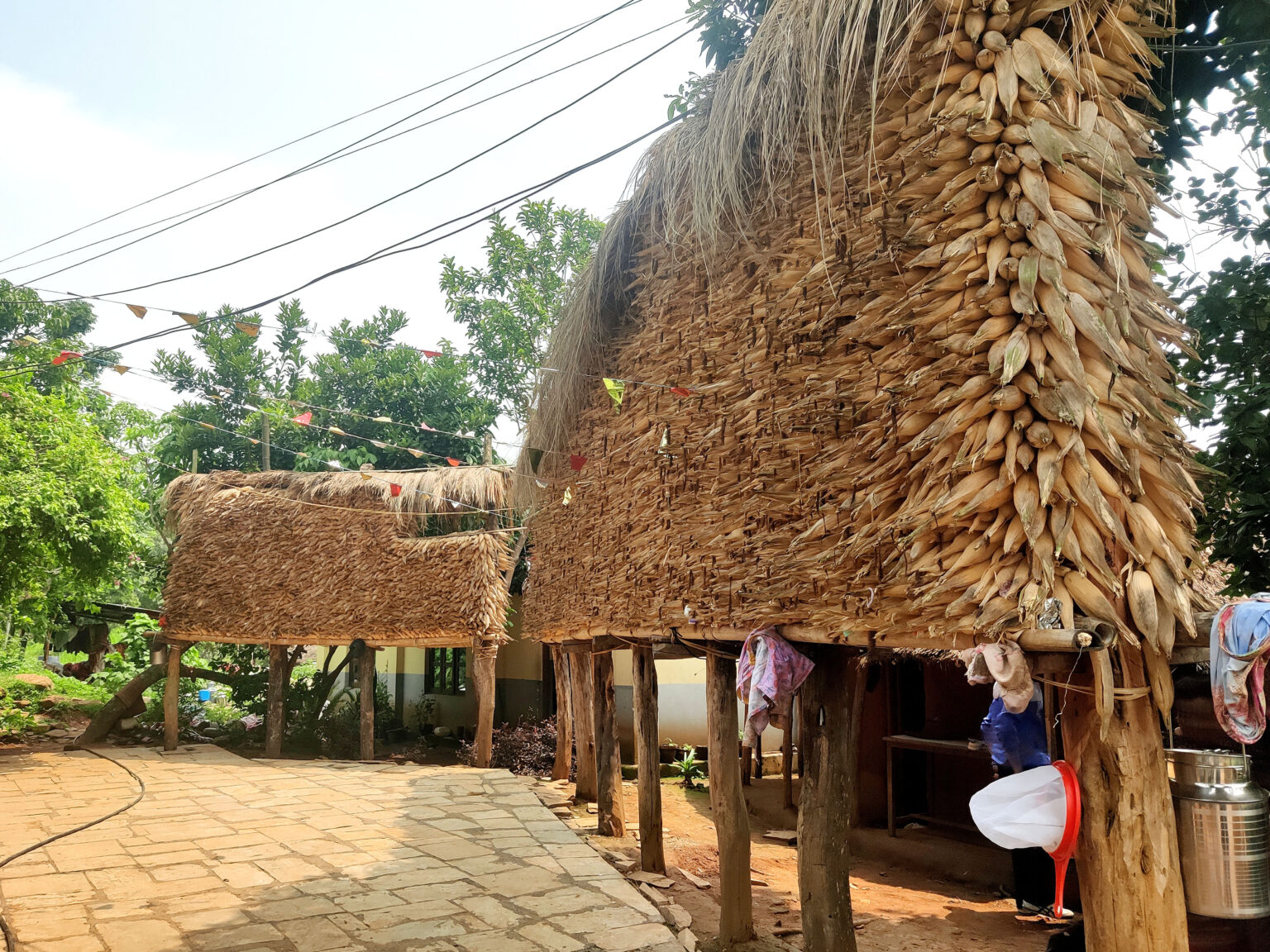
A stack of harvested maize stored at a local household in Dumsi, Byas Municipality-10, Tanahun. Photo: Radhika Kandel/RSS
To increase agricultural production, chemical fertilizers are purchased in large quantities. An annual subsidy of Rs. 30 billion is provided. However, due to ineffective supply and distribution systems, there is a shortage of chemical fertilizers every year. Issues such as low production and productivity, lack of basic agricultural inputs including fertilizer and irrigation, labor shortages and fallow land, competition with Indian products, climate change, and natural disasters are impacting food security.
The way forward
Due to the war in West Asia, increasing instability in the global food market, supply dependency on India, and the projected risk of drought in South Asia, Nepal’s food security has moved beyond being just an agricultural issue to becoming a matter of national security and geopolitical sensitivity.
Once a food exporter, Nepal has now reached a state where it must look toward its neighbor to secure its food supply. If a solution is not found, Nepal appears headed toward a serious crisis.
According to agricultural experts, the imminent crisis has also exposed long-term weaknesses in Nepal’s agricultural policy. Agricultural expert Krishna Prasad Paudel states that the problem is deepening because of the failure to find alternatives to chemical fertilizers and a lack of new thinking regarding farming. ‘Instead of seeking alternatives to chemical fertilizers, the government has done nothing substantial except pleading and crying out to India,’ says Paudel. ‘This does not provide a solution; it only makes the situation more severe.’
He emphasizes that both short-term and long-term policies are necessary to solve the problem. He argues that the way out of this crisis is to abandon the obsession with chemical fertilizers and imported food, and instead move toward indigenous fertilizers and mixed-cropping systems.
He suggests immediate action in producing indigenous or organic fertilizers. ‘While there is a shortage of chemical fertilizer, we must immediately start making indigenous and organic manure,’ Paudel says. ‘Even if this manure is not sufficient for the current rice crop, it will be useful for two months from now or for the upcoming wheat crop.’ Paudel notes that soil fertility can be improved immediately by collecting household weeds and kitchen wastewater in one place.
‘Instead of “heavy feeder” crops like maize, which require a lot of nitrogen and fertilizer, preparations should be made to plant mixed crops (legumes, pulses, and oilseeds),’ he says. He holds the view that in regions like the Terai Madhesh, where there might be immediate difficulties in using organic manure, it should be managed gradually. ‘In the small space where I live, I am farming by using a basket of organic manure without using a single grain of chemical fertilizer,’ Paudel shares. He mentions that more than half of the farmers are still farming without using chemical fertilizers even today.
It is not just about chemical fertilizers; there is also a projection of drought this time. The Department of Hydrology and Meteorology has stated that there will be only 55 to 65 percent of average rainfall this year. Ramesh Babu Amgai, head of the National Biotechnology Research Center under the Nepal Agricultural Research Council (NARC), suggests that farmers plant drought-tolerant rice varieties this year, noting that NARC has developed several such species.