Kathmandu
Sunday, July 12, 2026





The government's flagship promise of free buses for women has yet to leave the drawing board. With operational details unresolved and critics questioning its effectiveness, the experiences of India's successful Pink Bus program and Nepal's earlier experiment offer important lessons.
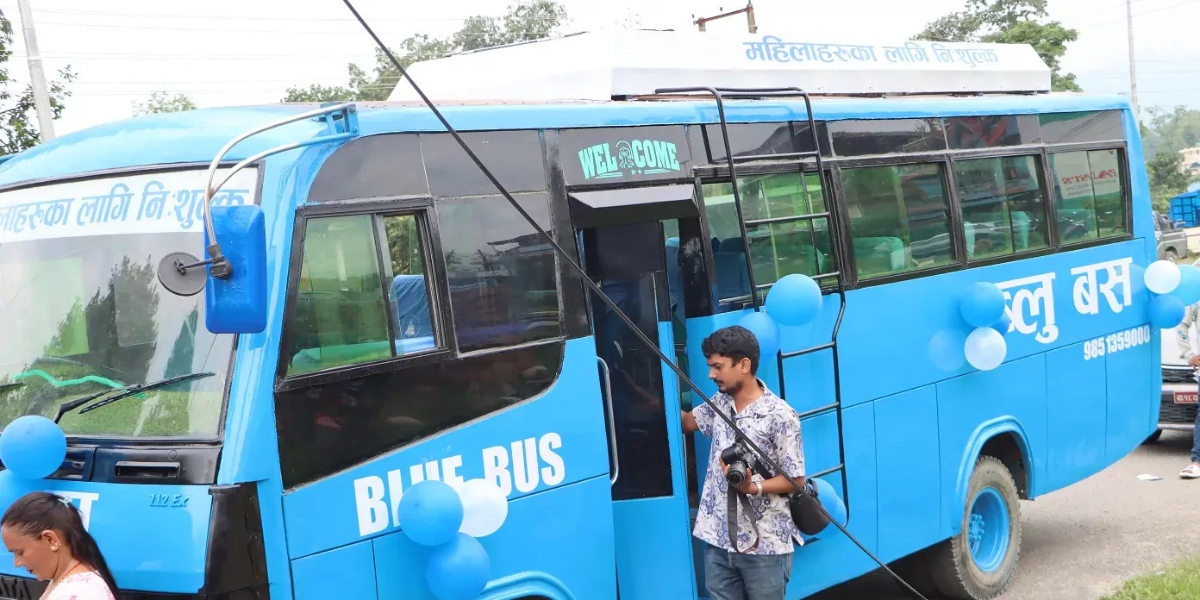
KATHMANDU: Four months have passed since the government led by the Rastriya Swatantra Party (RSP) announced the operation of free ‘Blue Buses’ aimed at ensuring safe travel for women. Since then, the ‘Blue Bus’ has become a subject of intense debate, extending from public forums to social media platforms.
The first meeting of the Council of Ministers led by Prime Minister Balendra Shah had approved a 100-point governance reform agenda on March 27. The 97th point of the agenda included a commitment to ‘operate free Blue Bus services across all seven provinces to ensure the safe movement of women, and to bring at least 25 buses into operation within 100 days in the first phase.’
Finance Minister Swarnim Wagle has also included the ‘Blue Bus’ initiative in the budget statement for the upcoming fiscal year 2026/27. Point number 40 (Na) of the budget statement states, “Necessary arrangements will be made to operate modern Blue Bus services equipped with CCTV cameras to ensure the safe movement of women.”
“First, the operational expenses need to be secured,” he says. “Only then will it be decided how, when, and on which routes how many buses will run. Claiming they will operate from July/Saun while the groundwork is still underway only spreads confusion.”
The government completed its 100 days on July 4. However, the commitment to operate at least 25 buses within 100 days, as specified in the agenda, has not been fulfilled. Meanwhile, there have been speculations that the existing green-colored Sajha buses might simply be repainted blue to be operated as ‘Blue Buses’.
However, Bhupendra Aryal, the Chief Executive Officer of Sajha Yatayat, states that the rumors about operating buses by merely painting them blue are not true. “We have seen AI-generated images of blue buses on social media and some media outlets. Those are not correct,” he says. “Sajha has its own identity, and that will remain.”
Aryal explains that ever since the government included the free ‘Blue Bus’ operation in its 100-point agenda, homework regarding collaboration with Sajha Yatayat has been underway from the very beginning. According to him, discussions are ongoing with the Ministry of Infrastructure Development regarding the use of stickers, banners, or other visual markers to represent the concept of the women-centric free ‘Blue Bus’ service. He adds that discussions are also taking place regarding the assurance of operational costs.
“Starting the operation is not a big deal; the main thing is how sustainable it will be,” Aryal says. “The free Blue Bus service will begin only after the government ensures the operational expenses.”
Meanwhile, media reports have surfaced claiming that starting July 17, eight electric buses from Sajha Yatayat with a seating capacity of 26 will be operated as a free transport service targeted at women.
According to preliminary plans mentioned in the reports, preparations are underway to operate two electric buses on the Budhanilkantha-Lagankhel-Godawari route, two on the Nagdhunga-Airport route, and four on the Ring Road.
However, Aryal maintains that the launch date, the number of buses, and the routes are yet to be finalized.
“First, the operational expenses need to be secured,” he says. “Only then will it be decided how, when, and on which routes how many buses will run. Claiming they will operate from July/Saun while the groundwork is still underway only spreads confusion.”
Safety and inclusivity in the debate
The concept of the free ‘Blue Bus’ is also facing criticism from a gender perspective. Rights activists and civil society members have expressed apprehensions that this concept, brought by the government for popularity, might further institutionalize gender discrimination.
They argue that merely providing separate buses for women will not curb harassment and violence in public transport. Some have expressed disagreement, calling the concept a ‘useless idea’.
They suggest that to ensure the safe movement of women, there must be the development of a gender-sensitive and dignified mindset, which needs to be implemented in practice.
Nevertheless, some have praised the government, viewing it as an effort to increase the mobility of women. The government’s concept is also built around the premise that operating modern ‘Blue Buses’ equipped with CCTV cameras will ensure the safe movement of women.
However, debates are also taking place highlighting that since the number of women passengers in Nepal is limited, the situation cannot be compared with the practices of India or other countries. Questions have also been raised by the gender and sexual minority communities regarding whether transwomen and transmen will be allowed to travel in the ‘Blue Buses’ designated for women.
This question, raised a few days ago by rights activist Sunil Babu Pant in a Facebook status, is equally worth pondering.
Memories of Chennai’s ‘Pink Bus’
Amidst these debates, I am reminded of my journeys on Chennai’s ‘Pink Bus’. In Chennai, the capital of the southern Indian state of Tamil Nadu, ‘Pink Buses’ provide free transport services to women. When I first learned about this, I was astonished. This was because I had only seen a few reserved seats for women in the buses, Hiaces, and microbuses operating in cities like Kathmandu. Getting to sit on a reserved seat felt like winning a major war.
When I first arrived in Chennai in July 2024 for my studies, I discovered that women could travel for free on the ‘Pink Bus’ without any hassle. For the first time, I took a ‘Pink Bus’ to travel to T. Nagar, which was eight kilometers away from my college. On that day, I experienced the convenience of a free public bus ride.
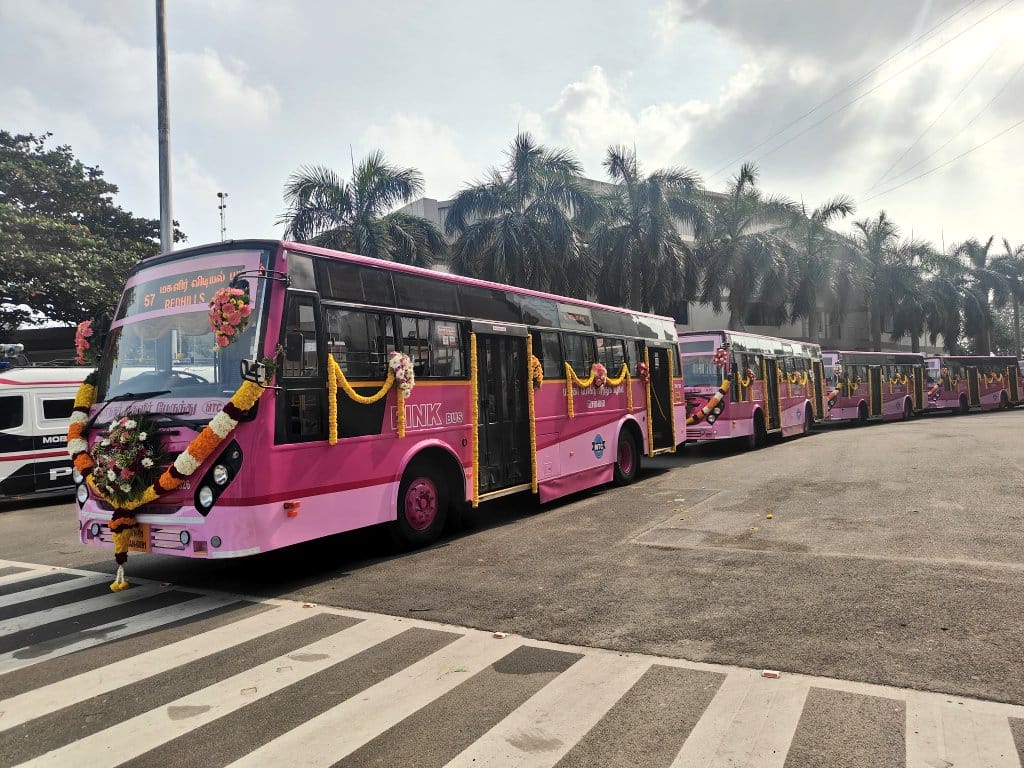
January 27, 2026: Inauguration of 10 ‘Pink Buses’ operated with the objective of transporting women in Chennai, India. Photo Source: Super Chennai
Those ‘Pink Buses’ operating in Chennai were pink in color. Men, women, or anyone could board these buses running on various routes. The conductor would give female passengers a ticket marked ‘Free’. They did not have to pay the fare. Male passengers, however, paid a discounted fare.
While one had to pay INR 35 for an eight-kilometer journey on other buses, male passengers only needed to pay INR 10 on the ‘Pink Bus’.
Each bus had one driver and one conductor. The driver focused solely on driving the bus. The conductor handled boarding, de-boarding, distributing tickets, and collecting fares.
Female passengers, in particular, could recognize the pink-painted bus from afar. Upon seeing passengers waiting for the bus, the driver would stop at the bus stop, and the conductor would assist them in boarding and exiting.
Chennai’s T. Nagar felt to me much like Kathmandu’s Asan Bazaar—a place where everything could be bought cheaply in one spot.
The crowds there were also reminiscent of Asan. During my ten-month stay from July 2024 to April 2025, the ‘Pink Bus’ made it very convenient for me to reach places like T. Nagar. Although Chennai was a new place and a new environment for me, the ‘Pink Bus’ became a reliable companion for my commutes.
Free travel after pandemic
Chennai’s ‘Pink Bus’ is a government-subsidized program. The Government of Tamil Nadu introduced this concept targeting women whose livelihoods were disrupted due to the COVID-19 pandemic, particularly those working in the informal sector.
With the aim of reducing women’s travel expenses and increasing their labor force participation, the Tamil Nadu government started operating ‘Pink Buses’ in June 2021. According to a study titled “Impact of Free Bus Travel on the Livelihoods of Women,” published in the Journal of Humanities, Arts and Social Science Studies on May 27, 2024, the objective of the ‘Pink Bus’ concept was to ensure that women do not lose employment and economic opportunities due to an inability to afford transport costs at a time when prices of everything were rising.
According to the study, the free bus travel policy has had a positive impact on the economic and social upliftment of low-income women in particular. It has increased access to employment and income generation. Notably, the mobility of women has surged.
According to The Indian Express, the proportion of female passengers using public transport in Tamil Nadu was 40 percent in 2021. According to a news report published by The Times of India on February 21, 2024, this rate had already crossed 65 percent.
According to Indian media, the free bus service has helped women in Chennai save between INR 800 to INR 1,000 per month. They have been able to utilize that money for household expenses.
Initially, ordinary government buses were painted pink to facilitate free travel for women. Additional buses were brought into operation in 2022. In 2026, 10 more buses commenced operations. These buses operate exclusively for women on five routes. Unlike other ‘Pink Buses’, male passengers are not allowed to board these.
The Indian Express, in a news report published in January 2026, mentioned that the Tamil Nadu government introduced this concept with the objective of easing the commute for women working in colleges and private companies. The drivers and conductors of these buses are also women.
According to a news report published by The Indian Express on July 6, 2026, around 7,300 buses are currently providing free transport services to women in Tamil Nadu. Around 7 million female passengers benefit from this daily.
The Tamil Nadu government spends approximately INR 3,600 crore annually to provide free bus services to women.
Practices elsewhere
In India, alongside Tamil Nadu, states including West Bengal, New Delhi, Punjab, Karnataka, Kerala, Telangana, Jammu & Kashmir, and Andhra Pradesh have been providing free bus travel facilities to women.
According to a report published by The Hindu on June 25, 2026, transgender passengers are also not charged fares in free buses targeted at women in several states.
In Pakistan’s capital, Islamabad, free ‘Pink Buses’ have also been operated targeting female students and teachers. The Ministry of Education there implemented this concept to encourage women’s mobility outside their homes and to increase their participation in educational opportunities.
According to the website of the organization Multiworks, 20 ‘Pink Buses’ are providing services under the program that commenced on August 7, 2024.
The Chitwan experiment
The concept of a ‘Blue Bus’ is not entirely new to Nepal. It is a concept that was previously tested but failed to achieve continuity.
On August 2, 2023, marking 100 days since he was elected to the House of Representatives through a by-election, RSP Chairman Rabi Lamichhane launched a free blue bus service for women in his constituency, Chitwan-2.
At that time, the bus seat covers were wrapped in blue cloth featuring the RSP’s bell election symbol. Arrangements were also made to play Lamichhane’s recorded appeal inside the bus. For the trial, a private bus with a 32-seat capacity was operated at a monthly rent of Rs 135,000. However, the service did not sustain.
Now, the RSP government is preparing to re-test the concept, which lacked continuity in Chitwan, across Kathmandu and all seven provinces. Therefore, before launching the new program, a public review is necessary regarding why the service in Chitwan stopped, how many women benefited from it, how much it cost, what the passenger feedback was, and where the main operational issues arose. Expanding the old concept on a larger scale without seeking answers to these questions could lead to a repetition of the same problems.
The experience of Chennai shows that free bus travel can reduce transport expenses for women, increase mobility, and expand access to education and employment. However, the foundation of their success is not just the color of the bus. Behind it lies massive government investment, a network of thousands of buses, a clear operational system, regular routes, the provision of conductors, and long-term political commitment. In Nepal’s ‘Blue Bus’ plan, answers to even the fundamental questions are yet to come.