Kathmandu
Friday, July 10, 2026





Grounded in Kirati myth and Nepali political history, the theatrical production of 'The Taste of Selroti' brilliantly knits together themes of maternal affection, human compassion, and resistance
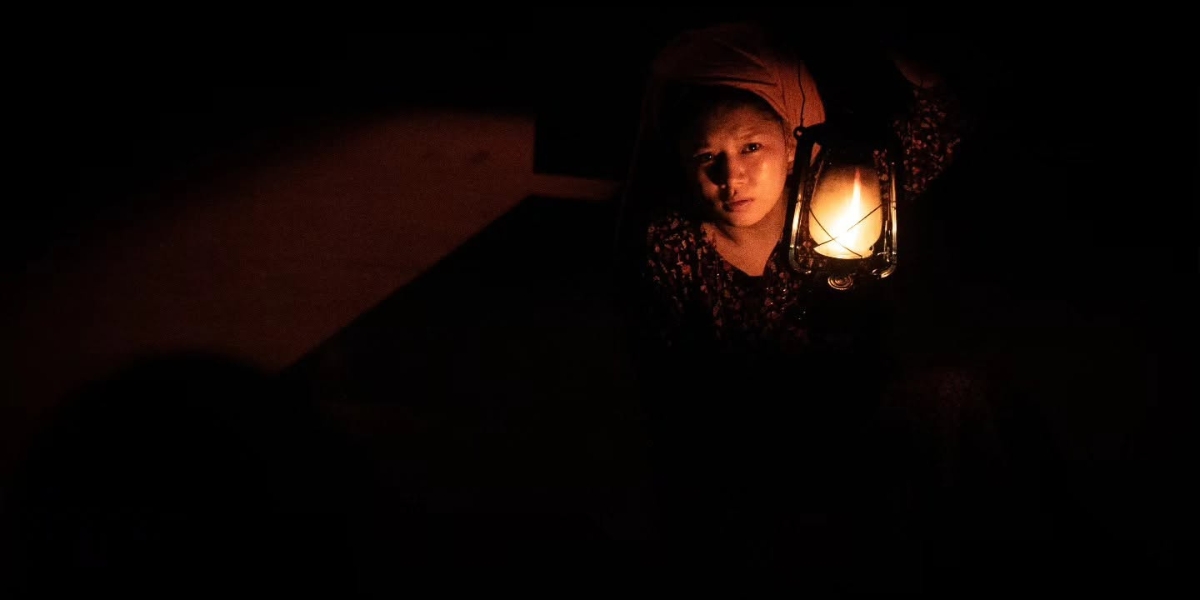
A new event always takes shape in the mind in the likeness of a past experience. For days now, the character ‘Badi,’ who walks back and forth through the dusty streets of Tehran, the capital of Iran, has been wandering through my mind like a metaphor. I find myself remembering him, a man carrying the monsoon rains in his eyes, in a way that makes my heart feel incredibly heavy.
The bridge that strengthens memory while spreading the vine of remembrance is the play The Taste of Selroti, which is currently being staged at Kausi Theatre.
‘Selroti’ is a traditional Nepali ring-shaped sweet bread made from fermented rice flour batter.
Will this play also pierce the corners of the heart in equal measure to The Taste of Cherry, which has been living in my mind for years? The mind is elated just holding onto the tail of the name. Eager to quench the restlessness of an inquisitive mind on a damp day, I am inside the theater at this moment. And with me is that very character ‘Badi,’ who walked away unable to find the meaning of life, whose memory I have to rest somewhere here today.
The centrality of love
Just like the shape of a Selroti, a relationship follows a cyclical form, completing a full circle and connecting back to its starting point. What a deep metaphor! How many of us are running away from love? From life?
In the first part of the play, which is divided into three parts, before the theater curtain opens, a goosebumps-inducing visual clip begins from the curtain itself the Gen Z protest. Along with the siren of an ambulance, the memory of the day of witnessing an unexpected event is repeated. What is about to happen here? Surely, everyone’s heart is squeezed. Thank goodness, the different scene after the curtain opens provides relief for a few moments. However, the wound that always remains fresh from the depth of that very movement is connected to the story.
The two characters, Mhisamma and Somyok, are restless in the remembrance of their incomplete story. The pain of losing a daughter in the Gen Z protest is alive in their memory. These two characters, who are immersed in the memory of their past relationship around the birthday of their deceased daughter, were a couple at one time.
“Are you happy?”
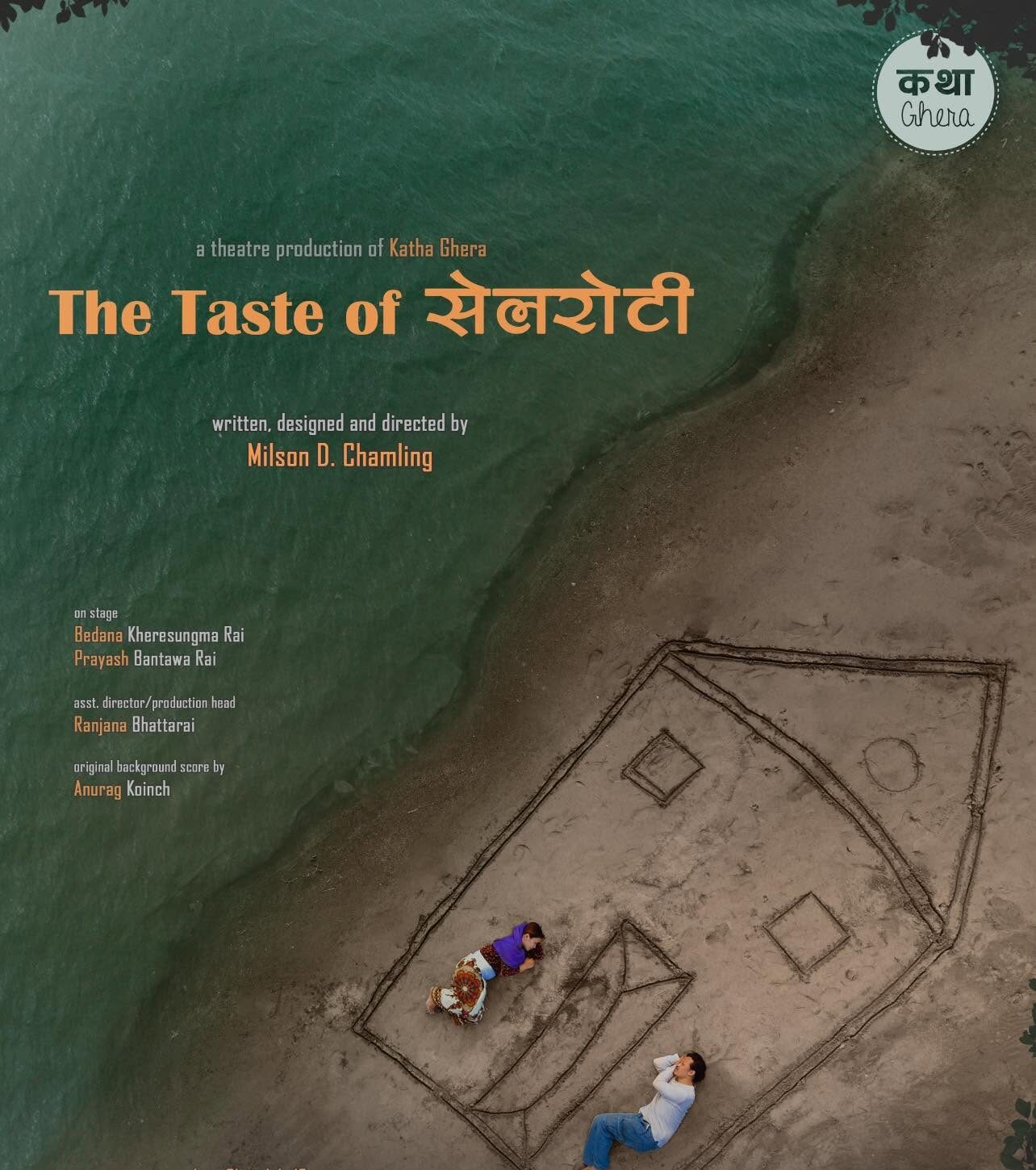
Poster of ‘The Taste of Selroti’
In response, remembering Somyok in every kiss of her current husband and feeling her own breath like Somyok’s breath after the smoke of every cigarette, what kind of irony is this for Mhisamma?
Mhisamma has a postmodern relationship, whose current husband is waiting for her outside on the street. The sweet aroma of Selroti has started spreading throughout the hall from the kitchen setting. But the environment is suffocating in the emptiness of the relationship. Selroti is just an excuse. In reality, these two characters want to lose themselves in their own past.
Social philosopher Erich Fromm has said that love between two people is possible only from the realization of their center of existence; its essence is portrayed here. The vividness of love is connected here to the central experience of Mhisamma’s and Somyok’s existence. In this very existential essence of love, they have never been separated from each other or from themselves. Rather, boundless love is surviving despite so much distrust and heartache.
Perhaps love also ends after complaints end, and that is why they exist with numerous complaints. The dialogues showing that love exists despite appearing not to exist between the two characters living an absurd life with the incompleteness of love feel as though they cover up the context of the daughter’s memory.
Maternal power and the philosophy of coexistence
The soft melody of the pregnant Sumnima, who is immersed in the waiting-celebration of a new creation. The entry of Paruhang was like the speed of the wind, and then the roar of Sumnima. In a single glimpse, it feels as if pages of many undescribed stories are hidden inside the cover of this scene.
Sumnima, who is walking carrying the primitive voice of civilization in her womb, has become even stronger with the unexpected arrival of Paruhang. The voice of Sumnima’s inner mind regarding the ownership of her womb stands parallel to the feminist consciousness expressing reproductive rights and bodily autonomy contained within the quote ‘My body, my rights.’
Like the Earth, Sumnima has become very logical with Paruhang regarding the rights of her womb and the depth of maternal affection. In this logic, there is resistance filled with the compassion of a mother sustaining a creation. The unique female consciousness contained in Mundhumi philosophy is drawn from this very point in the play.
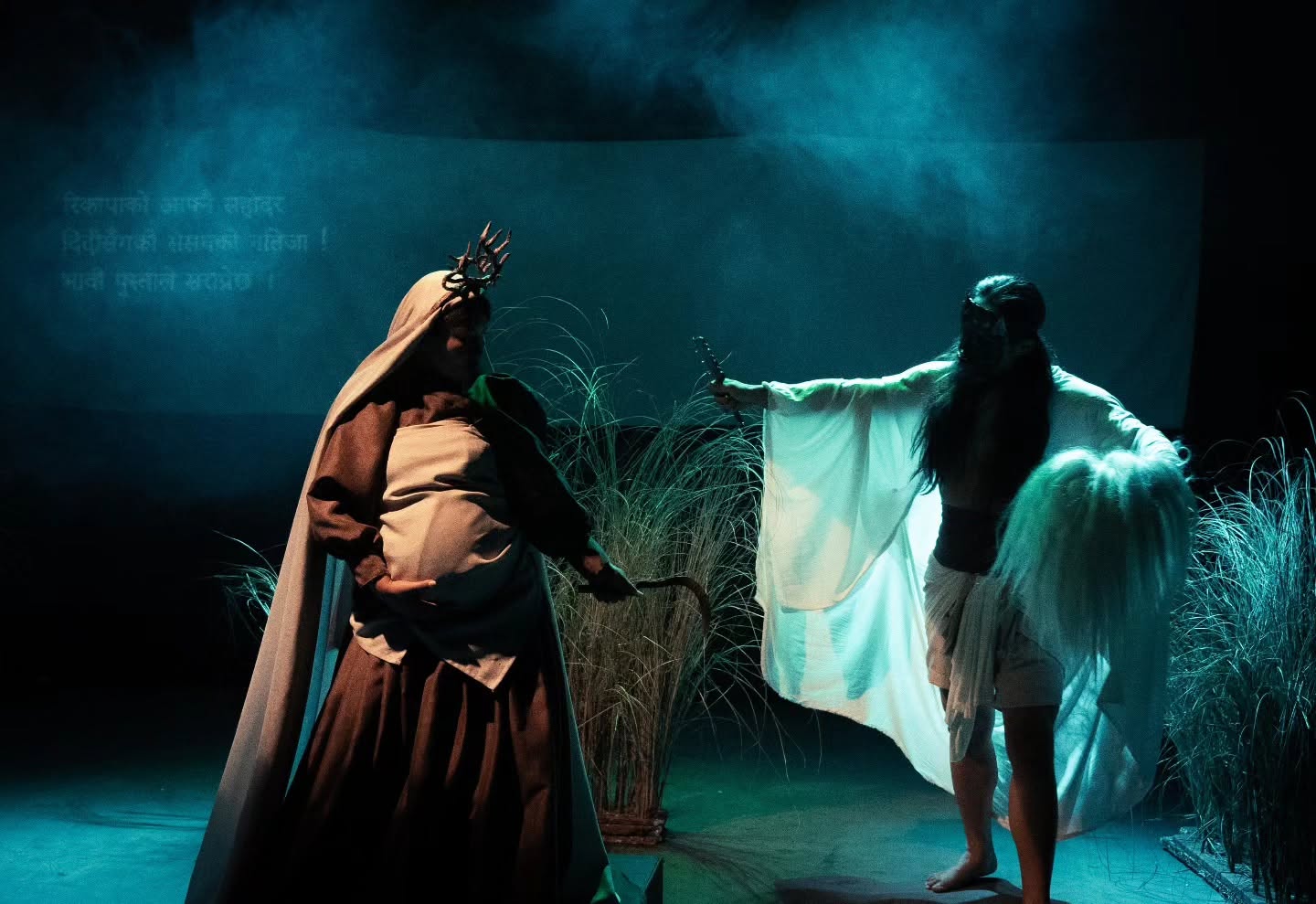
Found at the source of the Mundhumi creation story, the love of this romantic couple begins from the philosophy of coexistence that sustains the entire creation. In the love story that started by sending whispers of love to the wind, the stand after stand taken by Sumnima before Paruhang regarding the ownership of her womb is a deep utterance of maternal power within maternal consciousness.
In the environment that becomes soft in a moment with Paruhang’s clarification, love teaches the language of a shared journey rather than rights. Sumnima does not try to bind Paruhang to herself, nor does Paruhang try to dominate Sumnima. There is neither the language of ownership nor the desire for control.
‘Kissing the sprouting of love transformed into compassion, respect, and coexistence,’ Paruhang keeps saying as he leaves. ‘Do not let me wither away.’
While leaving each other free, they accept the truth of remaining incomplete without each other. The unseen love story within the creation staged here in the Mundhumi tale metaphorically incorporates the narrative of female consciousness and coexistence. Leaving behind the question of whether they met again or not at the edge of time, this chapter ends.
The inquisitive rhythm of consciousness
In the final chapter of the play, there is the story of a couple grieving the loss of their child, which is connected to the mythical sequence of the Thibiya bird living in Kirati legends. A mother’s struggle to protect her son’s life during the period of armed conflict illuminates the aspect of sensitivity inherent in motherhood.
Do the dreams of mothers miscarry like this in the web of deceit and lies? Crossing the threshold of the mind, Henkhama‘s boundless affection always keeps the lantern of hope burning. The dialogues between the two characters centered on the child break the audience’s hearts. Henkhama refers to ‘Mother Earth’ in Kirat culture.
The more times Hetchahang, who returned after consulting an oracle, repeats that their son will not return, the more times Henkhama rejects this truth. All these heart-wrenching scenarios of maternal love and affection make the audience emotionally one.
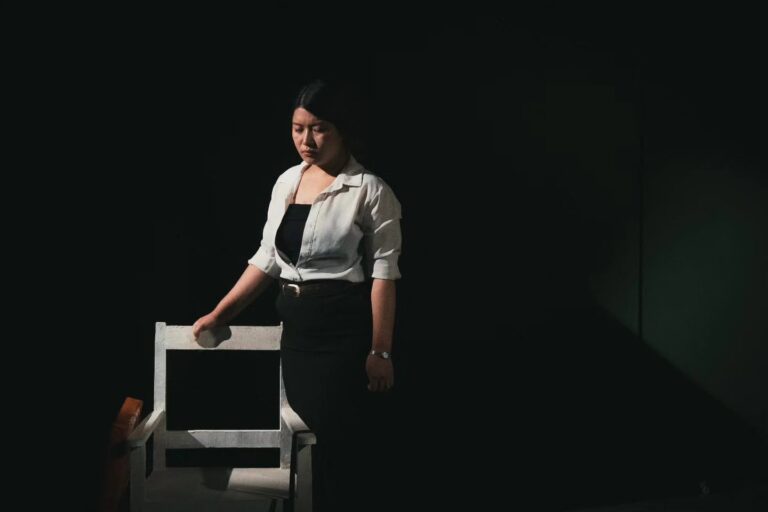
The lamentation of a mother imposed on the Thibiya bird of Kirati mythology finely weaves deep pain with the story of the Thibiya, that is, the Thebe bird, which walks along rivers singing songs of separation. Hetchahang, who walks around talking about the Communist Manifesto, agricultural revolution, and communism, is broken within himself.
This episode, which symbolically weaves the story of the people’s war and the loss of a son, fundamentally binds maternal affection, compassion, and resistance together with Kirati myth against the background of Nepali politics.
Memories within the circular loop of time
Serving many sensitivities of life together by making Selroti a metaphor is the strong aspect of the play. Inside the core of the story, whose beginning and end cannot be separated, just like the roundness of Selroti, lies a round ring of a different time.
Just like the shape of a Selroti, a relationship follows a cyclical form, completing a full circle and connecting back to its starting point.
In this very ring, catching the edge of Kirati mythology, political masks, human sensitivities, the sting of memory, love, and female consciousness are raised in a multidimensional manner. After all, wherever a person reaches, they ultimately return across the geography of their own memories. The Selroti metaphor is perhaps the symbolic language of this. And also a journey toward one’s own roots. Moreover, every story here is stretched, holding onto the vine of incompleteness. Keeping one part of the play entirely in the Bantawa language connects a campaign for language preservation along with a challenge to the ruler-centered linguistic structure. Even when the projector blinks time and again, the directorial ability to keep non-Bantawa speakers equally bound is highly commendable.
While connecting the story to political backgrounds like the armed people’s war and the Gen Z protest, the author’s ideology emerges in a balanced manner rather than taking a clear stand. The scene of the Gen Z protest shown through the projector does not seem to be given completeness by the first part.
When digressing in some places during the combination of context and dialogue, the play holds onto the thread of abstraction. The songs used in the play being recorded create artificiality in the environment. The scene where Mhisamma gives Selroti to Somyok at the time of parting feels unnatural, as if forced.
Despite this, the expressions of the two characters, bodily expressions, and the stage activity extended across different environments bind the audience in sweet remembrance. The acting skills of the artist duo Bedana Rai and Prayas Bantawa Rai are extremely magnificent.
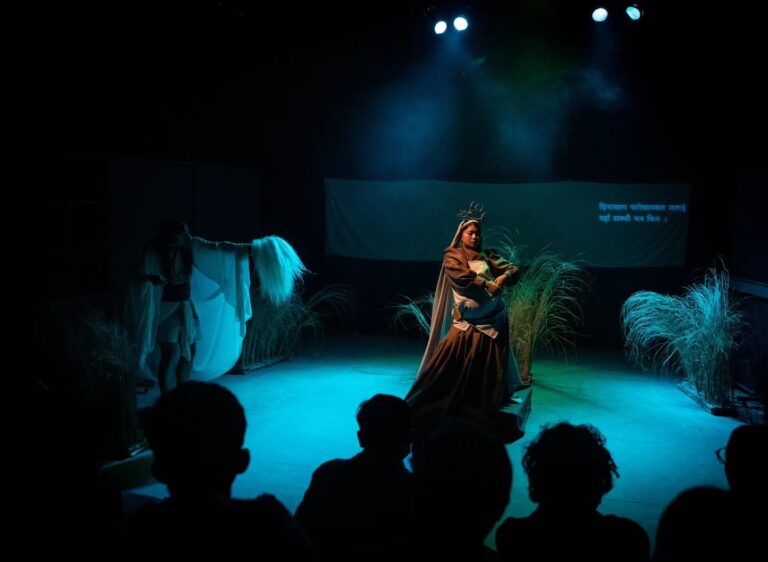
Perhaps because the writer himself is a poet, the entire play has become poetic. The directorial debut of writer and director Milson D. Chamling, who can finely weave three different times and contexts in an equal emotional and thoughtful manner, will certainly make the Nepali theatrical field more fertile.
The play ended. Outside, the monsoon rain of summer is pouring heavily. The mind grows homesick with the aroma of Selroti and the memory of my mother. In the midst of this, I have left Badi, who was with me all along, somewhere deep within the inner corners of my thoughts.
Mr. Badi, the struggle for existence directly extends from the existential crisis itself. This is simply how it is, because sometimes life itself becomes a completely unanswered question. You already know that the unnamed dream of spring is always hidden inside the womb of a freezing winter. Everything here is temporary, just like that unbearable moment trapped inside you.
I know I must meet the intact version of you one day, far from the existential emptiness, deep loneliness, and death-oriented absurdity that has spread over your entire being. At that time, I will listen to you to my heart’s content as you contemplate the consciousness of death through a simple calculation of the consciousness of life.
That meeting will surely happen at some unnamed turn of life. It will not take place under the cherry tree, but rather in some other hemisphere of memory that comes all the way around, just like the shape of a Selroti.