Kathmandu
Friday, July 10, 2026





Adopted after the judiciary was rocked by allegations of middlemen and manipulated case assignments, the daily lottery system has helped restore confidence in the courts and laid the groundwork for future automation.

KATHMANDU: Except on public holidays, the Chief Justice, justices, Chief Registrar, case management staff, and IT technicians gather in the meeting room of the Supreme Court every day at 10 AM. A black pouch is filled with different colored tokens, equal to the number of justices present, each marked with numbers and case codes.
The justices are then asked to draw these tokens from the pouch one by one, based on seniority. Based on the drawn token, the respective justice finds out which cases they will be adjudicating that day. Depending on the number and code on the drawn token, the court administration staff hands over the list containing the details of the cases to the justice.
The lottery system is considered transparent. Neither the judges nor the benches hearing the cases can predict anything in advance. Only after drawing the tokens is it known which cases will be decided by which justices through single, division, or full benches. Benches are formed after cases are allocated through the lottery process. Benches are formed through this very lottery process for hearings of cases included in the daily, weekly, and supplementary cause lists, as well as incidental cases managed by the Case Management Branch. The main objective of this process is to curtail the Chief Justice’s sole authority to assign cause lists, allowing justices to select the list of cases themselves through the lottery, thereby making the administration of justice transparent.
The lottery system for determining the cause list began at the Supreme Court on December 1, 2021. Following allegations that activities like case-setting under the influence of middlemen and “bench shopping” (manipulating to get a case assigned to a preferred judge) were dominant in the judiciary, the lottery system was initiated as an alternative for reform. Since then, it has maintained continuity and has been appreciated for preserving the dignity of the judiciary through the impartial distribution of cases.
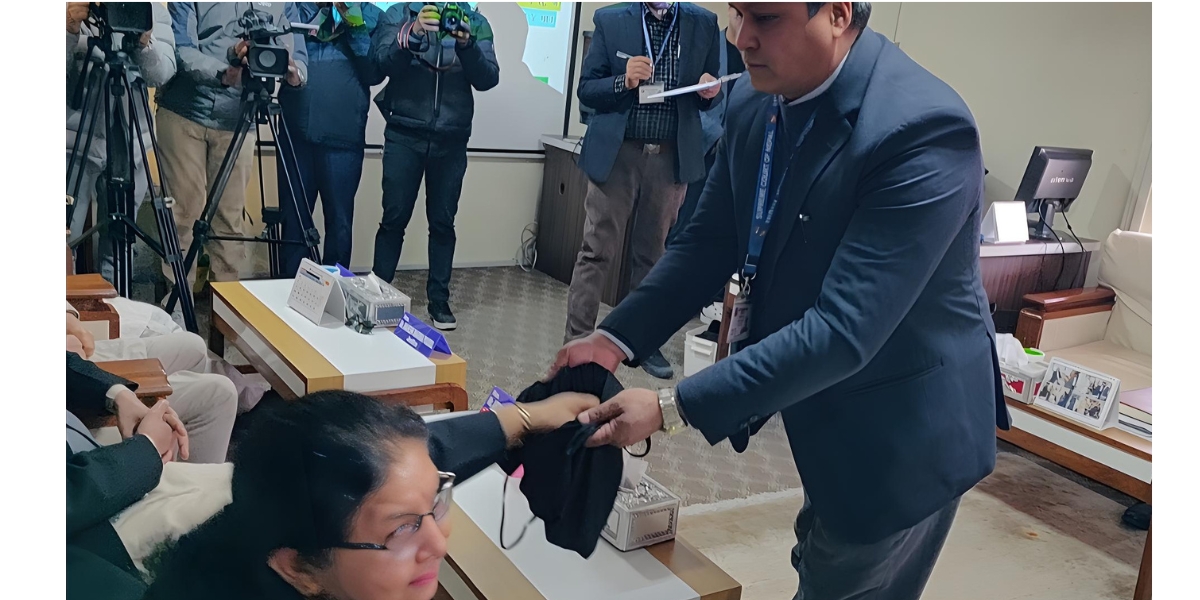
Justice Sharanga Subedi drawing a token. Photo: Bhasha Sharma
Before the implementation of the lottery system, right from the establishment of the Supreme Court, it was a tradition to assign daily cause lists at the discretion of the Chief Justice. While assigning the cause list, the Chief Justice held the authority to place a case in a bench of their choice. Because cases were distributed at the Chief Justice’s discretion and assigned to preferred judges, the court had to face serious allegations of “bench shopping.” Decisions delivered by the Chief Justice and certain benches designated by them had to face public criticism and commentary. Allocating cases through the lottery has also broken the Chief Justice’s monopoly and arbitrariness over the cause list.
On August 3, 2023, the day before retiring as Chief Justice, Hari Krishna Karki had said, “Middlemen are squirming badly because cause lists are being assigned through the lottery system.” Karki, who served as Acting Chief Justice for five months and Chief Justice for 50 days, suggested that the judiciary should advance toward a computer-based “automated cause list” system by further developing the lottery process. He claimed that the corruption taking place in a planned and institutionalized manner had stopped after daily cause lists began to be assigned through the lottery system.
Following the Supreme Court, High Courts and District Courts across the country have also been assigning daily cause lists through the lottery system.
The foundation of the lottery system, which is considered helpful in preserving the dignity of the judiciary, is a committee formed by the Supreme Court six years ago. On August 14, 2020, during the tenure of the then Chief Justice Cholendra Shumsher Rana, a committee was formed under the coordination of Justice Hari Krishna Karki to “study the aberrations, anomalies, irregularities, or corruption that may exist in the judiciary, and activities that may be carried out by middlemen, and the measures to be taken for their prevention.” The committee submitted its study report to Chief Justice Rana on July 29, 2021, and it was made public on August 25, 2021.
Among the various suggestions given by the report for policy and legal reforms, one aspect was determining the cause list and forming benches through the lottery system. To make every operation of the judiciary transparent and credible, the report suggested that the Chief Justice should not assign the cause list. The report stated: “By amending the existing legal provisions regarding the assignment of cause lists by the court, the cause list must be published in a transparent and credible manner through a lottery (raffle) system until an automated cause list system is implemented.” The report has still not been endorsed by the full court (comprising all justices) of the Supreme Court.

The Supreme Court. Photo: Bhasha Sharma
Managing the cause list through scientific methods is also an international standard. The ‘Istanbul Declaration on Transparency in the Judicial Process’ mentions that cause list management can be made scientific, organized, and credible.
Due to the existing system of forming benches and assigning case lists, widespread complaints had arisen that aberrations, irregularities, and corruption had increased in the judiciary. To address these complaints, alternatives were adopted: assigning a single judge to a case from start to finish in District Courts, and alternative methods for bench formation in High and Supreme Courts.
The study report of the committee led by Karki mentioned that the workload had increased due to the rising pressure of cases in the Supreme Court, and this was seen as a potential cause for aberrations and anomalies. To solve this, the report pointed out the need to review the jurisdiction of the Supreme Court and prepare the infrastructure to register cases online.
While suggesting the publication of the cause list through the lottery system, the report also recommended implementing a system to assign cause list responsibilities automatically.
The President of the Nepal Bar Association, Bijay Prasad Mishra, argues that while the lottery system has not completely elevated the dignity of the judiciary, it has sustained it. “It has been found that foreigners find this process unique, and they have liked it too,” he says.
He mentions that rumors are circulating about removing the lottery system—which is maintaining the judiciary’s dignity—and returning to the previous system where the Chief Justice assigned cause lists at their discretion. “Since justice is a divine act, Eastern philosophy suggests it should be left to coincidence rather than human control,” he says. “The lottery system should not be removed under any circumstances; rather, it should be transitioned soon to an automation system that assigns cause lists automatically.”
Rumors of removing the lottery system
The lottery system practiced in the Supreme Court has faced occasional opposition. Voices have been raised that the work of assigning cause lists should be left to the Chief Justice’s discretion by trusting them. Recently, however, Supreme Court sources have stated that the executive branch has pressured to remove the lottery system. The sources claim that pressure has arrived to remove the lottery system because, in writ petitions filed against the government, cases could be assigned to a preferred bench at the Chief Justice’s discretion to secure the desired verdict.
In an interaction program organized in Kathmandu on May 25, 2026, Bar Association President Mishra objected to the rumors that the lottery system for assigning cause lists at the Supreme Court was being removed. Accusing that attempts were being made to return to the system where the Chief Justice assigns the cause list, he stated that the judiciary should not be pushed toward political influence. He warned that the Nepal Bar would launch a strong protest if the lottery system were removed.
The lottery system began while the protest was ongoing,” he says. Mentioning that rumors about removing the lottery system are being heard now, he suggests that it should be continued as it has done no harm to anyone.
On May 27, 2026, the Supreme Court issued a press release to refute the claims. “The serious attention of the court has been drawn to news published in various media and social networks stating that an alternative to the lottery system implemented in the court is being considered,” said the statement issued by the Supreme Court spokesperson, Arjun Prasad Koirala. “No thought or concept to reconsider the lottery system adopted for daily cause list management has been formally discussed or debated anywhere.”
Former General Secretary of the Nepal Bar, Lilamani Poudel, believes that since the lottery system was started because judges were not trustworthy, it should not be removed as long as this situation persists. “The lottery system must be continued until an environment of trust in judges is created,” he says. “To make the assignment of cause lists more modern and scientific, we must leap beyond the lottery system and move to an automated computer system.”
The struggle to launch the lottery system
It was not easy to strip the cause list from the Chief Justice’s hands—where it had remained for years—and start a process where justices select it themselves. The Nepal Bar Association and the justices of the Supreme Court themselves had to struggle when cases on the daily hearing list began to be distributed to judges via lottery. After intense pressure, the then Chief Justice Cholendra Shumsher Rana was forced to implement the lottery system.
Senior Advocate Poudel, the then General Secretary of the Nepal Bar Association, recalls that they had to struggle immensely to implement the lottery system. “If the Chief Justice and Chief Judges of the High Courts had assigned the daily cause lists with good conscience, a lottery system wouldn’t be needed at all,” he says.
“But at that time, after public complaints and allegations arose that some judges in the Supreme Court and certain High Courts were exchanging favors by placing cases in benches convenient to them, this alternative was sought.”
He recalled that the 13th National Conference of the Nepal Bar held in Nepalgunj had passed a proposal stating that the judiciary must move toward automation to assign cause lists using automated technology. The study by the committee led by Hari Krishna Karki, formed by the Supreme Court, had also suggested adopting automation to assign case lists. However, after the Supreme Court responded that transitioning the cause list to automation was not immediately possible due to technical and financial constraints, going for the lottery system was suggested.
When there was a delay in starting the lottery system, the justices boycotted the benches, demanding the resignation of Chief Justice Rana. The justices boycotted the benches as a form of pressure for reform, stating that public complaints had mounted regarding cases not getting their turn for a long time due to the Chief Justice’s arbitrariness, a lack of transparency, the dominance of middlemen, and increased corruption. After 18 justices of the Supreme Court boycotted the benches, a full court meeting held on November 18, decided to adopt the lottery system.

At that time, the justices demanded Chief Justice Rana’s resignation, stating that the leadership of the judiciary had bartered and demanded a share in the executive, which was highly objectionable. Rana was accused of seeking a share in the government by demanding that his relative be appointed a minister during a meeting of the Constitutional Council. The then Prime Minister Sher Bahadur Deuba had appointed Gajendra Bahadur Hamal of Banke, a non-parliamentarian, as the Minister for Industry, Commerce, and Supplies under the Nepali Congress quota. Hamal took the oath of office and secrecy on October 8, 2021. Hamal, who was said to be from the Congress quota, became controversial because, on one hand, he was not a member of parliament, and on the other, he was the brother-in-law of Chief Justice Rana. Rana, however, immediately issued a press release claiming he had “not sought any share.” After becoming controversial, Hamal resigned from his post on October 10, 2021, two days after taking the oath, stating he had no greed for the position.
Senior Advocate Poudel recalls that complaints had reached the Bar at that time suggesting that not all judges, but a few, were abusing their authority. “After complaints arose that the then Chief Justice held a personal interest in cases, the Bar even submitted a written ultimatum, after which the Bar was forced to launch a protest. The lottery system began while the protest was ongoing,” he says. Mentioning that rumors about removing the lottery system are being heard now, he suggests that it should be continued as it has done no harm to anyone.
Objective of automation
To ensure that the overall cause list management involves minimal human intervention, the process of determining cause lists by drawing tokens was implemented for the time being. The objective, however, is more advanced than this. Instead of being limited only to the lottery process, the long-term goal is to assign cause lists through a computer-based automated system.
The ‘Procedural Guidelines Regarding Cause List Management Through Lottery System, 2021’ mentions that determining cause lists in the Supreme Court and making overall cause list management criteria-based, predictable, transparent, and credible will be shifted to a computer system.
To start the lottery system, the rules themselves had to be changed. On November 18, 2021, the full court meeting of the Supreme Court amended the regulations to assign case lists through the lottery system.