Kathmandu
Sunday, July 12, 2026





As Nepal enters the twentieth year since the end of the armed conflict, hopes for long-delayed transitional justice have resurfaced following the dismissal of commission officials and the rise of a new government promising reform.

KATHMANDU: Following the issuance of the Special Provision Ordinance on the Dismissal of Public Officials, 2026 on May 5, the officials of the two commissions formed to conclude transitional justice—the Truth and Reconciliation Commission (TRC) and the Commission of Investigation on Enforced Disappeared Persons (CIEDP)—were relieved of their posts. These officials had been appointed just 11 months ago. Since the formation of both commissions on February 10, 2015, officials had been appointed for the third time on May 14, 2025.
Despite the appointments of officials on three separate occasions and the subsequent activation of the commissions, the families of the victims of the 10-year armed conflict were never satisfied. Conflict victims, who had alleged political power-sharing as soon as the officials were appointed to the two commissions 11 months ago, stated that they felt a sense of relief after the officials were stripped of their positions.
The armed war initiated by the then CPN (Maoist) on February 13, 1996, with the aim of bringing about ‘people’s rule’, lasted for a decade. Before launching the war, the Maoists had submitted a 40-point demand to the then government led by Sher Bahadur Deuba of the Nepali Congress. Following the Comprehensive Peace Accord (CPA) between the Government of Nepal and the rebel side on November 21, 2006, the war formally ended, and the Maoists entered peaceful politics.
In accordance with the agreement, tasks such as arms management and the integration of Maoist combatants into the Nepali Army were completed. However, the management of combatants verified as disqualified from the camps, those seriously injured in the war, and those who were discharged remains incomplete.
Not only this, transitional justice—the crucial aspect of providing justice and reparation (compensation) to conflict victims—has been entangled for two decades and has become like an unresolved parasite. Because of this, the tears of the conflict victims have not stopped, and their wounds have been unable to heal.
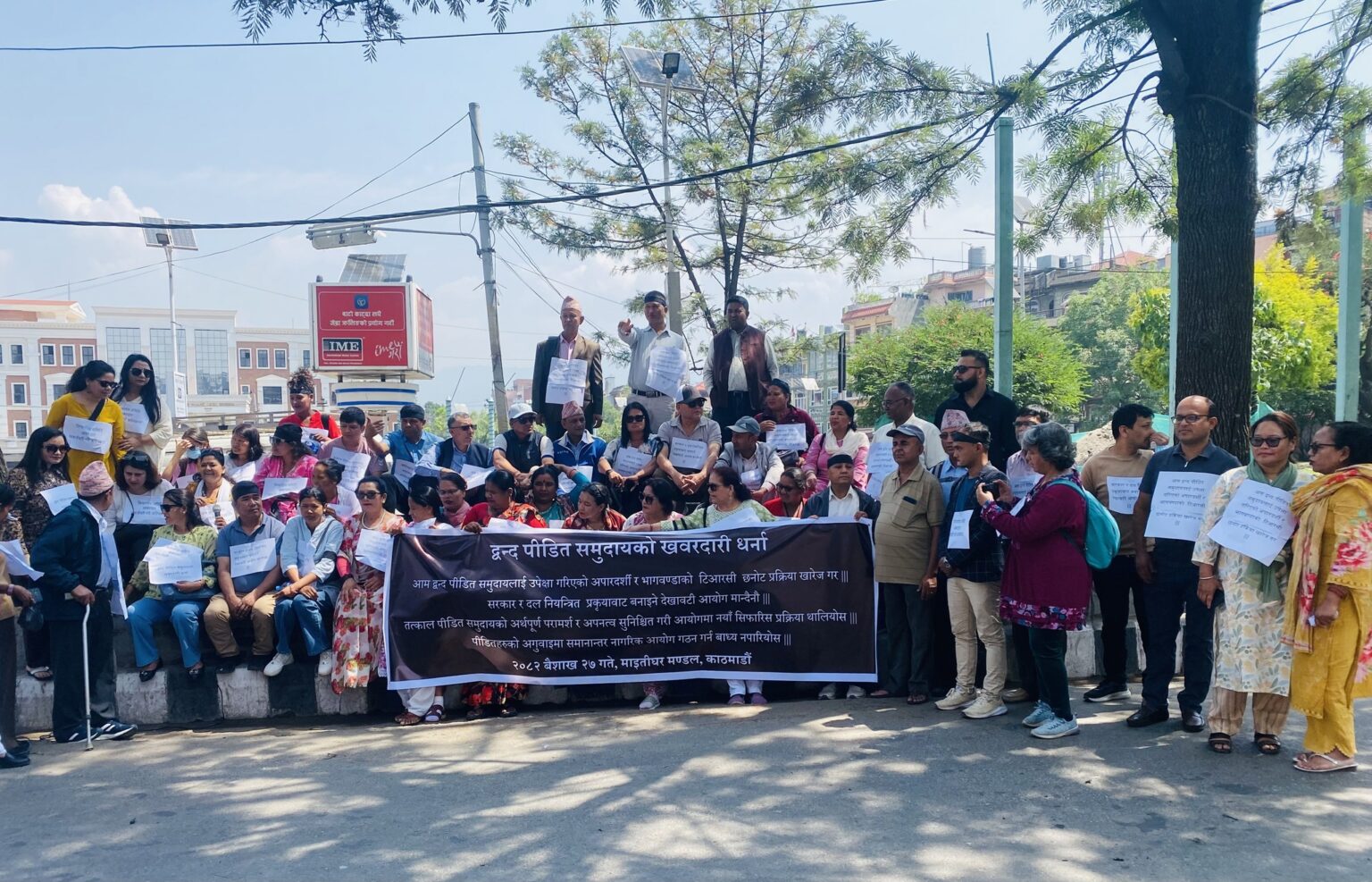
A warning sit-in protest staged by the conflict-victim community on May 10, 2026. Photo: Ram Bhandari’s Facebook
During the decade-long armed conflict, innocent individuals who had no connection to the war were killed. Along with such extrajudicial killings, many were forcefully disappeared. Numerous women suffered sexual violence and rape at the hands of both the state and the rebel sides. Many were displaced after the Maoists seized their houses and land.
Due to the conflict, the pace of the country’s social and economic development was obstructed. The Maoists destroyed state infrastructure, development facilities, and factories. Cultural life was disrupted. Caught in the crossfire between the state and the rebel sides, the lives of ordinary citizens became difficult and terror-stricken. There was a state of fear regarding whether family members would return safely in the evening after stepping out, or whether one would reach their destination safely while traveling.
There are serious incidents of human rights violations and crimes against humanity committed during the armed conflict. Those incidents included murder, abduction and taking of hostages, mutilation and causing disability, physical and mental torture, rape and sexual violence, and displacement.
The two commissions related to transitional justice were formed with the objective of investigating the incidents of human rights violations during the conflict period to maintain justice for the victims and reconciliation in society. The objectives behind the formation of these commissions were to investigate the incidents of gross human rights violations and excesses during the conflict period, find out the truth and make it public, provide respect and justice to the conflict victims, arrange for proper reparation or compensation, bring the perpetrators involved in serious human rights violations within the scope of legal action, and establish reconciliation and sustainable peace in society by addressing conflict issues. This was explicitly mentioned in the Comprehensive Peace Accord itself.
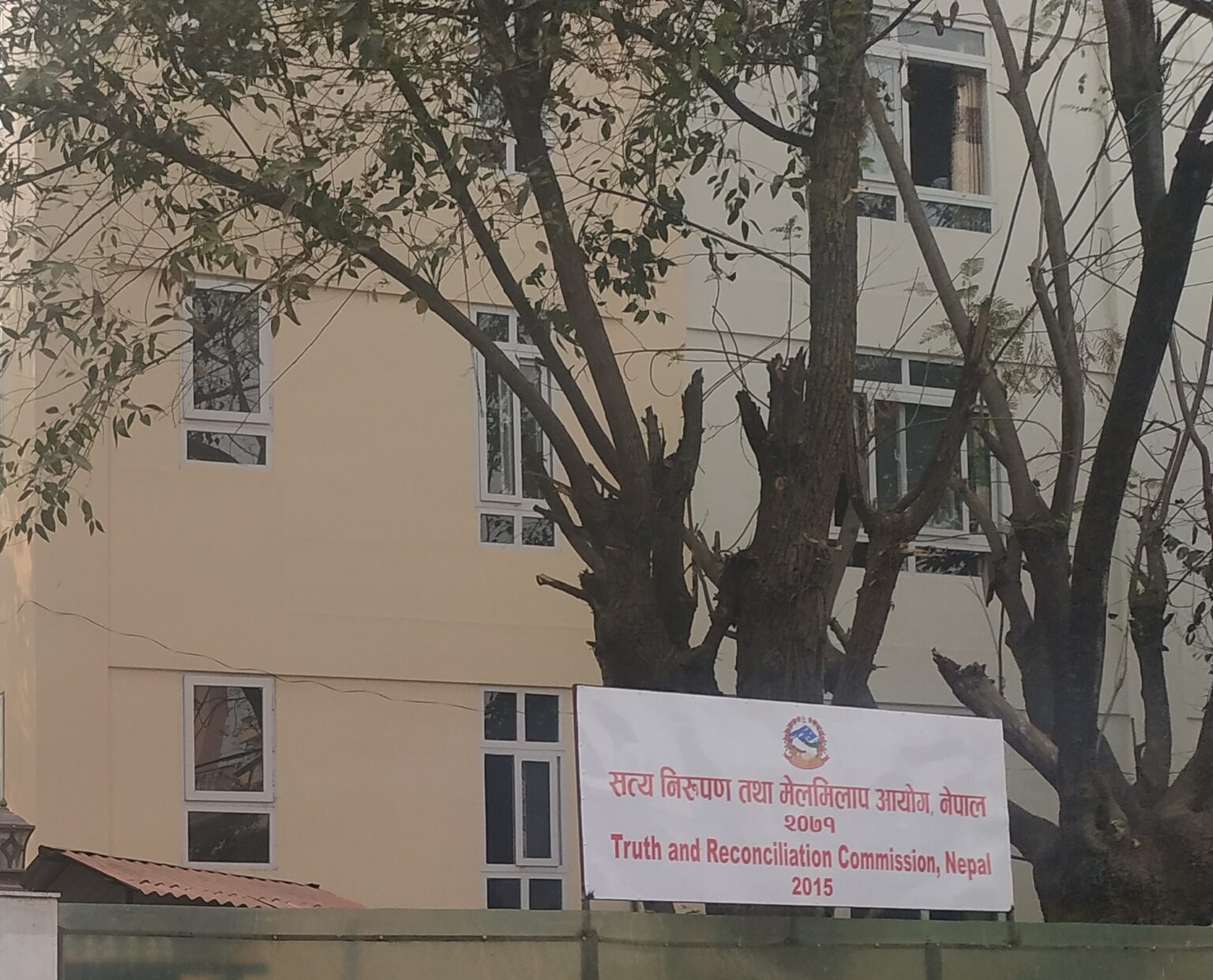
Truth and Reconciliation Commission. Photo: Commission’s Website
The two commissions collected complaints from conflict victims at different times. However, the complaints registered by them ended up gathering dust in drawers. The victim families have been saying that even though officials came to the commissions three times, no investigation could be conducted on the complaints, and justice could not be provided to the victims.
Although past governments promised to conclude transitional justice many times, work did not progress accordingly, meaning the victims’ wait for justice has not been fulfilled even as two decades approach since the Comprehensive Peace Accord.
Victims’ hope in the new government
The then Maoists and the Nepali Congress, which was in government when the war started, are connected to the armed conflict. For this very reason, conflict victims had been accusing both parties of being unable to deliver justice because they were previously in government. Indeed, even in the period since the formation of the transitional justice commissions, the parties showed extreme apathy toward moving the justice process forward.
Due to such neglect and delay, not only did the suffering of the victims increase, but Nepal also lost the opportunity to establish its image as a human rights defender because past governments failed to implement the verdicts and recommendations made by international organizations and communities regarding various conflict-era excesses.
After the Rastriya Swatantra Party (RSP), which secured a near two-thirds majority in the mid-term elections, formed the government on March 27, 2026, the victims have become optimistic that transitional justice will be concluded. They hope to receive justice because the government is comprised of individuals who were not party to the conflict. Being able to conclude a matter of international concern is also an opportunity for the government.
In the commitment paper brought by the RSP for the House of Representatives elections on March 5, it was mentioned that if they came into government, they would immediately start work to conclude the remaining tasks of transitional justice. The victims reside in expectation of justice also due to this matter, which is placed at number 12.
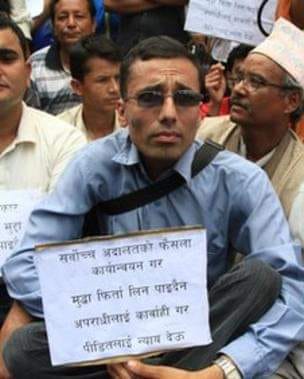
Conflict victim Suman Adhikari. Photo: Adhikari’s Facebook
Suman Adhikari, the founding chairperson of the Conflict Victims Common Platform (CVCP), says that work could not be done in favor of the victims because the three major parties turned the transitional justice commissions into places to provide employment to their cadres and play politics in the past.
On January 16, 2002, his father, teacher Muktinath Adhikari, was taken from his school on the charge of refusing to give donations, tied to an alder tree in Duradanda, Lamjung, and shot dead. That photograph of Muktinath published in the media at that time reflects the gruesome state of the conflict period. Suman has been active for 24 years, not only to bring the perpetrators of his father’s murder to justice but also for the justice of all conflict victims.
Adhikari says the new government should appoint independent individuals who are trusted by all and have experience in transitional justice as commissioners of the commission. “We want a swift solution. Officials should be appointed to the commission by forming a recommendation committee,” he says.
“The previous coalition governments feared that they might find themselves in trouble, but that fear does not exist now. This government also has an opportunity to conclude transitional justice.” He states that in the 12 years since the formation of the commissions meant to deliver justice, they have only added pain upon pain for the victims.
Adhikari states that for victims to receive justice, it should not be limited to putting someone in jail but must come as an overall package. “The government should study everything, cooperate with stakeholders in a way that past shortcomings are not repeated, and move the work forward,” is his suggestion.
Point number 84 of the government’s policies and programs brought for the upcoming fiscal year 2026/27 mentions that the process of transitional justice will be brought to a conclusion as soon as possible. ‘A justice system with compensation will be developed while ensuring equal access for all citizens. Free legal aid will be expanded for poor and helpless citizens,’ the policies and programs state. ‘The processes of transitional justice related to the armed conflict will be brought to a conclusion as soon as possible.’
Bhagi Ram Chaudhary, former chairperson of the Conflict Victim Common Platform, on the other hand, is a person who has maintained the view that whoever is in the commission, one must cooperate and work with them. The then army had abducted and disappeared his elder brother and sister-in-law. Other members of his family fell victim to violence.
He says that along with punishment for the guilty, the assurance of the victims’ future should also be addressed in the transitional justice process. “Since transitional justice means justice, all aspects must be covered in it. Employment, respect, education, and health, among others, must be ensured,” he says. “The price of our blood is not just locking up the guilty, it is the security of our future.”
However, according to his assessment, the current government has very little information regarding transitional justice. “It is the state, so we must hope, but there is also a bit of confusion,” Chaudhary says. “If the government wants to advance the process, it is a very big opportunity. It depends on whether or not the government is ready to spend a very large budget for the reparation of the victims.”
Transitional justice is a sensitive part of bringing the peace process, which started through the Comprehensive Peace Accord two decades ago, to a conclusion. It is also linked with the then CPN (Maoist), Nepali Congress, and CPN (UML) as the then rebel side and parties that have been in government at various times. Not only that, because it is also connected with the government’s security organ, the Nepali Army, Chaudhary doubts whether the government can move forward by consulting everyone. He mentions that many individuals from conflict-victim families have already passed away in the mere hope of receiving justice.
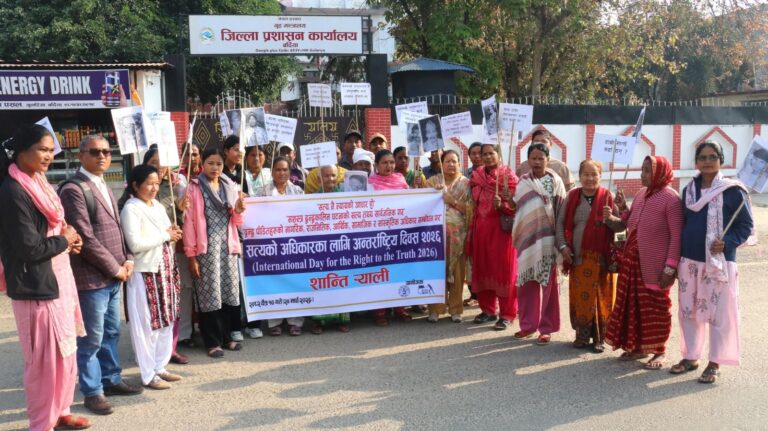
A peace rally organized by victims for the International Day for the Right to the Truth in front of the District Administration Office on March 24, 2026. Photo: Bhagi Ram Chaudhary’s Facebook
On April 8, 2026, conflict-victim activist Kalyan Budhathoki passed away at the age of 63. Displaced from Ramechhap due to the conflict, he had served as the acting chairperson of the Conflict Victim Common Platform. Adhikari, the founding chairperson of the Conflict Victim Common Platform, states that Budhathoki died because his kidneys failed and due to a lack of financial resources for treatment. “Many victims like Kalyan have passed away while dedicating themselves to the campaign for justice and while waiting for justice. The financial condition of many victim families is weak. Everyone is hoping that the state will address it.”
Ram Kumar Bhandari, chairperson of the National Network of Victims and Survivors of Serious Human Rights Abuses, says that the government has an opportunity to conclude the long-festering transitional justice process. His father was disappeared by the state side from Lamjung. Since then, he has been active in the campaign for justice for more than two decades.
He demands that the government immediately advance the transitional justice process in consultation with conflict victims. “With the dismissal of those who received old appointments, the path is now open for the government to start a new process and appoint new commissioners,” Bhandari says.
“Because previous governments worked without consulting the victims, the justice process failed; we are optimistic that the new government will work in a transparent manner.” He suggests that learning from the past, independent experts who understand the subject matter and representatives of the victims should be appointed to the commissions to conclude the process,” Bhandari added.
Work of the commissions so far
To investigate the truth of the incidents that occurred during the decade-long armed conflict, make them public, bring the perpetrators to justice, and deliver justice to the victims, the government formed the Truth and Reconciliation Commission and the Commission of Investigation on Enforced Disappeared Persons on February 10, 2015.
The commissions, which consist of five members including a chairperson, have seen their officials changed three times so far. However, the victim families almost always expressed dissatisfaction over the appointment of officials.
After the formation of the commissions, the work of collecting complaints from the victims did take place. A total of 63,718 complaints related to incidents of human rights violations and gross violations of human rights during the conflict period were registered at the Truth and Reconciliation Commission. The complaints are related to murder, abduction and taking of hostages, mutilation and causing disability, physical and mental torture, rape and sexual violence, property-related issues, and displacement, among others.
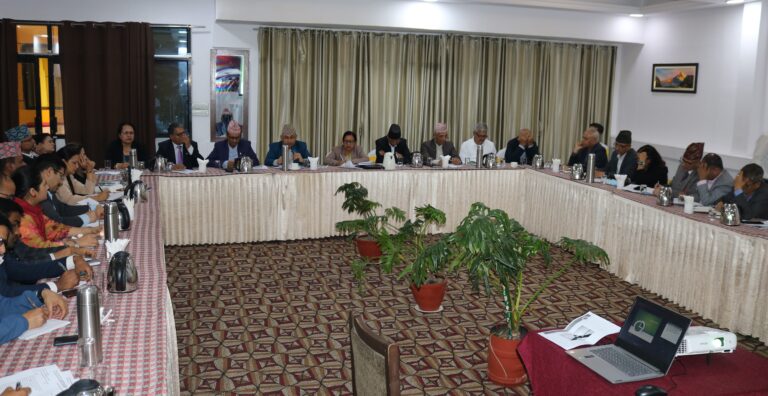
A drafting program for the truth investigation procedure of the Commission of Investigation on Enforced Disappeared Persons.
Out of these registered complaints, detailed investigation was conducted on 173, identity cards were distributed to 618 individuals, compensation was recommended for 538 individuals, and 2,268 complaints were archived, as mentioned in the commission’s annual report for the fiscal year 2024/25.
Similarly, 3,288 complaints were registered at the Commission of Investigation on Enforced Disappeared Persons. Among them, 746 complaints were investigated, while 277 complaints were sent to the TRC after they appeared to be related to truth and reconciliation upon review. A total of 137 complaints were duplicates, while 332 were archived. Detailed investigation was maintained for 2,542 complaints.
The Commission of Investigation on Enforced Disappeared Persons mentioned in its annual report of 2023/24 that it has faced various types of problems and challenges since its inception during the investigation of complaints and the search for truth. According to the commission, it faced problems in four areas: policy and legal, institutional and organizational, managerial, and practical.
Human Rights Commission’s list
On May 8, the National Human Rights Commission (NHRC) sent a letter to the government with a list of priorities that should be given to human rights. It covers subjects ranging from the implementation of fundamental rights to removing distrust toward the transitional justice mechanism.
The National Human Rights Commission has also drawn attention to the issue of amending the regulations of the The Enforced Disappearances Enquiry, Truth and Reconciliation Commission Act, 2014. It has asked to make the transitional justice process victim-friendly with the consultation and consent of the victims, along with amendments to the regulations of both commissions.
It clarified that the transitional justice process has received more priority from a criminal justice perspective, but this process requires a non-judicial perspective. It has asked to prepare standards through judicial and non-judicial processes and implement them.
The National Human Rights Commission has called on the government to give priority to ‘advancing the work of documentation and registration immediately to ensure the right to identification and reparation, as all victims have not been identified yet even when nearly two decades have passed since the Comprehensive Peace Accord. To establish easy access for victims, it has also asked to develop and implement complaints, access to the commission for sexual violence victims, and an information system regarding complaints.
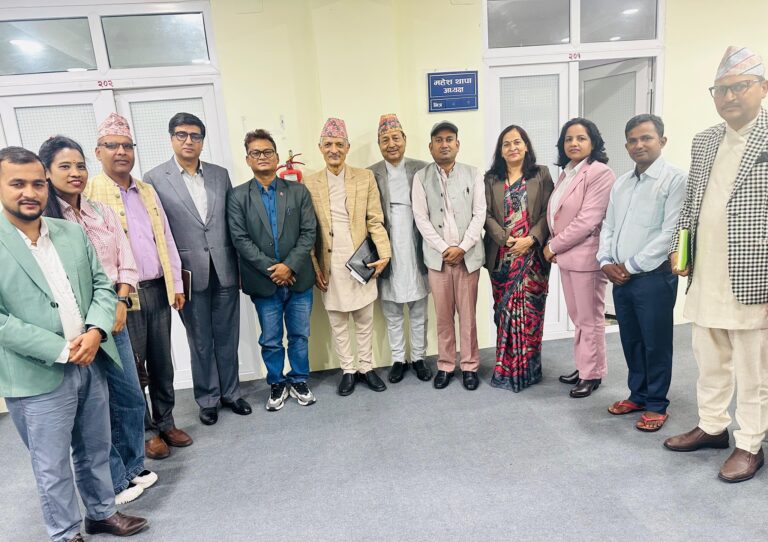
Conflict victim representatives with the then officials of the Truth and Reconciliation Commission. Photo: Bhagi Ram Chaudhary’s Facebook
The commission has also drawn the government’s attention to ensuring the participation of conflict victims in the phase of transitional justice. Similarly, it has been told to keep victims out of political bargaining, ensure unconditional action against perpetrators of serious human rights violations, and prioritize issues such as education-health, psychosocial counseling, livelihoods for victim families, and apologies to the victims.
Conflict victims’ appeal to the Prime Minister
Representatives of 40 organizations related to conflict victims sent an open letter to Prime Minister Balendra Shah on April 23, demanding the assurance of the right to truth, justice, and reparation, which has been stalled since two decades ago.
The letter mentions that an extremely important human rights agenda like transitional justice, which is related to the right to truth, justice, and reparation, does not appear at the center of the government’s priorities. Dissatisfaction was expressed over the fact that the issue of the transitional justice process was not included in the 100-point agenda for governance reform and the ‘national commitment’ brought by the government.
The letter states that past governments politicized and shared power over the pain and wounds of the conflict, and due to a lack of accountability, the victims had to face disappointment and humiliation.
The victims have demanded including transitional justice in the government’s national commitment, ensuring the exit of commissioners by amending the law, making the commissioner appointment process completely transparent, competitive, and victim-friendly, and aligning the law with international standards and the precedents of the Supreme Court.
Similarly, a demand has been made to formulate a national policy to address the immediate and long-term reparation needs of victims of human rights violations, including consultation with victims in the entire process of justice, conflict victims, and victims of the Gen Z protests.