Kathmandu
Sunday, July 12, 2026





As long as human beings continue to struggle with their own souls, 'Shirish Ko Phool' will remain alive
KATHMANDU: Many celebrated novels have been produced in Nepali literature, yet the number of works that continue to unsettle, transform, and endure across generations remains remarkably small. Among those rare literary achievements, Shirish Ko Phool by Parijat stands in a class of its own.
The first entry of this masterpiece into my memory is highly emotional. I heard the name of this work for the first time from my mother, Lata Kafle. Before reading it, I used to think Shirish Ko Phool might be a deep love story, a story of the intoxication of blooming love and the colorful ups and downs of a young mind, just like the softness of a flower. At that time, the word ‘flower’ constructed a picture of only softness, beauty, and romance in my brain. How was I to know that inside the metaphor of a flower, I would encounter the most restless soul of Nepali society!
Time changed; the generation changed, but the loneliness inside humans, the failure of love, the emptiness of relationships, and existential restlessness still remain. Precisely because of this, Shirish Ko Phool is alive even today. Perhaps, as long as humans continue to struggle with their own souls, this novel will remain alive as well.
The volume of the novel
A lot of discourse, debate, and interpretation have already taken place regarding Shirish Ko Phool; therefore, I do not want to make their density superficial by repeating old contexts. Nevertheless, when discussing it, the context of the Madan Puraskar and Shankar Lamichhane comes as a natural and mandatory part. It was Shirish Ko Phool that crowned Parijat as the first female writer to receive the Madan Puraskar. And the preface by Shankar Lamichhane had expanded the intellectual volume of the novel.
It is a deep truth accepted open-heartedly by Parijat herself, and there is an indelible imprint of Shankar Lamichhane in constructing the intellectual volume of Shirish Ko Phool. Those who speak say, “Where is Shirish Ko Phool actually just one book?” This is rather a single form of two separate books. One book, which Parijat wrote by pouring out even the philosophy, pain, and experiences of her life, and the other is the preface sketched by Shankar Lamichhane with his ‘abstract’ philosophy and the magic of words. To speak in the language of coffee connoisseurs, a thick taste just like that of a ‘double shot Americano’ is obtained from this.
It was Shirish Ko Phool that crowned Parijat as the first female writer to receive the Madan Puraskar.
When diving inside the philosophical volume of Lamichhane’s famous essay collection Abstract Chintan: Pyaj, I experience entering a separate universe. The question of how such a sophisticated combination of words became possible in his writing always astounds me. I am astounded by how a man possessed the capability to make such a deep, subtle, and philosophical commentary on that time and environment and on life and the world. The preface of Shirish Ko Phool keeps astounding me in that very same vibe.
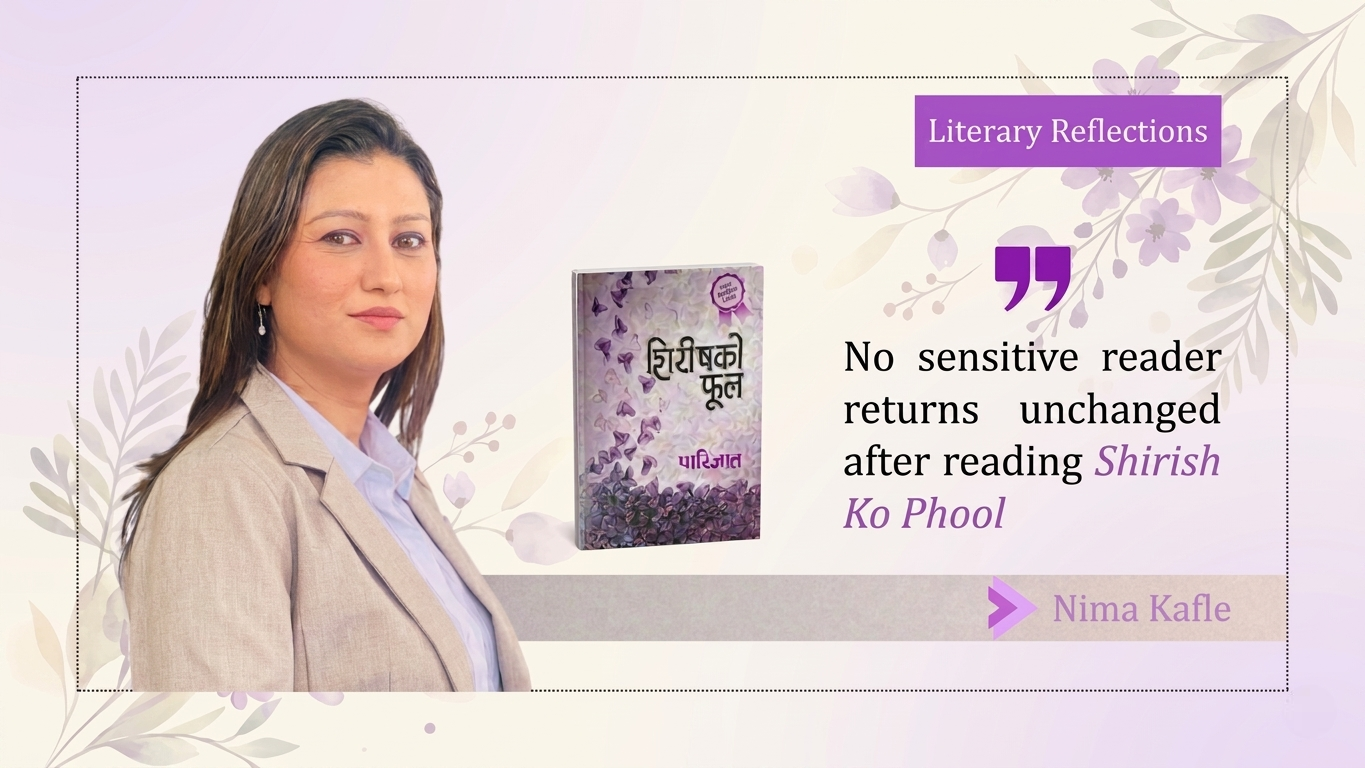
I have often said that no sensitive reader returns unchanged after reading Shirish Ko Phool. The novel shakes the very foundations of one’s thinking, confronting the reader with a profound shift in consciousness and leaving them at the threshold of an entirely new awareness. For that reason, I consider Shirish Ko Phool an informal manifesto of Nepali modernity itself. In that sense, I see Parijat as a true “chain breaker.”
Parijat ‘portrait’
I like Parijat for diverse reasons; I like her very much. The first reason for that is her fearless and rebellious nature. That is also the real strength of her writing.

Cover of Shirish Ko Phool
I did not get a chance to meet Parijat in person; when she passed away, I was spending my childhood in Sudurpaschim, Mahendranagar. However, when imagining her rebellious personality, I find her just like Arundhati Roy of today. In Arundhati, who is lighting a cigarette in a carefree style on the cover of the new book Mother Mary Comes to Me, the very strength to live on her own terms apart from society, fear, and worry and not to be afraid of being rejected is visible; I encounter that very same thing in Parijat. There is a freedom in the style of both of them, which possesses the courage to break the chains of old thinking in a single snap.
Parijat’s rebellion is not only political or social; it is rather a grand rebellion of consciousness. A ruthless rejection against established morality, artificial civilization, made-up love, and patriarchal rigidity. Therefore, while reading Shirish Ko Phool, the reader does not just read a story but is forced to come face-to-face with the endless weaknesses, anomalies, and illusions of their own life.
In the course of understanding Parijat’s personality, the ‘portrayal’ written by Khagendra Sangroula feels very powerful: ‘The small unplastered room located in Mhepi, a photograph of Che Guevara on one wall, and Parijat’s bed on the other wall.’ This itself is perhaps the real symbol of Parijat.
To understand Parijat, one must understand the time from 1963 to 1974. A general introduction to book titles, lists of authors, or literary movements alone is not sufficient. One must feel the restlessness, intellectual dissatisfaction, ideological rebellion, and creative self-struggle of that era from within. Because, during this time, Nepali literature threw away its old ‘cover’ for the first time and entered into direct dialogue with world literature.
Parijat’s rebellion is not only political or social; it is rather a grand rebellion of consciousness.
Before that, an artificial cover of sentimental love, moral preaching, idealistic characters, and social decency was dominant in Nepali literature. But, in that decade, literature began to look at the internal darkness of humans. Human loneliness, existential fear, sexual suppression, mental fragmentation, political suffocation, and the hollowness inside society were expressed extensively in literature for the first time.
At that very time, the ‘Tesro Aayam’ (Third Dimension) movement that rose from Darjeeling brought a deep intellectual vibration to Nepali literature. Indra Bahadur Rai, Bairagi Kainla, and Ishwar Ballav looked at literature not just as storytelling but as a multidimensional structure of consciousness. Indra Bahadur Rai gave philosophical depth to fiction. Bairagi Kainla constructed a new world of myths, symbols, and abstract consciousness in poetry. Ishwar Ballav transformed the internal emptiness and existential pain of modern humans into language.
Similarly, the ‘Ralfa’ movement came forward as a declaration of cultural disagreement. The creators of that generation held deep disagreement with the established power, made-up morality, and social hypocrisy. Bhupi Sherchan became the most influential voice during this time. He brought complex philosophy down into the language of the common human; therefore, I still like the work, like Ghumne Mech Mathi Andho Manchhe.
Dhruba Chandra Gautam demolished the traditional structure of the Nepali novel. Madan Mani Dixit reinterpreted history, myth, and philosophy from a modern perspective. Taranath Sharma launched a campaign through ‘Jharrobad’ to free the Nepali language from the Sanskrit-biased artificial burden. BP Koirala, while sitting inside prison, was deeply translating human psychology, sexuality, guilt, and political consciousness into literature. Amidst such an entirely male-dominated literary world of that decade, Parijat was an amazing presence.
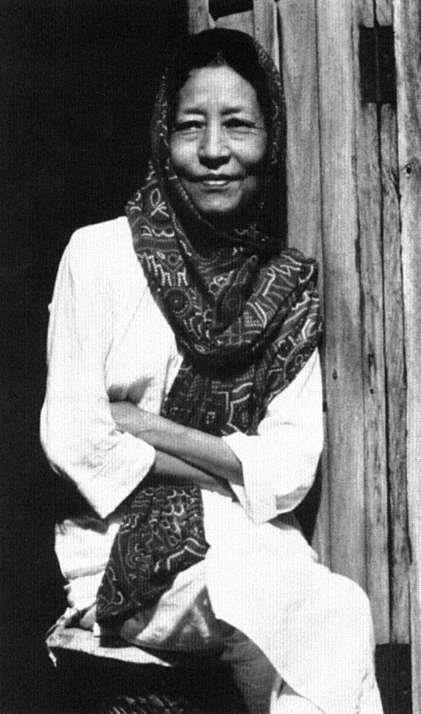
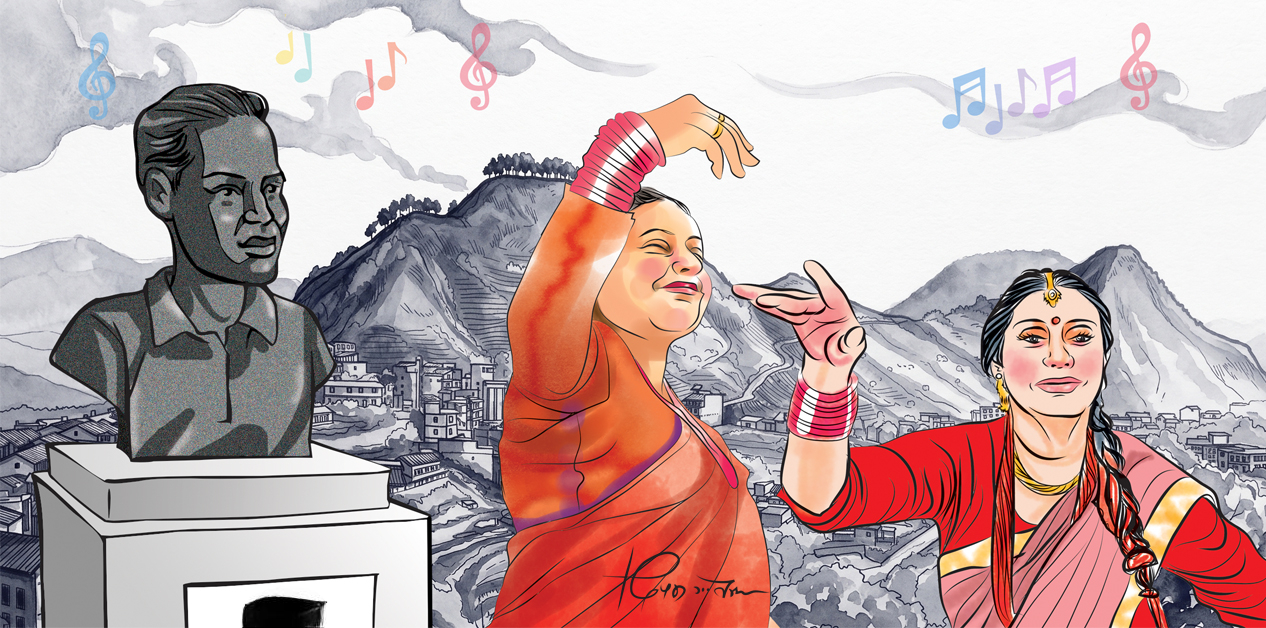
Pioneering Nepali writer and poet Bishnu Kumari Waiba, better known as Parijat
Global dimension
After reading Shirish Ko Phool, I have been looking at Parijat by placing her on the big map of world literature. I read this work of hers by placing it on an emotional and intellectual level, just like Emily Brontë, Virginia Woolf, Jane Austen, and Amrita Pritam. Because the pain visible in her works belongs to no limited society; it is the universal experience of the entire womanhood.
Like Catherine, visible in Emily Brontë’s novel Wuthering Heights, Sakambari of Shirish Ko Phool is not a character of a decorated society. She is neither a traditional ideal woman nor a product of the expectations built by society. She is an existence broken from within but fully conscious. Who does not rebel in a loud voice but resists in her very existence. Silence itself is her strength, and there is a deep storm inside that silence.
Just as there is a subtle struggle of society, marriage, and female freedom in Jane Austen’s novel Pride and Prejudice, that comes in a harsh and naked form in Shirish Ko Phool. Austen looks at society through satire and elegance, but Parijat shows the hollowness, inequality, and pressure of that very society without a cover. For her, relationships are not social games; they are heavy questions of existence.
With Virginia Woolf, Parijat connects even more deeply. Woolf made literature out of time, memory, and the fragmentation of the mind in Mrs Dalloway or To the Lighthouse. Parijat translated that very structure of consciousness into Nepali literature in Shirish Ko Phool, but in an even more harsh and uncomfortable manner. The consciousness of Suyogbir, one of its main characters, is not stable; it is broken and tired and repeatedly returns inside itself.
The connection of Parijat with Amrita Pritam feels even more direct and sharp. Just as there is a ruthless dissection of patriarchy and violence upon the body and history in Pinjar, that same level of subtle male psychology is encountered in Shirish Ko Phool as well. Through Suyog Bir, a mind demolished by a mixture of male ego, insecurity, fear, and emptiness is shown. This itself is also the most important thing of the novel.
‘Magnum opus’
Parijat can be interpreted through numerous literary and philosophical dimensions, yet she remains neither anyone’s shadow nor an imitation shaped by another’s influence. What she created was, instead, a profound transformation, a wholly original literary voice forged by blending the intellectual depths of world literature with the emptiness, exhaustion, and existential anguish embedded in Nepali life.
Shirish Ko Phool stands as a magnum opus of Nepali literature. It is not an echo of any existing tradition but an original, unsettling, and deeply introspective voice born entirely from its own ground. This is the kind of writing that does not comfort the reader or allow easy escape; rather, it compels one to confront the very nature of existence itself. That enduring ability to disturb, awaken, and provoke reflection is the true source of Parijat’s immortality.