Kathmandu
Tuesday, July 14, 2026





KATHMANDU: It is relevant to initiate this article from three contexts.
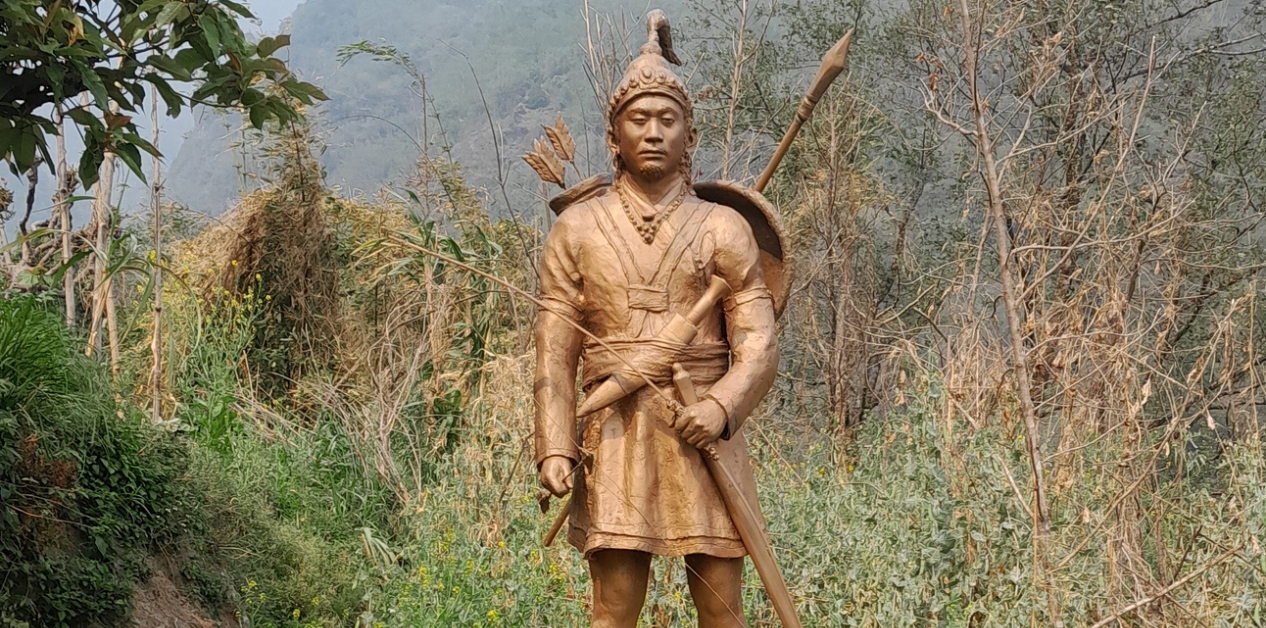
First, after the former Maoist leader and former Tourism Minister Sudan Kirati entered the Shram Sanskriti Party led by Harka Sampang on May 8, clips of the “Idol Scandal” of Bhojpur from four years ago have resurfaced on social media. The idols of Sumnima-Paruhang, constructed with the budget of the federal government, lie vandalized at Haanspokhari in Maiyung, while the idol of Yalambar is kept in the backyard of teacher Prem Sampang in Sawa, Temkemaiyung Rural Municipality-1. During the local, provincial, and federal elections of 2022, political parties and leaders engaged in accusations and counter-accusations regarding corruption in the Sumnima-Paruhang and Yalambar idols. Among those who gave the fiercest speeches were the then Member of Parliament Kirati and the Chairman of Temke Maiyung Rural Municipality, Dhruba Raj Rai. Rai was in the UML and Kirati was in the CPN (Maoist Centre). Now, both have arrived in the same political party, the Shram Sanskriti Party.
Second, the idol of Yalambar located in the park at Buipa, Khotang, is claimed to be the tallest in the world. Spread across 30 Ropanis (approximately 15,262 square meters) of land, the 120-foot-tall statue built with a 70 percent budget from the Koshi Provincial Government and 30 percent from the Diktel Rupakot Majhuwagadhi Municipality has been called the “Pride of Majhkirat.” However, at the time of the idol’s inauguration, the leaders of the idol construction split into two factions, creating a situation of clash. Following this, after the District Administration Office, Khotang, issued a letter on April 30 to postpone the inauguration program, the formal inauguration has been halted.
Third, after being elected as the Mayor of Dharan Sub-Metropolitan City with the identity of an independent activist, Harka Sampang announced the construction of a massive idol of Sumnima-Paruhang and started a donation campaign. From the very day the announcement was made to build the idol at Chindedanda in Dharan-20, donations poured in from home and abroad, and the influx of assistance still continues. The foundation stone of the idol site has also been laid. Sampang himself brought water from Salpapokhari and stones from Silichung—the sacred sites of the Kirat people’s faith—and laid the foundation stone by placing them at the idol site. Sampang has also become a federal Member of Parliament after forming the Shram Sanskriti Party. He is still involved in the idol work as well.

The idol of Sumnima-Paruhang at Sakela Park in Dharan. Photo Source: Social Media
The conceptualizers, planners, activists, and characters connected to these idols in every calculation across all three contexts belong to the Kirat Rai community. The Kirat community considers itself a nature worshipper and worships nature in its natural form. While some worship rivers by the name of a god, the Kirats worship the river as a river itself. According to them, a river is a flow of water and is itself eternal, truth, and power; fire, stone, water (rivers, ponds), sky, and wind are to be worshipped in that very form. Therefore, there are no idols of any kind in the traditional places of worship of the Kirats.
However, after the establishment of the republic, the attraction to idols has increased significantly within the Kirat community, and slightly more so in the Rai community. The process of making idols of characters and materials related to Kirat Rai beliefs, rituals, and culture is rapid. Among them, the idols of the Kirat Mundhumi characters Sumnima-Paruhang and the political character Yalambar have been made the most. Similarly, there are idols of Raichakule (primordial ancestral deity in the indigenous Kirat Rai culture), Makhi Kukur (dog), Chindo (flask), Dhol (drum), Jhyamta (cymbals), Silam Sakma (a sacred, protective symbol and ancestral ornament of indigenous Yakthung community), Teen Chula (three-stone stove), and weapons.
In the Sakhewa/Sakela Than (shrine), which is worshipped twice a year during Ubhauli and Udhauli, there used to be only a single pointed stone erected. There is a classical Mundhumi belief that the Sakhewa Than should not be cordoned off or isolated from the outside world. However, nowadays, the practice of placing idols in almost every Sakhewa Than has intensified.
Idols above emotions
Except for a few exceptions, the overall tradition in the Kirat community is to bury the deceased underground. After burying the deceased, it is an old custom to raise a small mound of soil and stone or build a small structure as a marker. That is called a grave, and in colloquial language, a place with many graves in a single area is called a graveyard. On the slope of Buipa Panchardobato in Diktel Rupakot Majhuwagadhi Municipality-14, Khotang, there were 3,600 graves of ancestors and relatives of the Kirat Rais of Buipa. Development arrived from the city to the graveyard hill. Development brought idols. Some called the idol itself development.
History says that Yalambar, the first king who ruled the Kathmandu Valley, was a Kirat. The present-day Kirats consider him their ancestor. Nevertheless, claims are also emerging that Yalambar has no relation to the current self-proclaimed Kirats like Rai, Limbu, Yakkha, Sunuwar, Dhimal, and Hayu. There are also those who say that since Yalambar is the ancestor of today’s Kirats, he naturally becomes the ancestor of the Rais as well. There is no question that the ancestor of the Rais would not be the ancestor of the Rais of Buipa. Yalambar is no ordinary ancestor; he is a king from five thousand years ago. The local leaders brought forward the idea of placing the statue of their ancestor king in their own place. Everyone agreed. The government also believed it. It gave money.
But such a monstrous idol could not be kept in someone’s backyard. The crossroads of the hills are not as wide as those of the Terai. It would not fit in a narrow intersection. While searching for a place, that very graveyard hill was found, a place that the ancestors and relatives of the local residents had preserved as their post-death abode for hundreds of years.
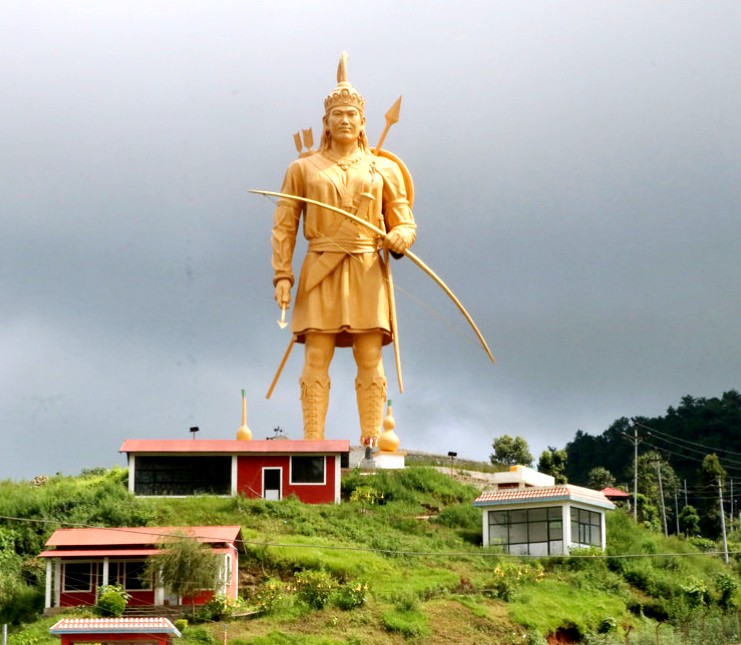
The magnificent statue of Yalambar in the park of Diktel Rupakot Majhuwagadhi Municipality-14, Buipa, Khotang. Photo: Social Media
The bulldozer arrived. Even before the bulldozer arrived, the villagers were made to agree under the pretext that the birth of development would erupt in the village once the idol was built. When the teeth of the bulldozer began to unearth the years-old skeletons of their relatives, some protested. But no tactic worked. The relatives had no choice but to suppress their heart’s pain and watch those skeletons. A 120-foot-tall monstrous statue of Yalambar was erected on the graveyard hill.
What the leaders of the idol project have to say is that the idol has elevated the dignity of not only the people of Buipa, but of all Kiratis, and not just Kiratis, but of all Nepalis across the world; tourists will flock to see the idol, and the locals will become financially prosperous. There are many examples in the world where graveyards themselves have been developed as tourist destinations. People travel just to see graves. The practice of the living visiting graves in memory and respect of the deceased exists worldwide. It exists among the Rais too.
A grave is not just a lifeless physical structure of stone and soil (and nowadays rods and cement). It is not just a general cultural ritual site or identity; it is the emotion of the relatives. In the 2050s BS (1990s), when government bulldozers ran over the Samadhi (burial ground) of Bankali in the Pashupat area, the Kirats who offered their chests in resistance are now themselves engaged in plowing the burial sites of their relatives to erect scarecrow-like idols. This is not right even according to modern theories of development, nor does it align with the essence of identity.
The fascination with wealth
According to the leaders who are placing and are eager to place idols everywhere, the idols reflect the identity of the Kirats. For their own ethnic and cultural identity, ordinary Kirat people have spent and are spending wealth and labor. In this, a narrative that the state has not accepted their identity is also mixed. Because of this, individuals can be found who surrender their entire inheritance for the construction of an idol that identifies their community. However, looking from the outside, even though it appears to be an identity campaign, a fascination with wealth (money) lies hidden within the effort of idol construction and installation.
Whatever idols have been built, they are made either of cement or plastic. They are extremely expensive. They are neither praiseworthy from the perspective of aesthetics, nor are they durable. In 2022, with the objective of influencing the three-tier elections in Bhojpur, plans were secretly made in the Ministry of Culture to construct idols, the budget was secretly allocated, sculptors were secretly commissioned to make them, they were secretly transported from Kathmandu, and they were secretly kept in remote places. Within a few days of placing the idol in Hanspokhari, it stands with a broken hand just from someone lightly touching it. Rs 5 million shattered in a single touch!
A contradiction is visible among Kirat intellectuals. They keep speaking out that Kirats are nature worshippers. Yet, they themselves are at the forefront of the rush for idol construction. That being the case, the contradiction in their understanding is not the cause; the fascination with wealth is the main reason. Identity has become the most reliable tool to emotionally manipulate the soft-hearted common people, and once it is said that the idol carries that identity, the leaders are receiving massive financial benefits from both the state treasury and the community. It is said that the mouth of money is black. For that very black thing, the developmental farming of yellow idols is flourishing in Kirat-majority areas. This is completely against nature worship and the Mundhum.