Kathmandu
Sunday, July 12, 2026





While Coordinator Asim Shah conducts discussions with various stakeholders, participants state that focused discussions on specific articles or sub-articles to be amended have not yet taken place.

KATHMANDU: The government has intensified its homework to prepare a ‘discussion paper’ on constitutional amendment. In this process, Asim Shah, political advisor to Prime Minister Balendra Shah and coordinator of the constitutional amendment task force, has been holding discussions with various stakeholders. However, participants state that focused discussions regarding which specific articles or sub-articles of the Constitution are to be amended have not yet taken place.
Apart from the main opposition party, the Nepali Congress, representatives from other parties represented in parliament are also participating in the task force. CPN (UML) leader Bhismanath Adhikari, who has already participated in two meetings of the task force, states that the government has not presented its official stance on this matter. “Discussions were held on making amendments, but the government’s stance on what specific issues to amend has not come forward,” he says. “The parties were asked to submit their own views.”
Another member of the task force and leader of the Nepali Communist Party, Dev Prasad Gurung, also admits that no concrete proposal has come from the government’s side. “The law secretaries had requested suggestions for discussion. We have suggested proceeding with the amendment process while remaining limited within the jurisdiction of the Constitution,” Gurung says.
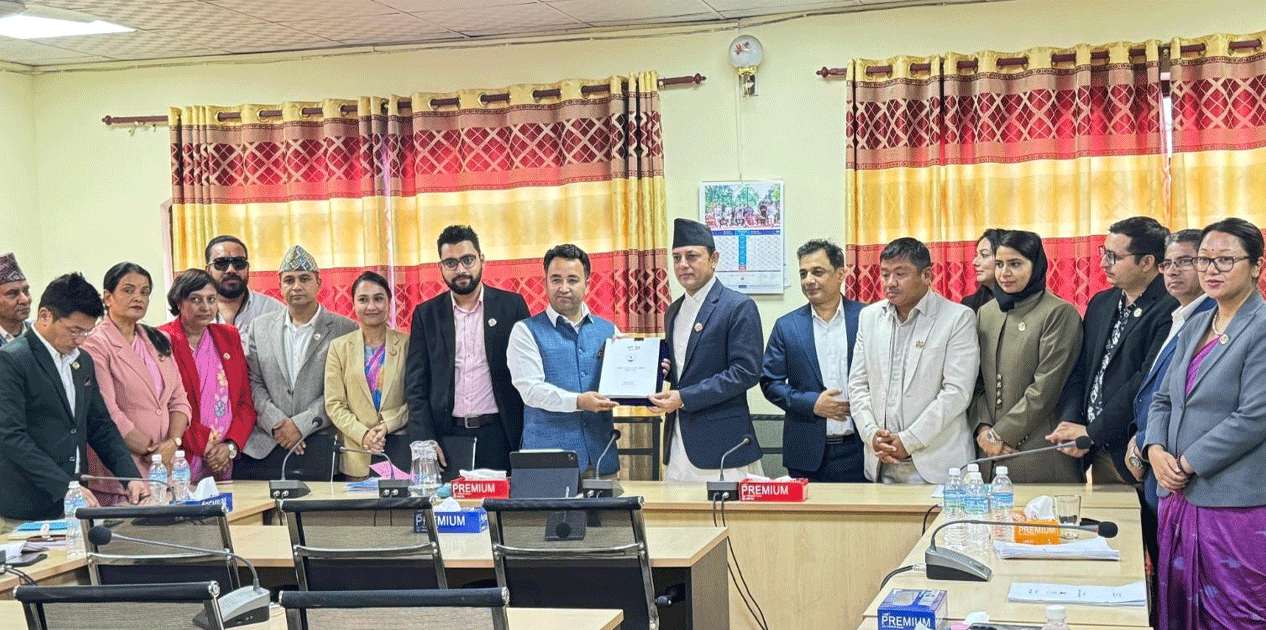
RSP lawmakers presenting the constitutional amendment proposal to Speaker DP Aryal.
Gyanendra Shahi, parliamentary party leader of the Rastriya Prajatantra Party, who participated in the task force meeting, has demanded that issues including secularism should be included in the amendment, while Rastriya Janamorcha leader Durga Paudel suggested abolishing the provincial structure by reviewing federalism.
Although specific issues were not tabled in the meeting, coordinator Shah has been steering discussions with stakeholders by prioritizing issues such as the form of governance, electoral system, federal structure, restructuring of the judiciary, the number of constitutional bodies, and inclusiveness.
Shambhu Thapa, former president of the Nepal Bar Association, states that after realizing this, he presented a separate view during the discussion. He says, “The preparations seemed like an intent to amend everything from fundamental rights to the form of governance and state structure. I found that wrong, and I expressed that view.”
A ploy for constitutional rewriting!
The Rastriya Swatantra Party (RSP) had raised the issue of constitutional amendment even before going to the elections. Its initial ‘bottom line’ included a directly elected executive, a fully proportional parliament, a provision where lawmakers cannot become ministers, a non-partisan local government, and an improved provincial structure.
The RSP’s election manifesto stated: ‘Within three months of running the government, we will prepare a “discussion paper” on constitutional amendment proposals to establish a national consensus.’
Following the elections where RSP received a mandate close to a two-thirds majority, the government led by Balendra Shah published ‘100 Agendas on Governance Reform’. Point 4 of this document also expressed a commitment to prepare a discussion paper on constitutional amendment.
It mentions: ‘To build a national consensus on the country’s long-term political and institutional reforms, electoral system, and other issues related to constitutional amendment, the Office of the Prime Minister and Council of Ministers will form a task force within seven days to prepare a “Constitutional Amendment Discussion Paper” and make the discussion process participatory, transparent, and fact-based.’
In accordance with this, the government initiated discussions by forming a task force under the leadership of Asim Shah. The task force has so far held discussions with constitutional experts, former attorneys general, former administrators, and media personnel, among others. However, in the meeting where Gen Z representatives were invited, only a few injured individuals from the movement turned up. Meanwhile, some activists announced they would not join the discussion under certain conditions.
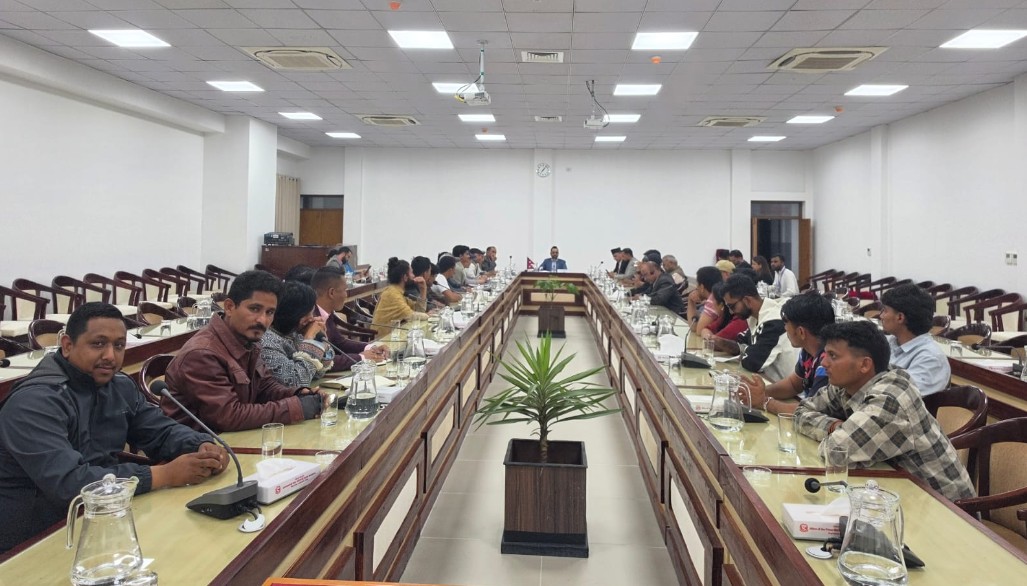
Constitutional Amendment Task Force Coordinator Asim Shah during a suggestion collection program with the injured and families of martyrs of the Gen Z movement regarding constitutional amendment. Photo: Prime Minister’s Secretariat
The government has assigned Leeladhar Subedi, the member-secretary of the task force (Joint Secretary at the Office of the Prime Minister and Council of Ministers), with the responsibility of collecting the written views of political parties, identifying the issues of constitutional amendment, and preparing and presenting the future action plan.
Indira Dahal, secretary of the Nepal Law Commission who is also a member of the task force, states that they are currently understanding the views of various experts and stakeholders. She mentions that during this process, views of stakeholders have also been taken regarding the form of governance, electoral system, and other issues. She informs that the plan is to move into discussions only after preparing the discussion paper once views are collected from everyone. Informing that the Law Commission is also working in this context, she says, “Review is a regular job at the Commission. We will submit our suggestions to the government within this fiscal year.”
However, former Bar President Thapa claims that the task force is conducting discussions on a proposal that is of a nature to amend the entire Constitution. He says, “In the name of amendment, it appeared as though they are trying to rewrite it. However, the current mandate is not for making haphazard changes to the Constitution. Principles must not be violated in this. This is a matter of the sovereign rights of the people.” He argues that while it is natural to make amendments if certain practical hurdles arise, everything should not be changed as if rewriting it.
The Constitution currently provides for a governance system described as a ‘multi-party competitive federal democratic republican parliamentary system based on pluralism’. Under this, it is ensured that the Council of Ministers led by the Prime Minister shall exercise the executive authority of the country. Lately, as debates regarding an executive president or an executive prime minister are ongoing in the public sphere, there is public curiosity about what kind of governance system the government is going to propose. In addition to this, participants have mentioned that the task force is holding discussions on issues such as the electoral system, federal structure, and the number or boundaries of provinces. However, the government has not made its official stance public regarding what kind of amendment it desires.
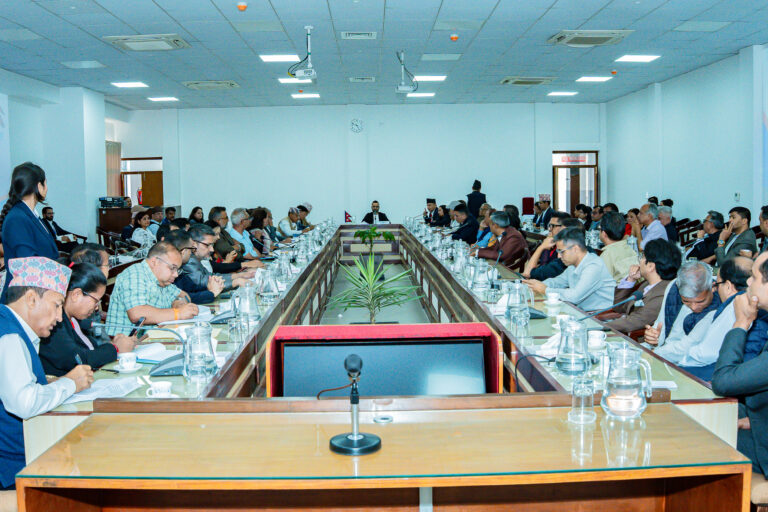
A suggestion collection program conducted by the Constitutional Amendment Task Force with editors. Photo: Prime Minister’s Secretariat
Task force member Dev Prasad Gurung argues that the government has the authority to amend the Constitution only by remaining within the perimeter provided by the Constitution. “Article 274 of the Constitution does not grant the authority to rewrite. Even while amending, basic features cannot be changed,” he says. “This Constitution was formed through numerous sacrifices and martyrdom. It cannot be corrected arbitrarily.”
He argues that a periodic House of Representatives, which has received a ‘mandate’ to carry out managerial tasks required for state governance and to formulate acts for policy-making, does not have the authority to overturn or rewrite the Constitution.
Furthermore, he mentions that he has not yet reached the conclusion that it is time to amend the Constitution. Nevertheless, he understands that the government is free to bring a constitutional amendment bill and prepare a discussion paper. “The government’s spirit seems to be that if there is a consensus among all parties in the task force, it will be taken to the parliament for amendment; if they do not agree, it will move forward by conducting public discussions,” he says.
On the other hand, Gen Z representatives have demanded the formation of a High-Level Constitutional Amendment Suggestion Commission to determine amendable issues, stating that the process adopted by the government appears non-transparent. Boycotting the discussion called by the task force on May 15, they alleged through a joint statement that the government formed the task force against the mandate of the Gen Z agreement.
Questions are also being raised in the public sphere regarding Asim Shah, who is leading the task force to prepare the constitutional amendment discussion paper. He is neither a constitutional expert, nor was he in the Constituent Assembly, nor is he currently in the House of Representatives.
Representative Amrita Ban says, “The Constitution cannot be amended by understanding the views of a limited number of people inside a closed room of Singha Durbar. Since constitutional amendment is an issue connected with the lives of the people, it must be discussed publicly.”
She states that because they were called and allocated a time of only three minutes, they published a statement and boycotted the discussion. Since this is said to be the initial phase, she expects a transparent process in the next stage.
Questions are also being raised in the public sphere regarding Asim Shah, who is leading the task force to prepare the constitutional amendment discussion paper. He is neither a constitutional expert, nor was he in the Constituent Assembly, nor is he currently in the House of Representatives. Previously, he only gained parliamentary experience by becoming a proportional representation member in the House of Representatives from the RSP.
Taking that context into account during the discussion, senior advocate Shambhu Thapa had asked Shah, ‘How will you create an environment to be present in the parliament?’ In response, Thapa states that Shah replied it is not mandatory to be a lawmaker to hold the responsibility of preparing the constitutional discussion paper.
CPN leader Gurung, who has also been a member of the Constituent Assembly, states that he too had suggested at the very beginning that a person knowledgeable in the Constitution should initiate work in this regard. He says, “I received a reply that Shah was made the coordinator only for preparing the discussion paper, and a committee comprising experts would be formed later.”
Constitution amendment: An issue for all parties
The issue of constitutional amendment is not something raised by the RSP alone; major political parties have included this issue in their recent political manifestos. The Nepali Congress and CPN (UML), who ran a coalition government until before the Gen Z movement, had also made constitutional amendment a major agenda.
On July 1, 2024, these first and second largest powers in parliament at that time, formed a power-sharing coalition by forging a seven-point understanding, including constitutional amendment. Accordingly, UML Chairman KP Sharma Oli became the Prime Minister on July 14. However, the coalition could not take concrete steps regarding that matter.
The Nepali Congress, a party that has not participated in the government’s task force, has formed a 17-member Constitutional Amendment Suggestion Committee under the coordination of Pushpa Bhusal. The committee includes senior advocates and constitutional experts Radheshyam Adhikari, Harihar Dahal, Prem Bahadur Khadka, Upendra Keshari Nyaupane, Sher Bahadur KC, Yadunath Khanal, Gopal Krishna Ghimire, Yogendra Bahadur Adhikari, Dinesh Tripathi, Sitaram KC, Lalit Bahadur Basnet, and advocates Ran Bahadur Thebe, Sharmila Shrestha, Jhalmaya BK, and Niraj Gupta.
Coordinator Bhusal argues that the basic structure of the Constitution should not be touched and only certain visible practical problems should be changed. For that as well, she suggests that the government must create a credible framework.
“Since the Constitution is a very important matter, a blueprint of issues that must be amended should be made by staying within the perimeter of democratic values and norms. For that, discussions must be held with the parties that wrote the Constitution in 2008, new parties, constitutional experts, and the Gen Z,” she says. “The system itself is not bad. Since federalism itself is the core foundation of the Constitution, many amendments are not necessary. It is necessary to focus on how to improve the parliamentary system and how to make the electoral system further inclusive and proportional.”
Coordinator Bhusal states that the Nepali Congress will first determine its own viewpoint regarding constitutional amendment. For that, she informs that the committee is currently taking opinions and suggestions from constitutional experts.
The UML, however, has not been able to hold formal discussions within the party regarding this matter. UML leader Adhikari states that they plan to hold discussions by forming a separate committee of experts within the party. He says, “Constitutional amendment should not be done on a whim. This is not an easy matter either. First, it is necessary to determine which specific issues to amend. We will make it public only after discussing this within the party and forming a shared viewpoint.”
Constitutional provision for amendment
To draft the constitution in Nepal, elections for the Constituent Assembly were held for the first time on April 10, 2008 and for the second time on November 19, 2013. The then President Dr. Ram Baran Yadav, during a meeting at the Constituent Assembly building in New Baneshwor on the night of September 20, 2015, announced the promulgation of the ‘Constitution of Nepal, 2015’, which was prepared with the participation of 601 members through direct and proportional systems.
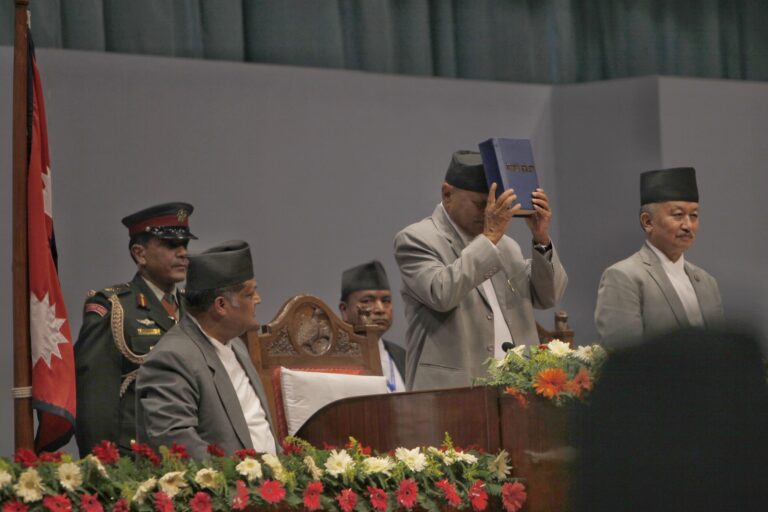
The then President Ram Baran Yadav while promulgating the Constitution of Nepal, 2015. Photo: Bikram Rai
Even though a decade has passed since the promulgation of the Constitution, several necessary laws have not been formulated. This is interpreted as a situation where the full implementation of the Constitution has not taken place. Similarly, debates often occur in constitutional circles that attempts are being made repeatedly to attack the Constitution. During the sequence of events following the Gen Z movement of September 8 and 9 where the elected government and the House of Representatives were dissolved, apprehensions were expressed regarding whether the Constitution itself would survive or not. Therefore, at this time, the issue of constitutional amendment is being viewed with sensitivity.
The provision for amendment is mentioned in Article 274 of the Constitution. It states, ‘This Constitution shall not be amended in a way that is prejudicial to the sovereignty, geographical integrity, independence of Nepal, and sovereignty vested in the people.’
It is mentioned in the Constitution itself that subject to other Articles of the Constitution, a bill to amend or repeal any Article of the Constitution may be introduced in either House of the Federal Parliament. In this process, a provision has also been made that the above-mentioned unamendable article cannot be touched. Similarly, there is a provision in the Constitution that the public must be informed when making amendments. According to the arrangement, ‘The bill shall be published publicly for the information of the general public within thirty days of its presentation in the concerned House.’
The Constitution also provides that amendments can be made to change the boundaries of a province. However, such a proposal can be approved or rejected by a majority of the members of the Provincial Assembly. If a bill is related to altering the boundaries of any province, the Speaker or Chairperson of the concerned House shall send such a bill to the Provincial Assembly for consensus within thirty days of its presentation in the Federal Parliament.
The sent bill must be approved or rejected by a majority of the total existing members of the concerned Provincial Assembly within three months, and information thereof must be sent to the Federal Parliament. The Constitution states, ‘If information is given to the concerned House of the Federal Parliament that a majority of the Provincial Assemblies have rejected such a bill, such a bill shall become inactive.’
The provision to review various matters a decade after promulgation is also within the Constitution itself. Article 265 contains provisions regarding the review of constitutional commissions. It states, ‘The Federal Parliament shall review the commissions formed in accordance with this Part after 10 years from the date of commencement of this Constitution.’
Since a decade has passed since the formation of the Constitution, the time for review has arrived, but it has not taken place. At a time when the commissions are facing criticism for not being able to work according to the Constitution, the government is preparing to amend the Constitution itself.
The difficulty of amendment
There is a constitutional provision that a two-thirds majority from the House of Representatives and the National Assembly is required for a constitutional amendment. In the House of Representatives, the RSP has close to a two-thirds majority. However, it has no presence in the National Assembly.
The Constitution provides that a bill registered in the parliament for constitutional amendment must be passed by a two-thirds majority in a joint sitting of both Houses.
Currently, excluding the Chairperson of the National Assembly and one nominated member, there are 56 members, among whom the Nepali Congress is the largest party. In the Assembly, there are 24 members from the Congress, 17 from the Nepali Communist Party, 11 from the UML, two from the JSP, one from the Loktantrik Samajwadi Party Nepal, and one from the Rastriya Janamorcha.
Based on these statistics, it appears mandatory for the RSP to take other parties along to amend the Constitution. If that cannot happen, despite having dominance in the House of Representatives, it will be difficult for the RSP government to get the constitutional amendment proposal passed by the National Assembly.