Kathmandu
Sunday, July 12, 2026






Looking at Lalit Narayan Rajbanshi’s performance over the past few months, many had begun to think that there was no ‘turn’ left in his bowling. This was because he had gone wicketless in seven out of his last 13 matches.
However, he proved this wrong in Nepal’s must-win match against Scotland under the ICC Cricket World Cup League-2, held at the TU Cricket Ground in Kirtipur on May 18. Making the ball ‘turn’ in his old rhythm, Lalit took four wickets. Everyone who doubted his performance was left astonished.
But for Sandeep Lamichhane, this performance by Lalit was not unexpected. He was celebrating every time Lalit took a wicket. After securing a 6-wicket victory against Scotland, media representatives asked him about this during the post-match conference.
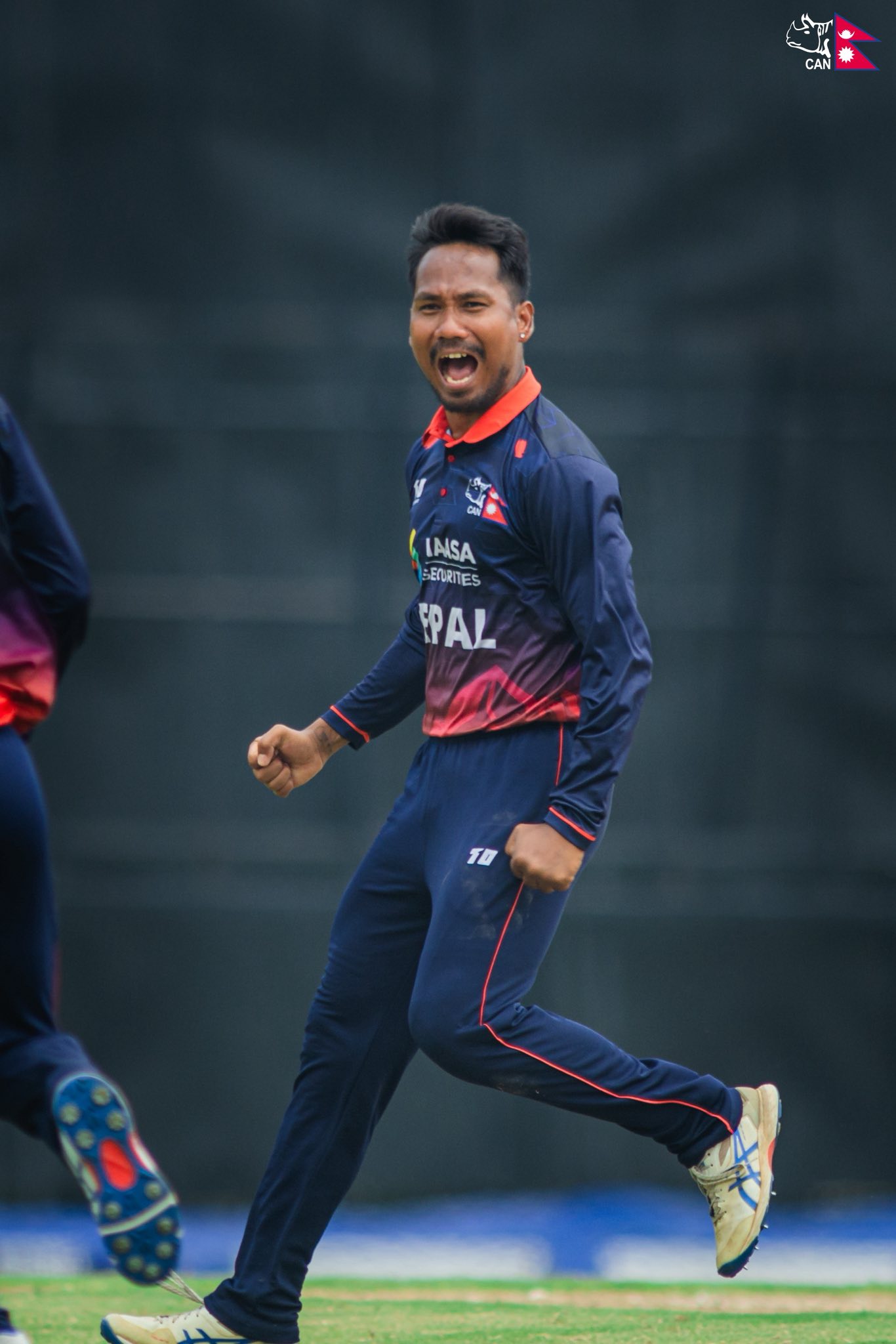
Lalit Narayan Rajbanshi after taking a wicket against Scotland.
“Naturally, one feels happy when Lalit takes a wicket. Because we have been a pair for a long time. Even when he wasn’t taking wickets, he was choking the opposition from one end, making it easier for me to take wickets,” Sandeep said.
Starting from zero, coming back from zero
Nepal achieved its first One Day International (ODI) status through the 2018 World Cup Qualifier tournament. Immediately after, all-rounder Shakti Gauchan, who had dedicated more than half of his life to Nepali cricket, announced his retirement from international cricket after playing the first ODI. For this reason, the Nepali team was looking for a new left-arm spinner as his successor. Lalit was the main contender.
Lalit was also included in the closed camp called by the Cricket Association of Nepal (CAN) for the tour of the Netherlands in July 2018. The schedule was for Nepal to play its first ODI match after playing a T20 International series against the Marylebone Cricket Club (MCC) and the Netherlands there. However, Lalit did not get to play any matches in the series. The single match in which he was in the playing-11 to play against the Netherlands was washed out due to rain.
On 1 August 2018, Nepal made its historic debut in ODI cricket. After Nepal was defeated by 55 runs in that match held at Amstelveen, Shakti Gauchan announced his retirement. Following Shakti’s retirement, in the second ODI match, it was not Lalit Rajbanshi but Lalit Bhandari who got the opportunity to make his debut. However, he did not retain his place in the national team after that.
Under pressure to qualify for the World Cup Global Qualifiers and save its ODI status, Nepal has climbed to fifth place among eight teams. Having played 27 matches, Nepal has reached 22 points. Now, nine matches remain to be played.
In January 2019, it was decided that Nepal would tour the UAE to play another ODI series. For this two-match series, however, Lalit secured his place in the team. He made his ODI debut through the first match held on 28 January. However, though he bowled seven overs and conceded 33 runs, he could not take any wickets. He remained wicketless in the second match as well. In the third and final match, however, he made an impact by taking two wickets in a single over.
Since then, the responsibility of handling the team in difficult situations in 50-over cricket has mostly remained on the shoulders of Sandeep and Lalit.
They are on the field together in the previous matches of League-2 as well as most of the matches of this cycle. Lalit, who played only eight innings in the previous cycle, has already played 21 innings this time. However, while Sandeep has taken 39 wickets in these 21 innings, Lalit, who played an equal number of matches, is limited to just 21 wickets.
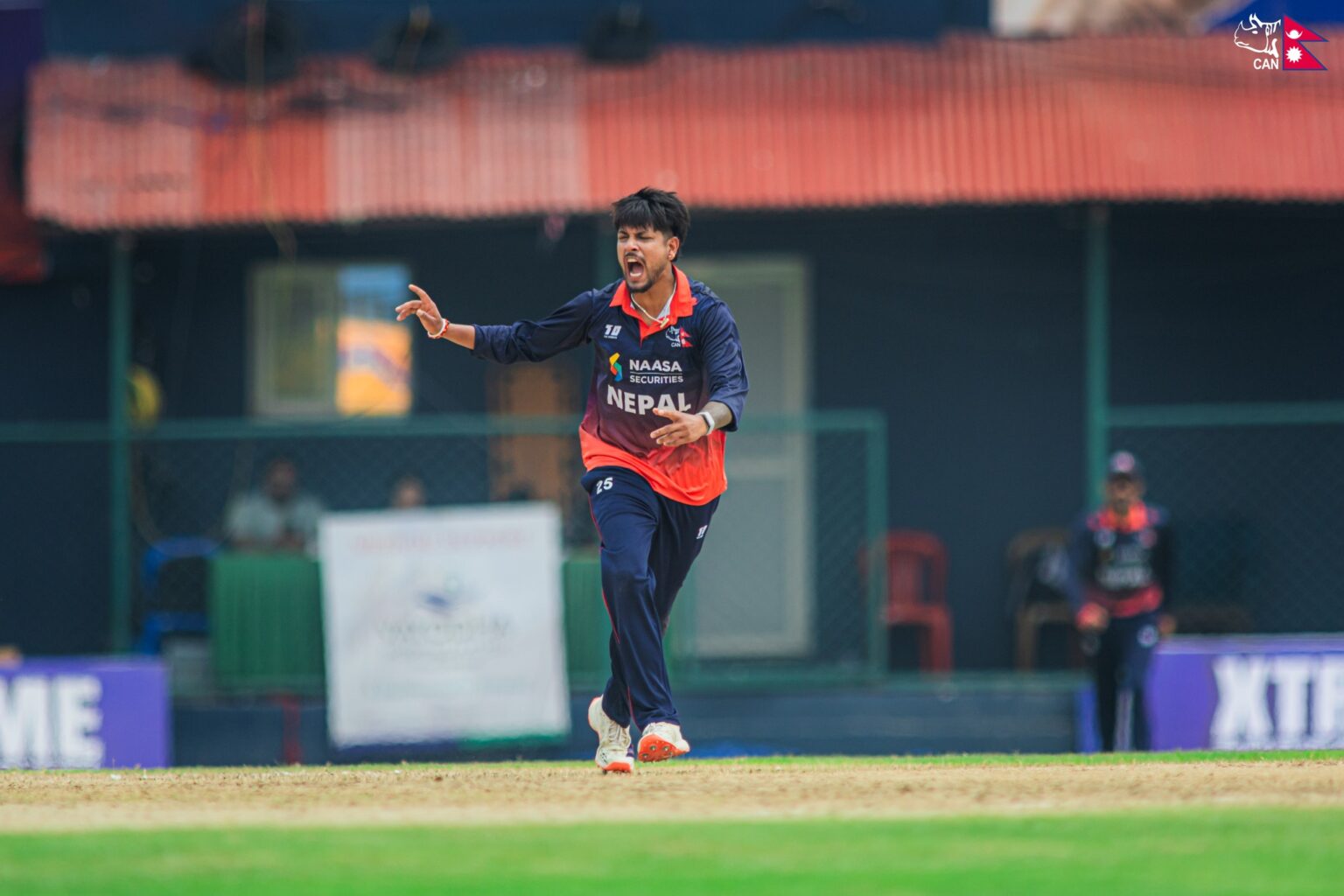
Sandeep Lamichhane.
Looking only at the last 13 matches, Sandeep has already registered 26 wickets to his name. Lalit, on the other hand, is limited to eight wickets. Sandeep was wicketless only in the match against Scotland on 8 June 2025.
In contrast, Lalit had failed to take wickets not only in the last four matches but also in the series involving the home team, UAE, and the USA held in the UAE last year in October-November. Amidst such a high-pressure situation, Lalit made an excellent comeback against Scotland on Monday. He put on an impressive performance, bowling eight overs and conceding 32 runs.
In the last five wins of League-2, Nepal has not allowed the opposition teams to cross even 200 runs. Remarkably, in four out of these five matches, Nepal has even bowled the opposition teams out.
Dipendra Chaudhary, a former selector of the Nepali national team, says that rather than looking at Lalit’s wicketless matches, one should look at how well he has supported Sandeep. “In cricket, partnership is just as important in bowling as it is in batting. If the pressure created by Sandeep cannot be converted into wickets from the other end, it becomes difficult to change the result. If pressure is being built from Sandeep’s end, then 1-2 wickets must come from the other end too. Otherwise, the momentum shifts to the opposition. In such situations, Lalit was being effective,” he says.
Sandeep has bowled 204.5 overs in 21 innings of this cycle. Having bowled 12 maiden overs, he has conceded 912 runs. Lalit, on the other hand, has bowled 176.3 overs, conceding 749 runs with eight maidens.
Relying solely on bowling
Before the League-2 series on home soil, Nepal’s performance did not look as expected. The team had lost its rhythm due to a lack of consistency in both the batting and bowling departments. However, utilizing the support of home fans and the advantage of their own pitch, Nepal has bounced back into the game. The team has consistently turned results in its favor based on excellent bowling performances in five out of the last seven matches.
With this, Nepal, which was under pressure to qualify for the World Cup Global Qualifiers and save its ODI status, has climbed to fifth place among eight teams. Having played 27 matches, Nepal has reached 22 points. Now, nine matches remain to be played.
So far, the main foundation of Nepal’s victory has been disciplined and aggressive bowling. In the last five wins of League-2, Nepal has not allowed the opposition teams to cross even 200 runs. Remarkably, in four out of these five matches, Nepal has even bowled the opposition teams out. This is considered a highly impressive achievement in One Day International cricket.

Nepali Cricket Team.
In this process, Nepal’s most impressive win is considered to be against the USA, which is in second place on the points table. In the match held on 16 May, Nepal defeated the American team by nine wickets. The USA had scored 158 runs losing four wickets in 30.5 overs. The Nepali bowlers did not let the team, which was once projected to reach the 300-run mark, get going at all. While adding 37 runs, the USA lost its remaining 6 wickets and was restricted to just 195 runs.
Two days after that, Nepal stopped Scotland, who was at the top of the points table, at just 194 runs. This team had scored 321 runs losing 6 wickets against the USA on 14 May. However, even such a powerful nation in batting became helpless before Nepal, suffering a 6-wicket defeat.
True, even before that, Nepal had defeated the UAE by 6 wickets and 37 runs. It also took advantage of its home ground by defeating Oman by 81 runs. In all these matches, Nepali bowlers took wickets consistently and did not allow the opposition’s partnerships to settle. Especially, the tight bowling done in the middle overs proved decisive for Nepal.
Pubudu Dassanayake, the coach of American cricket team, who has also managed the Nepali team, states that it is difficult for any team coming to play in Nepal. In his experience, while the ball turns and swings all day on most international pitches, conditions change even within a single day at the TU ground. It’s not that opposition teams coming to play in Nepal are unaware of this. However, Dassanayake says that Nepali bowlers are experts in how to handle such situations.
“Our spinners are still struggling to find the right pace and turn on these wickets. Nepali spinners, however, are the masters of these conditions,” he says.