Kathmandu
Sunday, July 12, 2026





Nepal’s public debt has climbed to Rs 2.97 trillion as of mid-May 2026, driven by steady domestic borrowing, slower external disbursements, rising debt servicing costs, and significant currency depreciation that alone accounts for more than half of this year’s increase
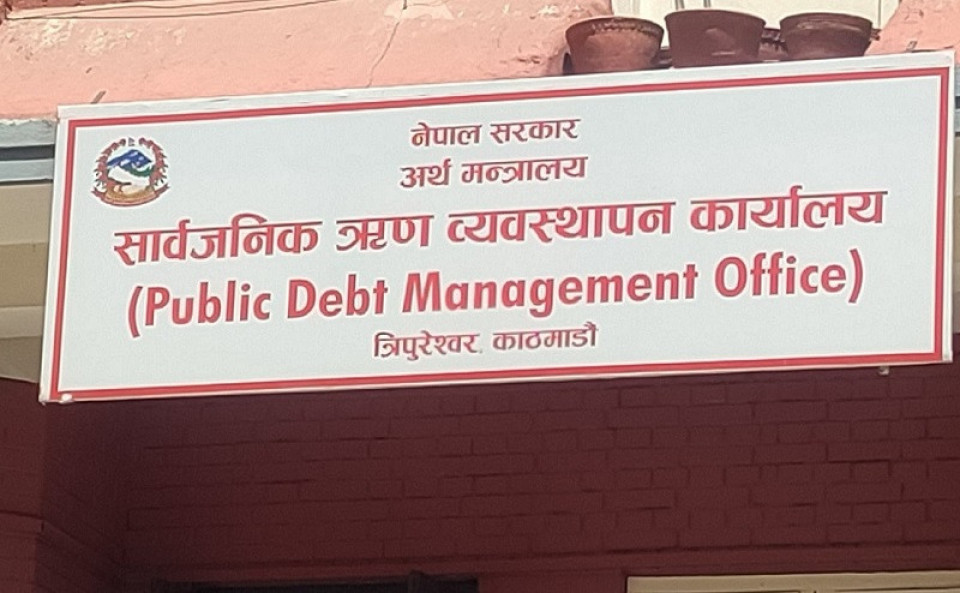
KATHMANDU: Nepal’s Public Debt Management Office under the Ministry of Finance publishes monthly Government Debt Statistics. The report for mid-July 2025 to mid-May 2026, covering the first ten months of fiscal year 2025/26, was released on May 19, 2026. It tracks how much the government owes, to whom, in what currencies, and what it has spent repaying those obligations.
The numbers tell a story of a country borrowing steadily to keep its fiscal engine running, with debt now closing in on the Rs 3 trillion mark.
How large is Nepal’s total public debt right now?
As of mid-May 2026, Nepal’s total outstanding public debt stands at Rs 2,975.04 billion, which is just under Rs 3 trillion. The country started this fiscal year in mid-July 2025 with a total debt of Rs 2,674.05 billion. In ten months alone, the debt pile has grown by Rs 300.99 billion, meaning Nepal has added roughly Rs 30 billion to its obligations every single month on average.
The figure includes both what the government owes to foreign creditors and what it owes domestically through securities sold in the local market. To put the scale in perspective, the Rs 2,975.04 billion outstanding debt is almost double what Nepal owed just six or seven years ago, making this the highest public debt figure the country has ever recorded.
How is the debt divided between external and domestic borrowing?
Nepal’s public debt comes from two streams. External debt, meaning what the government owes to foreign creditors in foreign currencies, stands at Rs 1,593.81 billion as of mid-May 2026. That represents 53.57 percent of total public debt.
Domestic debt, meaning what the government owes to local investors and institutions through rupee-denominated securities, stands at Rs 1,381.23 billion, which is 46.43 percent of the total. The external share is larger, but both have grown steadily.

External debt is almost entirely concessional in nature, coming with long repayment periods and low interest rates from multilateral institutions. Domestic debt carries market interest rates and has to be rolled over far more frequently, creating a more constant refinancing pressure on the treasury.
What is Nepal’s debt-to-GDP ratio, and what does it mean?
According to the report, Nepal’s total public debt equals 45.08 percent of gross domestic product as of mid-May 2026. External debt alone is 24.15 percent of GDP and domestic debt is 20.93 percent. This ratio is the standard international yardstick for assessing whether a country’s debt load is sustainable.
For context, the ratio was 48.04 percent just one month earlier in mid-April. The sharp drop did not come from reduced borrowing or accelerated repayments. The report itself notes, in a footnote, that the National Statistics Office published revised annual GDP estimates for fiscal year 2025/26 on April 28, 2026, and those revised figures have been used as the comparison base.
The GDP estimate was raised significantly, and dividing the same debt by a larger denominator made the ratio fall. The underlying debt burden in rupee and dollar terms is unchanged.
How much new debt did Nepal take on during these ten months?
The annual borrowing target for fiscal year 2025/26 was set at Rs 595.66 billion. Against that, Nepal mobilised Rs 365.16 billion in total new loans by mid-May, achieving 61.30 percent of the annual target.
Of this total mobilisation, domestic borrowing contributed Rs 298.67 billion, reaching 82.50 percent of the domestic target of Rs 362 billion. External borrowing contributed only Rs 66.49 billion, which is just 28.46 percent of the external target of Rs 233.66 billion.
This gap reflects the nature of foreign loan disbursements: they move on the schedules of multilateral banks and bilateral creditors, not on the government’s calendar.
With roughly two months of the fiscal year remaining, there is a large pipeline of undisbursed external loans still to come. Within the total new borrowing, domestic loans accounted for 81.79 percent and foreign loans 18.21 percent.
What role did currency depreciation play in the debt increase?
One of the most important numbers in the report is the exchange rate loss of Rs 167.76 billion. This is debt that was added to Nepal’s balance sheet not because the government took any new loans, but because the Nepali rupee weakened against international currencies, making the local-currency value of existing foreign obligations more expensive.
The report records a negative exchange figure of Rs 167.76 billion, meaning this amount inflated the external debt total purely through currency movement. When you add up the net new loans taken (Rs 365.16 billion), subtract the principal repaid (Rs 231.93 billion), and add the exchange loss (Rs 167.76 billion), you arrive at the total debt increase of Rs 300.99 billion for the ten-month period.
Exchange losses alone account for 55.73 percent of the net debt increase, meaning more than half of this year’s debt growth has nothing to do with fresh borrowing decisions.
What is Nepal’s net debt mobilisation this year, and why does it matter?
Net debt mobilisation is what remains after subtracting principal repayments from gross new borrowings, and it gives a clearer picture of how much the government is actually adding to its obligations through active borrowing decisions.

For the ten months through mid-May 2026, gross borrowing was Rs 365.16 billion and principal repayments were Rs 231.93 billion, giving a net mobilisation of Rs 133.24 billion. Of this, domestic net borrowing was Rs 113 billion and external net borrowing was Rs 20.23 billion.
The report notes that net debt mobilisation accounts for only 44.27 percent of the total debt increase of Rs 300.99 billion. The remaining 55.73 percent came from foreign exchange losses, underscoring that the depreciation of the rupee is now a more powerful driver of debt growth than the government’s own borrowing decisions, a situation that is largely beyond fiscal policy control.
How much is Nepal spending on debt servicing?
The total debt service budget for fiscal year 2025/26 was Rs 411.01 billion. By mid-May 2026, the government had already spent Rs 292.52 billion on debt service, which is 71.17 percent of the full-year budget used up in ten months. Debt service as a share of GDP stands at 4.43 percent.
Breaking this down: domestic debt service payments totalled Rs 236.20 billion, of which Rs 185.67 billion was principal repayment and Rs 50.53 billion was interest. External debt service payments came to Rs 56.33 billion, split between Rs 46.26 billion in principal and Rs 10.07 billion in interest.
Total interest paid across both domestic and external debt reached Rs 60.60 billion in ten months. Total principal repaid was Rs 231.93 billion. Every rupee spent on debt service is a rupee not available for education, health, or infrastructure, and at 4.43 percent of GDP, debt service has become one of the single largest expenditure pressures in Nepal’s budget.
What does the month-by-month picture of borrowing and repayment look like?
The report provides a detailed monthly breakdown of receipts and payments through mid-May. On the domestic side, mid-July to mid-August 2025 saw Rs 40 billion raised and Rs 27.10 billion in principal repaid. Mid-October to mid-November 2025 was the heaviest repayment month at Rs 32.11 billion in principal.
By mid-May 2026, the government had already spent Rs 292.52 billion on debt service, which is 71.17 percent of the full-year budget used up in ten months.
Mid-March to mid-April 2026 was unusual in that no domestic principal repayment was recorded for that month, while Rs 40 billion in new domestic loans came in. For external debt, mid-March to mid-April was the heaviest repayment month at Rs 9.97 billion in combined principal and interest. Mid-April to mid-May saw only Rs 8.76 billion raised and Rs 7.26 billion in external debt service paid.
On the interest side, the domestic interest bill ranged from a low of Rs 3.13 billion in mid-October to mid-November 2025 to a high of Rs 7.18 billion in mid-February to mid-March.
The pattern shows that debt service is spread across all months but is particularly heavy in the first and second quarters of the fiscal year, while new borrowing tends to be concentrated in specific windows tied to auction schedules.
How fast has Nepal’s debt grown, and what is the seven-year trajectory?
Nepal’s public debt has roughly doubled in about six and a half years. The opening balance of this fiscal year at mid-July 2025 was Rs 2,674.05 billion, and the current total is Rs 2,975.04 billion.
Looking further back, total public debt was around Rs 1,433 billion in fiscal year 2019/20. That means the country has added approximately Rs 1,542 billion in net debt over six and a half years, an average of about Rs 237 billion a year in net terms.
However, the pace has accelerated sharply. In the current fiscal year alone, the debt has grown by Rs 300.99 billion in just ten months, suggesting the annual addition will exceed Rs 350 billion by fiscal year end.
The opening balance of this fiscal year at mid-July 2025 was Rs 2,674.05 billion, and the current total is Rs 2,975.04 billion.
Much of this acceleration reflects both increased borrowing volumes and the compounding impact of currency depreciation on the external debt stock, a pressure that was less acute when the rupee was stronger.
What does the structure of repayments tell us about refinancing risk?
The monthly payment data reveals that Nepal’s domestic debt is rolled over very frequently, especially treasury bills, which mature in 28, 91, 182, or 364 days. This means a substantial portion of the Rs 1,381.23 billion in domestic debt must be refinanced continuously throughout the year.
In the ten months covered, Rs 185.67 billion in domestic principal was repaid while Rs 298.67 billion in new domestic loans were raised, showing that new domestic issuances significantly exceeded maturities.
On the external side, repayments are more predictable and spread over longer periods because most external loans are long-tenor concessional facilities.
The Rs 46.26 billion in external principal repaid this year reflects scheduled amortisation on existing loans.
The remaining unmet annual target of Rs 233.66 billion minus the Rs 66.49 billion already received leaves Rs 167.17 billion in external loans yet to arrive, which the government must draw down in the final two months of the fiscal year to meet its budget financing plan.
What are the key risks and concerns going forward?
Several structural pressures emerge clearly from this report. The exchange rate remains the single largest uncontrollable risk: with Rs 167.76 billion added to the debt in ten months purely through currency movement, any further rupee depreciation will automatically push the total above Rs 3 trillion even without a single new loan.
Debt servicing costs, at 4.43 percent of GDP and Rs 292.52 billion spent in ten months, are consuming a growing share of the budget. The gap between the domestic borrowing achievement at 82.50 percent of target and external achievement at only 28.46 percent means the government has leaned heavily on the domestic market, which raises interest costs and competes with private sector credit.
Net debt mobilisation of Rs 133.24 billion, while seemingly modest, comes on top of an already large stock, and the compounding effect over years is significant. Looking at the overall trajectory, Nepal’s public debt has doubled in roughly six years, debt service absorbs over 4 percent of GDP annually, and more than half of this year’s debt increase came from currency losses rather than deliberate borrowing.
These are not individually catastrophic numbers, but together they describe a fiscal position that demands serious management attention before the trajectory becomes harder to reverse.