Kathmandu
Sunday, July 12, 2026





Driven by a rush to deliver, the government is bypassing procedures, bypassing parliament, and ignoring democratic values; human rights activists are calling the forced eviction of the landless an inhuman crime.

KATHMANDU: Like many others, Gen Z activist Rakshya Bam remains haunted by last year’s youth movement. In a movement where fresh-faced youths achieved martyrdom, she and her fellow protestors raised their voices in favor of good governance and socio-economic equality, while protesting against the conservative and corrupt rule of the traditional parties.
The movement brought down the government of Khadga Prasad (KP) Sharma Oli. In the House of Representatives elections, the Rastriya Swatantra Party (RSP) secured a near two-thirds majority, and a government was formed under the leadership of Balendra Shah. Having consistently expressed high hopes for this government built on the foundation of Gen Z sacrifices, Rakshya is now dissatisfied.
According to her, the government is not aligning itself with the line of good governance—the major issue raised by the youth. As the government approaches its two-month mark, she observes that from its very initial steps, it has been losing its way and forgetting the essence of the youth movement. She says, “The Gen Z movement did not happen just to replace a few leaders. It was against the corruption and anomalies rampant in the country, and for social justice, public accountability, and a robust democracy.”
Although the core spirit of the movement was to move forward through democratic methods to establish good governance, strengthen citizens’ rights, and ease the general livelihood of the public, her assessment is that the government formed on the back of this rebellion is turning away from these matters.
She shares that she is disheartened by the current government’s style of governance, which has drifted from democratic processes and placed the individual at the center.
“The Gen Z movement was absolutely not meant to establish a tendency of centering an individual, fleeing from accountability, and trampling upon citizens’ rights,” Rakshya says. “The government is turning away from the people’s issues. It brings great sorrow to see the government trying to walk the same wrong path against whose anomalies we revolted.”

Cabinet meeting. File photo
Indeed, this government, which was formed on the issue of good governance, is evading that very issue. Good governance is a system where the government delivers services and manages resources appropriately based on transparency, accountability, participation, and the rule of law for its citizens. Good governance guarantees a corruption-free, inclusive, and people-oriented administration. However, while the Shah-led government has initiated improvements in public service delivery, it has adopted a one-sided approach without engaging in dialogue regarding the concerns of citizens. This has rendered the government’s work and methods opaque.Even though it is claimed that the government possesses an eagerness and urgency to work, rules and processes have been violated under its cover.
There is a long list of instances where the government has utterly neglected public livelihood, defied democratic processes, adopted a ruthless style, and insulted the parliament—an institution representing the people. The government devalued the very parliament where its own MPs hold a majority.
The RSP government, which in the past used to boastfully criticize old parties for ruling through ordinances, chose that exact same path. On April 22, upon the recommendation of the Prime Minister, President Ram Chandra Paudel summoned the parliament session. Not even 24 hours after the session was summoned, the parliament was prorogued. Behind this prorogation, there were no specific reasons such as natural disasters, calamities, or crises.
The reason for the abrupt prorogation came to light only when the government started rapidly recommending ordinances to the President. Fierce opposition ensued, with critics arguing that the government was trying to rule through ordinances by proroguing a parliament that had already been summoned. To such an extent, even the lawmakers of the ruling RSP expressed their opposition.
MP Ganesh Karki, considered close to Prime Minister Shah, commented that the recommendation of the ordinance was based on the literal text rather than the spirit of the constitution, adding that it was not an act of bravery for a government with a near two-thirds majority to halt parliament to bring an ordinance.
In a Facebook status written on April 29, Karki wrote: ‘Whether it is a “compulsion” or something else for a party that brought nearly two-thirds to stop a session and bring an ordinance will be revealed later, but this is certainly not bravery.’
Making a controversial decision by resubmitting an ordinance returned by the President for reconsideration without any modifications is not proper. This feels like choosing the same path of bad governance that past governments walked.
While one or two ruling lawmakers protested in a low tone, the opposition parties represented in parliament jointly demonstrated against the government’s step of bypassing parliament to bring ordinances and violating procedures. The Nepali Congress, CPN (UML), Nepali Communist Party (NCP), and Rastriya Prajatantra Party (RPP) held a joint meeting and issued a statement, even urging the President not to issue the ordinance.
Amid the opposition from rival parties, the government continued its work of ruling through ordinances. A strong example of this is the decision made by bringing the ordinance related to the Constitutional Council.
Two days after the government prorogued parliament, on April 27, it had recommended the ordinance related to the Constitutional Council. However, President Ram Chandra Paudel returned the ordinance to the government on May 4, concluding that it required reconsideration. President Paudel reached the conclusion that it needed reconsideration after seeing that the provisions proposed in the ordinance failed to internalize the spirit of the constitution and law.
According to constitutional law expert and Senior Advocate Radheshyam Adhikari, the scope of the ordinance did not come in a way that ensures the balance of power and checks and balances of the state within the Constitutional Council. Instead, it was brought to weaken the existing legal provisions and utilize the decision-making process for the vested interests of the regime. “The current Prime Minister does show a rush to work, but process and methodology are not visible. Summoning a parliament session, proroguing it, and bringing an ordinance was not appropriate,” he says. “Furthermore, the methodology and process did not align. It went against the democratic system; it was flawed.”
The Constitutional Council, which appoints officials to the state’s crucial constitutional bodies, consists of 6 members. According to legal experts, representation from both the ruling side and the opposition is included to maintain impartiality by curbing the executive’s arbitrariness.
Bishnu Maya Bhusal, an Assistant Professor at the Central Department of Law, Tribhuvan University, states that the provision of a majority has been given mandatory legal recognition to ensure that political balance is maintained in the decision-making process of the Constitutional Council. Senior Advocate Bhusal says, “Proroguing parliament today and bringing an ordinance the very next day or the day after is not a legal process from any perspective.”
Shah, who had clashed with the then-Prime Minister Oli when he was the Mayor of Kathmandu Metropolis and had been opposing his arbitrary style, chose that very ‘Oli path’ regarding ordinances after becoming Prime Minister.
The Shah-led government had amended the existing legal provisions regarding the decision-making process and majority of the Constitutional Council through the ordinance. The Council, chaired by the Prime Minister, includes 6 members: the Speaker of the House of Representatives, the Deputy Speaker, the Chairperson of the National Assembly, the Chief Justice, and the Leader of the Main Opposition Party. Among them, a provision was made where even if only the Chairperson and three members are present in a meeting, a decision made by three individuals—consisting of the Chairperson and two members—would be considered a majority.
The Constitutional Council, chaired by the Prime Minister, has the Chairperson of the National Assembly, Speaker of the House of Representatives, Deputy Speaker, Chief Justice, and Leader of the Main Opposition Party as members. Before the amendment via ordinance, a decision made by four members was required.
Senior Advocate Adhikari states that even by simple math, half of 6 is three, and to reach a majority in the Council, a decision by four individuals is necessary. “A decision simply cannot be made without four people. If any decision is made without a majority, it is flawed,” he says. “If it is claimed that after becoming Prime Minister, just three people are enough to reach a majority, it appears the government views the Constitutional Council merely as a tool to fulfill someone’s ambition.”
Another issue for which the government faced criticism is the recommendation for the appointment of the Chief Justice. Through the ordinance itself, Prime Minister Shah, taking the Speaker and Deputy Speaker along with him, recommended the fourth-ranked Justice Manoj Kumar Sharma for appointment as Chief Justice from the Constitutional Council. Senior Advocate Adhikari expresses dissatisfaction over the fact that debates and discussions have focused only on seniority, despite the presence of serious legal flaws in the decision-making process of the Council itself through the ordinance.
Supreme Court Bar Association executive committee member and Advocate Shashi Basnet states that the ordinance episode does not indicate that the government is moving forward in accordance with democratic values and principles. She says, “Making a controversial decision by resubmitting an ordinance returned by the President for reconsideration without any modifications is not proper. This feels like choosing the same path of bad governance that past governments walked.”
For political expediency, Prime Minister Balendra Shah has not only chosen the path of ordinances; bypassing seniority in appointments to state bodies, ignoring the parliament that elected him Prime Minister, and evading accountability have become almost normal for him.
Just as Advocate Basnet mentioned, previous governments had insulted parliamentary supremacy by bringing ordinances for political expediency. While in power, leaders from Khadga Prasad (KP) Sharma Oli to Sher Bahadur Deuba had wielded the weapon of ordinances. But ironically, the RSP—which had demonstrated its political rationale to the citizens for reform by pointing out those very old leaders and their perverted governance styles—followed the exact same path despite leading the government on the strength of a two-thirds public mandate.
Constitutional law expert Senior Advocate Raju Prasad Chapagain states that the core function of the Constitutional Council is to maintain impartiality and balance the power of the state by preventing executive arbitrariness. “Past governments used to bypass parliament, bring ordinances, and make decisions favorable to themselves through them; it is not right for the current government to walk that same wrong path,” he says. “The country should not be run based on whatever goes on in the ruler’s mind; it must be done in accordance with the spirit of the constitution and democratic values.”
In the years 2020 and 2021, the Oli-led government had brought ordinances amending the quorum and decision-making process Act of the Constitutional Council to facilitate smooth appointments in constitutional bodies. Oli had brought the ordinance related to the Constitutional Council for the first time on December 15, 2020 and for the second time on May 4, 2021. In the Council, which consists of a total of 6 members including the Prime Minister, the presence of five members was previously required to constitute a quorum.
However, the then-Oli government amended this to bring an ordinance allowing a meeting to sit even in the presence of a majority of members including the chairperson, and allowing that meeting to make decisions based on a majority. In accordance with that very ordinance, the recommendation for the appointment of 52 officials in constitutional bodies was made. For the first time, 32 individuals were appointed on February 3, 2021 and 20 individuals were appointed for the second time on June 24, 2021.
At that time, after ruling through ordinances, the Oli government faced fierce opposition. Shah, who had clashed with the then-Prime Minister Oli when he was the Mayor of Kathmandu Metropolis and had been opposing his arbitrary style, chose that very ‘Oli path’ regarding ordinances after becoming Prime Minister.
Devaluation of Parliament
For political expediency, Prime Minister Balendra Shah has not only chosen the path of ordinances; bypassing seniority in appointments to state bodies, ignoring the parliament that elected him Prime Minister, and evading accountability have become almost normal for him.
On May 11, such a jarring scene involving Prime Minister Shah was witnessed at the joint meeting of the Federal Parliament, which not only insulted the popularly elected parliament but also failed to maintain the dignity of the office of the President, the guardian of the constitution. On that day, while President Ram Chandra Paudel was presenting the government’s policies and programs, Shah left the meeting and walked out.
Walking out of the meeting on a special day of parliament when his own government’s policies and programs were being presented clearly shows that Prime Minister Shah did not prioritize parliamentary activities and practices. This also lends strength to the accusation that he is turning away from democratic values and principles.
This is the second parliament session since his appointment as Prime Minister. However, the Prime Minister has not addressed the parliament till date. Even on the day the government’s policies and programs were being presented, he handed over the file to the President’s hands in parliament and immediately walked out.
Opposition lawmakers have been constantly pressuring Speaker Dol Prasad Aryal almost daily, demanding a ‘ruling’ to present the Prime Minister, arguing that he must be called to the parliament meeting. After opposition parties searched for the Prime Minister in the House of Representatives meeting on May 21, Speaker Aryal even suspended the parliament meeting to go and meet the Prime Minister. However, even after that, the Prime Minister did not appear in parliament.
“While the President was reading out the government’s policies and programs, the Prime Minister left midway. What does this mean? The Prime Minister either did not want to answer the questions raised on the policies and programs or he evaded them,” Senior Advocate Adhikari says. “This is even being opposed inside the parliament. One must not turn away from democratic values and accountability in this manner.”
Parliamentary affairs experts state that there is a tradition in parliament where the Speaker and the Chairperson of the National Assembly initially welcome the President. According to those experts, a practice has existed where top dignitaries, including the Prime Minister, see off the President when the President departs after reading the government’s policies and programs. Ignoring these established democratic and parliamentary values of parliament, Prime Minister Shah left the meeting midway.
While the opposition in parliament has been continuously questioning the actions of the government and the Prime Minister, ruling lawmakers have also voiced opposition, albeit in small numbers. Amresh Kumar Singh, an MP from the ruling party RSP itself, fiercely opposed the working style of the Prime Minister and the government right inside parliament.
Speaking at the meeting of the House of Representatives held on May 19, he criticized the problems of Madhesh, the problems of Madheshi Dalits, the budget allocation process, parliamentary values, and the activities of the new government.
MP Singh stated that the government, in the name of breaking tradition, was trying to dismantle established democratic values and practices, and that this would end the very rationale of the constitution and the parliamentary system. ‘Not all traditions are broken in the name of breaking tradition. If we keep dismantling all traditions, the rationale of the parliament and parliamentary system will end. Our country’s constitution is moving forward by internalizing parliamentary practice,’ he had said.
Opposition lawmakers have been constantly pressuring Speaker Dol Prasad Aryal almost daily, demanding a ‘ruling’ to present the Prime Minister, arguing that he must be called to the parliament meeting. However, the Speaker has not issued a ruling on this matter so far. Instead, after opposition parties searched for the Prime Minister in the House of Representatives meeting on May 21, Speaker Aryal suspended the parliament meeting to go and meet the Prime Minister. However, even after that, the Prime Minister did not appear in parliament.
Illiberal and inhuman style
Prime Minister Shah, who is continuously evading parliamentary accountability, appears to have been working arbitrarily rather than through discussion and processes. In this sequence, some actions taken by the government have also appeared ruthless and inhuman.
How conservative is the governance style of the Shah-led government? This is made crystal clear by the atrocities and forced evictions carried out against the landless settlers without providing alternative arrangements and without even completing general procedures. It is an accepted principle that the state must belong to those who have no one and nothing. However, in the case of the landless settlers, the state turned entirely against them. Deploying a thick presence of security personnel in the settlements of unarmed people, bulldozers were run over their houses and huts. The government accomplished this task in an inhuman manner, without providing adequate time to move belongings and without arranging safe alternative housing.
The majority of these displaced landless settlers were daily wage laborers, street vendors, and domestic workers, who were earning their livelihood and residing in a corner of the city. Today, after that very basis of survival has been snatched away, their lives have been pushed into a whirlpool of confusion and uncertainty.
Kanchhi Maya Roka Tamang, who had been living in the settlement at Shantinagar for 26 years, was at home on April 25. But suddenly, a bulldozer arrived in front of her house. It demolished her house. She had received no prior notice that her house would be demolished. After the government suddenly demolished her house, her family—including her visually impaired husband and a son—is out on the street. She pours out her grief, “Whom does this government belong to? Are we not citizens of this country? Does the law permit forcing people out like this without notice, citing orders from above?”
This is not just Kanchhi Maya’s question; it is the shared question of more than 3,000 households and 16,000 individuals displaced after the government ran bulldozers through landless people’s settlements.
The step to evict the landless settlers, disrupting the rhythm of their lives, appears to be the result of Prime Minister Shah’s unilateral decision. On April 22, the then-Home Minister Sudhan Gurung was forced to resign after falling into controversy due to his relations with controversial businessman Deepak Bhatta, among other reasons. On that very day, the responsibility of the Ministry of Home Affairs also fell upon the shoulders of Prime Minister Shah. That same evening, Prime Minister Shah called the chiefs of the security agencies and directed them to clear the settlements of landless people on April 25 and 26.
Backed by this directive, the local levels began the work of evicting the landless settlers. Ultimately, within a week, deploying security agencies including the Nepal Police, Nepali Army, Armed Police Force, and Municipal Police in the settlement, more than 3,000 households were displaced.
The lives of the displaced settlers, chased away like non-citizens, were pushed into an uncertain journey. Their address, labeled as temporary housing, kept changing overnight; sometimes narrow hotel rooms, and at other times cold ‘holding centers’.
In the name of management, the state transported them from Kathmandu to Banepa and Nagarkot. Because of this, the employment and livelihood of those doing daily wage labor in Kathmandu were snatched away. The eviction they had to endure, like a bitter dream, caused physical fatigue and mental impact to the squatters, alongside inflicting a deep wound on their self-respect.
The majority of these displaced landless settlers were daily wage laborers, street vendors, and domestic workers, who were earning their livelihood and residing in a corner of the city. Today, after that very basis of survival has been snatched away, their lives have been pushed into a whirlpool of confusion and uncertainty.
Prime Minister Balendra Shah has neither become accountable to the parliament, nor is he seen in dialogue with the people. To such an extent, he does not even attend his own party RSP’s parliamentary party or other meetings.
Even the Supreme Court has spoken out regarding the government’s assault against the landless settlers. On May 8, a bench of Justices Kumar Regmi and Nityananda Pandey issued an interim order not to evict landless Dalits and unmanaged settlers without making proper alternative arrangements. The order also states that just management of housing, education, health, and food must be provided for the displaced squatters driven out after their settlements were demolished.
The opposition to the government’s step of evicting landless settlers is not limited only to the streets and the public sphere; human rights experts of the United Nations have also raised serious objections. They concluded that the displacement of the landless by the government without adequate consultation, prior notice, and proper compensation constitutes a violation of international human rights law and standards.
Human rights activist and Director of Amnesty International Nepal, Nirajan Thapaliya, comments that the government committed a crime against the landless. He says, “Demolishing the houses of landless squatters, snatching away their livelihood, and depriving children of their right to education are certainly actions against human rights; this is also a type of serious crime committed by the state against the landless.”
A Cabinet meeting held on May 19 decided to provide a relief amount of Rs 25,000 for rehabilitation and Rs 15,000 per month for up to three months to the landless settlers families. However, land rights activist Bhagwati Adhikari states that this step of the government is merely a ploy to strand the squatters rather than finding a real solution to the land problem.
“The government forcefully evicted the landless settlers and unmanaged settlers without even formulating a plan for management, and now a drama of management is being enacted,” she says. “The problem of landless settlers will not be solved by the decision made by the government. The government has adopted a policy of illusion to evade responsibility, rather than to manage the issue.”
PM above procedure
Prime Minister Balendra Shah has neither become accountable to the parliament, nor is he seen in dialogue with the people. To such an extent, he does not even attend his own party RSP’s parliamentary party or other meetings.
Following the announcement of election results, in mid-March, the RSP organized an orientation workshop for newly elected lawmakers at the Royal Tulip Hotel in Gwarko, Lalitpur. However, Prime Minister Shah did not attend the program, which ran for two days.
According to RSP lawmakers, Shah remains absent even from parliamentary party meetings. As a result, the parliamentary party meetings of the RSP nowadays take place without the leader of the party.
Prime Minister Shah appears only on Facebook via statuses and photographs. Having not been seen in public programs since being elected Prime Minister, he did participate in a Nepali Army program during this interval. Also holding the responsibility of the Ministry of Defense, he reached the Nepali Military Academy in Kharipati, Bhaktapur on April 9 to participate in the ‘Commissioning Ceremony’ of Officer Cadet training, where he also delivered a speech.
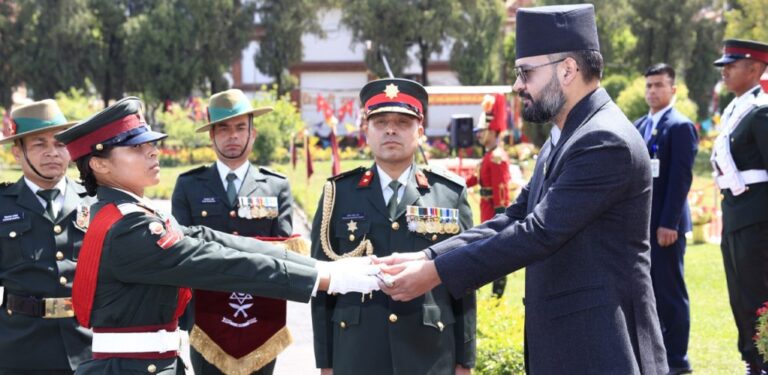
Prime Minister Balen at the Officer Cadet decoration program inside the Nepali Army battalion in Bhaktapur. Photo: RSS
Apart from this, the Prime Minister has not deemed it appropriate to fulfill the responsibility of listening to the people’s words and answering questions raised in parliament.
To understand this matter, we tried to contact Prime Minister Shah’s chief advisor Kumar Benjankar, those close to him within the government, and government spokesperson and Minister for Education and Sports Sasmit Pokharel, but they could not be reached.
To understand the RSP’s stance, we tried to contact RSP General Secretary and Chief Whip Kabindra Burlakoti, but contact could not be established with him either. In a public hearing program organized in Kathmandu Constituency No. 5 on May 24, government spokesperson and Minister for Information and Communication Sasmit Pokharel stated that the policy is to move forward by listening to the words of citizens.
Although it is said in speech that citizens’ words will be listened to, in practice, events such as devaluing the public mandate by ignoring parliament and operating the government on the Prime Minister’s unilateral decisions have continued to be observed.
Professor and Political Scientist at Tribhuvan University, Sucheta Pyakurel, analyzes that the RSP government is going against democratic values and principles.
“Since this government came from the foundation of the Gen Z protests, it ought to have worked by being even more democratic, accountable, and committed to good governance than past governments,” she says. “Right now, the government’s decisions appear immature. Running a government is not like running the Kathmandu Metropolitan City. Operating a state is a completely different thing. The state must be run on laws, principles, democratic values, and systems. The government has failed to show that in practice.”
She states that running the government arbitrarily will not be beneficial for citizens’ rights and democracy. Her understanding is that the Prime Minister and the government need to become mature. “People sitting in government must possess maturity; when that is lacking, a good team ought to show the path, which was not observed here. The tendency of thinking oneself above the citizens works to destroy democracy. The current government is walking that very path,” she says.
Gen Z activists have also publicly demonstrated opposition to the government’s style of working. On May 15, 25 Gen Z activists—including Rakshya Bam, Rijan Rana Magar, Tanuja Pandey, Arnav Chaudhary, Majid Ansari, and Arun Singh Nepali—expressed dissatisfaction with the government’s working style and staged a protest by refusing to attend discussions regarding constitutional amendment. Their assessment is that the government ignored past agreements and that the process of discussion itself remained opaque.