Kathmandu
Sunday, July 26, 2026





Through a sixth-century Purana, a conspiracy was hatched to dismantle the foundation of Buddhist philosophy by turning the Buddha—who was once condemned as a 'thief' in the Ramayana—into an incarnation of Vishnu
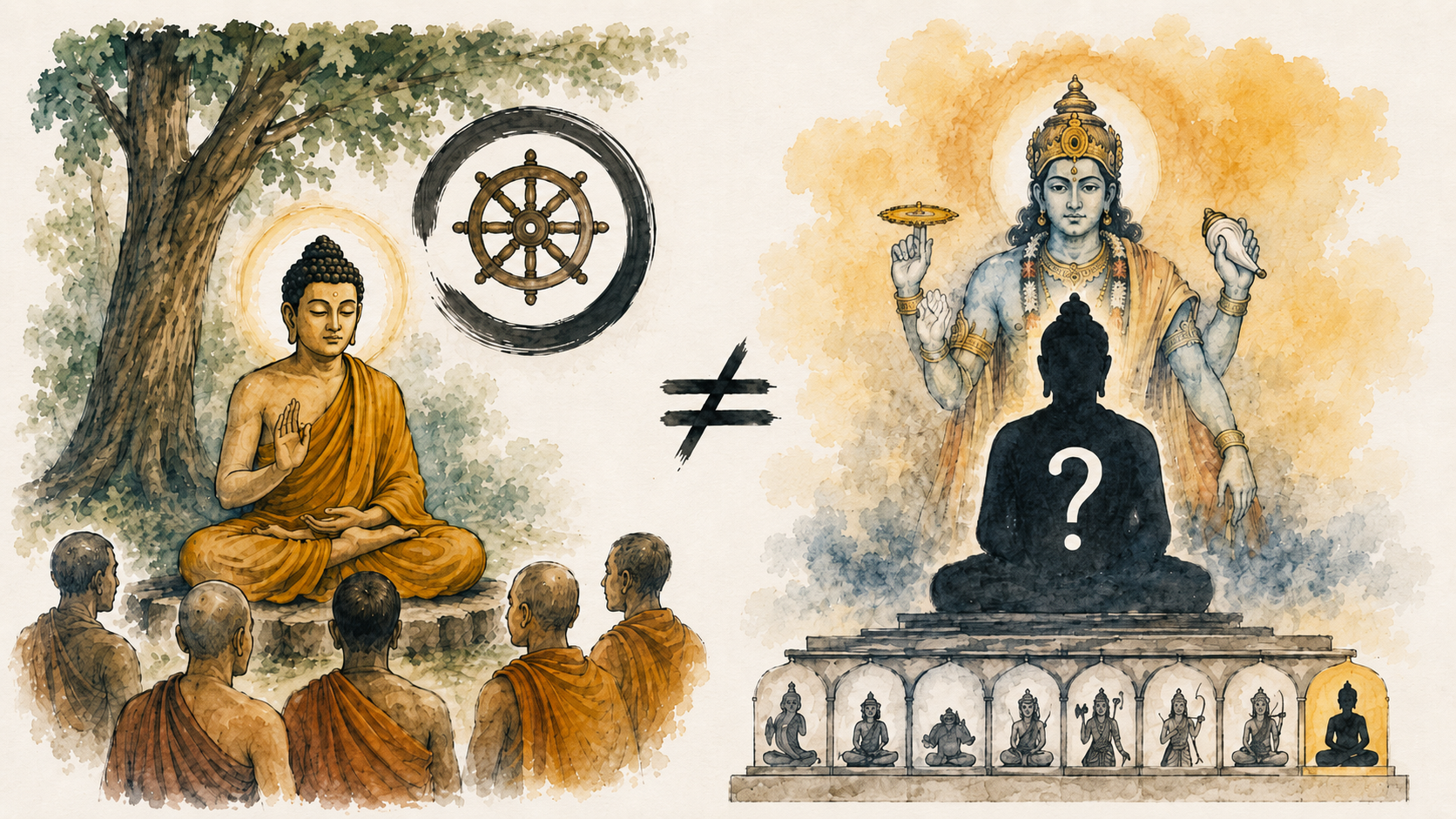
KATHMANDU: Nowadays, Hindu Vaishnavites (followers of Vishnu) consider Shakyamuni Gautama Buddha (563–483 BC) to be the ninth incarnation of Vishnu. They advance the argument that they too revere the Buddha and that he belongs to them as well. When arranging depictions or idols of the ten incarnations of Vishnu, they place the Buddha in the ninth position. Consistent with this view, they argue that Buddhist philosophy is not a distinct religion but merely a branch or sect of Hinduism. However, until a few centuries ago, this was not the stance held by Vaishnavites. In fact, the very concept of the Buddha as an incarnation of Vishnu had not yet developed within the Vaishnavite doctrine. Instead, the perspective toward the Buddha was highly negative, viewing him as a direct competitor.
Buddhists do not align with Vaishnavites regarding the belief that the Buddha is an incarnation of Vishnu, and they actively refute this claim. While Vaishnavites seldom engage in debates over the counter-arguments raised by Buddhists, they show no inclination to correct their narrative either. Instead, they obscure the issue in the public consciousness by invoking notions of religious tolerance and harmony.
The assertions made by Vaishnavites concerning the Buddha stand in stark contrast to the actual teachings of Gautama Buddha. While Vaishnavite Hindus advocate for the immortality of the soul, Gautama Buddha explicitly rejects the existence of a permanent soul. The concepts of the soul and the supreme soul (Paramatman) are central to Vaishnavite thought, but they find no place in the discourse of Gautama Buddha’s teachings.
In the realm of philosophy, Gautama Buddha’s most distinct and original contribution is Dependent Origination (Pratītya samutpāda), which is also understood as the law of cause and effect. In the Buddha’s own words, “He who sees Pratītya samutpāda sees the Buddha, and he who sees the Buddha sees Pratītya samutpāda.” It was upon the foundation of Pratītya samutpāda that Acharya Nagarjuna later formulated the doctrine of Emptiness (Shunyata). Pratītya samutpāda and Shunyata represent a philosophical framework that thoroughly critiques and refutes the entire worldview presented by Hindu texts like the Vedas, Upanishads, and Puranas. Given this fundamental divergence, treating the Buddha as the ninth incarnation of Vishnu is entirely incompatible. Therefore, analyzing this issue from both a historical and philosophical perspective is imperative.
The Buddha and his philosophy
Historical and archaeological research confirms that around the sixth century BC, there existed sixteen major realms (Mahajanapadas) alongside numerous smaller Janapadas. Among them was the Shakya Janapada, situated within the present-day Lumbini and Kapilvastu regions. Operating under a republican system of governance, this territory is also referred to as the Shakya Oligarchy or Republic.
During that era, much like in other republics, it was customary to address the head of the state as ‘King’ (Raja) or Maharaja. Suddhodana was an elected leader of this republic, and was consequently addressed as Maharaja. Because of this title, subsequent interpretations have often mischaracterized the state as an absolute monarchy, framing his son as the direct heir to a throne. However, such an interpretation is historically inaccurate.
In Kapilvastu, the capital of the Shakya Republic, Suddhodana and Maya Devi were blessed with a son on the day of the Baishakh Purnima (Full moon Day in May) in 563 BC. At the age of 29, this prince renounced his household life to pursue spiritual awakening. Following six years of intense ascetic practice, he attained enlightenment and became universally renowned as Gautama Buddha.
At that time, the spiritual landscape was dominated by two primary traditions: the Shramana and the Brahmana. Gautama Buddha emerged from the Shramana background, and upon achieving enlightenment, he became known as the Mahashramana (Great Ascetic). These two traditions held fundamentally different views regarding life and the cosmos. Their core values and principles were completely at odds, leading to friction not only on a philosophical level but on a social scale as well.
Gautama Buddha expanded his reach within a short span of time, offering a doctrine that did not merely differ from Brahmanical orthodoxy but directly challenged it. While the Brahmanical tradition anchored itself in eternalism (Shasvatavada), the Buddha’s teachings championed impermanence (Aniccavada). Vedic society was stratified into four primary varnas—Brahmin, Kshatriya, Vaishya, and Shudra. The Buddha completely disregarded this hierarchy; instead, he demonstrated the flaw of this caste system and granted equal access to everyone within his monastic order.
The Buddha’s work was deeply revolutionary on a social level and equally disruptive to the prevailing philosophical landscape. His teachings managed to draw even highly intellectual Brahmin scholars into the Sangha (unity). Consequently, the contemporary Brahmanical society grew deeply resentful and sought to create obstacles for him. Despite their efforts, the results were counterproductive, and the Buddha’s Sangha expanded rapidly. No matter the strategies deployed by opposing factions, the Buddha’s teachings, which were once concentrated within central India, have now spread across the entire globe.
Buddhists revere the Buddha as their supreme teacher (Shasta). To a Buddhist, the Buddha is neither a deity, a supreme being, nor a creator god. Rather, he is an extraordinary individual who completely eradicated attachment (Raga), aversion (Dvesha), delusion (Moha), and all forms of craving (Tanha), thereby achieving total liberation from the cycle of birth and death to attain a completely purified mind.
The title Bhagavan is used to describe the Buddha and historical Buddhas simply to denote this ultimate state of realization. It does not imply that the Buddha is an incarnation or manifestation of an external power. Conversely, when Vaishnavites designate the Buddha as the ninth avatar of Vishnu, they define him as another form of Vishnu. Accepting the concept of an avatar directly undermines the core principle of Buddhahood. Achieving Buddhahood signifies that the root causes of birth and death have been entirely extinguished, ensuring that no further rebirth can occur.
The concept of an avatar completely contradicts this principle of Buddhahood, as it implies that the Buddha had not actually achieved final liberation or Nirvana. For Buddhists, this assertion is entirely unacceptable.
Furthermore, the belief that the Buddha is the ninth incarnation of Vishnu treats the term ‘Buddha’ as a proper noun belonging to a single individual. In reality, ‘Buddha’ is not a personal name; it is a title, an honorific, and a description meaning ‘The Enlightened One.’ According to Buddhist doctrine, many individuals achieved enlightenment and became Buddhas prior to Gautama Buddha (the Buddhas of the past), just as others will achieve Buddhahood in the eras to come (the Buddhas of the future). Counting from the three Buddhas who preceded Dipankara Buddha, Gautama Buddha is placed 28th in line. According to Gautama Buddha himself, the actual number of past Buddhas is far greater. This realization inherently disproves the linear concept of a “ninth avatar.” While Bodhisattvas (those on the path to Buddhahood) do undergo rebirth, these instances are categorized strictly as rebirths rather than divine incarnations (avatars). Ultimately, viewing the Buddha as the ninth incarnation of Vishnu is a philosophical fallacy. For this reason, Buddhists firmly reject and refute the avatar narrative.
The origin of the ninth incarnation concept
The Buddha is explicitly mentioned in the Ramayana, a highly celebrated epic among Hindus. The reference here points directly to Gautama Buddha, born in 563 BC. While the events of the Ramayana are traditionally believed to have unfolded during the Treta Yuga, placing this era accurately within chronological history presents an issue. The inclusion of the Buddha indicates that the Ramayana was composed at some point following the Buddha’s Mahaparinirvana. It also confirms that at the time of the epic’s composition, the Buddha had not yet been classified as an incarnation of Vishnu. In fact, the text goes so far as to label the Buddha as a ‘thief’ (chor), suggesting that he deserved the same punishment meted out to criminals.
When various strategies failed to halt the spread of the Buddha’s teachings, and labeling him a thief produced no real impact, the concept of the ninth avatar was eventually formulated. However, this framework did not genuinely adopt the Buddha or his core philosophy; it was a tactical maneuver. The concept of avatarhood was used purely to absorb the Buddha into the orthodox pantheon by presenting him as the ninth incarnation.
The earliest reference to this ninth incarnation appears in the Vishnudharmottara Purana, which dates back to the sixth or seventh century. None of the Hindu texts preceding this era contain any mention of a sequential lineage connecting the earlier incarnations directly to the Buddha. Instead, these accounts transition straight from the earlier avatars to the future Kalki avatar.
According to the Vishnudharmottara Purana, whenever righteousness declines on earth, Vishnu assumes various forms to descend to the mortal realm, restore cosmic order, and return. According to this specific narrative, Vishnu needed to create an illusion to lead the demons away from the sacred teachings of the Vedas. To achieve this, Vishnu took on a deceptive form, manifesting on earth as the Buddha. The Purana claims that the Buddha’s purpose was to intentionally lead people astray into a web of illusion by teaching doctrines absent from the Vedas, thereby distancing them from Vedic rituals. Consequently, while Hindus are instructed to recognize the Buddha as an avatar and call him Bhagavan, they are simultaneously discouraged from worshipping him or following his actual discourses. This explains why many orthodox traditions have historically maintained a distant or adversarial stance toward the Buddha and Buddhist philosophy.
A comparative analysis
As established, while certain modern Hindu traditions view Gautama Buddha as the ninth incarnation of Vishnu, this perspective did not exist a few centuries ago. Historically, the orthodox outlook toward the Buddha and Buddhist philosophy was entirely critical, often producing highly distorted accounts of his life and teachings. Leaving aside the lack of consensus regarding his birth in the Lumbini grove on the day of full moon day of May (Baishakh Purnima) in 563 BC, the Vishnudharmottara Purana presents an entirely different set of biographical details. While the Purana retains the name Suddhodana for the Buddha’s father, it redefines Suddhodana negatively, portraying him as a demon rather than a human being. Furthermore, it claims the Buddha was born in a country called Kikat.
Shifting his birthplace from Lumbini to Kikat can be viewed as an intentional distortion. Kikat was not a specific city or kingdom, but rather a broader geographical region. In certain historical narratives, the entire subcontinent and its surrounding regions are referred to as Aryavarta—defined as the territory where Vedic rituals were practiced in their purest form. While some claim Aryavarta spanned an immense territory, the reality is that the region under absolute orthodox hegemony was never that expansive. Territories beyond their direct influence were labeled as peripheral or unholy regions (Pratyanta Pradesh), where their authority was rejected. Orthodox followers were explicitly warned against traveling to these regions; if travel was unavoidable, they were forbidden from staying overnight, and if they did stay, they were required to undergo purification rituals upon their return. The region of Kikat fell squarely into this category.
Historical texts confirm that after his great renunciation (Mahabhinishkramana) from Kapilvastu, the Buddha traveled directly toward Rajgir, the capital of Magadh. He did not head toward Magadha due to a lack of forests around Kapilvastu, but because Magadh and its adjoining areas were hotbeds for philosophical debate, discourse, and intellectual exploration. He attained enlightenment on the banks of the Nairanjana River in Magadh, and it was from Rajgir that his teachings gained widespread momentum. The revisionist claim placing the Buddha’s birth in Kikat was likely born out of this historical rivalry.
Conclusion
The existence of differing schools of thought, intense philosophical debates, and ideological counter-arguments is a natural and necessary aspect of intellectual evolution. Without distinct positions, separate philosophies cannot exist; they either merge or dissolve into one another. There is no dispute that Vedic principles predate Gautama Buddha, nor is there any doubt that the Buddha disagreed fundamentally with those Vedic values. Buddhist literature confirms that the orthodox Vedic schools viewed the Buddha as a primary challenger—a dynamic that persisted through the works of subsequent Buddhist acharyas and Hindu commentators alike.
With the passage of time and shifting political landscapes, the Buddha’s direct teachings and Buddhist institutional presence faded significantly from the Indian subcontinent for several centuries. This historical absence is verified by records from Emperor Akbar’s court; during interfaith assemblies representing various religious sects, there was no Buddhist philosopher present, nor was there any formal discussion on Buddhist philosophy. The eventual revival of Buddhist heritage and scholarship in India was largely catalyzed by the archaeological and historical discoveries during the British era.