Kathmandu
Thursday, July 2, 2026





Decreasing snowfall and rising rainfall displace stone and mud structures
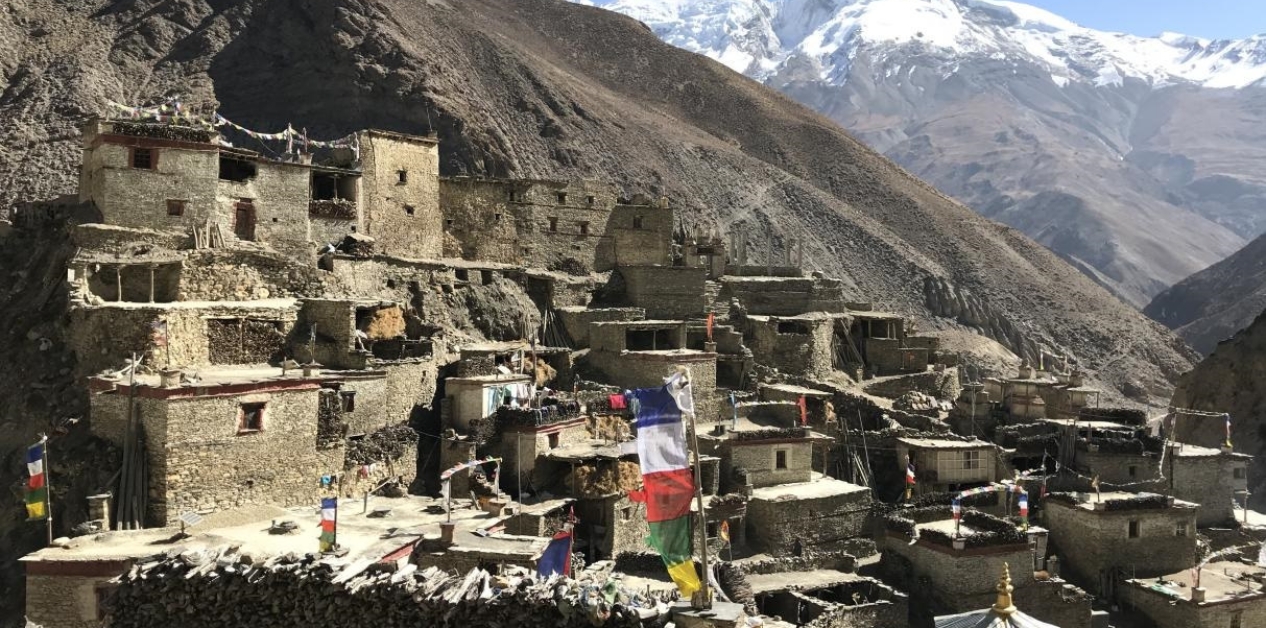
KATHMANDU: Traditional houses built of stone, mud, and wood were once the distinct identity and civilization of the mountainous district of Manang. Designed to easily withstand heavy snow loads and adapt to the local climate, these indigenous structures are gradually becoming history. Due to climate change, decreasing snowfall coupled with unpredictable heavy rainfall—alongside rapid tourism expansion along the Annapurna Circuit—has caused these traditional houses to vanish rapidly. Modern architectural styles using contemporary building materials are taking their place.
According to Anita Lama from Chame Bazar, stone and mud houses were historically considered safe, durable, and climate-appropriate because the region used to experience heavy snowfall during winters. However, as rainfall has increasingly replaced snow in recent years, mud roofs and walls suffer from severe leakage and structural damage. “Now, when building new houses, most people opt for corrugated zinc sheets and modern construction materials,” she says. She notes that the rising influx of tourists has further accelerated the demolition of old houses to build modern hotels and lodges.
Ganesh Ghale from Thanchok points out that traditional houses have virtually disappeared from Lower Manang, leaving them visible only in a few villages in the upper region. “Climate change has not only affected the natural environment but has also dealt a direct blow to our indigenous architecture and cultural heritage,” he adds.
Binod Gurung from Upper Manang shares that rising temperatures, shorter snowfall periods, and shifting precipitation patterns have made maintaining traditional building styles difficult. “If effective conservation measures are not adopted in time, Manang’s stone and mud houses will be confined to history books and memories,” he warns.
Modern houses along with the expansion of tourism
Beyond climate change, the rapid growth of the tourism business is a major factor displacing traditional houses in Manang. To attract tourists and ensure comfort, the construction of hotels and hospitality infrastructure using modern materials has intensified. According to the Integrated Service Office in Manang, there are currently 183 registered hotels and three homestays in the district.
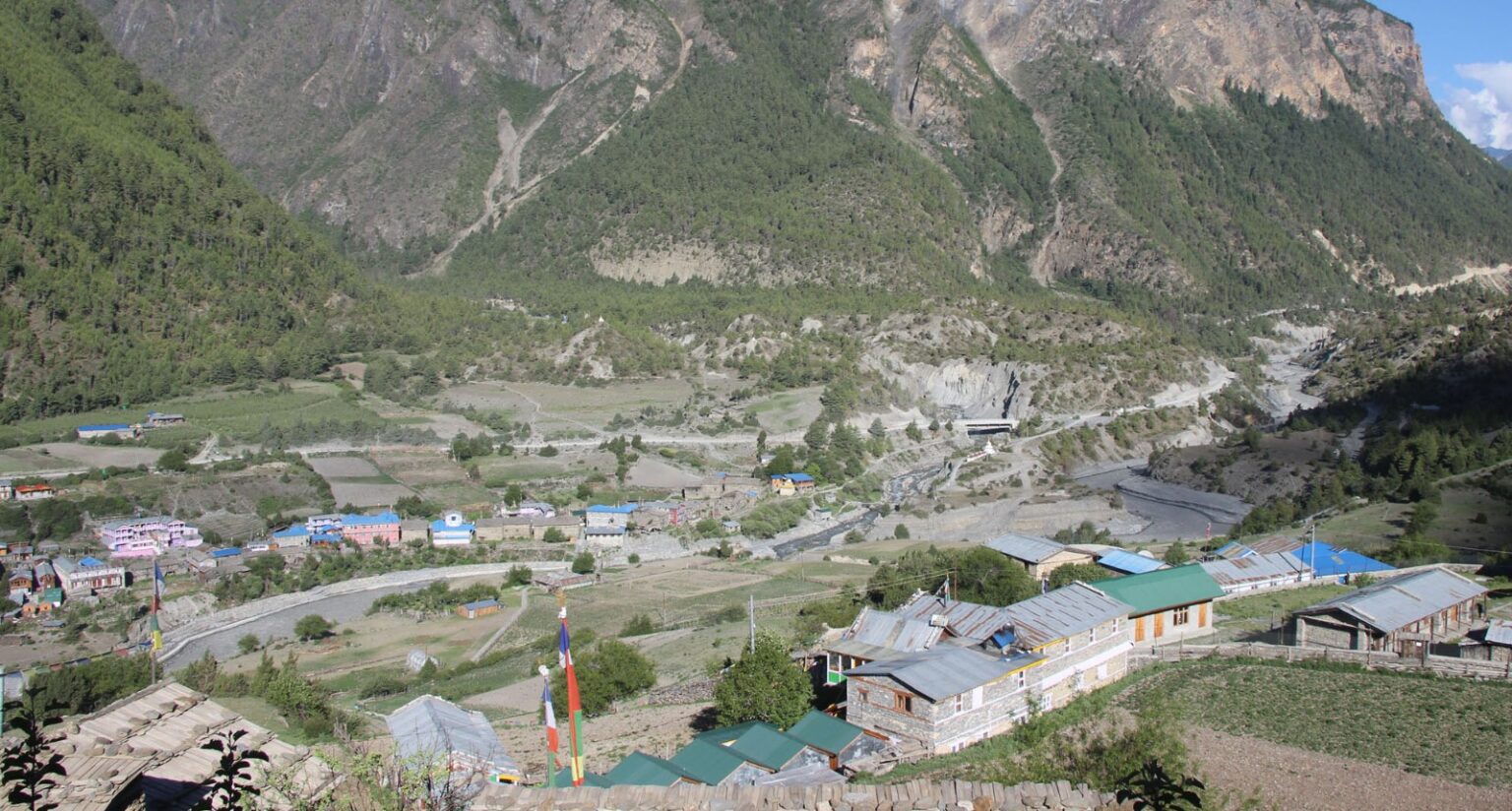
Lower Pisang Village, located in Ngisyang Rural Municipality, where a hotel has been built by demolishing a traditional, indigenous house.
Phurpa Chhering Lama, President of the Hotel Association Chame, explains that hotel entrepreneurs are forced to build modern structures due to changing tourist preferences. “Both domestic and international tourists rarely prefer staying in old-style houses anymore. They look for well-managed toilets, attached bathrooms, hot water, and other modern amenities,” he says. Consequently, the trend of either upgrading stone and mud houses into modern designs or erecting entirely new buildings has grown significantly in recent years.
Local governments show indifference toward conservation
Though Manang comprises four local units, traditional houses remain intact in only a handful of villages in the upper region. Despite this, out of the four local bodies, only Narpa Bhumi Rural Municipality has introduced an active program to protect them; the remaining three have failed to put forward any effective conservation initiatives.
Kancha Ghale, Chairman of Ngisyang Rural Municipality, acknowledges that hotel, restaurant, and other tourism infrastructure projects are moving at a rapid pace due to the Annapurna Circuit. He admits, “The municipality has not run any specific program for the preservation of traditional houses.” He points out that since snowfall has dropped and rainfall has increased, local residents themselves show little interest in constructing stone, mud, and timber houses.
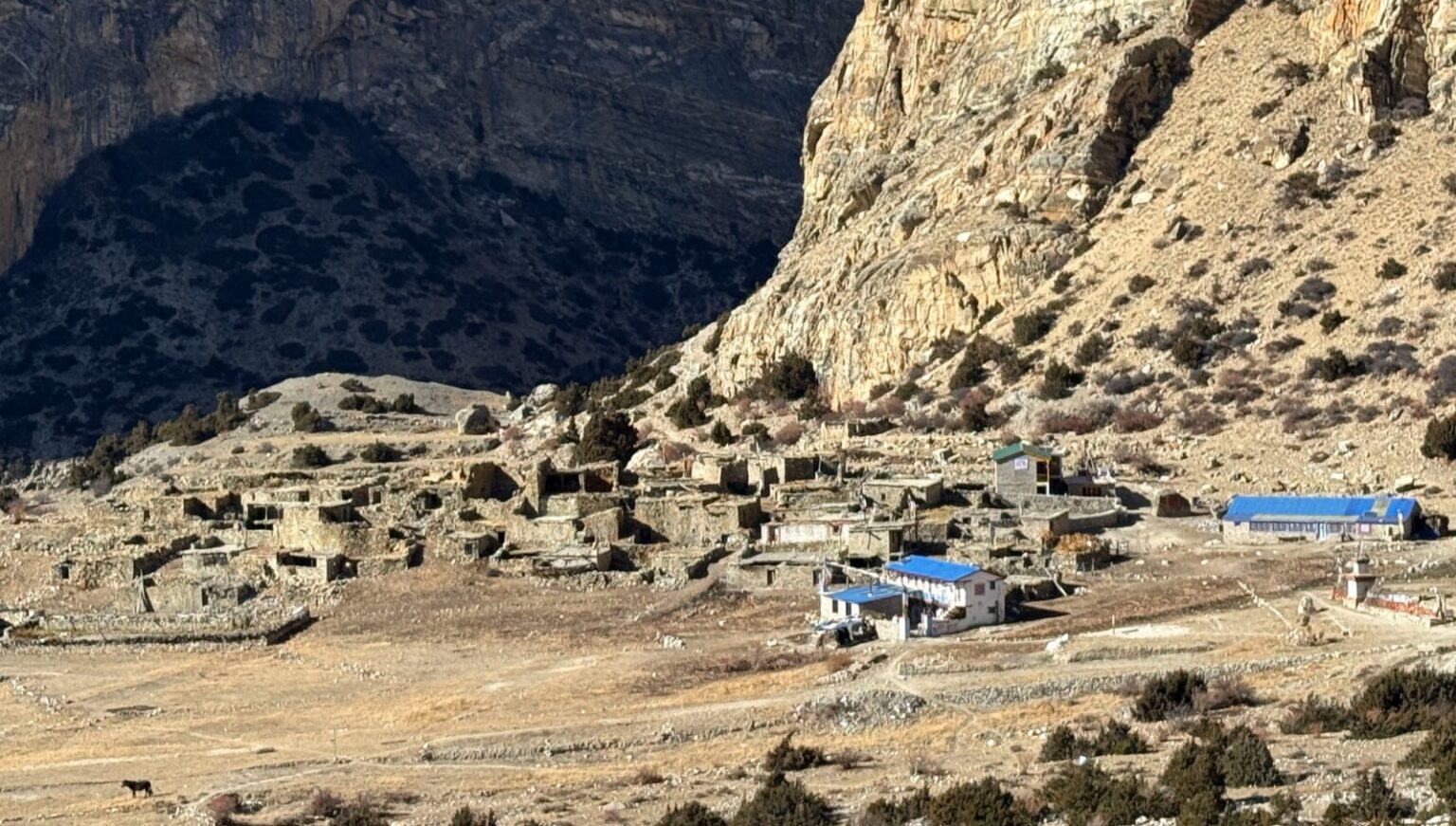
Kyang Village of Narpa Bhumi Rural Municipality.
Similarly, Dhan Bahadur Gurung, Chairman of Naso Rural Municipality, states that while the municipality has prioritized road and trail construction, no plan has been formulated so far to conserve traditional architecture.
Lokendra Gurung, Chairman of Chame Rural Municipality, also confirms that his office lacks targeted programs to mitigate climate change impacts or preserve historic homes. “To save these indigenous houses, government initiatives alone will not suffice. The local community must also understand their cultural, historical, and tourism value and actively engage in their protection,” he says.
Narpa Bhumi’s conservation campaign
In response to the threat facing these historic structures, Narpa Bhumi Rural Municipality in Manang has launched a dedicated campaign to save the distinct identity of the Himalayan civilization.
According to municipal data, Narpa Bhumi has 128 households. Among them, 28 houses have already transitioned to corrugated tin roofs and concrete structures. To shield the remaining settlement’s historic aesthetics, the village assembly has passed a policy specifically designating Phu Village as a protected site.
Konjo Tenzing Lama, Chairman of Narpa Bhumi Rural Municipality, notes that while it is impossible to conserve all villages within the municipality simultaneously, the goal is to protect at least one village as a living heritage site of Himalayan civilization. To achieve this, the local government is preparing to enforce a complete ban on the use of tin roofs, cement, and iron rods for house construction in Phu Village.
“To save our native architecture, the rural municipality has also arranged subsidies for local residents who choose to build or repair their homes using traditional styles,” Chairman Lama states.
The value of indigenous houses in high-altitude districts
Traditional houses built of stone, mud, and timber in mountain districts are not merely residential structures—they are living heritages of Himalayan civilization, culture, and localized knowledge. Built strictly in accordance with local geography, climate, and available natural resources, these houses reflect the generationally refined skills, lifestyle, and distinct identity of mountain communities.
These houses are naturally insulated. Thick stone walls and mud plaster help trap warmth during freezing winters while keeping interiors cool during summer. Furthermore, these houses preserve the original look of mountain villages, making them vital assets for cultural tourism. For domestic and international tourists visiting to observe authentic settlements, these homes serve as primary attractions. As they vanish, the risk of losing both the aesthetic charm and the cultural heritage of Himalayan settlements increases.
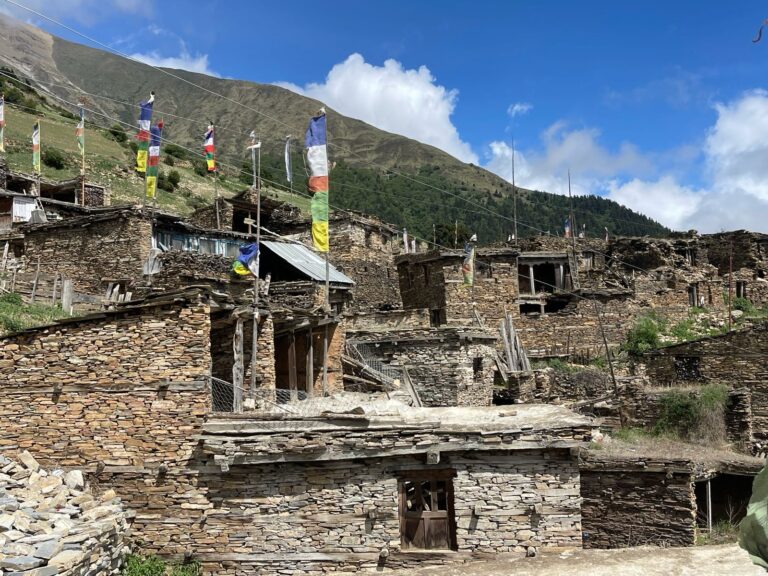
Traditional, indigenous houses built from stone, mud, and wood in Gyaru Village of Ngisyang Rural Municipality.
Rabin Kadariya, Chief of the Annapurna Conservation Area Project (ACAP), explains that because climate change has brought less snow, more rain, and increased leakage through mud roofs, maintaining these traditional homes has become difficult and expensive. “Because of these factors, locals are forced by circumstances, rather than choice, to construct modern houses out of concrete and tin,” he explains.
Kadariya asserts that protecting traditional homes does more than just save old buildings; it safeguards the history, culture, traditional construction techniques, and tourism foundation of mountain communities for future generations. “If we can conserve these indigenous settlements, we aren’t just saving a village—we are preserving a whole Himalayan civilization and its cultural heritage,” he notes.
Climate realities mirrored in scientific data
Data from the Department of Hydrology and Meteorology’s Humde Weather Station indicates that the impact of climate change in Manang cannot be measured by a single indicator alone. While day-time maximum temperatures do not show a continuous long-term increase, night-time minimum temperatures have risen significantly in recent years. Furthermore, fluctuations in rainfall volume and distribution have become increasingly volatile.
The long-term average maximum temperature in Humde stands at 14.2°C. Records show 2015 (15.95°C) and 2019 (15.30°C) as warmer-than-average years. Conversely, maximum temperatures in 2018, 2020, 2021, 2023, and 2024 were recorded below average. This suggests that rather than a linear increase, daytime temperatures are exhibiting heightened year-to-year volatility. The 2026 recorded figure of 10.90°C represents an incomplete annual log and should not be used for direct historical comparison.
The data for minimum temperatures, however, paints a completely different picture. Though the long-term minimum average is 0.2°C, the minimum temperatures for most years between 2019 and 2025 stayed notably above average. Readings reached 2.04°C in 2022, 1.52°C in 2024, and 1.72°C in 2025. This indicates that nights and mornings are becoming less cold, pointing to a gradual warming trend in the high-altitude region. In contrast, 2017 and 2018 stood out as exceptionally cold years.
Precipitation records also show massive annual variances in Manang’s rainfall totals. In 2017, 2019, 2020, and 2021, average rainfall exceeded 900 mm. Although data for 2024 and 2025 shows noticeably lower rainfall numbers, missing logs at certain weather stations mean these figures cannot be taken as definitive conclusions.
The data also highlights sharp microclimate variations within Manang itself. Areas like Tal, Goga, and Tilche receive relatively high rainfall, whereas the Humde and Manang Village areas remain comparatively dry. This emphasizes that climate change impacts manifest differently across separate locations even within a single district.
According to Ashok Bakhrel, a meteorologist at the Department of Hydrology and Meteorology, evaluating climate change impacts solely based on maximum temperatures yields an incomplete conclusion. It requires a comprehensive analysis of minimum temperatures, precipitation volume, rainfall distribution, and long-term trends. He points out that the data from Manang underscores how climate change impacts vary fundamentally across different locations and metrics.
Ultimately, climate change is shifting more than just the physical geography of the mountains; it is actively threatening the indigenous architecture that has defined Manang’s identity for generations. Without concrete preservation initiatives, the stone and mud houses that represent a critical chapter of Himalayan civilization risk being reduced to old photographs and fading memories.